
7 Common Fountain Pen Mistakes for New Users: A Guide to Flawless Writing
A single heavy-handed stroke can turn a $300 Pelikan gold nib into a useless piece of scrap metal in less than a second. While the transition from disposable pens to fine instruments like the Sailor 1911 Casual L is an exciting ritual, it often comes with a steep learning curve. Many beginners struggle with ink skipping or a persistent "death-grip" that leads to hand fatigue. You aren't alone if you feel a bit of anxiety about damaging your new investment. Understanding the most common fountain pen mistakes for new users is the first step toward a flawless, therapeutic writing experience.
We've curated this guide to help you move beyond the frustration of hard starts and scratchy nibs. You'll learn to respect the tactile synergy between your pen, your ink, and your paper. We will cover everything from the "trinity" of materials to proper cleaning schedules that prevent clogs. By the end, you'll have the confidence to build a curated collection of heritage tools without the fear of costly repairs. Let's transform your writing into the smooth, effortless flow it was meant to be 🎁.
Key Takeaways
- Master the zero-pressure principle by unlearning ballpoint habits and letting capillary action do the work for you.
- Identify and avoid common fountain pen mistakes for new users by understanding the chemical differences between fountain pen and calligraphy inks.
- Protect your investment with proper maintenance rituals, including safe cleaning temperatures for delicate celluloid and ebonite feeds.
- Navigate regional nib sizing and prioritize heritage craftsmanship over the temptation of low-quality "starter pen" bundles.
- Achieve a flawless writing flow by respecting the technical synergy between specialized paper, ink, and your chosen nib 🎁.
The Pressure Trap: Unlearning Ballpoint Writing Habits
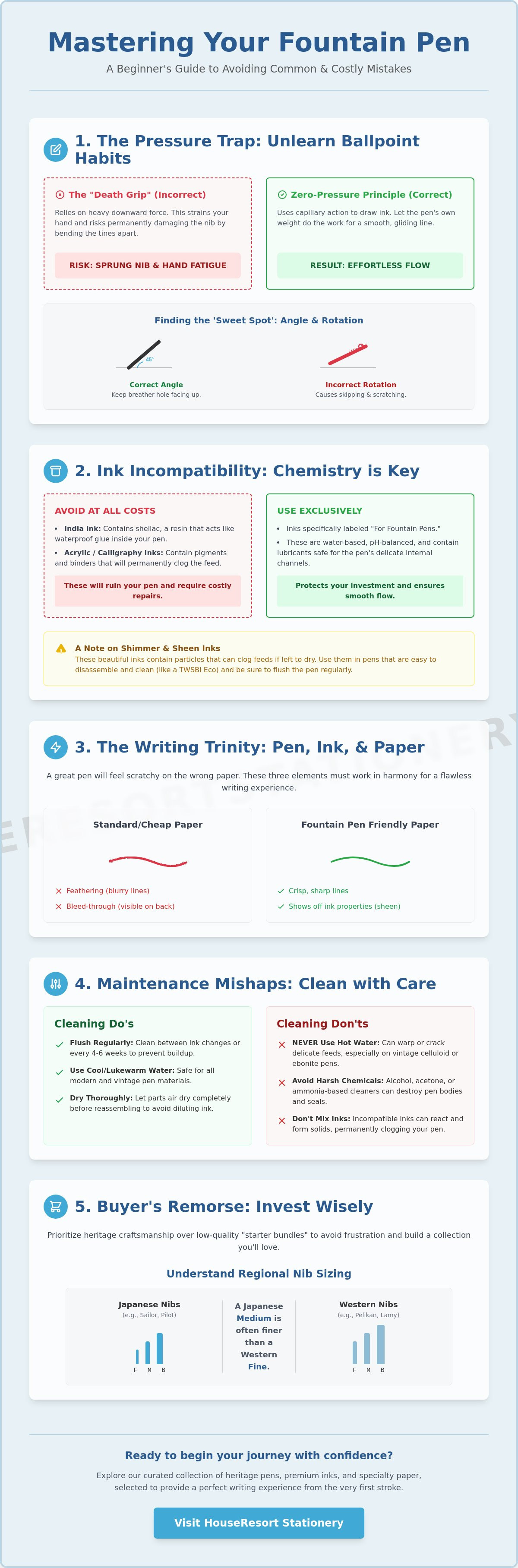
Transitioning from a standard ballpoint to a Fountain Pen requires a fundamental shift in your muscle memory. Most disposable pens rely on heavy friction and significant downward force to roll a thick, paste-like ink onto the page. In contrast, a fine writing instrument operates on the "Zero-Pressure" principle. It uses capillary action to pull liquid ink from the reservoir through the feed and onto the paper fibers. Applying ballpoint-level force is one of the most common fountain pen mistakes for new users, often resulting in a "sprung nib" where the metal tines are permanently bent apart. When this occurs, the ink can no longer bridge the gap to the paper, rendering the pen useless until it undergoes a costly professional repair.
The tactile feedback you receive from the page depends heavily on the material of your nib. A stainless steel nib, such as those found on a Kaweco Sport, offers a rigid and reliable feel that's more forgiving for those still mastering a light touch. A 14k gold nib is naturally softer and provides a more expressive, "bouncy" sensation. However, this softness makes it susceptible to damage if you maintain a "death grip" on the section. This excessive tension in your hand doesn't just risk the nib; it leads to rapid hand fatigue and cramping during long-form journaling sessions. A relaxed grip allows the tool to become an extension of your hand rather than a source of strain.
The 'Weight of the Pen' Test
To find the correct writing pressure, place your notebook on a flat surface and hold the pen at a 45-degree angle. Instead of gripping the section tightly, let the pen rest in the crook of your hand. Gently pull the nib across the page using only the mass of the pen itself. A well-tuned instrument should leave a consistent, wet line without any downward force from your hand. If you notice the tines spreading excessively or the ink pooling in heavy blobs, you're pressing too hard. The goal is a glide, not a scrub.
Finding the Sweet Spot: Angle and Rotation
Every nib has a specific "sweet spot" where the tipping material makes perfect contact with the paper. One frequent error is rotating the pen along its axis during a sentence, which causes the tines to lose alignment with the page. This "nib rotation" leads to frustrating ink skipping and a scratchy feel. You should always keep the breather hole facing directly upward. While a Broad nib offers a wider surface area and more forgiveness for slight angles, a Fine or Extra-Fine nib requires more precision to maintain a smooth flow 🎁.
Ink Incompatibility: Why 'Any Ink' Can Ruin Your Pen
Walking into an art supply store can be dangerous for a novice. You might see bottles of vibrant India ink or acrylic calligraphy ink and assume they're interchangeable with fountain pen ink. They aren't. India ink contains shellac, a resin that acts as a permanent binder. While this is perfect for a dip pen, it's a death sentence for a fountain pen feed. Once shellac dries inside the narrow channels of your pen, it becomes a waterproof plastic that's almost impossible to dissolve. Avoiding non-compatible fluids is one of the most common fountain pen mistakes for new users who prioritize color over chemistry. Stick to water-based inks specifically labeled for fountain pen use to protect your instrument's internal architecture.
Heritage brands like J. Herbin and Pilot offer reliable formulations that balance pH levels and lubrication. For instance, Pilot Iroshizuku inks cost approximately $0.51/ml and are world-renowned for their smooth flow and easy cleanup. Following these essential tips from Caran d'Ache ensures your feed remains clear and functional for decades. You should also be mindful of cartridge compatibility. Many beginners assume all cartridges are "universal," but brands like Lamy, Sailor, and Platinum use proprietary sizes. If you're using a Kaweco or a Pelikan, you'll need International Standard cartridges. For those who prefer bottled options, you can find a curated selection of heritage fountain pen inks at our boutique 🎁.
The Shimmer and Sheen Risk Factor
The "ink-tainment" trend has introduced stunning shimmer inks that contain tiny suspended particles. While beautiful, these particulates can settle and clog the fine feed channels if the pen sits idle. If you love the look of J. Herbin 1670 Anniversary ink, which costs about $0.63/ml, use it in a pen with a high-capacity feed. Piston-fillers like the TWSBI Eco are excellent for experimental inks because they're easy to disassemble for a deep clean. Always gently roll your pen before writing to redistribute the shimmer particles and prevent a "hard start."
Mixing Inks: A Recipe for Clogs
Never mix different ink brands or lines directly inside your pen. Different manufacturers use varying chemical stabilizers and dyes that may not play well together. When incompatible chemicals meet, they can react to create a thick, jelly-like substance. Ink sludge is a chemical precipitate that blocks capillary flow. To prevent this, flush your pen with room-temperature water until it runs clear before switching to a new color. This simple ritual preserves the delicate balance of your pen's capillary system.
The Paper Problem: Why Your Notebook is Making Your Pen Scratchy
You may own a perfectly tuned nib and premium ink, but your writing experience will still suffer if you use the wrong canvas. Standard office copy paper is designed for high-heat laser printers and fast-drying ballpoint inks. It's typically composed of loose, absorbent fibers that pull liquid ink deep into the page through capillary action. This leads to feathering, where your letters spread out like a spiderweb, and bleed-through, which renders the reverse side of your journal page useless. Failing to account for paper texture is one of the most overlooked common fountain pen mistakes for new users who expect a smooth glide on every surface. Paper quality is everything.
To achieve the vibrant sheen and shading seen in enthusiast communities, you need paper with high "sizing." Sizing is a chemical treatment applied during manufacturing to reduce the paper's absorbency. This keeps the ink on the surface longer, allowing the dyes to pool and dry into the complex colors the maker intended. If you're looking for the right tools to begin your journey, our Japanese stationery online store guide highlights the essential materials for a professional collection. High-quality paper isn't just a luxury; it's a technical requirement for the "trinity" of pen, ink, and page. Understanding these material relationships helps you avoid the Rookie Mistakes to Avoid when selecting your first high-end notebook.
Japanese Paper Standards: Midori and Hobonichi
Midori MD paper remains a gold standard for enthusiasts due to its slight tooth and incredible resistance to bleed-through. It provides enough feedback to feel the nib's movement without being scratchy. In contrast, Tomoe River paper, famously used in Hobonichi planners, is ultra-thin yet remarkably fountain pen friendly. Because it's so non-absorbent, ink dry times are significantly longer. We recommend using a "Pencil Board," or Shitajiki, underneath your current page. This plastic sheet provides a firm writing surface and prevents "ghosting" or indentations from affecting the sheets below.
The Traveler's Notebook Synergy
Modular systems offer a unique advantage for those testing different paper weights and textures. The Traveler's Notebook allows you to swap out inserts depending on whether you're sketching with a broad nib or planning with an extra-fine point. You can explore the versatility of this system in our guide to The Traveler's Notebook Starter Kit. Choosing a curated insert ensures your ink stays crisp and your handwriting remains legible across every entry 🎁.
Maintenance Mishaps: The Fine Line of Pen Cleaning
Leaving a pen inked and forgotten for 90 days is a recipe for a clogged feed. As the water in the ink evaporates, it leaves behind a concentrated sludge of dyes and binders that harden into a stubborn crust. While it's tempting to use aggressive measures to revive a dry pen, improper care is among the most common fountain pen mistakes for new users. Using boiling water, for example, can warp celluloid barrels or damage ebonite feeds, which are sensitive to high temperatures. Similarly, alcohol-based solvents or harsh household cleaners like Windex will cause modern resins and "demonstrator" plastics to cloud or crack permanently. Stick to room-temperature fluids to preserve the integrity of your writing tools.
Proper storage is the first line of defense against maintenance headaches. Storing a pen "nib-down" in a cup causes ink to pool in the cap, creating a messy surprise when you next uncap it. This can also lead to nib creep, where ink coats the top of the nib and obscures its decorative engraving. Instead, store your pens "nib-up" to let gravity pull ink away from the tipping, or "horizontal" to keep the feed saturated without flooding. If you aren't planning to use a specific pen for more than 14 days, the best practice is to flush it completely and store it dry. This simple habit prevents the "Dried Ink" dilemma entirely.
The 4-Step Professional Flush
A thorough cleaning doesn't require complex machinery. Follow this curated ritual to maintain your collection's performance:
- Initial Rinse: Flush the pen with room-temperature distilled water until the heaviest ink deposits are removed.
- Bulb Syringe Force: Use a rubber bulb syringe to force water through the grip section. This provides more pressure than a standard converter and cleans the feed channels more effectively.
- Repetition: Continue the process until the water exiting the feed is perfectly clear.
- The Wicking Technique: Wrap the nib in a clean paper towel and let it sit in a glass for 30 minutes. The towel will draw out excess moisture and any remaining ink through capillary action.
When to Use Pen Flush vs. Water
Distilled water is sufficient for 90% of cleaning tasks. However, stubborn ink stains in transparent demonstrator pens or high-pigment inks require a specialized approach. Professional pen flushes contain surfactants. These chemicals break the surface tension of the water, allowing the solution to penetrate deep into the microscopic crevices of the feed where water alone cannot reach. Be cautious with vintage instruments. You should never soak a vintage pen overnight, as older materials like casein or early celluloid can absorb water and swell. If you are looking for the right maintenance tools, you can find a professional fountain pen cleaning kit at our boutique 🎁.
The Boutique Curator's Approach: Avoiding 'Buyer's Remorse'
Quality over quantity is the mantra of any seasoned collector. Many beginners fall into the "Starter Pen Trap," where they purchase ten or fifteen low-cost, mass-produced pens from unverified marketplaces. While the low price point is tempting, the result is often a drawer full of scratchy nibs and inconsistent feeds. Investing in a single, well-engineered tool like the Kaweco AL Sport Piston Filler, a standout model for 2026, provides a vastly superior experience. One of the most common fountain pen mistakes for new users is equating a high volume of cheap pens with a well-rounded collection. A curated approach focuses on heritage brands that have spent decades, or even centuries, perfecting the tactile ritual of writing.
Understanding regional manufacturing standards is equally vital to avoid disappointment. A Japanese "Medium" nib from Sailor or Pilot is significantly finer than a European "Medium" from Lamy or Pelikan. This discrepancy exists because Japanese characters require more precision and thinner lines. If you enjoy the bold, wet flow of a Western nib, you might find a Japanese Fine too restrictive. For those seeking accessible luxury in 2026, the Sailor 1911 Casual L offers a hand-finished stainless steel nib that mimics the feel of gold without the $300 price tag often associated with precious metals. To see these differences in action, our "Looking For Gift Ideas" video series provides a visual guide to help you curate a cohesive stationery aesthetic 🎁.
Building a Modular Collection
A balanced collection doesn't require dozens of pens. We recommend starting with a "Workhorse" and a "Pocket Pen." The Lamy Safari remains a dependable workhorse for daily office tasks, while the Kaweco Sport is the definitive pocket pen for travel. As you grow more comfortable, experiment with different nib materials. While steel is durable and rigid, a 14k gold nib offers a "bouncy" responsiveness that transforms your handwriting. To complete the aesthetic, match your ink palette to your journal's leather cover. Pairing a deep J. Herbin brown with a tan leather notebook creates a sophisticated, analog synergy that makes the act of writing feel like a dedicated retreat.
The Role of Authorized Retailers
Where you buy is just as important as what you buy. Purchasing from an authorized retailer like HouseResort Stationery ensures that your instrument has passed rigorous quality control. "Grey Market" pens often bypass these checks, leading to misaligned nibs or "hard starts" that frustrate new enthusiasts. We specialize in filtering the market to present only the finest options, from brass sharpeners to premium pencil boards. Our curated sets are designed to remove the guesswork, providing you with a perfectly matched pen, ink, and paper combination. Ready to begin your journey? Explore our curated collection of fine fountain pens and discover the joy of a truly flawless writing experience 🎁.
Elevate Your Everyday Writing Ritual
Mastering the tactile art of analog tools is a rewarding journey of unlearning. By adopting the zero-pressure principle and respecting the specific chemical needs of your feed, you've already bypassed the most common fountain pen mistakes for new users. True success lies in the synergy between a precision-engineered nib and high-sizing Japanese paper. Whether you're using a Midori MD notebook or a Sailor 1911 Casual L, these technical choices transform a simple task into a relaxing, mindful escape from the digital world.
As an authorized retailer for heritage brands like Kaweco, Lamy, and Sailor, we provide the authentic tools necessary for a flawless experience. Our boutique curation includes premium Japanese paper and specialized maintenance kits to protect your investment for years to come. If you need inspiration for your next addition, explore our expert-led "Looking For Gift Ideas" video series for a curated look at our current inventory. Shop our Boutique Curation of Fine Fountain Pens to find your next workhorse tool. Your perfect writing flow is just one well-chosen pen away. Enjoy the process of discovery 🎁.
Frequently Asked Questions
Why is my new fountain pen scratchy even on good paper?
Misaligned tines are the most likely reason for a scratchy feel on premium paper. Even on a high-sizing sheet like Midori MD, if one tine sits higher than the other, it will catch the paper fibers. Use a 10x jeweler's loupe to inspect the tipping material. If the tines aren't perfectly level, you'll feel resistance regardless of your paper choice.
Can I use regular tap water to clean my fountain pen?
You can use tap water, but distilled water is the superior choice for long-term care. Tap water often contains minerals like calcium that can accumulate inside the feed channels over many years. In regions with hard water, these microscopic deposits eventually restrict capillary flow and cause frustrating ink skipping.
How often should I realistically clean my pen if I use it daily?
You should clean your pen every 4 to 8 weeks if you use the same ink color consistently. If you switch between high-pigment or shimmer inks, you must flush the pen every time you change colors. Regular maintenance helps you avoid common fountain pen mistakes for new users, such as permanent clogs caused by dried ink particulates.
What should I do if I accidentally dropped my pen on its nib?
Stop writing immediately and avoid the urge to bend the metal back yourself. A professional nib repair for a gold nib can cost between $200 and $500 depending on the extent of the damage. Seek out a qualified nibmeister who uses specialized tools to realign the tines without risking a permanent snap.
Why does my ink look lighter or darker than the bottle's label?
Your pen's ink flow and your paper's absorbency determine the final color. A "dry" pen like a Kaweco Extra-Fine puts down less liquid, making colors appear pale. A "wet" pen like a Pelikan Broad saturates the page, which makes the same ink look several shades darker and more concentrated.
Is it okay to leave ink in my fountain pen if I'm not using it for a week?
Leaving ink in a pen for seven days is generally safe if the cap is airtight. Modern caps are designed to prevent evaporation for short periods. If you don't plan to use the pen for more than 14 days, it's best to flush it and store it dry to prevent clogs.
Do I really need expensive paper for a fountain pen to work?
You don't need "expensive" paper, but you do need paper with a high sizing level. While Tomoe River is a premium choice, many mid-range journals work perfectly well if they're fountain pen friendly. Avoid standard 20lb office copy paper, as it's too absorbent and will cause your ink to feather and bleed.
Can I mix two different colors of ink to create a custom shade?
You should only mix inks from the same brand and product line to ensure chemical compatibility. Mixing different brands can cause a reaction that creates a thick, jelly-like precipitate. This sludge is one of the common fountain pen mistakes for new users that can lead to permanent feed blockage 🎁.