
Best Bullet Journals: A Connoisseur’s Guide for 2026
Your journal is ruining your pens. That feathering you see when a fine nib meets cheap, porous paper isn't a flaw in your writing instrument; it's a mismatch between a precision tool and an unworthy surface. If you've ever watched a beautifully inked stroke bleed through a page or struggled with a spine that refuses to lay flat on your desk, you already understand that not all journals for bullet journal use are created equal.
You're right to want more. The analog productivity community has grown far beyond grid paper and a basic pen, and the standards have risen with it. Choosing the wrong notebook doesn't just frustrate your creative flow; it actively works against the archival quality and functional beauty you're trying to build.
This guide cuts through the noise. We'll break down the technical paper specifications that matter most to fountain pen users, explain what binding styles actually support a flat-lay spread, and walk you through the curated selection of heritage journals worth your investment in 2026. Consider it your blueprint for building an organization system that's as durable as it is beautiful.
Key Takeaways
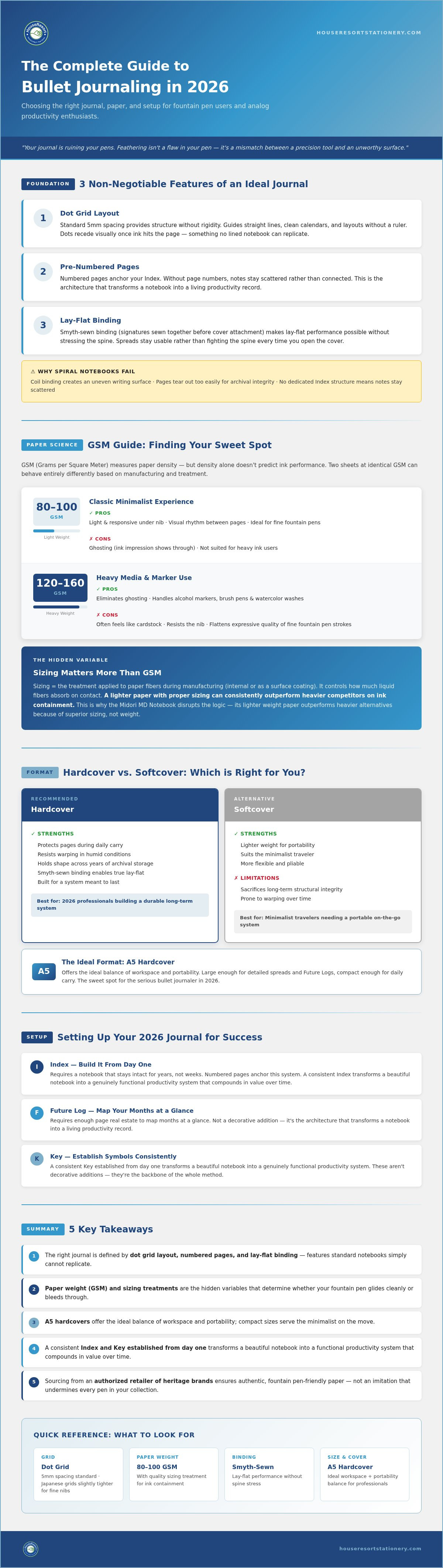
- The right journals for bullet journal use are defined by specific technical features — dot grid layouts, numbered pages, and lay-flat binding — that standard notebooks simply cannot replicate.
- Paper weight (GSM) and sizing treatments are the hidden variables that determine whether your fountain pen glides cleanly or bleeds through to the next spread.
- Format matters as much as paper quality: A5 hardcovers offer the ideal balance of workspace and portability, while compact sizes serve the minimalist who needs a system on the move.
- A consistent Index and Key established from day one transforms a beautiful notebook into a genuinely functional productivity system that compounds in value over time.
- Sourcing from an authorized retailer of heritage brands ensures you receive authentic, fountain pen-friendly paper — not an imitation that undermines every pen in your collection.
Defining the Ideal Journal for Bullet Journaling
Not every notebook earns the title. The best journals for bullet journal use share three non-negotiable features: a dot grid layout, pre-numbered pages, and a binding engineered to lie flat under pressure. Remove any one of these, and the system starts to break down. Numbered pages anchor your Index, the dot grid guides your layouts without imposing rigid lines, and lay-flat binding means your spreads stay usable rather than fighting the spine every time you open the cover.
Standard spiral notebooks fail this test immediately. The coil binding creates an uneven writing surface, pages tear out too easily for archival integrity, and the lack of a dedicated Index structure means your notes stay scattered rather than connected. A purpose-built journal treats every page as part of a larger, retrievable system.
That distinction matters most when you build your Future Log and Index from day one. The Future Log requires enough page real estate to map months at a glance; the Index requires a notebook that stays intact for years, not weeks. These aren't decorative additions to the method. They're the architecture that transforms a notebook into a living productivity record.
Why the Dot Grid is the Professional Standard
A dot grid sits precisely between the rigidity of ruled lines and the ambiguity of blank pages. The standard 5mm spacing gives you enough structure to write in straight lines, draft clean calendars, and sketch layouts without a ruler. Tighter Japanese grid patterns, common in notebooks from heritage manufacturers, compress this spacing slightly to suit finer nibs and smaller handwriting styles. Either way, the dots recede visually once ink hits the page, keeping your spreads clean and uncluttered. That's something no lined notebook can replicate.
The Tactile Difference: Hardcover vs. Softcover
Durability isn't just about surviving a bag. A hardcover journal protects its pages during daily carry, resists warping in humid conditions, and holds its shape across years of archival storage. Smyth-sewn binding, where signatures of pages are sewn together before being attached to the cover, is the engineering detail that makes lay-flat performance possible without stressing the spine. Softcover notebooks offer lighter portability, which suits the minimalist traveler, but they sacrifice long-term structural integrity. For the 2026 professional building a system meant to last, the hardcover remains the stronger investment.
The right journal doesn't just hold your plans. It becomes a record of how you think, decide, and create over time. That's the shift from basic task management to something worth keeping.
The Science of Paper: GSM, Sizing, and Ink Performance
Paper weight is the specification most buyers check first, and the one most commonly misunderstood. GSM, or Grams per Square Meter, measures the density of a sheet, but density alone doesn't predict how your ink will behave. Two sheets at identical GSM ratings can perform entirely differently depending on how the paper was manufactured, treated, and finished. Understanding the full picture separates a frustrating purchase from a genuinely satisfying one.
GSM Breakdown: Finding Your Sweet Spot
The 80-100 GSM range defines the classic minimalist experience. Sheets feel light and responsive under a nib, and the slight translucency creates a visual rhythm between pages that many purists find appealing. The trade-off is ghosting, where the impression of ink on one side shows faintly through to the reverse. For bullet journaling, this is often acceptable; for heavy ink users, it isn't. The 120-160 GSM range eliminates ghosting almost entirely and handles alcohol markers, brush pens, and light watercolor washes without buckling. The weakness competitors rarely acknowledge is that high-GSM paper frequently feels like cardstock. It resists the nib rather than receiving it, which flattens the expressive quality of a fine fountain pen stroke.
This is exactly where the Midori MD Notebook Journal disrupts the logic entirely. Its paper sits in the lighter weight range yet consistently outperforms heavier competitors on ink containment. The reason isn't GSM; it's sizing.
The Hidden Variable: Sizing and Paper Texture
Sizing refers to the treatment applied to paper fibers during manufacturing, either internally during pulp production or externally as a surface coating. This treatment controls how much liquid the fibers absorb on contact. Unsized or lightly sized paper behaves like a sponge: ink spreads laterally through the fibers, causing feathering at the edges of every stroke. Well-sized paper, particularly the smooth, tightly calendered stock used in Japanese heritage notebooks, holds ink at the surface long enough for it to dry cleanly. The result is sharper line definition, better color saturation, and the conditions necessary for fountain pen inks to express their full character.
That last point is the gap most guides miss entirely. Sheening inks, which shift color depending on light angle, and shading inks, which pool darker in the wet areas of a stroke, require paper that allows ink to sit on the surface rather than absorbing instantly. Smooth, sized paper creates that window. Rough or porous paper closes it completely, stripping every ink of its personality before it dries.
Archival quality adds a third dimension to this decision. Acid-free paper resists the yellowing and brittleness that degrades standard notebooks within a decade. For journals meant to function as long-term productivity records, this isn't optional. The best journals for bullet journal use combine acid-free certification with proper sizing, ensuring your records stay legible and your ink stays vibrant for years. If you're investing in fine writing instruments, the paper they meet deserves the same standard; explore the curated notebook selection at HouseResort Stationery to find surfaces that match your tools.
Top Journal Formats: A5 Hardcovers vs. Modular Systems
Format is a decision most buyers make once and rarely revisit. That's a mistake. The physical dimensions of your journal, and whether its pages are fixed or interchangeable, shapes how you use it every single day. Getting this right before you commit to a system saves you from the frustration of outgrowing a notebook mid-volume.
A5 has earned its reputation as the standard for good reason. At 148 x 210mm, it gives you enough horizontal space for a weekly spread without requiring a desk to write comfortably. It fits in most bags without dominating them. The page count typical of A5 hardcovers, usually between 200 and 250 pages, maps cleanly onto a quarterly or semi-annual journaling cycle, which means your Future Log and Index stay proportional to the content they're organizing. For most people building their first serious system, A5 is the right starting point.
Smaller formats serve a different kind of user. B6 notebooks compress the A5 experience into a jacket-pocket form factor, retaining enough writing surface for daily logs and task lists while cutting weight significantly. True pocket-sized journals, typically A6 or smaller, work best as capture tools rather than primary systems: they're ideal for rapid logging on the move, with content migrated to a larger home base at the end of the day. Neither replaces A5 for full-system work, but both solve real problems for the minimalist who refuses to carry a bag.
The Traditional Hardcover Experience
Fixed-page journals from European manufacturers like Leuchtturm1917 prioritize consistency: numbered pages, dedicated Index pages, and a predictable structure that suits users who want their system pre-scaffolded. Japanese designs, by contrast, tend toward restraint, offering clean, uninterrupted page runs that let the user define every structural element from scratch. Both approaches have merit. The right choice depends on whether you want the journal to guide your system or simply hold it.
The Modular Advantage: Traveler's Notebooks
The fixed-page format has one genuine weakness: it forces every category of your life into a single spine. Work logs, personal reflections, and creative sketches share pages whether you want them to or not. Modular systems solve this directly. A Traveler's Notebook holds multiple slim booklets inside one leather cover, letting you dedicate separate inserts to separate contexts. Swap in a dot grid for your bullet journal spreads, a blank insert for sketching, and a lined booklet for meeting notes. One cover carries all three without conflating them.
The leather cover itself is part of the value proposition. Quality leather develops a patina over years of daily handling, becoming more personal with use rather than showing wear. For the journals for bullet journal user who thinks in systems built to last, that longevity matters. When an insert runs out, you replace the booklet, not the cover. The investment compounds rather than resets.
- Dot grid inserts: Primary bullet journal spreads, monthly and weekly layouts
- Blank inserts: Mind maps, freehand sketches, creative planning
- Lined inserts: Meeting notes, long-form writing, reference material
- Kraft paper inserts: Ephemera storage, ticket stubs, collected clippings
HouseResort Stationery carries an authorized selection of Traveler's Company notebooks and inserts, which means you're getting the genuine article rather than an imitation that compromises the system before you've written a single line. That distinction matters when the cover you're buying is meant to outlast a decade of inserts.
Setting Up Your 2026 Journal for Success
A premium journal deserves a deliberate setup. The notebook you've chosen, the paper you've evaluated, the binding you've tested for lay-flat performance: none of it reaches its potential if the first pages are treated carelessly. How you open a new journal shapes every spread that follows.
The Perfect Tool Pairing
Paper quality and writing instrument quality are inseparable. A fountain pen rewards well-sized paper in ways no ballpoint can replicate: the nib responds to surface texture, ink flow adjusts to paper absorbency, and the result is a line with genuine character. On the right sheet, a fine nib produces a stroke that's crisp at the edges and rich in the center. That's the pairing worth building toward.
Not every layout decision belongs in permanent ink, though. Blackwing 602 pencils are the professional's drafting tool for exactly this reason. Their smooth, dark graphite marks cleanly on premium paper without digging into the surface, and they erase completely. Use them to sketch your weekly layout before committing headers and dividers in ink. It's a small discipline that eliminates the frustration of a misaligned spread.
Color-coding your system is where Pilot Iroshizuku ink earns its reputation. The range offers enough tonal variation to support a multi-category Key without resorting to garish contrast. A muted blue-grey for work tasks, a warm amber for personal priorities, and a deep green for long-term projects creates a system that reads at a glance without looking like a highlighter test. The inks' shading behavior on smooth paper adds a visual dimension that reinforces the hierarchy without extra effort.
Establishing Your Key and Index from Day One
Reserve the first two pages for your Key and the next two for your Index before writing anything else. This isn't optional scaffolding; it's the architecture that makes your journals for bullet journal use retrievable rather than just decorative. A Key with five or fewer symbols stays usable under pressure. An Index updated every time you complete a collection keeps your system honest across months of entries.
Before any of this, run a pen test on the inside back cover or the last page. Lay down strokes with every instrument you plan to use: your fountain pen at full flow, your Blackwing in both light and firm pressure, any brush pens or fineliners in your kit. Let them dry and check the reverse for bleed-through and ghosting. This single step prevents mid-notebook surprises and confirms your tool pairing before it matters.
Customization with Washi and Brass
Functional accessories extend your system without adding meaningful weight. Brass page clips mark your current daily log so you open to the right spread instantly. A short brass ruler keeps your hand-drawn dividers clean and consistent across spreads. Neither item requires a separate case; both clip to the cover or sit flat between pages.
Washi tape solves the problem of permanent section marking without damaging the page. A narrow strip along the fore-edge of your monthly log pages creates a visual tab that survives repeated handling. Because washi tape is repositionable, you can adjust your navigation system as the journal fills without leaving adhesive residue or tearing the paper. It's a non-destructive solution that keeps your journals for bullet journal use adaptable through an entire volume.
- Brass clip: Marks the active daily log for instant access
- Short brass ruler: Keeps dividers and headers consistent across spreads
- Narrow washi tape: Creates repositionable fore-edge tabs for monthly navigation
- Pencil for layout drafts: Commits structure before ink makes it permanent
The goal is a kit that works without becoming its own organizational problem. Explore the curated accessories and writing instruments at HouseResort Stationery to find the tools that complete your setup without cluttering it.
Why HouseResort Stationery is the Choice for Analog Enthusiasts
Most online stationery retailers are aggregators. They stock whatever sells, source from whoever offers the best margin, and treat a heritage notebook the same way they'd treat a pack of printer paper. HouseResort Stationery operates from a fundamentally different premise: that the tools you write with deserve the same level of curation as the writing itself.
That philosophy isn't marketing language. It's the operational logic behind every stocking decision, every manufacturer partnership, and every product description on the site. When you're searching for the right journals for bullet journal use, the retailer you buy from matters as much as the journal you choose.
Our Curated Manufacturer-First Approach
HouseResort Stationery carries heritage brands like Midori and Traveler's Company because these manufacturers have decades of documented commitment to paper quality, binding integrity, and fountain pen compatibility. The selection process for the 2026 collection isn't passive. Every product in the catalog meets a baseline standard: it must perform reliably with a fountain pen, resist feathering on fine nibs, and hold its structure across months of daily use. If it doesn't clear that bar, it doesn't make the shelf. That filtering is the work a generalist retailer simply won't do.
Authorized retailer status is the other half of this equation. Counterfeit and gray-market notebooks are a genuine problem in the analog community, particularly for high-demand Japanese brands. Buying through an authorized channel guarantees you're receiving the paper the manufacturer actually made, with the sizing, weight, and finish specifications that earned the brand its reputation. An imitation that looks identical in a product photo can strip the shading character from your best fountain pen ink entirely.
Expert Support for Your Journaling Journey
The boutique curator model means the knowledge comes with the product. If you're pairing a broad-nibbed pen with a heavy ink, the paper recommendation changes. If you're building a modular system with a Traveler's Notebook cover and need inserts that handle both brush pens and fine nibs, that's a specific conversation with a specific answer. HouseResort Stationery brings that technical depth to every interaction, moving well past generic "good for beginners" advice.
The educational resources extend that support beyond the purchase. The Japanese stationery guide is a practical starting point for anyone building their first serious analog kit, covering the manufacturers, materials, and tool combinations that actually work together. It's the kind of resource that reflects genuine expertise rather than a content calendar obligation.
Analog enthusiasm is a community, not just a habit. HouseResort Stationery understands that the person buying a Midori MD notebook isn't just buying paper; they're investing in a practice. That's the distinction that makes a boutique worth returning to.
Your 2026 System Starts with the Right Foundation
The decisions covered in this guide compound quickly. Paper sizing determines whether your fountain pen performs or frustrates. Binding quality determines whether your spreads stay usable or fight you daily. Format determines whether your system scales with your life or against it. Get these right from the start, and your journals for bullet journal use become a record worth keeping for years.
Three things are worth carrying forward. First, GSM alone doesn't predict ink performance; sizing and surface treatment are the variables that actually matter. Second, the format you choose shapes your daily workflow more than any layout technique. Third, buying from an authorized retailer isn't a formality; it's the difference between paper that performs and paper that pretends to.
HouseResort Stationery brings specialized expertise, fountain pen-friendly paper you can trust, and an authorized selection of heritage brands to every purchase. The curation has already been done for you.
Shop our curated collection of premium journals for bullet journaling and build a system that's genuinely worth returning to every single day.
Frequently Asked Questions
What is the best GSM for a bullet journal?
The ideal GSM depends on your tools. For fountain pen users, 80-100 GSM paper with strong sizing treatment performs better than heavier, poorly treated stock. If you're working with alcohol markers or brush pens regularly, 120 GSM and above prevents bleed-through more reliably. The critical point: don't chase a GSM number in isolation. A lightly weighted sheet with excellent surface sizing will outperform a denser sheet with poor fiber treatment every time.
Is a dot grid better than lined paper for journaling?
For journals for bullet journal use specifically, dot grid is the professional standard. The 5mm dot spacing guides straight writing and clean layout work without the visual noise of full ruled lines, which recede completely once ink is on the page. Lined paper locks you into a fixed row height that makes calendar grids, habit trackers, and freeform spreads genuinely awkward to execute. Blank paper offers freedom but no structural support. Dot grid solves both problems simultaneously.
Which journals are best for fountain pens?
Japanese-manufactured notebooks consistently lead this category. The Midori MD Notebook is a benchmark example: its tightly calendered, well-sized paper holds ink at the surface cleanly, allowing shading and sheening inks to express their full character. The key criteria are smooth surface texture, strong internal sizing, and acid-free certification. Any journal meeting those three standards will reward a fountain pen. Any journal that doesn't will frustrate even the finest nib in your collection.
How do I prevent ghosting and bleed-through in my notebook?
Two variables control this: paper weight and surface sizing. Ghosting, where ink impression shows faintly through the reverse, is largely unavoidable on lighter paper but rarely affects usability. Bleed-through is a sizing failure; it means the paper fibers are absorbing ink laterally rather than holding it at the surface. Before committing to a new journal, run a full pen test on the last page using every tool in your kit. Let the ink dry completely, then check the reverse. That single step prevents mid-volume surprises.
What is the difference between a Traveler's Notebook and a standard journal?
A standard journal is a fixed-page system: one cover, one paper type, one context. A Traveler's Notebook is a modular leather cover that holds multiple slim insert booklets simultaneously, letting you separate work logs, creative sketches, and personal reflections into dedicated inserts without carrying multiple notebooks. When an insert fills up, you replace the booklet rather than the cover. The leather develops a personal patina over years of use, making it a long-term investment rather than a consumable.
Are hardcovers better than softcovers for daily use?
For daily carry and long-term archival storage, hardcovers win. They resist warping in humid conditions, protect pages during bag carry, and hold their structural shape across years of use. Smyth-sewn hardcovers specifically offer lay-flat performance without stressing the spine over time. Softcovers are genuinely useful for the minimalist who prioritizes weight and pocket-fit, but they sacrifice durability. If your journals for bullet journal use are meant to function as multi-year records, the hardcover is the stronger investment.
Can I use watercolors in a 100 GSM journal?
Light watercolor washes are possible on 100 GSM paper, but the results are inconsistent. Standard journal paper isn't sized or pressed for wet media; it will buckle under anything beyond a very diluted application. For dedicated watercolor work, a separate sketchbook with 200 GSM or higher cold-press paper is the right tool. In a modular system like a Traveler's Notebook, you can solve this cleanly by using a heavyweight blank insert specifically for wet media alongside your standard dot grid insert.
Why is Japanese paper considered superior for stationery enthusiasts?
Japanese paper manufacturing applies exceptionally tight quality control to fiber selection, surface calendering, and sizing treatments. The result is a sheet that's smooth enough to let fountain pen nibs glide without resistance, sized firmly enough to prevent feathering, and consistent enough that every page in a notebook performs identically. Heritage manufacturers like Midori have refined these processes over decades. That accumulated craft knowledge is why Japanese paper remains the reference standard for serious analog enthusiasts, not marketing heritage.