
Best Fountain Pen Nib for Everyday Writing: A Connoisseur’s Guide for 2026
Is your favorite pen sitting idle because it turns standard notebook paper into a blurry, feathered mess? It's a common frustration for enthusiasts who want their tools to work as hard as they do. You deserve a writing instrument that glides without causing hand fatigue and leaves a crisp line that dries before you turn the page. Finding the best fountain pen nib for everyday writing isn't about chasing the highest price tag. Instead, it's about matching your unique hand pressure to the right feed and tip geometry.
We understand that a pen should be a reliable partner, not a source of smudges and inconsistency. With the fine nib market segment projected to reach $1.24 billion in 2026, more writers are seeking that perfect balance of precision and flow. This guide helps you discover the ideal nib to elevate your daily notes into a sophisticated analog escape. We will break down the technical differences between Japanese and Western sizing while offering curated advice to ensure your next ink stroke is flawless, regardless of the paper you use.
Key Takeaways
- Define your "daily driver" by prioritizing reliability and versatility across different paper qualities to ensure consistent performance during rapid note-taking.
- Navigate the critical sizing differences between Western and Japanese manufacturers to find the best fountain pen nib for everyday writing without line-width surprises.
- Evaluate the practical benefits of rigid stainless steel versus the luxury and corrosion resistance of 14k or 21k gold nibs for long-term hand comfort.
- Solve the common problem of ink feathering on cheap paper by mastering the synergy between your nib's ink flow and specific ink properties.
- Discover how cultural heritage and Kanji characters influenced the precision of Japanese nibs, offering a unique advantage for those who use small planners or journals.
Defining the Perfect Everyday Fountain Pen Nib
A "daily driver" fountain pen serves a different purpose than a ceremonial desk piece or a vintage collector's item. It must be a resilient companion that withstands the rigors of rapid note-taking, frequent travel, and the unpredictable quality of standard office paper. Reliability is the cornerstone of this philosophy. You need a pen that starts instantly, even after sitting capped for a weekend; it should feel like a natural extension of your hand during a long brainstorming session. Finding the best fountain pen nib for everyday writing requires moving past aesthetics to focus on how the tool interacts with your specific environment.
The nib is frequently described as the soul of the writing instrument. It dictates the entire tactile experience, from the way ink flows onto the page to the physical vibration you feel as you form letters. Technical overviews of Fountain Pen Nibs highlight how geometry and material composition influence performance. In 2026, as the premium fountain pen market grows toward an estimated $1.08 billion, enthusiasts are increasingly valuing this analog connection. The perfect everyday nib balances heritage craftsmanship with the high-speed demands of modern professional life. It offers a reliable escape from the digital fatigue of screens while meeting several practical constraints:
- Consistency: Delivering a steady line without skipping or hard starts.
- Portability: Maintaining a secure seal to prevent leaks during transit.
- Versatility: Performing well on both premium journals and standard copy paper.
Tactile Feedback vs. Smoothness
Feedback is the intentional friction between the nib and the paper, often compared to the sensation of a high-quality pencil. While many beginners seek a "glass-smooth" experience, seasoned writers often prefer a touch of resistance. This feedback provides essential control during fast-paced writing. Without it, the pen can feel like it's skating across the page, leading to messy, illegible script. Your personal threshold for resistance will determine your comfort level; a bit of "tooth" helps you feel the paper surface and maintain precision during long meetings.
Ink Flow and 'Wetness' in Daily Use
The "wetness" of a nib refers to how much ink it deposits. A wet nib offers vibrant color and a lubricated feel, but it can be a liability on cheap paper. For the mobile professional, a moderately dry nib is often the secret hero of the workspace. It ensures that ink dries quickly, preventing smudges on important documents or planners. This efficiency also extends your ink capacity, allowing you to write more pages before needing a refill. Balancing the best fountain pen nib for everyday writing means choosing a feed system that manages flow without sacrificing the rich, consistent lines that make fountain pens so enjoyable to use.
Fine vs. Medium: Finding Your Daily Writing Sweet Spot
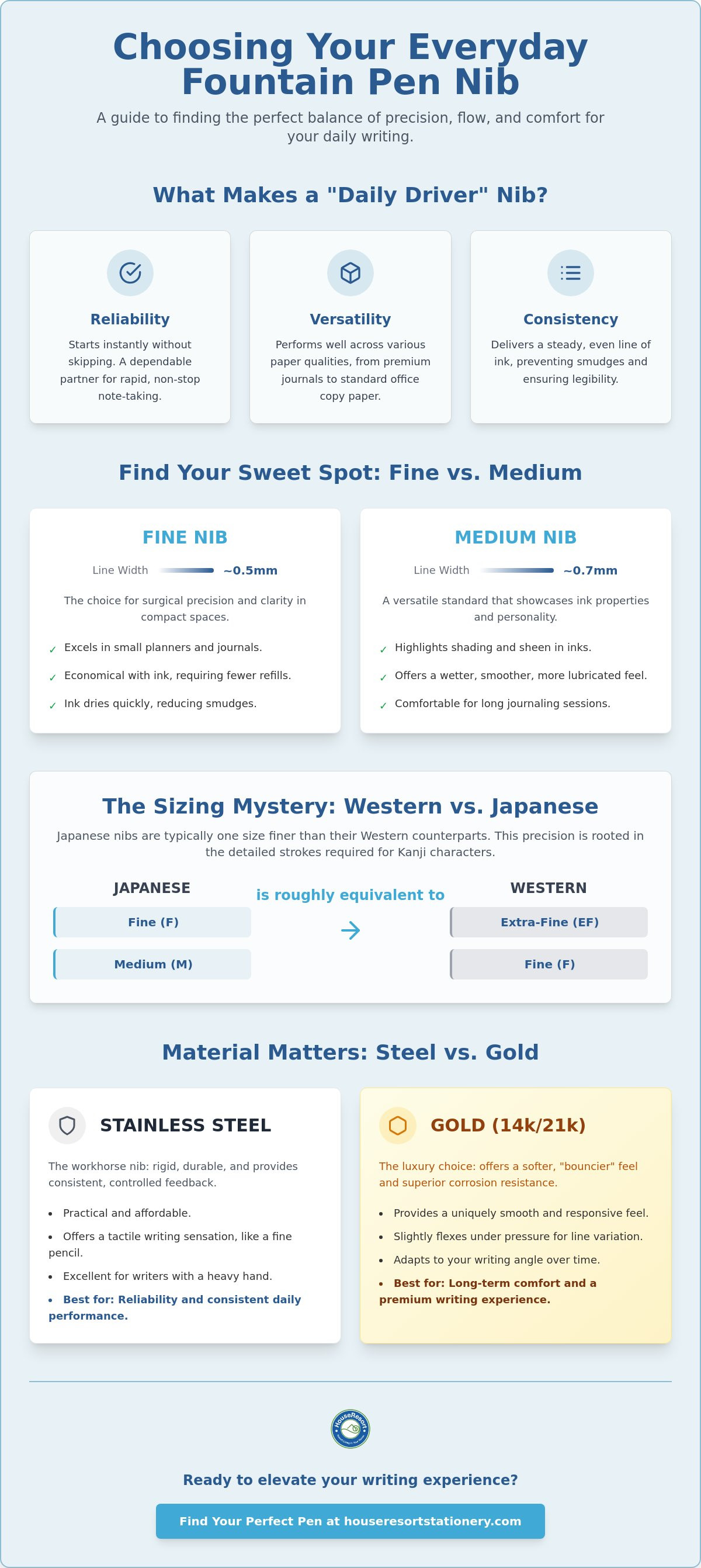
Selecting the best fountain pen nib for everyday writing is a choice between surgical precision and expressive flow. This decision dictates how you organize thoughts within the margins of a page and how often you engage with your inkwell. While a 0.5mm Fine stroke maintains legibility in compact spaces, a 0.7mm Medium line allows the specific personality of your handwriting to emerge. Both sizes offer distinct advantages depending on your professional environment and aesthetic preferences.
The Fine nib remains the standard for the structured professional. It excels in small planners, complex spreadsheets, and pocket-sized notebooks where space is a premium. Because these nibs deposit less ink, they represent the most economical choice for long-form writers. You'll find yourself refilling the reservoir less frequently, which is a practical benefit for those who travel or manage heavy daily correspondence. This efficiency also minimizes drying time, reducing the risk of smudges during rapid note-taking.
Conversely, the Medium nib serves as a versatile standard for those who value the visual impact of their script. It provides a broader canvas that highlights the unique characteristics of your chosen ink. Experts often discuss the value of personalized nibs to match specific writing angles and pressures. A Medium nib offers a wetter, more lubricated feel that glides across the page. This reduced friction makes it a comfortable partner for extended journaling sessions or drafting personal letters.
- Fine Nibs (0.5mm): Best for small handwriting, cheap office paper, and maximum ink economy.
- Medium Nibs (0.7mm): Best for showing off ink shading, relaxed writing styles, and premium stationery.
The Case for the Extra Fine (EF) Nib
For technical tasks or extremely small handwriting, the Extra Fine nib is indispensable. It provides unmatched accuracy for needle-like script. However, these thinner tips can feel "toothy" on lower-grade paper. To improve the experience, pair EF nibs with high-lubrication inks. This combination ensures a smoother glide without sacrificing the precision required for dense layouts or mathematical notations.
The Medium Nib as a Creative Compromise
Medium nibs are the ideal choice for enthusiasts who appreciate ink properties like shading and sheen. The wider line allows ink to pool slightly, revealing the depth of color that a Fine nib might miss. This encourages relaxed, flowing letterforms, turning a routine task into a moment of tactile pleasure. For the best results, consult our Japanese Stationery Online Store Guide to find premium paper pairings that manage this increased ink flow with grace. If you're looking to upgrade your desk setup, browse our collection of fine fountain pens to find your next reliable companion.
Deciphering Sizing: Western vs. Japanese Nib Standards
The most common pitfall when searching for the best fountain pen nib for everyday writing is the discrepancy between global manufacturing standards. A "Medium" nib from a German maker will produce a significantly broader line than a "Medium" from Japan. This is known among connoisseurs as the "One Size Down" rule. To achieve a line width similar to a Western Fine, you must typically select a Japanese Medium. This distinction is vital for ensuring your notes remain legible within the constraints of standard ruled paper.
These differences are rooted in cultural history rather than arbitrary factory specifications. Japanese manufacturers historically designed their tools to accommodate the intricate, multi-stroke nature of Kanji characters. This required a level of precision and thinness that Western scripts, characterized by flowing loops and cursive connections, simply did not demand. Consequently, Japanese nibs are often the superior choice for technical writing, architectural notations, or anyone with naturally compact handwriting. In contrast, Western nibs cater to a broader, more expressive stroke that fills the page with color.
Consistency remains a hallmark of industry leaders in 2026. While boutique makers offer unique character, heritage brands like Pilot and Lamy provide the most reliable sizing across their entire catalogs. Choosing between these giants often comes down to the desired tactile sensation. Sailor is renowned for its specialized feedback, while Pilot prioritizes a frictionless, buttery glide. Understanding these brand-specific nuances allows you to tailor your writing experience to your specific professional needs.
- Japanese Sizing: Runs finer; ideal for planners and complex characters.
- Western Sizing: Runs broader; ideal for rapid cursive and bold signatures.
- Consistency Leaders: Pilot, Lamy, and Sailor maintain the highest manufacturing tolerances.
The Japanese Precision Approach
Heritage makers like Sailor and Pilot represent the pinnacle of technical accuracy. A Sailor nib is famous for its unique "pencil-like" feedback, offering a controlled writing experience that prevents the pen from sliding during complex tasks. This makes instruments like the Sailor Pro Gear Slim a benchmark for precision. For professionals who require absolute legibility in dense notes, the Japanese approach provides the best fountain pen nib for everyday writing by ensuring every stroke remains distinct.
The Western Bold Tradition
European manufacturers like Lamy and Kaweco offer a more robust, "workhorse" experience. These nibs are typically characterized by a bouncier, more forgiving nature that handles varied writing angles with ease. If you are transitioning from standard gel pens, a Western Fine will feel the most familiar in terms of line weight and resistance. Brands like Lamy are celebrated for their durability in fast-paced office environments. Their steel nibs are built to withstand the pressure of quick brainstorming sessions without sacrificing the smooth flow expected of a luxury tool.
Nib Materials and Feedback: Steel vs. Gold for Daily Comfort
The choice between steel and gold is more than a matter of prestige. It's a functional decision for your daily tool. Stainless steel nibs offer a firm, reliable experience. They resist the heavy pressure often applied during rapid note-taking. These nibs are durable. Conversely, 14k and 21k gold nibs provide a luxurious softness. Gold is naturally flexible. It resists the corrosive nature of certain specialty inks. For a consistent daily driver, both materials have their place in a modern collection.
Finding the best fountain pen nib for everyday writing doesn't always require the most expensive option. Many enthusiasts believe gold is inherently smoother. This is a common myth. Smoothness depends on the quality of the tipping material and the final hand-tuning performed at the factory. A well-tuned steel nib from a heritage brand will easily outperform a poorly aligned gold one. Quality manufacturing matters most. As a boutique curator, I recommend choosing based on the tactile sensation you prefer rather than the metal's market price.
Comfort for Long Writing Sessions
Gold's natural elasticity acts like a shock absorber for your hand. This subtle "bounce" reduces fatigue during hours of journaling or drafting. Over time, a gold nib can even adapt slightly to your specific writing angle. This creates a personalized "sweet spot" that feels uniquely yours. Steel remains the pragmatic choice for high-pressure environments or shared office settings. A rigid tip prevents damage from heavy-handed users who might accidentally spring a softer gold nib.
Durability and Maintenance
Gold offers a hidden advantage when using iron gall or high-pigment inks. These fluids can be acidic and eventually corrode lesser metals. Gold remains untarnished. For those who prefer the modularity of modern designs, steel nibs are often easier to swap. Pens like the Lamy Safari allow users to change sizes in seconds without professional tools. Regardless of the base metal, the tipping material is a hard alloy of iridium or osmium that actually touches the paper to ensure years of smooth friction. If you're ready to upgrade your experience, explore our curated selection of fine fountain pens to find your perfect daily companion.
Optimizing Your Setup for Real-World Writing Conditions
The true test of a writing instrument happens on standard office paper, not just premium stationery. Most enthusiasts eventually face the challenge of ink feathering and bleed-through on low-grade copy paper. Finding the best fountain pen nib for everyday writing involves more than just selecting a size; it requires understanding how that metal tip interacts with the fiber of your paper. If you frequently navigate unpredictable paper qualities, a Fine or Extra Fine nib is your most reliable ally. These narrower tips deposit less ink, which prevents the liquid from soaking too deeply into absorbent fibers and creating a blurry mess.
Achieving a flawless experience also depends on the relationship between your nib and your ink. There is a simple rule for the daily user: match "dry" nibs with "wet" inks, and vice versa. A dry nib, which restricts ink flow, benefits from a lubricated, free-flowing ink to ensure a smooth glide. Conversely, if you prefer a wet-writing Medium nib, pairing it with a drier ink will help control the line width and significantly reduce drying times. This balance is essential for maintaining clean, legible notes during fast-paced professional meetings.
Maintenance is the final pillar of a consistent daily driver. For pens used every day, a simple flush with room-temperature water every 30 days prevents ink residue from restricting flow. This habit ensures that your pen starts instantly every time it touches the page. Consistent maintenance preserves the precise geometry of the nib, allowing it to perform at its peak regardless of the environment.
Selecting the Right 'Daily Driver' Ink
In a professional setting, dry time is as important as color. You need an ink that sets quickly to avoid smudges when you close your journal or turn a page. Well-behaved blue and black inks remain the standard for their reliability and professional appearance. We recommend consulting our guide on Pilot Iroshizuku Bottled Ink to find a formula known for its legendary flow and ease of cleaning. These inks are specifically engineered to provide a lubricated feel that enhances any nib size.
Pairing with Premium Analog Tools
When you have the luxury of choosing your surface, the tactile synergy between a high-quality nib and premium paper is unmatched. A Traveler's Notebook provides the perfect ecosystem for a Fine nib, offering a portable and modular setup for the mobile professional. Pairing a 14k gold nib with the subtle texture of MD Paper creates a writing ritual that improves focus and mental clarity. This combination turns a simple task into a sophisticated analog escape, allowing your thoughts to flow as smoothly as your ink.
Elevate Your Daily Writing Ritual
Mastering the nuances of nib geometry and material transforms a simple tool into a lifelong companion. Whether you prioritize the needle-like precision of a Japanese Fine for technical notes or the cushioned glide of a Western 14k gold nib for long-form journaling, your choice should reflect your unique environment. The synergy between your ink flow and paper quality is just as vital as the nib itself. Consistent maintenance ensures that this tactile escape remains a reliable part of your professional life for years to come. It's about finding that specific balance where the pen disappears and only your thoughts remain on the page.
Finding the best fountain pen nib for everyday writing is the final step in curating a personal analog experience that feels like an extension of your own hand. At HouseResort Stationery, we act as your boutique curator, offering a selection that has been meticulously filtered by fellow enthusiasts. As an authorized retailer for premium heritage brands, we provide an expertly organized catalog categorized by manufacturer and material to respect your time and passion. Explore our curated collection of fine fountain pens and nibs to discover the tool that will define your writing journey. Let your next stroke be your most inspired one yet.
Frequently Asked Questions
What is the best fountain pen nib size for a beginner?
A Medium nib is the most recommended starting point for those new to the hobby. It provides a balanced ink flow that works well on most paper types while remaining forgiving of varied writing angles. This size allows you to experience the characteristic smoothness of a fountain pen without the potential toothiness of finer points.
Do Japanese fountain pen nibs really write thinner than European ones?
Yes, Japanese nibs from manufacturers like Pilot or Sailor are typically one size finer than their Western counterparts. A Japanese Medium often produces a line similar to a European Fine. This difference stems from the precision required to write intricate Kanji characters, making these nibs the best fountain pen nib for everyday writing when using small planners or journals.
Can I use a broad nib for everyday note-taking at work?
You can use a broad nib if your workspace provides high-quality, ink-resistant paper. However, broad nibs deposit a significant amount of ink, which often leads to feathering or bleed-through on standard office copy paper. For professional environments with unpredictable paper supplies, a Fine or Medium nib is usually a safer, more legible choice.
Is a gold nib worth the extra cost for a daily writing pen?
A gold nib is worth the investment if you prioritize long-term tactile comfort and elasticity. While steel is durable and rigid, gold offers a subtle "bounce" that reduces hand fatigue during extended sessions. For a daily tool, the corrosion resistance of 14k or 21k gold also ensures your pen remains in peak condition regardless of the ink you choose.
How do I stop my fountain pen from bleeding through cheap paper?
Switch to a finer nib size and pair it with a "dry" ink formulation to minimize paper saturation. Finer tips deposit less liquid, which prevents the ink from soaking through the fibers of low-grade paper. Using well-behaved inks specifically designed for office environments will also help maintain crisp lines without unwanted feathering or smudging.
What is the difference between a stub nib and a regular medium nib?
A stub nib has a flat, rectangular tip that creates thick vertical strokes and thin horizontal lines. This adds natural flair to your handwriting without requiring special pressure. A regular medium nib has a rounded tip, providing a consistent line width in every direction, which is often preferred for rapid, utilitarian note-taking.
How often should I clean my everyday fountain pen?
You should clean your pen approximately every 30 days to ensure consistent ink flow and prevent clogging. If you use high-pigment or permanent inks, more frequent flushing is recommended. A simple rinse with room-temperature water during your monthly maintenance routine is usually sufficient to keep the feed and nib performing at their best.
Does my handwriting style determine which nib I should buy?
Your handwriting size is the primary factor in selecting the best fountain pen nib for everyday writing. If your script is small and compact, an Extra Fine or Fine nib will keep your letters from closing up and becoming illegible. Writers with large, loopy cursive often prefer Medium or Broad nibs to showcase the ink's color and character.