
Can You Take a Fountain Pen on an Airplane? A Connoisseur’s Travel Guide (2026)
What if the only barrier to a perfect in-flight journaling session is the fear of an ink-stained disaster? For the dedicated collector, asking can you take a fountain pen on an airplane involves more than just TSA compliance; it's a question of preserving your finest tools. You probably worry that a shift in cabin pressure will turn a cherished heritage pen into a leak that ruins your leather carry-on or a crisp dress shirt. It's a common anxiety that often leaves beautiful writing instruments at home.
Flying with a fountain pen is a solved engineering problem, not a risk to your wardrobe. You can master the art of high-altitude writing without a single drop of misplaced ink. This guide provides the technical precision needed to handle airport security and atmospheric changes with ease. We will cover the 3-1-1 liquid rules for bottled ink, the physics of air expansion, and why shut-off valves in models like the Pilot Custom 823 or Opus 88 make them ideal travel companions. You'll leave with the confidence to pack your favorite analog tools and enjoy a seamless, leak-free journey.
Key Takeaways
- Understand the physics of air expansion and why the air bubble in your reservoir is the primary cause of in-flight leaks.
- Learn the "Full Tank" and "Clean Slate" strategies to effectively neutralize pressure changes before you reach the boarding gate.
- Confirm that can you take a fountain pen on an airplane under current TSA regulations while mastering the 3-1-1 rule for bottled ink.
- Discover the mechanical advantages of vacuum-filling systems and integrated shut-off valves from heritage manufacturers that physically seal ink away from the nib.
- Master the proper etiquette for uncapping and writing at cruising altitude to ensure your tactile tools perform perfectly at 30,000 feet.
Understanding the Science: Why Fountain Pens Leak on Planes
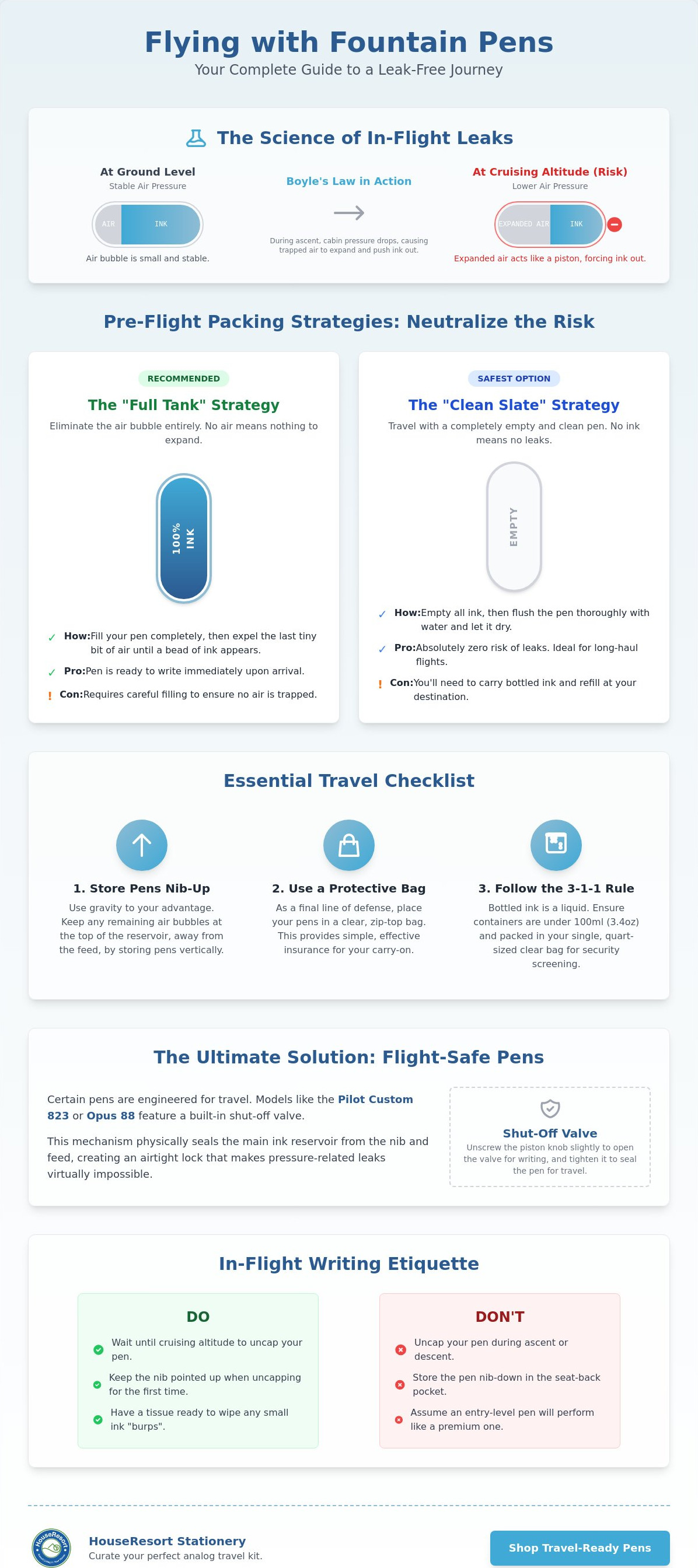
The physics of flight presents a specific challenge for the analog enthusiast. While the question of whether can you take a fountain pen on an airplane is easily answered by TSA guidelines, the mechanical reality of the journey is dictated by Boyle's Law. This principle of physics states that as the pressure of a gas decreases, its volume increases proportionally. During a flight, even in a pressurized cabin, the air pressure is significantly lower than at sea level. This causes any air trapped inside your pen's reservoir to expand. Because ink is a liquid and cannot be compressed or expanded in the same way, the growing air bubble acts as a physical plunger, forcing the ink out through the feed and into the cap.
This "piston-effect" is the primary culprit behind the dreaded ink leak. In older aircraft, cabin pressure often fluctuated wildly, leading to catastrophic spills. Modern jets like the Boeing 787 Dreamliner or the Airbus A350 maintain a more consistent "cabin altitude" of about 6,000 feet, which is gentler on your stationery. However, the risk remains. A minor "burp" of ink might only require a quick wipe of the nib, but a full reservoir expansion can saturate the cap and create a mess the moment you unscrew the barrel at 30,000 feet.
The Role of the Feed and Capillary Action
A pen's ability to withstand these pressure shifts often depends on the quality of its construction. The feed is a sophisticated component designed to regulate ink flow using capillary action. Understanding how fountain pens work is essential for any traveler; the fins on a high-quality feed are specifically engineered to trap excess ink before it escapes the nib. Luxury pens from heritage manufacturers often feature more complex feed geometries that can "buffer" a small amount of expanded ink. This is why a well-crafted instrument is less likely to leak than a basic entry-level model with a simpler, less forgiving feed design.
Atmospheric Pressure vs. Liquid Volume
It is a common misconception that the ink itself expands during flight. In reality, the liquid volume remains stable while the air bubble behind it becomes the catalyst for trouble. This is why the "danger zone" for your pen occurs during the ascent and descent phases, where pressure changes are most rapid. To ensure a successful trip, keep these factors in mind:
- Ascent: Rapidly decreasing pressure causes the internal air bubble to push ink out.
- Descent: Increasing pressure can suck air back into the pen, occasionally causing a secondary "burp" if ink has pooled in the cap.
- Airtight Seals: A secure cap seal is your final line of defense against atmospheric shifts.
The piston-effect in aviation stationery care describes the mechanical force exerted by expanding air that turns a reservoir into a pressurized pump. By acknowledging these scientific realities, you can prepare your kit for a perfectly clean flight.
The Connoisseur’s Packing Strategy: Full vs. Empty
Achieving a leak-free flight requires a deliberate approach to reservoir management. When planning your next trip, the decision of can you take a fountain pen on an airplane usually comes down to your preparation strategy. Most enthusiasts follow one of two professional-grade paths: the Full Tank or the Clean Slate. Both methods aim to neutralize the expansion of air that occurs as the cabin pressure drops during your ascent.
The goal of the Full Tank strategy is to eliminate the air bubble entirely. If there is no air trapped behind the ink, there is nothing to expand and push the liquid through the feed. To achieve this with a converter, draw your ink as usual, then turn the pen nib-up and slowly twist the piston until a tiny bead of ink appears at the tip. This ensures the reservoir is 100% full. For those on long-haul international flights who don't intend to write, the Clean Slate strategy is the safest option. Flushing your pen and traveling with it completely dry removes any risk of staining your collection or your luggage.
Always store your pens vertically with the nib pointing toward the sky. This "Nib-Up" rule utilizes gravity to ensure that any residual air sits at the top of the reservoir, nearest the feed. If pressure shifts, the air escapes through the nib first, rather than the ink. Even the most meticulously prepared kit benefits from a secondary layer of protection. A simple, clear zip-top bag acts as boutique-safe insurance for your fine leather pen rolls or stationery cases.
Filling Techniques for Maximum Capacity
Topping off a converter requires a steady hand and a bit of patience. For eye-dropper filled pens, which lack internal mechanical seals, "burping" the pen before boarding is essential. Hold the pen nib-up and gently warm the barrel with your hands; this allows the initial air expansion to escape before you reach cruising altitude. If you prefer a more streamlined approach, cartridges are naturally flight-safe. Their factory seals remain airtight and pressure-resistant until the moment you puncture them for use.
Transporting Bottled Ink and TSA Compliance
Carrying your signature colors involves navigating the TSA's 3-1-1 liquids rule. All containers in your carry-on must be 3.4 ounces (100ml) or less. While large heritage glass bottles are beautiful, they often exceed these limits. To stay compliant and save space, consider the 15ml sizes of pilot iroshizuku bottled ink. These smaller vessels fit perfectly into a quart-sized bag and provide more than enough ink for a two-week journey.
For checked luggage, vibration is as much of a threat as pressure. Secure your ink bottle threads with a single wrap of plumbers tape or parafilm before tightening the cap. This creates a mechanical seal that prevents the cap from backing off during transit. By pairing these technical steps with a selection of travel-ready fountain pens, you can ensure the question of can you take a fountain pen on an airplane never ends in a stained pocket.
Choosing Flight-Safe Fountain Pens with Shut-Off Valves
While packing strategies are effective, choosing the right tool simplifies the entire process. When considering can you take a fountain pen on an airplane, look for instruments designed with specialized shut-off valves. These mechanisms provide a physical barrier between the ink reservoir and the nib. This engineering choice transforms a delicate writing instrument into a robust travel companion capable of withstanding significant pressure drops.
Piston fillers remain popular for their impressive ink capacity. However, vacuum-filling systems offer a distinct advantage for frequent flyers. A standard piston filler relies entirely on an airtight cap and a high-quality feed to manage pressure. In contrast, a vacuum filler uses an internal gasket to lock the ink away from the feed entirely. As of June 2026, several manufacturers are recognized for perfecting this technology. The Pilot Custom 823 is a legendary choice for its reliability. The Opus 88 series uses a unique eyedropper system paired with a manual shut-off valve. For those seeking modern performance, the TWSBI Vac700R, Nahvalur Original Plus, and Asvine V126 provide exceptional engineering that prioritizes a leak-free experience.
The Mechanics of the Vacuum Shut-Off
To engage the safety seal, you simply tighten the "blind cap" at the end of the barrel. This action pushes a rubber gasket against the opening of the reservoir, physically isolating the ink. This seal is so effective that the pen becomes virtually leak-proof, even if stored nib-down. For international business travelers, this is the gold standard for reliability. When you are ready to write at cruising altitude, you must unscrew the blind cap slightly to allow ink to reach the feed. Maintaining these pens is straightforward; a small amount of silicone grease on the internal rod every few months ensures the mechanism remains smooth and airtight.
Pocket Pens: The Compact Traveler’s Alternative
If a large vacuum filler feels too substantial for your carry-on, pocket pens offer a different solution. Smaller reservoirs found in Kaweco or Schon DSGN models contain a much smaller volume of air. Less air results in less expansion during ascent. Metal-bodied pens, such as those machined from brass, copper, or aluminum, are exceptionally durable. They resist the physical stresses of travel and fluctuating cabin temperatures better than some resin counterparts. Protect these smaller tools with a dedicated leather sleeve. This prevents scratches and keeps your instrument secure within a bag or pocket throughout the journey.
In-Flight Etiquette: Writing at 30,000 Feet
The transition from a quiet airport lounge to a cramped aircraft seat requires a shift in your writing habits. While the technical question of can you take a fountain pen on an airplane is settled before you board, the success of your mid-air correspondence depends on timing. You should never uncap your pen during the initial climb. As the aircraft gains altitude, the cabin pressure drops rapidly. This is the period of greatest atmospheric stress on your pen's reservoir. Wait for the "Fasten Seatbelt" sign to turn off. This signal usually indicates that the aircraft has reached a stable cruising altitude and the cabin pressure has equalized.
When you are ready to write, hold the pen vertically with the nib pointing toward the ceiling. Uncap it slowly in this upright position. Keeping the pen vertical for five to ten seconds allows any trapped air to escape through the feed without carrying ink with it. If you are using a vacuum filler, this is the moment to slightly unscrew the blind cap to allow ink flow. Watch the nib carefully during the first few strokes. If you notice a sudden, heavy flow of ink, your pen is about to "burp." Stop writing immediately and wipe the nib. This prevents a small droplet from becoming a large stain on your tray table.
The Cruising Altitude Sweet Spot
Steady cabin pressure makes the cruising portion of your flight the most enjoyable time for analog creative work. The vibration of the engines often provides a rhythmic backdrop for focused tasks. This environment is perfect for practicing fountain pen doodle journaling for beginners. The controlled environment allows you to test how your specific nib and ink combination reacts to the dry, recycled air of the cabin. If you feel any resistance or "railroading," a gentle tap on the paper usually restores the capillary flow.
Paper Quality and Cabin Humidity
Aircraft cabins are notoriously dry environments, often maintaining humidity levels below 20%. This low humidity causes ink to dry significantly faster than it does at sea level. While this prevents smudging, it can lead to "hard starts" if you leave the pen uncapped during a long thought process. Standard airplane paper, such as customs forms or napkins, is usually too absorbent for fountain pens. To avoid feathering and bleed-through, a dedicated traveler's notebook is the preferred companion. These modular systems use high-quality paper designed to handle wet inks even in fluctuating conditions.
Always keep a small sheet of blotting paper tucked into your journal. It acts as a shield to protect your previous pages from any unexpected ink transfer in the cramped confines of your seat. Before you prepare for descent, cap your pen securely and store it nib-up once more. To ensure your collection is ready for your next destination, SHOP our curated selection of travel-ready journals and protective accessories.
Curating Your Analog Travel Kit with HouseResort Stationery
Preparation is the hallmark of the modern connoisseur. While the logistics of can you take a fountain pen on an airplane are now clear, the ultimate goal is a frictionless writing experience from departure to arrival. HouseResort Stationery serves as an authorized retailer for heritage manufacturers, ensuring that every instrument in your kit meets the highest standards of craftsmanship and authenticity. Selecting tools by maker allows you to build a collection based on material quality and proven engineering, which is essential for the stresses of international travel.
Protection is the next priority for any valuable collection. A dedicated leather pen wrap or a structural hard case prevents the physical shocks of transit from affecting your nib’s alignment. These accessories do more than protect; they organize your tools into a cohesive boutique experience that fits inside a carry-on. By investing in quality storage, you ensure that your pens remain as pristine at your destination as they were when you left your desk. We invite you to explore our curated collections of travel-ready stationery to find the perfect match for your next itinerary.
The Modular Approach to Travel Journaling
With over 50 million Americans engaging in regular journaling in 2026, the demand for portable, high-quality kits has never been higher. A modular approach allows you to adapt to any environment. Your kit should include a primary flight-safe fountain pen, a backup mechanical pencil for quick notes, and a modular notebook system. Organizing these items into a single, accessible pouch makes security checkpoints effortless. There is a profound tactile joy in documenting a journey with premium materials; it turns a standard flight into a creative retreat. Using a modular system ensures you always have the right paper and pen combination for the task at hand.
Expert Recommendations for Your Next Flight
For the enthusiast seeking reliability, our curated choices focus on instruments with integrated safety features. The global fountain pen market reaching a value of $1.05 billion in 2026 reflects a deep appreciation for these specialized tools. We recommend focusing on manufacturers known for vacuum-filling technology and superior seals. Before you head to the gate, use this final checklist for a leak-free flight:
- Verify Reservoir Level: Ensure your pen is either 100% full or completely flushed and empty.
- Check Your Ink: Confirm all bottled ink is in containers under 3.4oz and stored in a clear bag.
- Engage Safety Valves: Tighten the blind caps on your vacuum fillers to seal the ink chamber.
- Orient Nib-Up: Store your pen vertically in your seatback pocket or carry-on bag.
By following these professional standards, you can confidently answer the question of can you take a fountain pen on an airplane with a resounding yes. Visit our specialized manufacturer categories to discover the heritage tools that will accompany you on your next great adventure.
Elevate Your High-Altitude Correspondence
Traveling with your finest writing tools doesn't need to be a source of anxiety. By understanding the relationship between air volume and cabin pressure, you've mastered the primary hurdle of aviation stationery care. Whether you choose the reliability of vacuum-filling systems or the simplicity of traveling with a clean, flushed reservoir, your analog tools are ready for the journey. You no longer need to wonder can you take a fountain pen on an airplane; you simply need to pack with intention and enjoy the tactile rewards of writing at cruising altitude.
HouseResort Stationery serves as an authorized retailer of heritage brands, offering specialized knowledge in vacuum-filling systems and a curated selection of travel-size Pilot Iroshizuku inks. This expertise ensures you find instruments that perform perfectly under atmospheric stress while remaining TSA compliant. Our boutique approach filters the market to present only the most reliable options for the discerning traveler.
Explore our curated collection of flight-ready fountain pens and journals at HouseResort Stationery. Your next great story is waiting to be written at 30,000 feet. Safe travels and happy writing.
Frequently Asked Questions
Does the TSA allow fountain pens on planes in 2026?
The TSA permits fountain pens in both carry-on and checked luggage without restriction as of June 2026. While the pens themselves are always allowed, any bottled ink in your carry-on must comply with the standard 3-1-1 liquids rule. This means each bottle must be 3.4 ounces or less and fit within a single quart-sized bag.
Will my fountain pen explode if I leave it in my checked bag?
Fountain pens do not explode in checked luggage, but they are still susceptible to pressure-induced leaks. The cargo hold is pressurized similarly to the cabin, meaning the same rules of air expansion apply to your reservoir. Because checked bags face more vibration and temperature shifts, keeping your collection in a carry-on bag is the safer choice for heritage materials.
What is the best fountain pen for flying without leaking?
Instruments featuring a physical shut-off valve are the most reliable choices for frequent flyers. Vacuum-filling models like the Pilot Custom 823 or the TWSBI Vac700R allow you to seal the ink chamber completely from the feed. This mechanical lock ensures that can you take a fountain pen on an airplane without any risk of ink escaping into the cap during ascent.
Can I take a bottle of fountain pen ink in my carry-on?
You can transport bottled ink in your carry-on if the container is 100ml or smaller. Many enthusiasts prefer traveling with 15ml Pilot Iroshizuku bottles because they are compact and easily meet security requirements. For added security, wrap the bottle threads in plumbers tape to prevent the cap from loosening during the flight.
Should I fly with my fountain pen nib up or nib down?
Always store your pens with the nib pointing toward the sky. This orientation ensures that the air bubble remains at the top of the reservoir, closest to the feed. When the cabin pressure drops, the expanding air can escape through the nib without pushing a column of ink out ahead of it.
Do I need to empty my fountain pen before every flight?
Emptying your pen isn't necessary if you follow the "Full Tank" strategy. A reservoir that is 100% full contains no air to expand, making it remarkably stable at high altitudes. If you cannot fill the pen completely, flushing it and traveling with a "Clean Slate" is the only way to guarantee zero leaks.
What happens if my fountain pen leaks during the flight?
If you discover ink in the cap, clean it immediately with a damp cloth or a small amount of water. Most modern inks are water-soluble and won't cause permanent damage if addressed quickly. Avoid using hand sanitizer or alcohol-based wipes on your pens, as these chemicals can cloud or crack luxury resins and celluloid barrels.
Are cartridges safer than converters for air travel?
Unpunctured cartridges are the safest option because they are factory-sealed and pressure-resistant. Once a cartridge is punctured and in use, it behaves much like a converter. However, converters offer the distinct advantage of allowing you to manually remove the air bubble before boarding, which helps you master the art of how can you take a fountain pen on an airplane safely.