
Choosing the Perfect Traveler’s Notebook Cover: A Connoisseur’s Guide for 2026
What if your most essential creative tool wasn't a digital device, but a single piece of hand-cut leather that grows more beautiful with every passing year? You likely appreciate the tactile ritual of opening a fresh notebook, but the variety of sizes and the fear of scuffing a premium traveler's notebook cover can feel paralyzing. It's easy to get lost in the technical details of how many inserts a spine can truly hold without losing its sleek, functional profile.
Selecting the right cover is about more than just aesthetics; it's about building a modular system that supports your daily life. This guide will show you how to select, set up, and maintain a premium cover that evolves alongside your writing journey. We'll explore the technical nuances of the 2026 "THE TRAVELER'S SPIRIT" collection, master the art of internal organization, and learn the specific steps to cultivate a unique patina that tells your story. By the end, you'll have the confidence to choose a heritage piece that serves as a lifelong companion for your fountain pens and daily reflections.
Key Takeaways
- Identify the core benefits of a modular journaling system and how a single cover adapts to your changing creative needs.
- Choose between the Regular and Passport formats by weighing the demands of long-form writing against the convenience of everyday carry.
- Select a traveler's notebook cover crafted from vegetable-tanned leather to ensure a durable, heritage-quality tool that gains character through use.
- Master the technical setup of elastics and connecting bands to securely house multiple inserts within your organizational system.
- Learn professional maintenance techniques to preserve your leather while integrating 2026 diary refills and fountain pen-friendly paper.
Understanding the Traveler’s Notebook Cover: The Foundation of Modular Journaling
A traveler's notebook cover serves as the structural heart of a modular stationery system. It isn't just a protective layer; it's a carefully engineered leather shell that uses a simple system of elastics to hold your creative life together. Enthusiasts value this design because it shifts the focus from a single, static book to a living tool. By utilizing a high-quality leather exterior, the traveler’s notebook becomes a lifelong companion that adapts as your needs change. This approach resonates deeply with modern analog collectors who find beauty in the tactile and the permanent. The design philosophy is rooted in the aesthetic of wabi-sabi, where the scratches, oils, and wear on the leather are not viewed as damage, but as a record of your personal history.
The Anatomy of a Quality Cover
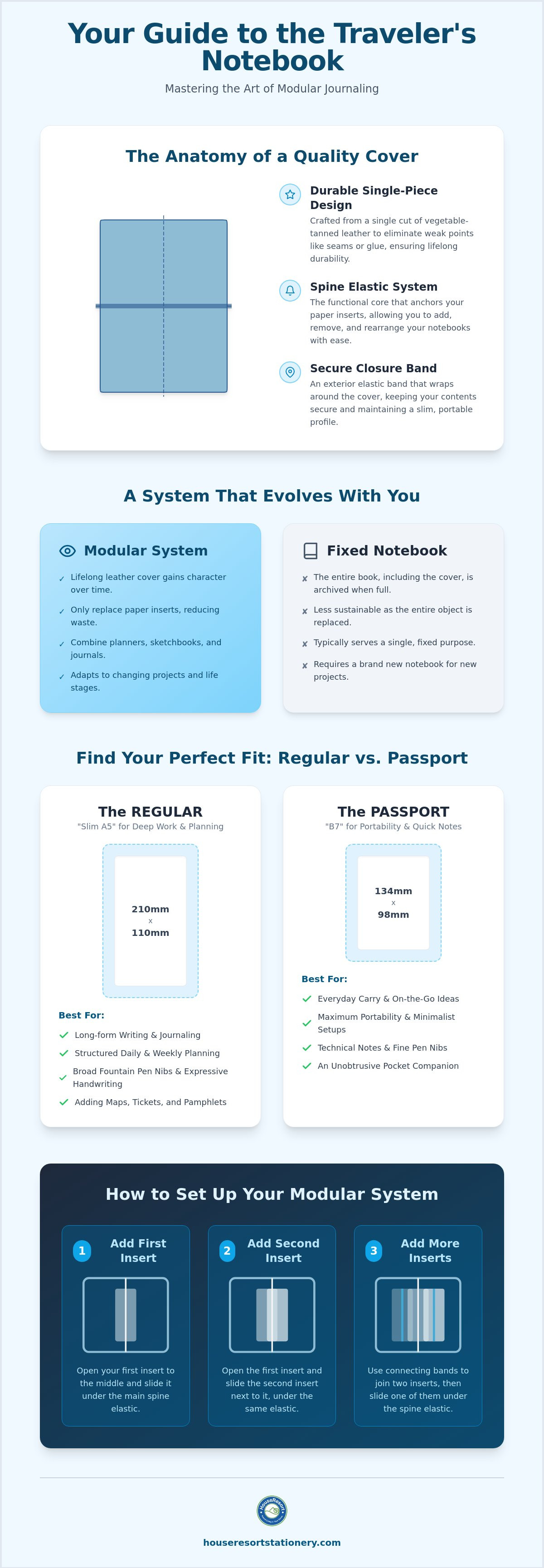
Durability begins with construction. A premium traveler's notebook cover is typically cut from a single, thick piece of vegetable-tanned leather. This single-piece design eliminates weak points like stitching or glued seams that often fail with heavy use. The functional core of the cover is the spine elastic, which acts as the anchor for your paper inserts. A secondary closure band wraps around the exterior to keep your thoughts secure. Every element is intentionally minimal. The "slim" profile is a hallmark of the heritage design, specifically engineered to slide into a coat pocket or a crowded bag without adding unnecessary bulk. It prioritizes portability while maintaining enough structural integrity to protect your fountain pen-friendly paper from the elements.
Modular vs. Fixed Notebooks
Choosing a modular cover over a fixed notebook is a commitment to sustainability and flexibility. When a standard journal is full, you must archive the entire object, including the cover. With a modular system, the leather shell remains while only the paper inserts are replaced. This allows you to mix and match different types of content simultaneously. You can house a 2026 planner, a watercolor sketchbook, and a lined notebook all within the same traveler's notebook cover. As you move through different life stages or professional projects, you simply swap the refills. The system grows with you, transitioning from a travel log to a daily work planner or a creative sanctuary without requiring you to break in a new piece of leather. It’s an efficient, thoughtful way to organize a multifaceted life.
Size and Format: Choosing Between Regular and Passport Covers
Selecting the right dimensions for your traveler's notebook cover is the most critical decision in your analog journey. The choice generally falls between two heritage standards: the Regular and the Passport. While both utilize the same modular elastic system, they serve distinct purposes. The Regular size, measuring approximately 210mm by 110mm, is often described as "Slim A5." It provides a vertical, narrow canvas that is ideal for structured planning and long-form writing. In contrast, the Passport size (134mm by 98mm) is designed for maximum portability. It mirrors the dimensions of a standard B7 notebook, making it an unobtrusive companion for those who prioritize efficiency over page real estate.
Your preferred writing tools should influence this decision. If you favor broad fountain pen nibs or have large, expressive handwriting, the Regular size offers the necessary width to prevent cramped lines. A larger canvas often encourages the deep reflection associated with the mental health benefits of journaling, allowing space for complex thoughts to breathe. Conversely, if you use extra-fine nibs for technical notes, the Passport size provides ample space without the weight of a full-sized journal. The choice is personal. Size dictates function.
When to Choose the Regular Size
The Regular size is the gold standard for dedicated journalers. Its height allows you to tip in standard travel pamphlets, maps, and boarding passes without folding them into awkward shapes. Many enthusiasts source specific refills from a Japanese stationery online store to ensure their Regular size cover is paired with the finest MD Paper. This format is particularly well-suited for 2026 vertical planners, where the hourly layout requires vertical height to remain legible. It’s a desk-friendly option that transitions beautifully from a home office to a creative session at a local cafe.
The Passport Size as an EDC Powerhouse
For those who value "Everyday Carry" (EDC) utility, the Passport size is unmatched. It fits effortlessly into jacket pockets or small crossbody bags. By adding a simple zip-pouch insert, your traveler's notebook cover transforms into a functional wallet. You can store credit cards, currency, and a passport alongside your paper refills. This dual-purpose setup is perfect for professionals who need to capture quick sparks of inspiration or fleeting tasks while on the move. It’s about having a reliable tool within reach at all times. You can explore our curated selection of journals to find the traveler's notebook cover that fits your hand perfectly.
The Material Science: Why High-Quality Leather is Essential for Stationery Enthusiasts
A traveler's notebook cover isn't just a decorative accessory; it's a technical necessity for protecting high-end writing tools. Vegetable-tanned leather stands as the gold standard for these covers because of its organic processing. Unlike chrome-tanned alternatives that rely on harsh chemicals, vegetable tanning uses natural tannins from bark and leaves. This results in a dense, fibrous structure that offers superior durability. For the fountain pen connoisseur, this material provides a crucial benefit. The thick leather acts as a natural shock absorber, shielding delicate resin bodies and precious metal nibs from impact or abrasive contact while your journal is stored in a bag. Mass-market synthetic covers simply cannot offer this level of structural protection or longevity.
The most celebrated characteristic of heritage leather is the development of a "patina." This isn't a sign of wear, but a mark of maturity. As you handle the traveler's notebook cover, the oils from your skin and exposure to ambient light slowly transform the surface. A brand-new cover is a blank canvas. Over months of use, it develops a glossy sheen and a deepened color profile unique to your specific handling habits. This evolution creates a sense of belonging for the collector. It moves the object beyond a simple transaction and into the realm of a personal artifact. Synthetics don't age; they only degrade. High-quality leather, however, gains aesthetic value with every passing year.
Leather Care for the Connoisseur
Maintaining the integrity of your leather requires a disciplined, minimalist approach. Most premium covers arrive with a high concentration of internal oils, so initial conditioning is usually unnecessary. If the leather begins to feel dry after a year of heavy use, apply a small amount of pH-balanced conditioner to keep the fibers supple. This prevents the surface from cracking over decades of service. Light scratches and scuffs are part of the journey. You can often "rub out" minor marks using the heat and friction of your thumb. This redistributes the leather's natural oils to heal the surface without the need for harsh chemicals.
Color and Texture Variations
Choosing a color is a strategic decision for your long-term setup. Heritage Brown and Camel shades are famous for showing the most dramatic patina, darkening into rich, honey-toned hues. Classic Black offers a more subtle, professional evolution, developing a deep, mirror-like luster rather than a significant color shift. The tactile experience also varies by finish. A smooth, matte finish feels silky and modern, while a pebbled texture provides a more rugged, secure grip. Regardless of the choice, a genuine traveler's notebook cover ensures your 2026 planners and fine fountain pens remain protected in a shell that only grows more beautiful with time.
How to Set Up Your Modular Notebook System: From Elastics to Inserts
Setting up your traveler's notebook cover is a technical ritual that transforms a simple leather shell into a personalized organizational tool. The process begins by selecting your primary anchor insert. This is the foundation of your system, typically a high-use item like a 2026 vertical planner or a dedicated journal. You slide this insert through the main spine elastic, centering it to ensure the weight is evenly distributed. This single anchor provides the stability needed to add more layers without compromising the sleek profile of the leather.
To expand beyond a single notebook, you must master the use of connecting bands. These silicone loops allow you to link two inserts together in a "piggyback" fashion. You place the bands around the center pages of two separate notebooks, effectively creating a single, thicker unit. You then slide this combined unit behind the main anchor insert. This method allows your traveler's notebook cover to house three separate paper refills securely. While it's tempting to add more, three inserts represent the "sweet spot" for most users. It provides enough variety for planning, sketching, and note-taking while allowing the leather to wrap comfortably around the contents.
Maximizing Your Capacity
Managing the bulk of your system is essential for maintaining portability. If you exceed three inserts, the cover often develops a "v-shape" where the edges no longer meet. This puts unnecessary strain on the spine elastic and can lead to uneven wear on the leather. For heavy users, the solution is often a tactical rotation. Move completed inserts to a larger archival storage system and keep only current projects within your portable cover. This disciplined approach ensures your daily carry remains light and functional. It prevents the system from becoming a burden during travel or daily commutes.
Essential Hardware and Accessories
Essential hardware elevates the utility of your setup. Heavy-duty brass clips are indispensable for holding pages open, especially when engaging in fountain pen doodle journaling. These clips provide the necessary tension to keep the paper flat for intricate ink work. Pen holders are another critical addition. You must select the correct size based on your instrument; a Lamy Safari requires a larger loop than a slim Sailor Pro Gear. Adding a PVC pouch provides a secure space for stickers, receipts, and business cards, rounding out the modular ecosystem. You can view our collection of modular accessories to find the perfect components for your unique configuration.
Curating Your Analog Escape: Maintenance and Accessory Integration
Finalizing your setup for the year ahead involves more than just selecting paper. It requires a thoughtful integration of tools that respect the heritage of your traveler's notebook cover. As an authorized retailer, HouseResort Stationery prioritizes heritage makers who understand the technical requirements of the analog enthusiast. A cohesive aesthetic is built through the deliberate pairing of aged brass, supple leather, and rich ink. This curation ensures that your journaling experience isn't just functional, but a sensory escape from the digital noise of 2026. By focusing on authentic materials, you ensure that your modular system remains a reliable companion for years to come.
The synergy between your cover and your writing instruments is a hallmark of the connoisseur's desk. High-quality leather provides a soft, protective environment for fine fountain pens, preventing the micro-scratches often caused by synthetic materials. When you choose an authorized heritage maker, you're investing in a product designed to endure the rigors of daily use without losing its structural integrity. This commitment to quality is what allows a simple notebook to transform into a curated heirloom. It’s about more than organization; it's about the preservation of your personal narrative in a format that honors the craft of stationery.
The 2026 Planning Cycle
The official release of the 2026 Diary items on October 15th, 2025, introduced the evocative theme "THE TRAVELER'S SPIRIT." When setting up for the new year, you must choose between weekly, monthly, or daily formats based on your specific scheduling density. The beauty of the modular system is that you can archive your 2025 inserts while keeping the same leather cover. This continuity allows the patina to develop uninterrupted over decades. For those seeking a unique format, the 20th-anniversary "Card Size" set, available starting April 23rd, 2026, offers a compact alternative for minimalists who wish to refresh their system mid-year. Setting up your new year with a fresh customization set, available July 1st, 2026, ensures your system stays as dynamic as your projects.
Fountain Pen Synergy
Protecting your fountain pen nibs is a primary function of high-quality paper inserts. Standard refills often feature MD Paper or similar fountain pen-friendly stocks that prevent feathering and bleed-through. To truly personalize your entries, many connoisseurs use pilot iroshizuku bottled ink to match the tone of their leather. A deep "Yama-budo" purple pairs beautifully with a weathered camel cover, while "Shin-kai" blue-black complements a classic black shell. When journaling on the go, always include a sheet of blotting paper. This prevents ink transfer between pages when you close your traveler's notebook cover quickly. This attention to detail preserves both your writing and the longevity of your leather investment, ensuring your analog escape remains pristine.
Embarking on Your 2026 Analog Journey
Choosing a traveler's notebook cover is an investment in a tool that matures alongside your creative life. You've learned how the distinction between Regular and Passport sizes dictates your daily functionality, and why heritage leather is the only material capable of developing a truly personal patina. By mastering the modular setup of elastics and connecting bands, you can now curate a system that supports your 2026 planning cycle with precision.
HouseResort Stationery remains committed to supporting your passion for quality craftsmanship. As an authorized retailer of heritage brands, we provide the expert curation fountain pen enthusiasts require to protect their finest instruments. Our inventory is carefully selected to ensure your analog tools are as reliable as they are beautiful. We offer fast national shipping across the US to help you begin your next chapter without delay.
Explore our curated collection of authentic Traveler’s Notebook covers and accessories.
Your story deserves a cover that honors the depth of your experiences. We're excited to see how your new notebook evolves through the coming year.
Frequently Asked Questions
How many inserts can a standard traveler’s notebook cover hold?
A standard cover comfortably holds between one and three inserts. While it's technically possible to fit four or five refills using multiple connecting bands, this often causes the leather to bulge, preventing the edges from closing flat. Three inserts is widely considered the optimal limit for maintaining a slim, portable profile while providing enough variety for planning and journaling.
Does the leather cover come with paper inserts included?
The standard starter kit includes the leather cover, one blank notebook refill, a cotton protective bag, and a spare rubber band. Specialized inserts, such as the 2026 weekly planners or fountain pen-friendly grid paper, are typically purchased separately. This allows you to build a curated internal system that matches your specific organizational needs from the first day of use.
What is the difference between "Regular" size and A5?
The Regular size is significantly narrower than a standard A5 notebook, measuring 210mm by 110mm. This format is often called "A5 Slim." Because a standard A5 notebook is 148mm wide, it will not fit inside a Regular traveler's notebook cover without being trimmed. The slimmer dimensions are intentional, designed to make the journal easier to hold in one hand while traveling.
How do I clean a leather traveler’s notebook cover?
Cleaning begins with a simple, soft cloth to remove surface dust. For minor scuffs, the heat and friction from your thumb are usually sufficient to redistribute the leather's natural oils and "heal" the mark. If the leather feels exceptionally dry after a year of use, apply a small amount of pH-balanced leather conditioner. Avoid harsh chemicals that can interfere with the natural patina process.
Can I use fountain pens with the standard inserts?
Standard refills from heritage manufacturers are designed specifically for fountain pen use. They often feature MD Paper, which is engineered to prevent feathering and bleed-through. This high-quality surface allows your ink to show its true color and shading without soaking through to the other side. It's a reliable choice for enthusiasts who demand a smooth, feather-resistant writing experience in every entry.
How do I stop my notebook from feeling too bulky?
The best way to manage bulk is to limit your setup to three inserts and rotate them frequently. If your traveler's notebook cover feels heavy, archive completed journals into a dedicated storage binder and keep only active projects in your leather shell. Avoid overfilling PVC pockets with thick stacks of receipts or cards, as this creates uneven pressure that can distort the leather over time.
What are connecting bands and how do I use them?
Connecting bands are silicone elastic loops that allow you to join two notebook inserts together. You place the band around the center pages of two notebooks so they sit spine-to-spine. This linked pair is then tucked behind the primary insert that is already secured to the cover's main elastic. This simple hardware is what enables the modular, multi-book system to function securely.
Is the leather cover waterproof or should I treat it?
Vegetable-tanned leather is not waterproof and will develop spots if exposed to heavy moisture. If your cover gets wet, wipe it immediately with a dry cloth and let it air dry naturally away from heaters or direct sunlight. Most collectors avoid waterproof treatments to allow the leather to breathe and age, but a light application of leather wax can provide a basic level of water resistance.