
Creative Journaling Ideas for 2026: Elevate Your Analog Practice
What if the most intimidating part of your new Midori or Traveler's notebook isn't the blank page, but the fear that your first stroke of ink won't be worthy of the paper? It's a common hesitation for enthusiasts who appreciate the craftsmanship of a fine nib and the tactile texture of premium stationery. You've likely felt the pressure to keep every page perfect, which often leads to repetitive long-form entries or a stack of beautiful but empty journals. This year, we're moving beyond those limitations with fresh creative journaling ideas designed to help you find a sophisticated balance between structured writing and expressive art.
You'll discover how to maximize the unique properties of your specialized inks and transform your practice into a calming, sensory experience. We'll show you how to embrace the beautifully messy scrapbook trends of 2026 while maintaining the professional elegance of a curated collection. From layering rich purple and burgundy hues to experimenting with micro-journaling techniques, this guide provides the prompts and technical tips you need to build a meaningful, tactile archive. It's time to stop saving your best tools for a "perfect" moment and start creating a keepsake you'll cherish for years.
Key Takeaways
- Reclaim your focus by integrating analog practices into the 2026 digital detox movement through tactile heritage tools.
- Unlock the hidden potential of your ink collection using technical methods like chromatography and swatching to reveal complex color profiles.
- Design sophisticated layouts using photography principles like the Rule of Thirds to balance intentional negative space with artistic elements.
- Explore unique creative journaling ideas including sensory mapping and daily sketching to deepen your connection to the physical world.
- Select the ideal paper foundation by comparing the performance and fountain pen synergy of heritage brands like Midori, Hobonichi, and Traveler’s Company.
The Evolution of Creative Journaling: Why Analog Matters in 2026
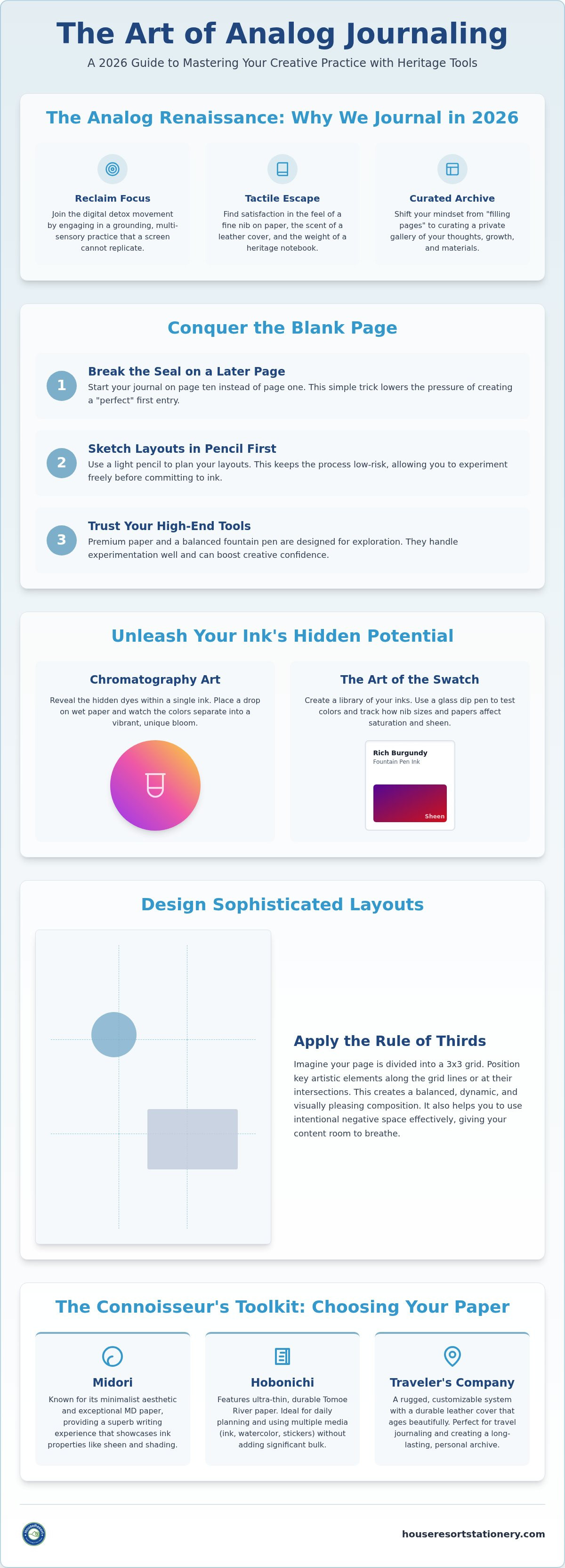
Creative journaling is no longer just about recording daily events. In 2026, it has evolved into a multi-sensory practice that blends texture, color, and introspective thought. This shift coincides with a significant digital detox movement. Enthusiasts are trading blue light for the soft glow of a desk lamp and the weight of a heritage notebook. By treating your notebook as an Art diary, you create a physical record that a digital app cannot replicate. The return to analog tools isn't a rejection of technology; it's a deliberate choice to engage with the world through touch and sight.
Using premium paper from makers like Midori or Hobonichi changes how you think. Standard office paper is purely functional, but high-end stationery acts as an active participant in the creative process. When you explore creative journaling ideas, the paper's specific tooth and sizing dictate how your ink shades or sheens. This requires a Boutique Curator mindset. You aren't just filling pages. You're managing a private gallery of thoughts and materials. This perspective shifts the focus from a chore to a curated collection of your own growth.
Breaking the 'Blank Page' Anxiety
Owning a premium notebook often brings a specific pressure. You don't want to ruin expensive paper with bad art or messy handwriting. This fear of the first page is common, but you can lower the stakes with a few simple shifts. Try starting your journal on page ten instead of page one. Alternatively, use a pencil for your initial layouts to keep things low-risk. High-end tools like a well-balanced fountain pen actually boost your creative confidence once you begin. The precision of a gold nib makes every mark feel intentional. As you experiment with different creative journaling ideas, remember that the paper is designed to handle your exploration, not just your perfections.
Journaling as a Tactile Escape
The psychological benefits of analog practice come from its physical feedback. There's a unique satisfaction in the subtle scratch of a fine nib moving across a page. This sensory input helps ground you in the present moment. Many collectors find that creating a dedicated analog sanctuary at home enhances this effect. This is a space where the smell of a Traveler's Company leather cover and the weight of a brass pen become signals for your brain to relax. The experience is deeply personal. It's about the resistance of the paper, the flow of the ink, and the quiet ritual of opening a book that was made to last a lifetime.
Ink-Centric Creative Journaling Ideas: Mastering Sheen and Shade
Ink is the lifeblood of the analog experience. While many creative journaling ideas focus on heavy acrylics or stickers, the true connoisseur looks to the technical properties of bottled ink to add depth. When you focus on Understanding Art Journaling, you realize that ink is more than a tool for legibility. It's a medium for emotional expression. By exploring chromatography art, you can reveal the hidden dyes within a single color. Simply place a drop of ink on a wet scrap of paper to watch the blues, pinks, and yellows separate into a vibrant bloom. This technique turns your journal into a laboratory where science and art meet.
Mastering your ink also means understanding how it interacts with specific paper types. To make sheening inks truly pop, you need paper with high ink resistance, such as those found in Midori or Hobonichi notebooks. These surfaces allow the ink to sit on top of the fibers rather than soaking in immediately. Even perceived flaws like ghosting or bleed-through can be integrated into your creative journaling ideas. Ghosting adds an archival, lived-in aesthetic that suggests a history of thought. If an ink bleeds through, use that mark as a starting point for a sketch on the following page. This approach removes the fear of imperfection and treats the journal as a dynamic, evolving object.
The Art of the Ink Swatch
A well-organized swatch library is essential for any serious collector. Use a glass dip pen to quickly test new colors without the need to ink up a full fountain pen every time. You can create a dedicated index in the back of your journal to track how different nib sizes affect color saturation. Ink sheen is the metallic-like surface layer that appears on high-quality paper. By swatching, you can identify which inks offer this brilliant finish and which provide subtle shading. Shading occurs when the ink pools at the end of a stroke, creating a beautiful gradient from light to dark.
Technicolor Writing: Multi-Pen Layouts
Color-coding isn't just for productivity; it's a way to map your internal landscape. Assign specific colors to different emotional tones or recurring themes in your life. Integrating pilot iroshizuku bottled ink is an excellent way to bring nature-inspired palettes into your spreads. Use a deep forest green for grounding thoughts and a bright cerulean for moments of inspiration. You can also use high-shading inks to create headers that mimic the look of professional calligraphy. The natural variation in the ink does the hard work for you. If you're ready to expand your palette, browse our curated ink selection to find a shade that speaks to your current practice.
Structural Creativity: Designing Cohesive Journal Spreads
A beautiful journal spread relies on more than just high-end materials. It requires a sense of balance. Many enthusiasts struggle with layout, often feeling that every inch of the page must be filled. However, applying the Rule of Thirds can transform your approach to creative journaling ideas. Imagine a 3x3 grid across your open notebook. By placing your main artistic element at one of the four intersections, you create a natural, professional flow. This technique prevents the page from feeling cluttered and guides the viewer's eye across your thoughts and sketches.
Embracing negative space is equally vital. Leaving parts of the page intentionally empty isn't a waste of paper; it's a creative choice. It provides visual "breathing room" that highlights your most important entries. This structural clarity supports Journaling for Emotional Wellness, as it mirrors a calm and organized mind. When the page isn't overwhelmed, your reflections have room to resonate. To maintain this balance while experimenting with different media, consider a modular system. Using a traveler's notebook allows you to keep art, schedules, and long-form writing in separate inserts. You can swap these out as your needs change, ensuring your creative practice remains flexible.
Grid-Based Layouts and Geometric Play
Precision is a hallmark of a sophisticated journal. Dot grid paper, like that found in Midori MD notebooks, provides a subtle guide for perfectly aligned headers and "windows." You can construct a minimalist weekly spread by drawing clean boxes for each day, leaving a larger window for a "highlight of the week" sketch. This geometric approach keeps your creative journaling ideas grounded. It's about creating a framework that supports your expression without dictating it. The grid disappears into the background once the page is filled, leaving only a structured, professional result.
Washi Tape as a Design Border
Washi tape is more than a decorative accessory. It's a functional tool for structural design. Use heritage-patterned tapes to create removable dividers or index tabs at the edge of your pages. This helps you navigate your notebook without adding permanent bulk. You can also layer transparent tapes to create a watercolor-like effect, adding depth to your borders without the risk of warping the paper with liquid paint. Framing a quote or a small photo with a thin strip of tape creates a focal point that feels intentional and curated. It's a simple way to integrate ephemera while maintaining the clean aesthetic of a high-quality analog practice.
Curated Prompts for Introspective and Artistic Growth
Expanding your practice requires more than just technical skill; it demands a shift in perspective. These creative journaling ideas focus on intentionality and the long-term value of your analog record. Start with the 'Object of the Day' prompt. Choose a single physical item, perhaps a vintage brass weight or a glass inkwell, and document it with both a detailed sketch and a written description of its provenance. You can also experiment with Sensory Mapping. Instead of a chronological log, record your day through the lens of sound, smell, and touch. This creates a multi-dimensional memory that a standard list of tasks simply cannot capture.
Reflection on your tools is another way to deepen your practice. Use a Heritage Reflection prompt to write about your current fountain pen or leather cover. Consider who might inherit these objects and what stories they will tell. You can also pair your internal state with your materials using an 'Ink and Emotion' prompt. Match your ink color to your current mood, perhaps a brooding grey for a rainy afternoon or a vibrant orange for a breakthrough. This ritual turns the act of inking your pen into a mindful moment of self-assessment.
Visual Prompts for Non-Artists
If you don't consider yourself an artist, start small. Margins are the perfect place for fountain pen doodle journaling for beginners. These low-stakes marks help you get used to the flow of ink without the pressure of a full-page composition. Try a 'One Line a Day' drawing challenge where you capture a single shape or silhouette. Using a blackwing 602 is ideal for this phase. The soft, dark graphite allows you to lay down erasable sketches before committing with permanent ink. It's a professional way to build your visual vocabulary without the fear of making permanent mistakes.
Deep Work and Planning Prompts
Your premium journal is also a powerful tool for high-level planning. Conduct quarterly 'Goal Audits' to ensure your daily actions align with your broader ambitions. This is a time for honest assessment and course correction. The 'Analog Inbox' method is another essential technique. Use a dedicated page to capture every mental distraction or task that arises during your deep work sessions. This clears your mental clutter and keeps you focused on the page in front of you. As you reach the end of a notebook's life, take time for a final reflection. Review your entries to identify recurring themes or shifts in your perspective before moving into a fresh volume. Explore our curated selection of heritage notebooks at HouseResort Stationery to begin your next chapter.
The Connoisseur’s Toolkit: Essential Supplies for Creative Success
Paper is the foundation of every analog practice. While a standard notebook might suffice for quick notes, the connoisseur understands that the interaction between a gold nib and a high-quality surface is what transforms a simple entry into a work of art. When you explore creative journaling ideas, your choice of materials dictates the technical possibilities of your spreads. The "Big Three" heritage manufacturers—Midori, Hobonichi, and Traveler’s Company—each offer a distinct sensory experience. Choosing between them isn't about finding the "best" book. It's about matching the tool to your specific creative intent.
A complete toolkit also requires the right accessories to manage the physical nature of fine stationery. Blotting paper is an essential companion for wet-writing fountain pens, as it prevents accidental smudges on high-resistance paper. Heavy brass clips are another staple for the serious journaler. These tools hold your notebook flat, providing a stable surface for detailed sketching or complex collage work. To keep your practice mobile, consider a dedicated leather pen case. Protecting your investment from scratches ensures your tools remain in peak condition for years. Building a portable kit allows you to maintain your practice in any environment, turning a quiet cafe or a park bench into a private sanctuary for reflection.
Selecting the Right Notebook for Your Style
Your paper choice should align with your preferred media. Hobonichi planners utilize Tomoe River paper, which is celebrated for its incredible thinness and ability to handle heavy ink loads without bleeding. This paper is the gold standard for enthusiasts who want to see maximum sheen and shading. In contrast, Midori MD notebooks offer a slight tactile "tooth" that provides pleasant feedback as you write. This texture is ideal for those who enjoy the physical sensation of the nib against the page. For those who value modularity, the japanese stationery online store finds often highlight the Traveler’s Notebook system. This allows you to combine different paper weights and styles within a single leather cover, adapting to your evolving creative journaling ideas.
Maintenance and Care for Your Creative Tools
Professional results require well-maintained equipment. Clean your fountain pens thoroughly between ink changes to prevent muddy colors and ensure consistent flow. This is especially important when switching between high-shimmer inks and standard dyes. Your leather journal covers also benefit from occasional conditioning to prevent drying and cracking. Organizing your washi tape and sticker collections in a dedicated binder or box makes it easier to find the perfect accent for your spread. By treating your supplies with the respect their craftsmanship deserves, you ensure that every session at your desk is focused on creation rather than frustration.
Cultivating Your Creative Sanctuary in 2026
Creative journaling is a journey of technical mastery and mindful presence. You've explored how to balance structured layouts with the expressive potential of sheening inks and heritage paper. By implementing these creative journaling ideas, you transform your notebook from a simple planner into a tactile archive of your personal growth. The synergy between a fine nib and premium paper creates a sensory experience that digital tools simply cannot replicate. It's about more than just writing; it's about the physical act of creation.
As an authorized retailer of heritage brands like Midori, Hobonichi, and Traveler's, we ensure every item is carefully selected for fountain pen compatibility. We offer national shipping across the US to help you build a professional toolset that lasts a lifetime. Explore our curated collection of fine journals and fountain pens today. Your journal is a private sanctuary. Don't wait for the perfect moment to start. The true beauty lies in the practice itself.
Frequently Asked Questions
What are some easy creative journaling ideas for beginners?
Easy creative journaling ideas for beginners include ink swatching, margin doodling, and simple daily prompts. You don't need complex illustrations to begin a meaningful practice. Try the "Object of the Day" prompt by sketching a single household item with your favorite fountain pen. This builds confidence and helps you understand how your nib interacts with premium paper without the pressure of a full-page masterpiece.
Can I use fountain pens for art journaling without smudging?
You can use fountain pens for art journaling without smudging by pairing them with blotting paper and fast-drying inks. High-quality papers from heritage brands like Midori or Hobonichi have specific sizing that handles ink beautifully. Always allow a few extra seconds for sheening inks to dry on the surface, or use a brass clip to keep the page open and undisturbed while the ink sets.
What is the best notebook for creative journaling in 2026?
The best notebook for 2026 depends entirely on your specific analog style and paper preference. Hobonichi is the premier choice for those who prioritize Tomoe River paper's ability to show off ink sheen and shading. Midori MD is better suited for writers who enjoy a slight tactile tooth and a minimalist aesthetic. Traveler's Company remains the top choice for modularity, allowing you to carry multiple paper types in one leather cover.
How do I start a creative journal if I can't draw?
You can start a creative journal without drawing by focusing on structural elements like washi tape, stickers, and collage. Use dot grid paper to create clean, geometric headers or windows for your writing. Ink swatching and chromatography are also excellent ways to add vibrant color and visual interest to your spreads. These techniques allow you to create a beautiful, artistic record using your existing stationery tools.
What are the benefits of using a Traveler's Notebook for creativity?
A Traveler's Notebook offers unmatched modularity and portability for your creative practice. You can maintain separate inserts for long-form writing, sketching, and watercolor within a single leather cover. This system allows you to experiment with different paper types and layouts without committing to one style for the entire year. It is the perfect tool for the explorer who wants a flexible, heritage-quality sanctuary that grows with them.
How do I choose the right ink for my creative spreads?
Choosing the right ink involves looking for technical properties like shading, sheening, or chromatography. Shading inks create a beautiful gradient within a single stroke, while sheening inks add a sophisticated metallic layer on high-quality paper. Consider the emotional tone of your entry and select a color from a heritage manufacturer that reflects your current mood. Testing your inks with a glass dip pen helps you find the perfect match.
Is creative journaling different from bullet journaling?
Creative journaling focuses on the aesthetic and sensory experience of the page, whereas bullet journaling is primarily a productivity and organization system. While you can certainly combine the two, creative journaling emphasizes artistic expression and mindful reflection. It is about building a tactile, visual keepsake of your life. Bullet journaling is more concerned with task management, rapid logging, and future planning in a structured format.
How much time does creative journaling take each day?
The time required for creative journaling ideas varies based on your personal schedule and creative goals. Micro-journaling sessions can take as little as five to ten minutes during a morning coffee break or commute. For more introspective artistic growth, you might dedicate thirty minutes to a complex spread on the weekend. The key is to find a rhythm that feels like a relaxing escape rather than another daily chore.