
Fountain Pen Doodle Journaling for Beginners: A Creative Guide for 2026
You don't need an art degree to turn a pristine notebook into a personal sanctuary. Many enthusiasts feel a quiet anxiety when facing a blank page, worrying that a single stray line might ruin their expensive paper. It's a valid concern, especially when you're balancing the nuances of ink flow and paper texture for the first time. You want a creative outlet that feels like a retreat, not a stressful test of your drawing skills.
This guide to fountain pen doodle journaling for beginners will show you how to transform that hesitation into a relaxing, tactile meditation. You'll discover how the craftsmanship of a Lamy Safari or a Kaweco Sport does half the creative work for you, allowing your thoughts to flow without the frustration of smudging or feathering. The right tools make the difference between a messy page and a masterpiece you're proud to keep.
We'll walk through the essential tools for 2026, from the $7 Platinum Preppy to the buttery texture of Midori MD paper. You'll learn which inks provide the best control and how to build a beautiful, personalized journal that serves as a much-needed escape from your digital screens. By the end, you'll have the confidence to let your nib glide across the page with purpose and ease.
Key Takeaways
- Master the basics of fountain pen doodle journaling for beginners by combining reflective writing with low-stakes, spontaneous sketches.
- Discover the 'Trifecta Rule' to ensure your nib, ink, and paper work in perfect harmony for a smooth artistic experience.
- Learn simple drawing techniques like 'The Aura' and 'Ink Drop' that leverage the natural flow of premium fountain pen ink.
- Transform your journal layouts by using artistic headers and functional dividers to organize your daily entries.
- Adopt the 'Resort' mindset by turning routine pen cleaning and maintenance into a relaxing self-care ritual.
What is Fountain Pen Doodle Journaling?
Doodle journaling is the artful fusion of reflective writing and spontaneous drawing. It's a low-stakes way to decorate a daily log without the pressure of creating a formal masterpiece. Unlike traditional sketching, which often aims to represent real-world objects with precision, doodling focuses on repetitive patterns and abstract shapes. This practice allows you to explore your thoughts while your hand moves freely across the page. It's an accessible entry point for anyone who feels they lack "artistic" skills but craves a creative outlet.
The choice of tool is central to this experience. A Fountain pen offers a level of effortless ink flow that standard ballpoints or gel pens simply can't match. Because the ink is pulled onto the paper via capillary action, you don't need to apply heavy pressure to the page. This ergonomic comfort is essential for long, meditative sessions. In a digital-heavy 2026, where our eyes are constantly fixed on screens, fountain pen doodle journaling for beginners provides a vital form of "analog rest." It's a tactile escape that grounds you in the physical world.
The Joy of the Tactile Experience
The "feedback" of a steel or gold nib on high-quality paper is a sensory delight. You can feel the subtle texture of the wood fibers as the pen glides. The weight of a solid brass or high-grade resin pen body adds a sense of permanence to your work, often increasing your stroke confidence. Line variation refers to the intentional change in stroke width achieved through the nib's shape or the subtle pressure applied during a downward pull. This adds instant character to even the simplest shapes.
Why Beginners Should Start with Patterns
Starting with repetitive patterns is the best way to overcome "blank page anxiety." When you focus on simple, repeating shapes like circles or grids, the fear of making a mistake vanishes. Organic patterns, such as vines or flowing waves, are particularly forgiving because they naturally hide any minor tremors or slips of the hand. Beyond the aesthetic appeal, these repetitive movements build the muscle memory required for better handwriting and more controlled ink delivery. It's a relaxing way to master your tool while creating a beautiful, personalized record of your day.
The Beginner’s Toolkit: Pens, Paper, and Ink
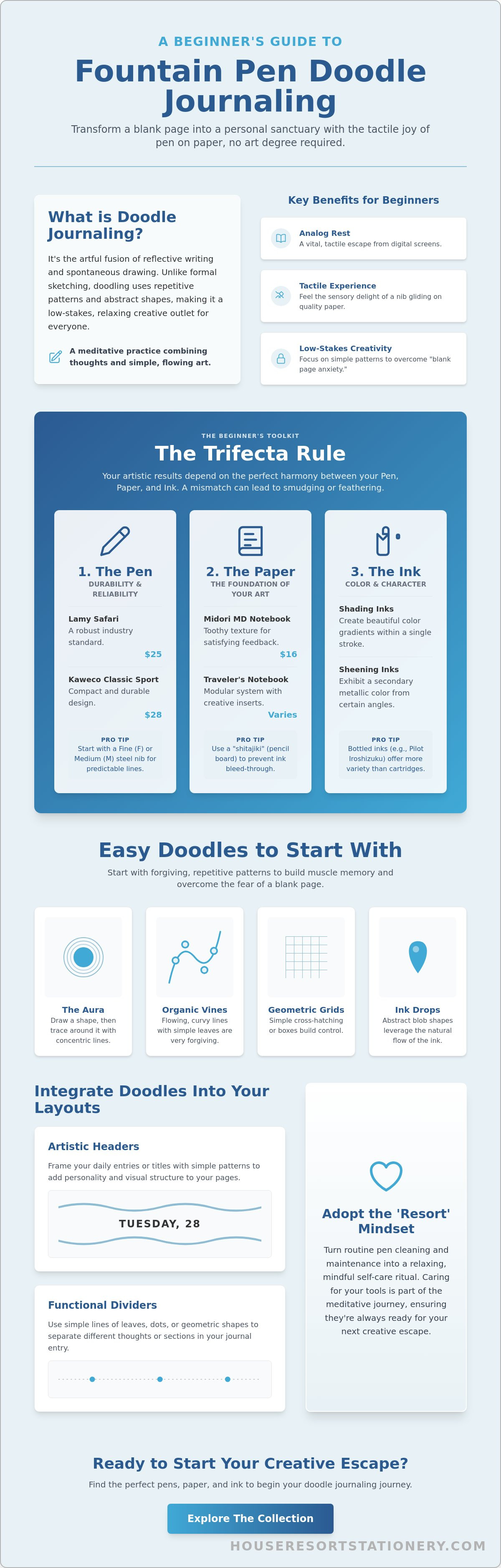
Successful fountain pen doodle journaling for beginners relies on a specific balance known as the Trifecta Rule. This principle states that your artistic results are determined by the interaction between your nib, your ink choice, and your paper selection. If one element is mismatched, you'll face issues like feathering or ink starvation. Choosing the right combination ensures your creative sessions remain a relaxing escape rather than a technical struggle.
Selecting Your First Creative Pen
Durability and reliability are paramount for your first tool. The Kaweco Classic Sport ($28) and Lamy Safari ($25) are industry standards for a reason. These pens feature robust steel nibs that withstand the varied pressure of doodling. Fine (F) or Medium (M) nibs offer the ideal "sweet spot" for patterns; they provide enough ink to show off color without overwhelming the page. For those interested in a fountain pen for planner decoration, these models provide a consistent flow that won't skip during intricate linework. Steel nibs are generally preferred over gold for beginners because they offer a stiffer, more predictable feel during the thinking benefits of doodling.
Premium Paper: The Foundation of Your Art
Low-grade paper causes ink to spread like a watercolor on a napkin. To prevent this, you need "fountain pen friendly" surfaces that resist bleeding. The Midori MD Notebook Journal ($16) is a curated favorite for its unique toothy texture that provides satisfying tactile feedback. For a more modular approach, the traveler's notebook allows you to swap out creative inserts as you fill them. Always use a pencil board, or "shitajiki," beneath your active page to protect the sheets underneath from heavy ink saturation.
Bottled Inks: Adding Color and Character
Bottled inks open a world of visual character that cartridges cannot match. Shading inks create beautiful color gradients within a single stroke. Sheening inks, such as those from the Pilot Iroshizuku line ($25.60), offer stunning metallic highlights as they dry. J. Herbin inks are also excellent, reliable choices for those starting their collection. Keep a sheet of blotting paper nearby to manage wet spots during dense pattern work. 🎁 Explore our curated collection of beginner-friendly inks to find your perfect match.
Easy Drawing Ideas and Patterns for Beginners
The transition from selecting your tools to making the first mark shouldn't feel intimidating. Fountain pen doodle journaling for beginners is unique because the ink itself dictates the style. You aren't just drawing; you're managing fluid dynamics on a microscopic level. One of the most effective ways to start is with 'The Aura' technique. Begin by drawing a simple central shape, like a leaf or a geometric diamond. Then, echo that outline outward with concentric lines, leaving a small gap between each. This repetitive motion showcases the ink's consistency and creates a rhythmic, pulsating effect on the page.
The 'Ink Drop' technique is another beginner-friendly method that utilizes the pen's natural saturation. By slowing your stroke or lingering at the end of a line, you allow a small pool of ink to form. Once dry, these areas appear darker and more saturated, providing instant depth without the need for complex cross-hatching. You can apply this to botanical doodles, such as simple leaf vines, where the base of each leaf is slightly heavier than the tip. Alternatively, try stacking squares or triangles; the overlapping corners will naturally darken, giving your geometric patterns a three-dimensional quality without requiring art school skills.
The 5-Minute Pattern Challenge
If you're feeling stuck, try this structured exercise to build muscle memory. It's a quick way to see how your pen handles different directions and speeds. Use this as a warm-up before you start your daily journal entry.
- Step 1: Draw a series of connected 'S' curves across the width of your page, keeping the lines loose and flowing.
- Step 2: Add small dots or 'seeds' in the interior curves of each line to create an organic, vine-like appearance.
- Step 3: Fill the negative space between the curves with fine hatch marks; this is the perfect way to show off the shading properties of your ink.
Ink-Centric Doodles: Playing with Sheen
To truly exploit the beauty of premium inks, you need to create areas where the liquid can pool. Draw 'puddles' or thick, bold borders around your text to encourage the ink to sheen, revealing those hidden metallic highlights. If you want a softer look, use a water brush to lightly touch the edges of your fountain pen lines. This turns a simple doodle into a soft wash of color, creating a painterly effect. You can even create abstract 'ink swatches' by layering circles of different colors, allowing them to bleed into one another. These swatches act as beautiful, low-stakes art that makes every page of your journal feel like a curated gallery.
Integrating Doodles into Your Journal Layouts
Doodling is often seen as a distraction, but in a well-organized notebook, it serves as a structural tool. Mastering fountain pen doodle journaling for beginners involves moving beyond random sketches and using your nib to create functional layout elements. You can use simple geometric patterns or flowing vines as dividers between your morning reflections and your evening gratitude lists. These visual breaks provide a rhythmic pause for the reader, making the transition between different thoughts feel intentional and polished. It's about creating a sense of order through artistic expression.
Creative headers are another way to elevate your pages without requiring advanced skills. Surrounding your daily titles with simple banners or delicate floral sprays adds a professional touch to even the most basic entries. If you find a page feels too text-heavy, use the 'Corner Cluster' technique. By filling the bottom corner of a page with a cluster of organic shapes or overlapping circles, you balance the visual weight of the written word. This creates a harmonious flow that guides the eye across the paper, turning a simple log into a curated experience.
You can also turn your doodles into interactive elements by creating custom habit trackers. Instead of a standard grid, draw a series of petals or a stack of small squares. Coloring in one element for each day you complete a task turns your progress into a growing piece of art. This transformation of data into a visual garden makes the act of tracking your habits feel like a reward rather than a chore. It's a meticulous way to observe your growth while enjoying the tactile feedback of your favorite pen.
Planner Decoration for the Unartistic
You don't need to be an illustrator to add flair to your daily planner. Small, repetitive icons for the weather, your mood, or specific tasks look sophisticated when drawn with the consistent flow of a fine nib. Using washi tape to frame a specific section creates a 'safe zone' for your doodles, preventing them from overlapping with your essential task lists. Blending precise, professional text with soft, organic textures creates a cohesive and curated look that mirrors a high-end boutique aesthetic. 🎁 Visit our curated selection of journals and planners to find the perfect foundation for your creative layouts.
The 'Daily Scribble' Habit
Set a timer for 2 minutes to engage in stream of consciousness doodling. This practice helps you process complex thoughts when the right words feel out of reach. By building a dedicated 'doodle library' in the back of your notebook, you create a personal reference for patterns that you find particularly relaxing. It's a reliable way to track your creative growth while maintaining the organized feel of your Leather Cover journal. This habit ensures your stationery remains a place of both productivity and mindful retreat.
Caring for Your Tools and Growing Your Hobby
Doodling is significantly more ink-intensive than standard correspondence. When you engage in fountain pen doodle journaling for beginners, your nib spends more time in contact with the paper, often laying down dense patterns or "Ink Drop" pools. This increased flow means you'll empty your converter faster and may notice more pigment buildup within the feed. Frequent use is actually beneficial for your pen's health, but it does require a more proactive approach to maintenance to ensure the ink remains as fluid as your creativity.
We encourage you to adopt a "Resort" mindset regarding your stationery care. Instead of viewing cleaning as a chore, treat it as a relaxing ritual that marks the end of a successful journaling week. This quiet time allows you to appreciate the craftsmanship of your Lamy or Kaweco while preparing your tools for their next session. Meticulous care preserves the integrity of the materials and ensures that your investment lasts for decades. It's a mindful pause that mirrors the calm of the doodling process itself.
Switching between vibrant ink colors is one of the greatest joys of the hobby, but it requires discipline to avoid cross-contamination. If you're moving from a dark, sheening ink to a lighter shading ink, even a tiny residue can muddy the new color. The analog community is a fantastic resource as you grow; with the fountain pen market projected to reach $2.56 billion by 2025, there are more "pen meets" and online enthusiast groups than ever before. Sharing your progress and pattern libraries with others helps turn a solitary hobby into a shared passion.
Basic Pen Maintenance for Doodlers
Flush your pen with room temperature water whenever you change ink colors or if the pen has sat idle for more than a week. Pigment-heavy or shimmering inks can occasionally clog the feed; if you notice a skip in your lines, a gentle soak in water usually clears the obstruction. Always store your pens horizontally. This position keeps the nib moist and ensures immediate ink flow the moment you're ready to start your next doodle. It prevents the ink from settling too deeply in the back of the pen or drying out in the tip.
Your Next Steps in the Stationery World
As your confidence grows, you might explore specialized nib grinds like Stubs or Architects to add unique textures to your drawings. These tools offer different line widths that can make a simple "S" curve look like professional calligraphy. Many collectors choose to curate a dedicated travel kit, pairing their favorite pen with a protective Leather Cover and Brass Sharpeners for a complete analog experience. Ready to start? Shop our curated collection of beginner-friendly fountain pens and journals 🎁
Elevate Your Daily Analog Ritual
Doodling is more than a creative hobby; it's a dedicated retreat into a world of tactile craftsmanship. You've discovered how the Trifecta Rule of nib, ink, and paper creates a seamless experience. By integrating simple patterns like 'The Aura' into your layouts, you turn functional logs into personalized works of art. These small, mindful additions make your journal a place of rest and reflection. Proper maintenance ensures your tools are always ready for the next stroke.
Success in fountain pen doodle journaling for beginners requires the right foundation. As an authorized retailer for heritage brands like Kaweco, Blackwing, and Midori, we've curated the finest tools for your collection. Explore our expert-curated "Gift Ideas" video series for inspiration or specific product deep-dives. We provide reliable national US shipping on all our premium analog goods to help you build your perfect kit.
Discover the perfect fountain pen and journal for your creative journey at HouseResort Stationery 🎁
Your blank pages are an invitation to slow down and create. Pick up your pen, trust the ink, and enjoy the process of making your mark.
Frequently Asked Questions
Will fountain pen ink bleed through my journal pages?
Ink will bleed through if the paper is too porous or thin to handle liquid ink. To prevent this, always select journals labeled as fountain pen friendly, such as those with 120g paper or specialized coatings. These surfaces keep the ink on top of the page, ensuring your doodles stay crisp without ruining the reverse side of the sheet.
What is the best nib size for a beginner who wants to doodle?
A Fine (F) or Medium (M) nib is the most versatile choice for those starting out. Fine nibs allow you to draw intricate details and tight patterns without the ink lines merging together. Medium nibs are excellent if you want to see more of the ink's shading properties, as they lay down a slightly wetter line that fills shapes beautifully.
Do I need special ink for drawing, or can I use standard cartridges?
Standard cartridges are perfectly suitable for fountain pen doodle journaling for beginners. While bottled inks offer a wider range of colors and effects like sheen or shimmer, cartridges from reputable brands provide a reliable and mess-free experience. Just ensure you never use India ink or calligraphy ink, as these will permanently clog your pen's internal feed.
How do I prevent my hand from smudging the ink while I doodle?
The most effective way to prevent smudging is to work across the page in a direction that keeps your hand away from wet ink. If you're right-handed, try doodling from the top-left to the bottom-right. You can also place a piece of blotting paper or a clean plastic sheet under your hand to protect the paper from skin oils and accidental smears.
Can I use a fountain pen on regular printer paper or cheap notebooks?
You can, but the experience is often disappointing because the ink tends to feather and spread. Standard printer paper is highly absorbent, which pulls the ink deep into the fibers and creates fuzzy edges on your drawings. For the best results in your fountain pen doodle journaling for beginners, investing in high-quality paper is just as important as the pen itself.
What happens if I leave ink in my pen for too long without using it?
If a pen sits idle for weeks, the water in the ink evaporates, leaving behind a concentrated residue that can block the flow. You might notice the pen feels scratchy or fails to start when you touch it to the paper. A quick flush with room temperature water is usually enough to clean the feed and get your ink flowing smoothly again.
Is it okay to mix different brands of fountain pen ink?
It's best to avoid mixing different ink brands directly inside your pen. Every manufacturer uses a unique chemical formula, and mixing them can sometimes cause a reaction that forms a thick sludge. If you want to experiment with custom colors, always mix them in a small, separate vial first and let the mixture sit for a day to ensure it remains fluid.
How do I fix a doodle mistake in my journal?
Since fountain pen ink is permanent, the best approach is to incorporate the mistake into a larger pattern. You can turn a stray line into a new leaf or a geometric border, which often adds unexpected character to your layout. If the error is too large to hide, use a high-quality correction tape that matches your paper’s specific cream or white tone.