
Fountain Pen Drawing Ideas: A Curated Guide for Creative Expression in 2026
What if the very nib you fear damaging is actually the key to unlocking a level of line variation that no digital brush can replicate? It's natural to feel a sense of hesitation when bringing a precision instrument like a Pilot Custom 74 to an art journal. You might worry about ink smudging on non-specialized paper or the delicate tip catching on a rough fiber. We understand that for the collector, every stroke is an exercise in intentionality and respect for the craft.
This guide provides a sophisticated roadmap of fountain pen drawing ideas and technical methods curated specifically for the enthusiast who values both heritage and creativity. You'll discover how to master the unique geometry of your nibs to create depth and texture. We also address the practicalities of the artist's kit, from understanding which Iroshizuku inks excel in atmospheric washes to selecting the right paper for your 2026 Jibun Techo planners. By the end of this exploration, you'll have the confidence to transform your collection from a set of writing tools into a versatile studio for expressive art.
Key Takeaways
- Experience the unique tactile feedback of gold and steel nibs that encourages intentional mark-making over digital alternatives.
- Match your artistic style to specific nib types, utilizing Fude nibs for bold urban sketches or flex nibs for organic botanical flourishes.
- Discover sophisticated fountain pen drawing ideas that utilize the unique line qualities of heritage nibs for urban and botanical subjects.
- Master professional ink techniques including hatching, cross-hatching, and stippling to create rich gradients and textures.
- Optimize your drawing setup by selecting specialized Japanese paper and notebooks designed to prevent feathering and ink bleed.
The Renaissance of Analog Art: Why Draw with a Fountain Pen in 2026?
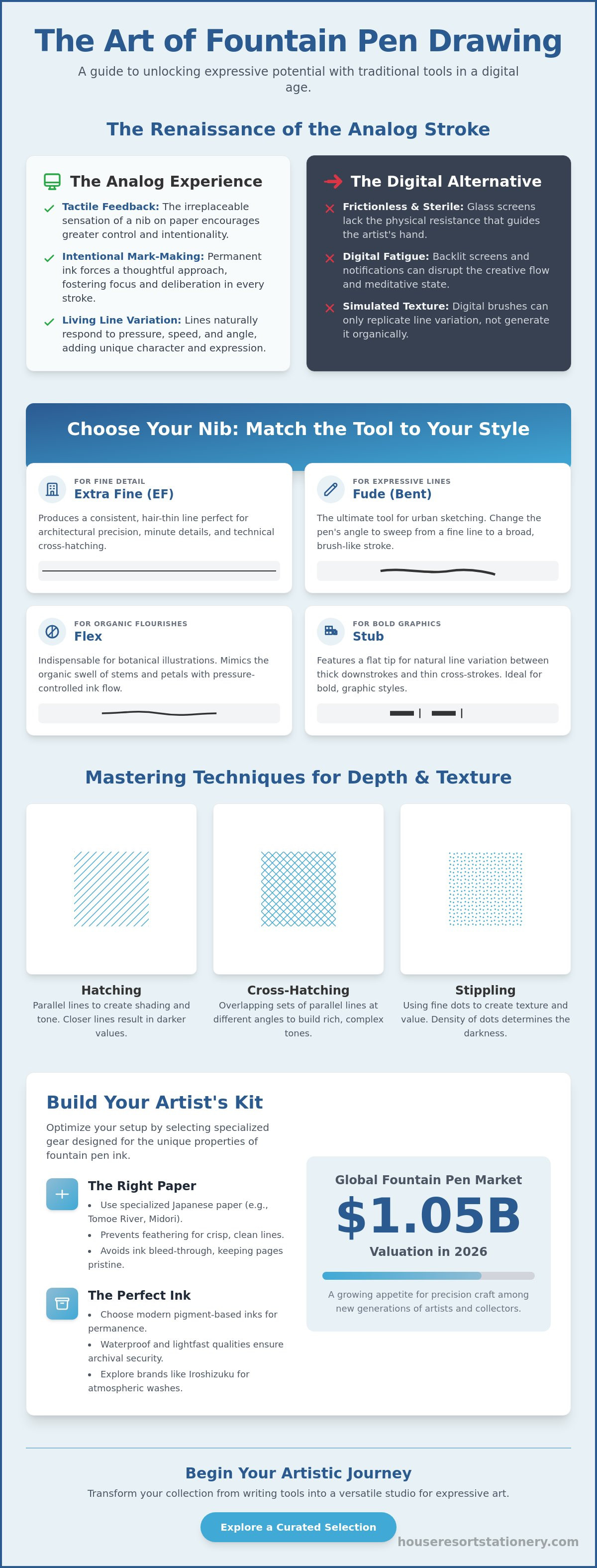
The resurgence of analog media in 2026 is a measured response to digital fatigue. Artists and collectors now prioritize tactile experiences over pixel-perfect convenience. A fountain pen offers a level of intentionality that stylus-based drawing lacks. Every mark is permanent. Every stroke requires a specific pressure. This permanence forces the artist to slow down and consider the composition before the nib touches the surface. With the global fountain pen market valued at $1.05 billion this year, it's clear that the appetite for these precision instruments is growing among younger generations who value craft over mass production.
Understanding the history of the fountain pen reveals a tool designed for endurance and precision. While originally engineered for professional correspondence, its role has expanded into the world of creative journaling and fine art. Modern pigment-based inks provide archival security. These inks are waterproof and lightfast, ensuring that your sketches remain vibrant for decades. Finding new fountain pen drawing ideas starts with recognizing that your writing instrument is also a sophisticated art tool capable of professional-grade results.
The Tactile Connection: Why Analog Still Wins
The sensation of a gold or steel nib gliding across premium Japanese paper is irreplaceable. This physical interaction provides immediate sensory data to the hand. Digital screens are frictionless and sterile. In contrast, the marriage of a well-tuned nib and a textured page creates a unique dialogue. Feedback is the intentional resistance between nib and paper fibers. This resistance allows for greater control over fine details and informs the speed of your stroke.
Engaging with analog tools acts as a psychological palate cleanser. It removes the distractions of notifications and backlighting. When you explore fountain pen drawing ideas, you aren't just creating an image; you're participating in a meditative ritual. The rhythm of the ink flow and the quiet scratching of the nib foster a deep state of creative focus. This tactile escape is essential for maintaining a healthy balance in a hyper-connected world.
Line Variation: The Secret Weapon of the Fountain Pen
Standard ballpoints and gel pens produce a uniform, static line. They lack character. A fountain pen uses a gravity-fed system that creates a living line. This line responds to your speed, the angle of the pen, and the pressure applied. A slight change in hand position can transition a stroke from a whisper-thin hairline to a bold, saturated mark. This range is the foundation of the expressive stroke in fine art.
Collectors often choose nibs based on their specific geometry. Fine nibs offer precision for technical hatching. Broad or stub nibs provide dramatic flair for landscape silhouettes. This inherent versatility makes the fountain pen a superior choice for those looking to move beyond simple sketching. It bridges the gap between the functional world of note-taking and the limitless possibilities of creative expression.
Essential Gear: Matching Your Nib and Ink to Your Artistic Style
Selecting the right instrument is the first step in executing your fountain pen drawing ideas. Unlike the uniform output of a ballpoint, a fountain pen's performance is dictated by its nib geometry. This technical choice transforms the paper into a stage for varied expression. Understanding the history of pen and ink drawing helps artists appreciate how modern tools like fude and flex nibs evolved to meet specific creative needs. It's about finding the marriage between the metal tip and your personal aesthetic.
Choosing Your Nib Geometry
- Extra Fine (EF) Nibs: The Sailor Pro Gear Slim EF is a masterclass in architectural precision. It produces a consistent, hair-thin line perfect for technical cross-hatching and capturing the minute details of urban facades.
- Fude Nibs: These bent nibs are the ultimate tool for urban sketching. By changing the angle of the pen, you can sweep from a broad brush-like stroke to a fine detail line in a single movement.
- Flex Nibs: For botanical illustrations, a flex nib is indispensable. It allows you to mimic the organic swells of petals and stems through pressure-controlled ink flow, achieving copperplate-style flourishes.
- Stub Nibs: Use these for bold, graphic illustrations. Their flat tips create natural line variation that adds a "poster-style" weight to your compositions.
Heavy sketching sessions require a reliable reservoir. The TWSBI Eco is a favorite for this reason. Its piston-filling mechanism holds a significant volume of ink, ensuring your creative flow isn't interrupted by frequent refills. If you're looking to upgrade your current kit, you can explore our curated selection of professional-grade pens and find a tool that resonates with your hand.
Ink Properties for Artists
Your choice of ink is just as critical as the nib. Artists must decide between waterproof pigment inks and water-soluble dye-based inks. Pigment inks are essential if you plan to layer watercolor washes over your line work. They bond permanently with the paper fibers once dry. Conversely, water-soluble inks allow for ink washing. This technique involves using a wet brush to pull color from the lines to create soft, atmospheric gradients and shadows.
Beyond permanence, look for "shading" and "sheen" to elevate your work. Shading occurs when ink pools in certain areas of a stroke, creating a beautiful gradient of color within a single line. Many connoisseurs consider pilot iroshizuku bottled ink the gold standard for this effect. It flows reliably through even the finest nibs while offering a sophisticated palette inspired by Japanese nature. Sheen is a metallic luster that appears on the surface of high-saturation inks when they dry on non-absorbent paper. These properties add a secondary layer of depth to your fountain pen drawing ideas, making each piece feel like a unique artifact.
Curated Fountain Pen Drawing Ideas for Every Skill Level
Generating fresh fountain pen drawing ideas requires a shift in perspective. You aren't just choosing a subject; you're selecting a partner for your nib's specific geometry. The goal is to find themes that celebrate the liquid nature of ink and the precision of the metal tip. Whether you're a seasoned collector or a new enthusiast, focusing on subjects that highlight line variation and ink saturation will yield the most rewarding results. Transitioning from writing to drawing is a natural evolution for any connoisseur of fine stationery.
Urban Sketching and Architectural Studies
Capturing the geometry of the built environment is a classic exercise in perspective. A Fude nib is the superior choice here. It allows you to switch between the fine lines of a window pane and the broad, sweeping shadows of an alleyway by simply adjusting your hand angle. Focus on a single vanishing point to ground your composition. To sketch a simple storefront, follow these steps:
- Define the primary rectangular frame of the building using light, quick strokes.
- Establish your vanishing point to align the tops of doors and windows.
- Use the flat side of the nib to block in deep shadows under awnings or inside doorways.
- Add fine details like brickwork or signage using the tip of the nib for high-contrast clarity.
Botanical Illustrations and Organic Textures
Botanical studies allow you to explore organic fragility through varied line weights. This is where you can apply fountain pen doodle journaling for beginners techniques to create intricate leaf and flower patterns. Use a "broken line" technique. By lifting the nib slightly and leaving small gaps in your outlines, you suggest light hitting the delicate surface of a petal. This prevents the drawing from looking too heavy or "coloring book" style. Vary your pressure to capture the rugged texture of wood grain or the cool smoothness of stone. These subtle shifts in ink delivery create a sense of three-dimensional life on the page.
Abstract Doodling and Zentangle Patterns
If you prefer a more meditative approach, abstract patterns offer a way to test the limits of your ink's saturation. Repetitive motion fosters a deep state of creative focus. You can explore "ink blossoms" by lingering with the nib on the paper for a second longer than usual. This allows the ink to pool and spread naturally into the fibers, creating soft, organic spots. This method is particularly effective with shading inks that reveal different colors as they dry. Combine multiple ink colors in non-representational art to see how different formulas interact. It's a low-stakes way to enjoy your collection while producing vibrant, complex visuals.
Mastering Fountain Pen Techniques for Depth and Texture
Technique is the bridge between a premium tool and a finished masterpiece. While the previous sections focused on selecting the right nib and ink, your mechanical execution determines the final mood of your work. Mastering these methods allows you to move beyond simple outlines and explore complex fountain pen drawing ideas that rival traditional etchings. It's about understanding how to manipulate fluid ink to suggest three-dimensional form. These techniques require patience, but they reward the artist with a level of detail that digital tools often struggle to replicate.
Hatching and Cross-Hatching: Building Values
Hatching is the most direct way to build value and shadow with a fountain pen. Success depends on the consistency of your line spacing. If your lines are uneven, the shadow will look cluttered rather than intentional. Professional results often come from following the contour of the object. If you're drawing a sphere, your hatching lines should curve slightly to mimic the surface. This creates a sense of volume that straight lines cannot achieve. Cross-hatching with a fountain pen creates a unique "etched" aesthetic. By layering sets of parallel lines at different angles, you can create deep, rich blacks while maintaining a sense of airiness within the composition.
For those seeking even more precision, consider reverse nib drawing. By turning your pen over and writing with the back of the nib, you can achieve an ultra-fine hairline. This is perfect for the final highlights or the most delicate textures in a technical drawing. It effectively gives you two nib sizes in one instrument, allowing for a broader range of fountain pen drawing ideas without switching pens mid-session.
The Ink Wash Technique
Many artists overlook the painterly potential of water-soluble inks. The "line and wash" method involves creating your initial drawing with a dye-based ink and then activating it with a wet brush. This pulls the pigment from the lines to create soft, atmospheric shadows. It's a sophisticated way to add depth to urban sketches or botanical studies without introducing a secondary medium like watercolor. The result is a monochromatic piece with a cohesive, professional finish.
When selecting inks for this technique, look for those with high chromatography. Some inks are composed of multiple dye colors that separate when they touch water. A seemingly black ink might reveal hidden undertones of purple, blue, or green during a wash. This multi-tonal effect adds an unexpected layer of complexity to your art. It turns a simple sketch into an exploration of color theory and fluid dynamics. Ready to experiment with these advanced methods? Shop our collection of artist-grade fountain pens and inks to find the perfect tools for your next project.
Finally, don't ignore stippling for creating the softest gradients. By applying thousands of tiny ink dots, you can build up value with extreme control. It's a high-effort technique that yields a stippled, vintage look. While time-consuming, it's an excellent way to practice hand-eye coordination and appreciate the precise ink delivery of a well-maintained nib.
Building Your Drawing Setup with HouseResort Stationery
Your artistic output is only as refined as the ecosystem supporting it. While we have explored various fountain pen drawing ideas and technical methods, the final variable in the equation is your stationery setup. A master-grade nib cannot perform its best on standard office paper. It requires a surface designed to handle the specific chemistry of liquid ink. Building a professional kit is about more than just aesthetics; it's about ensuring your tools don't fight against your creative intent. The right combination of paper and pen transforms a simple sketch into a permanent artifact.
Selecting the Right Paper for Ink Layering
Selecting the correct paper is easily 50% of the drawing experience. If you use paper that is too absorbent, you will experience feathering. This is where the ink wicks into the fibers and destroys your fine lines. For those following our Japanese stationery online store guide, the preference for Tomoe River or Midori MD paper is clear. The 52gsm Tomoe River paper is particularly essential for artists using shading inks. Its coated surface allows the ink to sit on top and dry slowly. This preserves the vibrant sheen and tonal gradients discussed in earlier sections. Uncoated papers may offer faster drying times, but they often sacrifice the complex ink properties that make fountain pen art so unique.
Curating Your Professional Artist Toolkit
A curated professional toolkit allows you to take your studio anywhere. Pairing a traveler's notebook with a solid brass pencil case creates a modular, durable system for urban sketching. We recommend carrying at least two pens. Use one with an Extra Fine nib for technical details and another with a Fude or Stub nib for broad washes. This dual-pen approach allows you to execute complex compositions without the need for constant cleaning or ink swapping while you're in the field. The tactile nature of these tools, from the leather of the notebook to the weight of the brass, enhances the analog ritual of your practice.
Maintenance is the final pillar of a successful setup. Drawing with fountain pens often involves using high-saturation or pigment-based inks, which can lead to clogs if the pen is left idle. Develop a routine of flushing your pens every two to three weeks with cool water. This simple habit protects your investment and ensures that your ink flow remains consistent. A well-maintained pen is a reliable partner for your most ambitious fountain pen drawing ideas. By choosing heritage tools and specialized materials, you elevate your creative process to a professional standard. We invite you to explore the HouseResort Stationery curated collection to find the specific journals, pens, and inks that will define your collection in 2026.
Elevating Your Creative Journey in 2026
The transition from a writing enthusiast to an ink artist is a path of discovery and technical refinement. You've learned that the secret to professional results lies in the synergy between your nib's geometry and the specialized surface of Japanese paper. By mastering techniques like cross-hatching and atmospheric ink washes, you can transform simple outlines into complex works of art. These fountain pen drawing ideas serve as a foundation for a lifelong practice of intentional, analog mark-making.
At HouseResort Stationery, we believe that the right tools are essential for this creative evolution. As an authorized retailer of heritage brands, we provide a selection that is carefully curated by analog enthusiasts for collectors who value tradition and quality. Whether you are building a modular travel kit or a dedicated home studio, we offer national shipping on all premium stationery to ensure your collection is always ready for your next stroke.
Explore our curated collection of fine fountain pens and artist-grade journals today. Your collection is more than a set of tools; it's an invitation to explore the limitless potential of the page. We look forward to seeing the unique masterpieces you create.
Frequently Asked Questions
Is it safe to draw with an expensive fountain pen?
Yes, it's perfectly safe to draw with a premium instrument as long as you use fountain-pen-friendly inks. These tools are precision-engineered for contact with paper and can handle the varied strokes required for art. Using a heritage gold nib for sketching is a common practice among connoisseurs who appreciate the unique tactile feedback that only a high-end tool provides.
What is the best nib size for a beginner drawing with fountain pens?
A Fine (F) or Medium (M) nib is the most versatile starting point for a beginner. These sizes offer a reliable balance between intricate detail and consistent ink flow. As you become more comfortable with the medium, you can explore specialized geometries like Fude or Flex nibs to expand your repertoire of fountain pen drawing ideas and line variations.
Can I use watercolor over my fountain pen drawings?
You can use watercolor over your drawings if you select a waterproof pigment-based ink. Dye-based inks are water-soluble and will smear when they touch a wet brush. It's essential to let the ink dry completely, usually for 24 hours, before applying a wash to ensure your lines remain crisp and professional.
How do I prevent my fountain pen ink from smudging while I draw?
Preventing smudges requires a combination of quick-drying ink and mindful hand positioning. Many artists use a "bridge" or a small piece of scrap paper under their hand to protect the work surface from natural oils and wet ink. Choosing a coated paper also helps the ink dry on the surface without feathering, though it requires a few extra seconds of patience.
What are the best drawing ideas for someone who can’t draw well?
Abstract patterns and repetitive doodling are excellent fountain pen drawing ideas for those still developing their skills. Focus on simple geometric shapes or Zentangle-inspired patterns that prioritize the rhythm of the stroke over representational accuracy. This approach lets you enjoy the tactile feedback of your pen and the beauty of the ink without the pressure of realism.
Do I need special paper for fountain pen sketching?
Yes, specialized paper is a requirement to prevent feathering and bleed-through. Standard office paper is too porous and will cause your ink to spread uncontrollably into the fibers. Premium Japanese papers, such as Tomoe River or Midori MD, are engineered to handle the liquid nature of fountain pen ink while preserving its specific color and sheen.
How often should I clean my pen if I use it for drawing every day?
Clean your pen every two to three weeks if it's in daily use, particularly with pigment-based inks. Drawing often involves slower strokes and heavier ink delivery than writing, which can lead to faster buildup in the feed. Regular maintenance with cool water ensures a consistent flow and protects the internal components of your precision instrument.
Can I use India ink in my fountain pen for drawing?
No, you should never use India ink or calligraphic dip pen ink in a fountain pen. These formulas contain shellac or binders that will harden inside the feed and permanently clog the internal mechanics. Stick to artist-grade inks specifically labeled for fountain pen use to ensure the longevity and performance of your collection.