
Fountain Pen Nib Sizes Explained: The Ultimate Guide to Finding Your Signature Line
Why does a "Fine" nib from a Japanese maker like Pilot feel like a needle, while a European "Fine" from Lamy writes like a bold marker? Having fountain pen nib sizes explained is often the missing link between a frustrating writing experience and a truly signature line. You've likely felt the disappointment of a premium pen feathering on your favorite paper or making your handwriting look cramped and messy. It’s a common hurdle for enthusiasts who expect consistency across different heritage brands.
We believe that choosing a writing instrument is a tactile, personal decision that requires technical precision. This guide will help you master the nuances of nib widths so you can select the perfect tool for your handwriting style and journal preferences. We'll provide a clear framework for matching nibs to your unique pressure and paper choices. By the end, you'll have the confidence to invest in your next heirloom pen with total clarity and professional insight.
Key Takeaways
- Understand how the nib functions as the heart of your writing instrument by balancing capillary ink flow with tactile feedback.
- Gain clarity with fountain pen nib sizes explained across a spectrum from Extra-Fine precision to the bold character of Broad tips.
- Master the use of specialty Stub and Italic nibs to achieve effortless line variation and visual flair without changing your natural grip.
- Apply a simple measurement technique for your handwriting's "x-height" to ensure your script remains legible and never looks cramped.
- Learn why selecting specific heritage manufacturers is the most reliable way to ensure nib consistency in your growing collection.
Understanding the Fountain Pen Nib: The Soul of Your Writing
The nib is the defining element of any fine writing instrument. It is more than just a piece of shaped metal; it is the point of contact where your thoughts meet the page. This metal tip delivers ink through capillary action, a physical process where liquid flows through narrow spaces without the assistance of external forces. When you have fountain pen nib sizes explained through the lens of craftsmanship, you realize the nib dictates both the tactile feedback you feel and the visual character of your script. A well-tuned nib offers a specific "tooth" or smoothness that defines your relationship with the paper.
Most modern nibs feature a small ball of hard-wearing tipping material welded to the end. This is usually a specialized alloy of platinum group metals designed to resist the friction of constant writing. This material ensures your pen lasts for decades rather than wearing down after a few months of use. Beneath the nib sits the feed, a critical component that regulates the air and ink exchange. A professional-grade feed must support the specific demands of different nib sizes to prevent ink starvation or "railroading," especially when using broader tips that require a higher volume of ink.
The Anatomy of a Nib
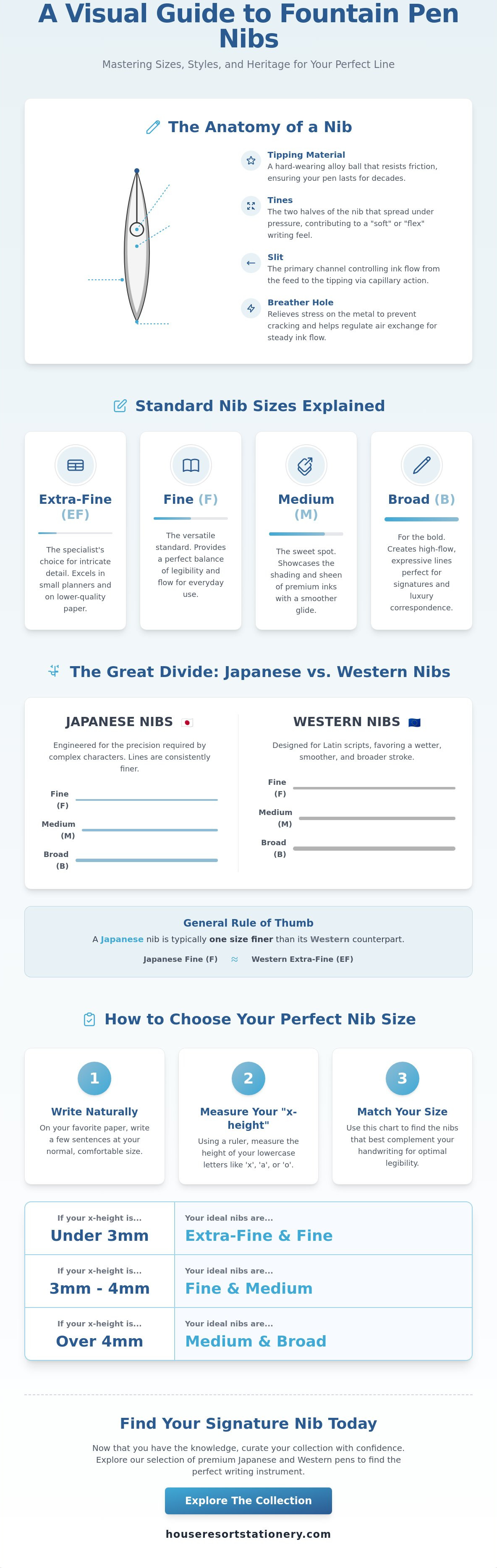
To appreciate the Anatomy of a Fountain Pen Nib, you must look at the fine details. The slit acts as the primary channel, controlling how much ink reaches the tipping. The tines are the two halves of the nib that spread slightly under pressure; they contribute to the "flex" or softness of your writing experience. Finally, the breather hole serves a functional purpose by relieving stress on the metal. It prevents cracks from forming over years of use and helps the feed maintain a steady flow of air to the reservoir.
Why Nib Size Matters for the Analog Enthusiast
Choosing the right size is a practical necessity for comfort. A nib that's too broad for your natural handwriting can make your letters look like illegible blobs. Conversely, a nib that's too fine might feel "scratchy" if you have a heavy hand. Finding your match reduces hand fatigue during long journaling sessions. When you explore fountain pen nib sizes explained in detail, you see how line width impacts ink properties like shading and sheen. Broader nibs lay down more liquid, which allows you to see the complex color variations of premium inks. As a boutique curator, I look for pens where the nib and feed work in perfect harmony to provide a consistent, reliable line every time you touch paper.
Standard Nib Sizes Explained: From Extra-Fine to Broad
Selecting a nib is an exercise in curation. Each size offers a distinct emotional "vibe" that changes how you interact with your paper. Having fountain pen nib sizes explained through a curator's lens reveals four primary categories that define the modern writing experience. These standards help you match the tool to the specific task, whether it's rapid note-taking or formal correspondence.
- Extra-Fine (EF): This is the specialist's choice for intricate detail. It excels in small planners or when writing on lower-quality paper where ink spread is a concern.
- Fine (F): Most enthusiasts consider this the versatile standard. It provides a balance of legibility and ink flow, making it ideal for everyday use.
- Medium (M): Often called the sweet spot, the Medium nib begins to showcase the true properties of your ink. You'll notice better shading and sheen here while enjoying a smoother glide across the page.
- Broad (B): This is for the bold. It creates high-flow, expressive lines perfect for signatures or luxury correspondence.
The Great Divide: Japanese vs. Western Sizing
One of the most confusing aspects of this hobby is the regional difference in manufacturing. A Japanese Fine nib, produced by heritage brands like Pilot or Sailor, is significantly thinner than a Western Fine from a maker like Lamy. This stems from cultural requirements. Japanese characters require immense precision in small spaces; Western scripts, rooted in Latin characters, favor a wetter, broader stroke. You can explore the technical mastery behind these tools in our Japanese Stationery Online Store Guide. Historical records at The Pen Museum show that these regional standards evolved to meet the specific needs of local calligraphers and clerks over centuries.
Material Differences: Stainless Steel vs. Gold Nibs
The material of your nib also influences how the size feels. Stainless steel nibs are often called "nails" because they are rigid and consistent. They provide a predictable line width, which is excellent for beginners who are still mastering their writing pressure. Gold nibs, typically 14k or 18k, offer a natural "spring" or cushion. This flexibility can slightly increase the perceived width of your line as the tines spread under natural writing pressure. When looking at fountain pen nib sizes explained for collectors, the material is just as important as the tip's width. If you're ready to find your next daily driver, browse our curated collection of fine fountain pens to see these nibs in action.
Specialty Nibs: Adding Character to Your Script
Once you've had standard fountain pen nib sizes explained, the next step in your curation journey involves specialty grinds. These nibs move beyond simple utility to offer a bespoke writing experience. They allow you to manipulate the visual weight of your script without changing your natural grip. For the enthusiast, these tools transform a simple journal entry into a curated piece of analog art. These specialized tips are designed for specific aesthetic outcomes, ranging from the structured lines of a draftsperson to the flowing flourishes of a calligrapher.
- Stub Nibs: These feature a flat tip with rounded corners. They provide natural line variation where vertical strokes are wider than horizontal ones. Unlike sharp italics, stubs are smooth enough for rapid, daily note-taking.
- Italic Nibs: Similar to stubs but with much sharper edges. They offer maximum crispness and high contrast, though they require a disciplined hand to avoid catching the paper fibers.
- Flex Nibs: These nibs use soft, responsive tines that spread under pressure. This allows you to control line weight dynamically as you write, making them the ultimate tool for traditional flourishing.
- Architect Nibs: A niche choice that provides the reverse effect of a stub. You get thin downstrokes and wide cross-strokes, which is ideal for block lettering and architectural notation.
The Rise of the Pocket Pen Nib
The evolution of the pocket pen has changed how we view nib versatility. Compact designs require a nib that performs reliably across various paper types without skipping or leaking during transit. The Kaweco Classic Sport is a masterclass in this category. It offers a range of interchangeable nibs that make it a favorite for collectors who value portability. When you're choosing a nib for a pocket-sized EDC pen, a Medium is often the safest bet. It provides enough ink flow to feel luxurious but remains controlled enough for quick notes on the go.
Flex Nibs for Modern Journaling
Modern journaling has seen a resurgence in flex writing as a mindful practice. It turns every header or date entry into a focal point. You can use line variation to highlight important sections or create decorative borders in your planner. However, you'll need to master the learning curve. You must control your downward pressure to avoid railroading. This occurs when the tines spread too far for the feed to maintain a consistent ink bridge. Integrating these techniques into Fountain Pen Doodle Journaling adds a layer of sophisticated flair to your creative sessions. These specialty options ensure that having fountain pen nib sizes explained leads you toward a truly personalized signature style.
How to Choose Your Perfect Nib Size: A Practical Framework
Selecting the right nib isn't a static decision based solely on a manufacturer's label. It's a dynamic choice influenced by how you hold the pen and the surfaces you choose to write on. Having fountain pen nib sizes explained through a practical framework allows you to move past guesswork and into a curated writing experience. To find your signature line, you must evaluate four distinct variables that dictate how ink meets paper.
- Step 1: Analyze your x-height. Measure the height of your typical lowercase "x". If your script is under 2mm, a Japanese Fine or Extra-Fine is necessary to keep your loops from closing.
- Step 2: Evaluate your pressure. Heavy-handed writers naturally spread the nib tines, which creates a wider line. If you have a firm grip, consider sizing down to compensate for this natural spread.
- Step 3: Audit your paper. Absorbent papers pull more ink from the feed, making a Fine nib write like a Medium. Ink-resistant papers do the opposite, keeping lines crisp and true to size.
- Step 4: Balance your ink. Wet, lubricated inks require a finer nib on standard paper to prevent feathering, while "dry" inks can make a Fine nib feel scratchy.
Matching Nib to Handwriting Style
Your natural script should dictate your tool. Small, cramped handwriting benefits most from the precision of a Japanese EF or Fine nib. These sizes ensure that the counters of your letters stay open and legible. If you have a large, loopy script, a Medium or Broad nib is the better choice. These broader tips allow the ink to keep pace with your hand speed without feeling "tight" or restrictive. For those who take rapid notes during meetings, a Fine nib paired with a dry ink is a reliable combo that prevents smudging as you turn the page. This systematic approach ensures fountain pen nib sizes explained in this guide translate directly to your daily productivity.
The Paper Factor: Why Your Notebook Changes Everything
Paper changes the equation entirely. A Medium nib that glides like silk on a coated surface might feather and bleed on standard office copy paper. This is why pairing your nib with the right Traveler’s Notebook inserts is essential for a consistent experience. High-quality, ink-resistant paper makes a nib feel slightly narrower and more controlled because the ink sits on the surface rather than soaking in. This allows you to see the true character of the nib's grind. If you're ready to test these variables for yourself, explore our curated selection of journals and planners designed to handle every nib size with grace.
Curating Your Collection: Finding Your Signature Nib at HouseResort Stationery
Building a collection is an act of intentionality. At HouseResort Stationery, we prioritize heritage manufacturers that maintain strict tolerances for nib consistency. Having fountain pen nib sizes explained is the first step toward mastery; the second is experiencing the physical difference between a German steel nib and a Japanese gold one. We act as your boutique curator, filtering through the global market to present only the most reliable instruments. As an authorized retailer, we ensure every pen in our catalog meets the high standards expected by enthusiasts and collectors. This commitment to quality ensures that your investment provides a lifetime of tactile pleasure without the variability often found in mass-market alternatives.
Iconic Starter Nibs for Beginners
The "Starter Trio" represents the foundation of many successful collections. The Lamy Safari is a perennial favorite because of its interchangeable nib system. You can swap an Extra-Fine for a Broad in seconds. This allows you to experiment with different line widths without purchasing a new pen body. The TWSBI Eco offers a massive ink capacity and a piston-filling mechanism usually found in luxury models. Its Medium nib is particularly smooth, making it a joy for long writing sessions in your favorite journals. For those who need portability, the Kaweco Sport provides a reliable experience in a pocket-sized form factor. Starting with a Western Fine is generally the safest entry point for new users. It offers enough line width for legibility while remaining controlled on standard paper types.
Precision Craftsmanship: The Japanese Masters
When you are ready to move beyond entry-level tools, the Japanese masters offer unparalleled precision. The Sailor Pro Gear is famous for its 21k gold nibs, which provide a unique, "pencil-like" feedback. This tactile sensation is highly sought after by writers who want to feel the paper beneath them. Pilot's Custom series represents the gold standard for smoothness. Regardless of whether you choose an EF or a B, Pilot nibs glide across the page with minimal resistance. Having fountain pen nib sizes explained through these specific brands helps you navigate premium tiers with confidence. HouseResort Stationery helps you filter these choices based on your specific handwriting and paper preferences to ensure a perfect match for your collection.
Our status as an authorized retailer means you receive a genuine product backed by full manufacturer support. We understand the aesthetic and functional value of every pen we sell. Whether you are looking for your first Lamy or a limited-edition Sailor, our catalog is organized to make your discovery process effortless. We invite you to explore our selection of fine fountain pens, notebooks, and planners to find the tool that speaks to your personal style. We offer national shipping across the United States to ensure your next favorite pen arrives safely at your door. Your signature line is waiting to be discovered.
Refine Your Daily Writing Experience
Mastering the nuances of your writing tools turns a simple task into a mindful ritual. Having fountain pen nib sizes explained gives you the technical foundation to match your pen to your specific handwriting style and choice of paper. Whether you prefer the needle-point precision of a Japanese Extra-Fine or the expressive flow of a Western Broad, the right nib ensures your thoughts glide across the page without friction. Remember to account for your writing pressure and the absorbency of your journals to maintain that perfect, crisp line.
HouseResort Stationery is your destination for high-quality analog tools. As an authorized retailer for heritage brands like Lamy, Kaweco, Sailor, and TWSBI, we offer a carefully curated selection for enthusiasts who value craftsmanship. We provide national shipping across the United States, bringing the boutique experience directly to your door. Explore our curated collection of fine fountain pens and find your perfect nib size today. Your handwriting is a unique signature; give it the precision it deserves.
Frequently Asked Questions
What is the most popular fountain pen nib size for beginners?
A Medium or Fine nib is the most popular choice for those new to the hobby. A Medium nib offers a smooth, reliable writing experience that works well with standard office paper. If you have smaller handwriting or use a planner with tight grids, a Fine nib provides better legibility. Both sizes are standard offerings from heritage brands like Lamy and TWSBI that we curate for their consistency.
Are Japanese nib sizes really smaller than Western ones?
Japanese nib sizes are consistently finer than their Western counterparts due to cultural writing requirements. A Japanese Fine nib from Pilot or Sailor typically writes like a Western Extra-Fine from brands like Lamy or Pelikan. This difference exists because Japanese kanji characters require more precision in small spaces than the Latin alphabet. Always check the manufacturer's origin before committing to a specific size to ensure it matches your expectations.
Can I change the nib on my fountain pen if I don’t like the size?
Many fountain pens allow you to swap the nib unit if you're unhappy with the line width. Brands like Lamy are famous for their interchangeable nib systems that slide off the feed easily. However, some luxury pens or specific vintage models have fixed nibs that require professional adjustment. It's best to check if your specific pen model supports user-replaceable nib units before you attempt a swap.
Which nib size is best for left-handed writers to avoid smudging?
Left-handed writers often find that Extra-Fine or Fine nibs are the best options for avoiding smudges. These smaller sizes lay down less ink, which allows the script to dry much faster on the page. When you have fountain pen nib sizes explained for southpaws, the focus is always on controlling ink volume. Pair these finer nibs with a "dry" ink and ink-resistant paper to further reduce the risk of your hand dragging through wet lines.
Do broad nibs use more ink than extra-fine nibs?
Broad nibs consume significantly more ink than Extra-Fine nibs because they have a wider slit and larger tipping surface. This higher flow is necessary to create those bold, expressive lines and to showcase the shading properties of premium inks. If you choose a Broad nib, you'll notice your ink reservoir depletes faster. You'll likely need to refill your pen more frequently during heavy writing or journaling sessions.
What nib size should I use for a bullet journal?
A Fine nib is usually the ideal choice for a bullet journal. Most dot-grid notebooks feature 5mm spacing, which requires a precise line to keep your tasks and logs legible. If you enjoy decorating your spreads or using larger headers, a Medium nib offers a nice balance between utility and visual flair. This systematic approach ensures your layouts stay organized and visually clean throughout the year.
Does the nib material affect the actual line width?
The material itself doesn't change the physical width of the tipping, but gold nibs often feel broader in practice. Gold is softer than steel and offers more "spring," which causes the tines to spread slightly under natural writing pressure. This creates a wetter, wider line compared to a rigid steel nib of the same labeled size. This is a subtle nuance often discussed when having fountain pen nib sizes explained for collectors.
How do I know if my nib is "scratchy" or just has "feedback"?
Feedback is a purposeful tactile sensation, while a scratchy nib is a sign of a mechanical misalignment. Feedback feels like writing with a high-quality pencil; it's a controlled resistance that helps you feel the paper. A scratchy nib actually catches or tears the paper fibers, which is often caused by tines that aren't perfectly level. If your pen skips or feels like it's digging into the page, it likely needs a professional tuning.