
Fountain Pen vs. Ballpoint vs. Rollerball: The Definitive Writing Guide
What if the hand fatigue you feel after a long journaling session isn't a sign of a busy day, but a symptom of using the wrong tool for your grip? Most writers settle for whatever is closest at hand. They often struggle with ink feathering on premium paper or the frustrating drag of a dry refill. We agree that a pen is more than a utility; it's a tactile connection to your thoughts. To master that connection, you must understand the nuances of the fountain pen vs ballpoint vs rollerball.
This guide promises to demystify the technical differences between these three modes so you can find your perfect instrument. You'll learn how oil-based ballpoint inks differ from the liquid, water-based flow of a fountain pen or rollerball. We'll provide a clear decision framework for your next purchase and show you how to match specific nibs to the journals in your collection. By the end, you'll have the confidence to choose a tool that respects both your hand and your paper.
Key Takeaways
- Learn the fundamental differences in ink chemistry and delivery systems that define the fountain pen vs ballpoint vs rollerball experience.
- Discover how to minimize hand fatigue by matching your writing pressure to the specific "drag" or "glide" of different pen mechanisms.
- Understand the critical synergy between ink viscosity and paper quality to prevent feathering and ensure a crisp line in your favorite journals.
- Establish a clear decision framework for choosing between everyday reliability and sophisticated aesthetic expression for your next instrument purchase.
- Gain professional insights into curating a high-quality collection from authorized heritage manufacturers.
The Three Pillars of Analog Writing: Mechanism and Ink Chemistry
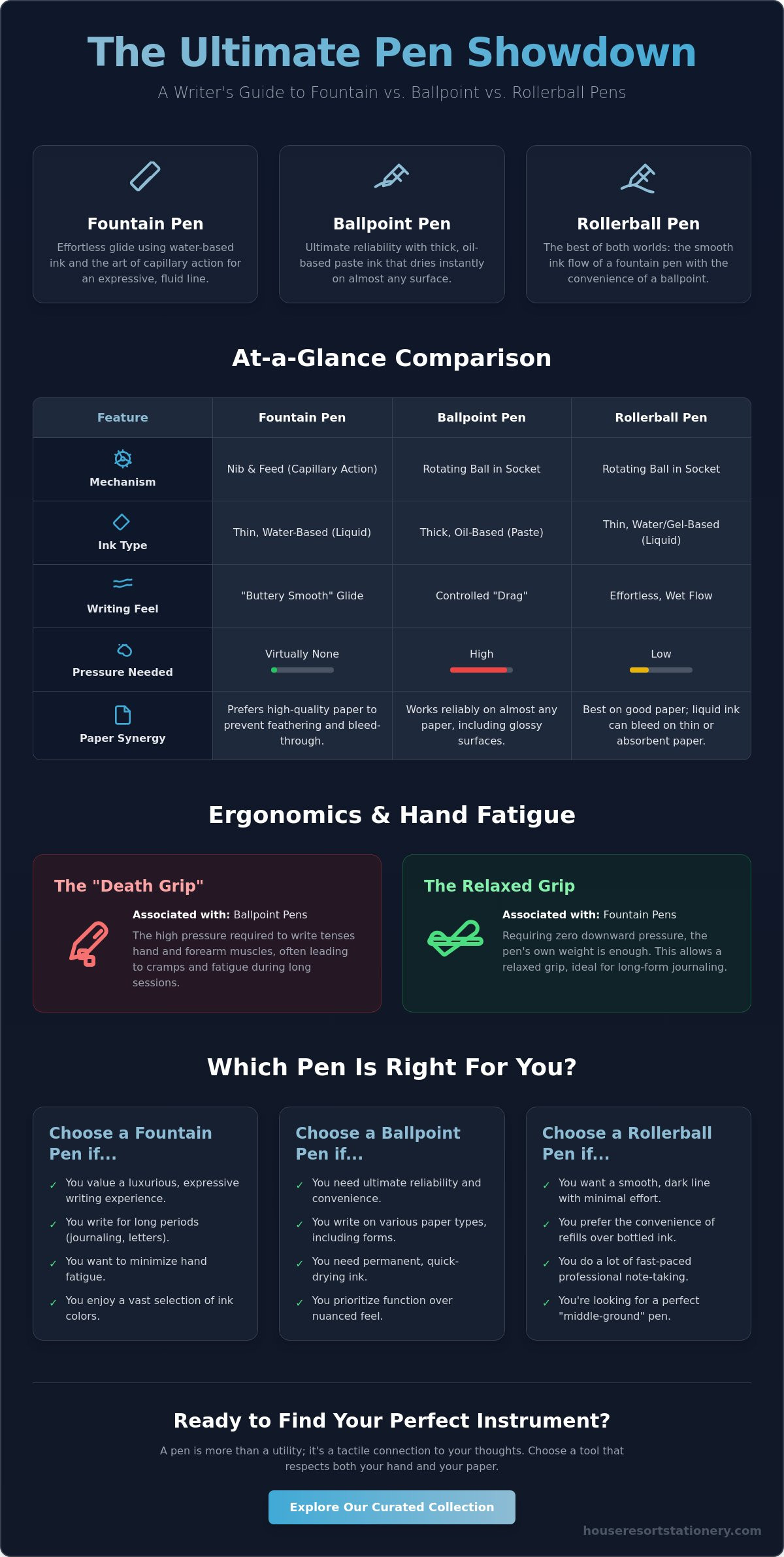
The fundamental difference between these tools lies in the physics of how ink meets the page. While they all serve the same purpose, their internal delivery systems vary wildly. Understanding the fountain pen vs ballpoint vs rollerball dynamic begins with ink viscosity. Viscosity dictates the "feel" of the stroke. A thick, oil-based ink requires pressure to transfer. A thin, water-based ink flows almost effortlessly. This choice isn't just about aesthetics; it's a decision about how much work you want your hand to perform during a writing session.
The History of the Pen reveals a steady progression toward convenience and reliability. Early writers moved from quills to steel nibs, eventually developing the internal reservoirs we see today. Each innovation solved a specific problem, whether it was the mess of an open inkwell or the slow drying time of liquid ink. Today, we categorize these solutions into three primary modes, each offering a distinct tactile signature based on how it manages the flow of fluid.
Fountain Pens: The Art of Capillary Action
A fountain pen is a sophisticated system of three parts: the nib, the feed, and the reservoir. It doesn't rely on gravity alone. Instead, it uses capillary action. This is the same physical force that draws water up through the roots of a plant. The feed, usually made of ebonite or plastic, features tiny channels that regulate the flow. This ensures the nib stays wet without dripping. Because the ink is water-based, it creates a low-friction experience. The nib glides. It requires almost zero downward pressure. This reduces hand fatigue during long sessions in your journals. Enthusiasts often choose their filling system based on ritual and capacity. Options include convenient cartridges, versatile converters, or high-capacity piston fillers.
Ballpoints and Rollerballs: The Mechanics of the Sphere
Ballpoints and rollerballs share a common ancestor: the rotating ball. A tiny sphere, usually made of tungsten carbide, sits in a socket at the tip. As you write, the ball rolls, picking up ink from the reservoir and depositing it on the paper. The difference is the chemistry. Ballpoints use a thick, oil-based paste. This ink dries instantly and works on almost any surface, but it requires significant pressure to rotate the ball. Rollerballs bridge the gap. They use the same ball mechanism but swap the paste for liquid, water-based ink or gel. This provides the smooth, "wet" feel of a fountain pen with the rugged convenience of a disposable refill. It's the perfect middle ground for those who value both performance and ease of use.
Tactile Feedback and Flow: Comparing the Writing Experience
The sensory experience of writing is often the deciding factor for any collector. When evaluating the fountain pen vs ballpoint vs rollerball, the most immediate difference is tactile resistance. Ballpoints possess a distinctive "drag." This occurs because the high-viscosity oil ink requires physical force to rotate the ball and transfer the paste. It's a controlled, high-friction experience. Nibs, by contrast, offer a "glide." A well-tuned fountain pen feels as though it's hovering on a microscopic cushion of liquid. This lack of resistance is what enthusiasts call "buttery smoothness."
Audible feedback also shapes the writing session. Some fountain pen nibs "sing" or provide a pencil-like tooth that communicates the texture of the paper to your fingertips. Ballpoints and rollerballs are generally silent. They provide a clinical, consistent movement. Historical records at The Pen Museum highlight how the industry evolved to balance these sensory traits, moving from the scratchy quills of the past to the precision-engineered spheres of the modern era. Choosing between them is a matter of deciding how much "feedback" you want from your page.
Ergonomics and Hand Fatigue
Hand comfort is where the technical differences become practical. Ballpoint users often develop a "death grip." Because the ink requires downward pressure, the muscles in the hand and forearm remain tense. This often leads to cramping during long sessions. Fountain pens require zero pressure; the weight of the pen alone is usually enough to initiate ink flow. This allows for a relaxed, open grip that is ideal for long-form journaling. Rollerballs serve as a vital compromise. They offer the liquid flow of a fountain pen with the familiar hold of a ball-based tool, making them excellent for fast-paced professional note-taking. If you find your hand aching after a single page, it's time to explore a more ergonomic writing instrument from our collection.
Line Variation and Personality
A pen should be an extension of the writer's personality. Fountain pens are unmatched in this regard. Depending on the nib's shape and flexibility, you can achieve beautiful line variation, where downstrokes are thicker than cross-strokes. This adds a calligraphic soul to everyday cursive. Furthermore, fountain pen inks often exhibit "shading," where the ink pools in certain parts of a letter to create a gradient of color. Ballpoints and rollerballs prioritize consistency. They produce a uniform line from the first word to the last. While they lack the expressive flair of a nib, they're the superior choice for carbon copies or official documents where a standardized, unchanging mark is required.
The Critical Synergy: Matching Pen Type to Your Paper and Journal
The finest pen is only half of the sensory equation. The paper you choose completes it. When you weigh the merits of the fountain pen vs ballpoint vs rollerball, you must consider how each ink interacts with different fibers. Absorption is the silent variable that defines your experience. If a paper is too porous, liquid ink spreads through the fibers like a thirsty root system. This effect is known as "feathering." It destroys the crispness of your handwriting. Conversely, heavily coated paper might cause the ink to sit on the surface for minutes, leading to frustrating smudges.
Understanding paper density is essential for any collector. Grams per square meter (GSM) measures the weight of the paper, but it isn't always a direct indicator of ink compatibility. A high GSM sheet can still allow bleed-through if the internal sizing is poor. As discussed in Britannica: Pen History, the evolution of writing implements has always been deeply tethered to the surfaces available to receive the mark. Modern enthusiasts must balance ink viscosity with the specific texture and coating of their chosen journals to achieve a perfect result.
Fountain Pens and High-Performance Paper
For those who appreciate the ritual of the nib, specialized paper is non-negotiable. Japanese manufacturers like Midori and Hobonichi have mastered the art of "fountain pen friendly" surfaces. These papers feature unique coatings that prevent feathering while allowing the ink to showcase its natural shading and sheen. However, this performance requires patience. Because the ink doesn't sink into the fibers immediately, dry times are significantly longer. You may need to use blotting paper to protect your work. For a deeper look at these curated tools, explore our Japanese stationery online store guide.
The Ballpoint’s Versatility on Everyday Stationery
Ballpoints remain the undisputed champions of the "to-do list." Their oil-based ink is incredibly forgiving. It sits on top of cheap office pads and recycled paper without bleeding through to the reverse side. If you need to stock up on these daily essentials, learn more about Mega Office Supplies to discover a wide range of quality office stationery. Rollerballs present a greater challenge. Their liquid or gel ink is more aggressive than ballpoint paste. On thin notebook pages, a rollerball often creates "ghosting," where the writing is visible on the other side of the sheet. If you prefer the smooth flow of a rollerball, prioritize journals with at least 80 or 90 GSM and a smooth, non-absorbent finish. Matching your instrument to your paper ensures your thoughts remain clear and legible.
Selecting Your Instrument by Purpose: From Journaling to Boardrooms
The "Everyday Carry" (EDC) philosophy isn't about finding a single, universal tool. It's about curation. When you evaluate the fountain pen vs ballpoint vs rollerball, you're matching a specific mechanism to your environment. A boardroom demands reliability and prestige. A personal studio invites expressive, slow-paced ritual. A balanced workflow often utilizes multiple instruments to handle different tasks throughout the day. This multi-pen setup ensures you have the right ink chemistry for every surface and situation.
The Professional’s Toolkit
Ballpoints remain the undisputed standard for professional signatures and legal documents. Their oil-based ink is permanent and dries instantly. This makes them ideal for carbon copies and official forms where a tamper-resistant mark is necessary. If you spend your day in fast-paced meetings, the rollerball serves as a vital crossover tool. It provides a smoother, more fluid experience than a ballpoint while maintaining the convenience of a simple cap-and-go system. Many organized professionals manage their schedules by integrating a Traveler’s Notebook. This modular system keeps your professional notes organized while offering a dedicated space for your favorite pens.
The Creative and Personal Journaler
Personal writing is the natural home of the fountain pen. It's an instrument for mindfulness. The lack of pressure required to write allows your thoughts to flow without physical interruption. You can elevate this experience by using pilot iroshizuku bottled ink. These curated colors bring a sense of season and mood to your journals that standard refills cannot match. If you're looking for a way to break through writer's block, fountain pen doodle journaling is a rewarding creative practice. It allows you to explore the subtle line variations of your nib in a relaxed, visual format that celebrates the tactile nature of the hobby.
Building a personalized toolkit is a journey of discovery. You might carry a reliable ballpoint for quick notes and a cherished fountain pen for evening reflection. This approach respects the strengths of each mode. You can browse our authorized collection of heritage pens to find the specific instruments that best serve your professional and personal life. By choosing your tools with intention, you turn every writing task into an enjoyable escape.
Curating Your Collection at HouseResort Stationery
Acquiring a fine writing instrument is an investment in your personal legacy. When you evaluate the fountain pen vs ballpoint vs rollerball, you aren't just buying a refill; you're selecting a tool that should last a lifetime. Selecting between a fountain pen vs ballpoint vs rollerball is a matter of matching your personal rhythm to the right delivery system. At HouseResort Stationery, we act as your boutique curator. We've done the meticulous work of filtering the global market to present only the most reliable heritage manufacturers. Our commitment to authorized retailing ensures that every piece in your collection is authentic and backed by expert support.
The global high-end fountain pen market was valued at $1.82 billion in 2025. This growth reflects a resurgent appreciation for analog tools that offer long-term value. By focusing on established makers, we prioritize instruments that feature superior repairability and craftsmanship. A gold nib or a precision-engineered ballpoint mechanism isn't a disposable commodity. It's a functional work of art that rewards the user with every stroke. We believe the shopping experience should be a relaxing escape, allowing the products to speak for themselves through their material quality and heritage.
Heritage Manufacturers and Quality Assurance
Purchasing from an authorized retailer is the only way to guarantee the provenance of your pen. Established brands offer better long-term value because they provide access to nib tuning and structural repairs. The craftsmanship behind the world’s best nibs involves decades of metallurgical expertise. In 2024, nearly 48% of buyers in Europe and Japan moved toward refillable ink converters. This shift toward sustainability and quality is a hallmark of the modern collector. We select our inventory based on these technical standards, ensuring your instrument performs flawlessly on the high-GSM papers discussed earlier in this guide.
Your Next Steps in Analog Excellence
Your journey doesn't end with a single pen. Many connoisseurs find that a complete writing kit requires a variety of textures and leads. You might match your next "grail pen" with the iconic blackwing 602 pencils to handle quick sketches and erasable notes. This holistic approach to stationery ensures you're prepared for any creative or professional task. Explore our curated collections today to find the specific tools that resonate with your aesthetic. Whether you seek the effortless glide of a nib or the rugged reliability of a ballpoint, we are here to guide your selection with professional precision and a shared passion for the craft.
Mastering Your Analog Toolkit
Finding the right balance in the fountain pen vs ballpoint vs rollerball debate is a personal journey that depends on your environment and your paper. You've discovered how ink viscosity dictates the glide of a nib or the reliable drag of a ballpoint. You also understand that the synergy between your pen and the GSM of your journal is the secret to crisp, legible handwriting. Whether you prioritize the effortless flow of a fountain pen for deep reflection or the rugged convenience of a ballpoint for professional signatures, your choice reflects a commitment to quality materials.
HouseResort Stationery is proud to be an authorized retailer of world-class heritage brands. We offer a curated selection for enthusiasts and professionals who value craftsmanship over disposable trends. Our team provides expert support for your analog journey, ensuring every instrument you select meets our rigorous standards for performance. Explore our curated collection of fine writing instruments at HouseResort Stationery to find the tool that speaks to your hand. It's time to transform your daily notes into a rewarding sensory ritual.
Frequently Asked Questions
Which pen type is best for left-handed writers?
Ballpoint pens are the most practical choice for left-handed individuals because their oil-based ink dries almost instantly. This prevents the smudging that occurs when a hand moves across wet text. If you prefer a fountain pen, select a fine or extra-fine nib. These dispense less ink and dry faster. Using fast-drying inks specifically formulated for lefties can also help maintain a clean page.
Can I use fountain pen ink in a rollerball pen?
Most rollerball pens are not designed to accept bottled fountain pen ink. They typically use proprietary cartridges or specific refills containing liquid or gel ink. However, some specialized manufacturers produce refillable rollerballs with internal converters. Unless your pen is explicitly marketed as refillable with bottled ink, don't attempt to fill it manually. Doing so can lead to leaks or a clogged feed system.
How long does a typical ballpoint pen refill last compared to a rollerball?
A standard ballpoint refill generally lasts significantly longer than a rollerball counterpart. Ballpoints use a thick paste that is dispensed sparingly. A single refill can often write for several kilometers of text. Rollerballs use liquid, water-based ink that flows more generously. This creates a smoother experience but causes the reservoir to deplete much faster. You will likely replace rollerball refills three to four times more often.
Do fountain pens really leak on airplanes?
Fountain pens can leak on airplanes due to changes in cabin pressure. Air trapped in the reservoir expands and pushes ink out through the nib. To prevent this, fly with your pen either completely full or completely empty. Always store the pen in a nib-up position during takeoff and landing. Many modern designs are more air-travel friendly, but following these precautions ensures a mess-free flight.
What is the best pen for writing on glossy paper or thermal receipts?
Ballpoint pens are the superior choice for writing on glossy paper or thermal receipts. The oil-based ink adheres to non-porous surfaces and dries quickly. Water-based inks found in the fountain pen vs ballpoint vs rollerball comparison will bead up or smear on these coatings. If you frequently sign credit card slips or glossy labels, a reliable ballpoint ensures your signature remains permanent and legible without smudging.
Why are fountain pens more expensive than ballpoints or rollerballs?
Higher costs for fountain pens stem from precision engineering and premium materials. Gold nibs, for instance, offer a flexibility and corrosion resistance that steel cannot match. Heritage manufacturers also invest in hand-finishing and rigorous quality control. While a disposable ballpoint is a commodity, a fine writing instrument is designed for decades of use. The long-term value lies in its durability and the ability to replace individual parts.
How often do I need to clean my fountain pen?
You should clean your fountain pen every four to eight weeks to maintain optimal flow. If you use permanent or shimmer inks, more frequent flushing is necessary to prevent clogs. Always clean the pen when switching between different ink colors to avoid contamination. A simple flush with room-temperature water is usually sufficient. Regular maintenance ensures the feed channels remain clear and the nib performs consistently.
Which pen is better for fast note-taking during meetings?
In the context of the fountain pen vs ballpoint vs rollerball debate, rollerballs are often the best choice for fast-paced note-taking. They offer the effortless glide of a liquid ink without the need to manage a delicate nib or cap. This allows you to focus entirely on the conversation. While ballpoints are also convenient, the increased pressure required can lead to hand fatigue. A rollerball provides the speed and comfort necessary for high-volume writing.