
How Does a Cartridge Converter Fountain Pen Work? A Connoisseur’s Guide
Why limit your writing to a handful of plastic cartridges when a world of shimmering, custom-mixed bottled inks is just a mechanical twist away? For many enthusiasts, the transition from disposable refills to a refillable reservoir feels like a daunting leap into messy territory. Understanding how does a cartridge converter pen work is the essential first step toward reclaiming the heritage ritual of fine writing. It is the bridge between modern convenience and the tactile satisfaction of a high-quality analog tool.
You likely appreciate the craftsmanship of a heritage manufacturer but feel uncertain about the specific suction mechanics or which converter fits your favorite brand. We understand that fear of an ink-stained desk or a mismatched part. This guide clarifies the mechanics, compatibility standards, and maintenance routines to help you unlock an endless palette of ink colors. We will break down the physics of piston and plunger systems, identify the correct fit for brands like Kaweco or LAMY, and provide the confidence you need to fill your pen without a single drop out of place.
Key Takeaways
- Grasp the mechanical principles of vacuum and displacement to understand how does a cartridge converter pen work during the filling process.
- Distinguish between standard international and proprietary fitting systems to find the perfect match for your pen's specific aperture.
- Implement professional maintenance routines that keep your ink flow consistent and protect your instrument from clogging.
- Unlock access to a limitless selection of bottled inks, moving beyond the restricted colors available in disposable cartridges.
- Enhance your daily writing ritual by pairing specialized ink delivery systems with high-quality journals and paper.
Understanding the Hybrid Nature of Cartridge Converter Systems
A cartridge converter is a removable, refillable reservoir that acts as the ultimate hybrid in the writing world. It mimics the shape and fit of a disposable cartridge but incorporates a mechanical filling system, such as a tiny piston or a plunger. This design offers the best of both worlds. You enjoy the convenience of a modern cartridge pen while accessing the vast ink variety typically reserved for dedicated piston fillers. If you are traveling, you can simply pop out the converter and use a cartridge. When you are back at your desk, the converter returns to its place for bottled ink use.
To understand how does a cartridge converter pen work, think of it as a manual pump that docks securely into your pen's section. Most heritage makers prefer this specific system because it respects the user's freedom of choice. It also addresses a growing environmental concern. With more than 15 million fountain pens sold worldwide in 2024, the cumulative plastic waste from disposable cartridges is substantial. A high-quality converter serves as a permanent tool, drastically reducing your environmental footprint while maintaining a professional writing experience.
The Anatomy of a Converter-Ready Pen
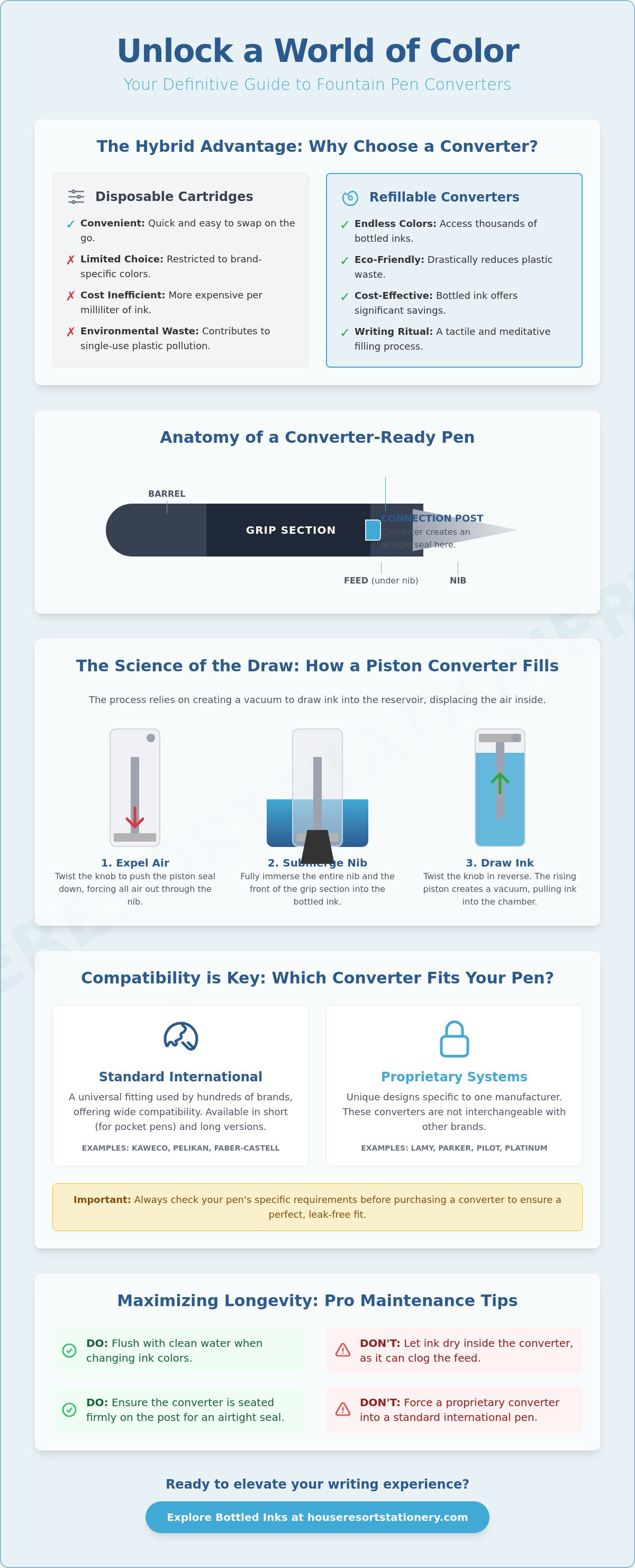
Identifying a pen ready for a converter is simple. When you unscrew the barrel, you will see a small protruding post or "nipple" inside the grip section. The converter seats firmly onto this post to create an airtight seal. This interface is critical. It allows the converter to interact with the feed, which is the finned component that regulates ink flow to the nib. Understanding the various fountain pen filling mechanisms helps you appreciate why this modular setup is so effective. It is important to distinguish between "converter-included" models, which ship with the unit, and "converter-compatible" pens, where the accessory must be purchased separately.
Why Enthusiasts Prefer Converters Over Cartridges
The primary draw for any connoisseur is the ink. Using a converter unlocks access to thousands of colors, including the prestigious pilot iroshizuku bottled ink collection. These inks offer shading and sheen properties that standard cartridges rarely replicate. There is also a practical, financial benefit. Buying ink in bulk glass bottles is significantly more cost-efficient than purchasing individual plastic refills. Beyond the math, there is the ritual. The tactile act of submerged filling is a meditative process. It connects you to the history of the craft and ensures you know exactly how does a cartridge converter pen work with your specific instrument.
The Science of the Draw: How Different Converter Mechanisms Work
The fundamental physics behind how does a cartridge converter pen work relies on the creation of a vacuum. By moving a seal or compressing a reservoir, you displace the air inside the chamber. When that seal moves back or the reservoir expands while the nib is submerged, the resulting low pressure draws ink upward into the pen. This process is a delicate balance of pressure and seal integrity. To ensure a successful draw, the entire nib and the feed's breather hole must be fully submerged in the ink bottle. If the pen draws in air instead of liquid, the vacuum fails, resulting in a half-filled converter and potential ink splatters.
For a broader look at the evolution of these tools, exploring Fountain Pen Filling Systems reveals how modern converters have refined these age-old principles for better reliability. Many premium converters include a small metal spring or a glass bead known as an agitator. These components are not decorative; they serve to break the surface tension of the ink. Without them, ink can occasionally "hang" at the back of the converter, failing to reach the feed. Capillary action is the physical phenomenon where ink travels through the narrow channels of the feed to the nib through surface tension and adhesive forces.
Piston-Action Converters (Twist and Slide)
Piston-action converters are the industry standard for heritage brands. They utilize a threaded rod that moves a rubber seal up and down the barrel. To fill, you twist the knob to move the seal toward the nib, expelling all air. Once submerged, a reverse twist creates the vacuum needed to pull the ink. The longevity of this mechanism depends entirely on the seal quality. A silicone-lubricated, tight-fitting seal ensures the vacuum remains strong for years of consistent use. You can browse our curated selection of fine fountain pens to find a mechanism that suits your specific writing style.
Squeeze and Plunger Mechanisms
Squeeze mechanisms, often called aerometric fillers, use a flexible rubber or silicone sac protected by a metal frame. These are frequently found in compact models like the Kaweco Sport. While they offer a lower ink capacity, their simplicity makes them incredibly durable. Alternatively, plunger or push-button styles rely on rapid air displacement to pull ink in a single stroke. These often provide a higher capacity but can be more challenging to clean thoroughly. Understanding how does a cartridge converter pen work with these varied mechanisms allows you to choose an instrument that balances capacity with ease of maintenance.
Compatibility and Fit: Standard International vs. Proprietary Systems
The term "Standard International" suggests a universal compatibility that rarely exists in practice. While many European brands adopt this convention, "standard" is a misnomer in a market defined by precision engineering. Understanding how does a cartridge converter pen work involves more than the internal vacuum; it requires a precise physical fit at the connection point. The technical difference lies in the aperture, or the diameter of the opening that seats onto the pen's feed. Most standard systems utilize a 2.4mm opening, but even a fraction of a millimeter's difference can lead to a loose seal or a cracked section. Forcing a mismatched converter into a delicate grip section is a common mistake that causes catastrophic leaks and permanent hardware damage.
Identifying how does a cartridge converter pen work within your specific collection starts with recognizing the aperture size. A Boutique Curator's rule of thumb is to always verify the manufacturer's specific converter model before making a purchase. While it's tempting to use a generic part, the material quality and tolerances of a brand-specific unit ensure the longevity of your instrument. Using a genuine part respects the craftsmanship of the maker and guarantees the intended ink flow.
The Proprietary Giants: Lamy, Pilot, and Sailor
Several heritage manufacturers use proprietary connections to ensure a perfect, leak-proof seal that generic parts cannot replicate. Lamy is a prime example, offering specific models like the Z28 and Z27. The Z28 features small protruding tabs designed to lock into the notches of a Lamy Safari or Al-Star, while the Z27 is smooth for professional models like the Lamy Studio. Pilot also utilizes a unique system, ranging from the compact CON-40 with its internal agitator beads to the high-capacity CON-70. The CON-70 uses a unique push-button vacuum mechanism that only fits into larger barrels, such as the Custom 74. Sailor follows suit with its own narrow-diameter converters, ensuring their specific feed systems receive a consistent ink supply.
Standard International Brands
Many beloved brands share the 2.4mm standard international port, including Kaweco, Pelikan, Monteverde, and Faber-Castell. You can often identify these by the small, stepped opening at the tip of the converter. However, barrel length remains a critical consideration. Pocket pens like the Kaweco Sport require a "short" international converter because a full-sized unit prevents the barrel from closing. Larger desk pens easily accommodate "long" or full-capacity versions. Always check the internal clearance of your pen's barrel before assuming a standard converter will fit, as the mechanical length is just as important as the aperture diameter.
Maximizing Longevity: Maintenance, Cleaning, and Troubleshooting
Maintaining a fine writing instrument is a ritual that preserves both its aesthetic beauty and its functional precision. The golden rule of fountain pen care is simple: flush the converter with every ink change. This practice prevents residual ink from different manufacturers, which often have varying pH levels, from reacting and creating stubborn clogs. To speed up this process, many enthusiasts use a bulb syringe. By fitting the syringe over the section's nipple, you can force water through the feed much faster than by repeatedly twisting the converter knob. This efficiency is vital when you want to switch colors quickly without compromising the purity of the next ink.
A common sign of mechanical fatigue is the "stuck piston." If the twist mechanism feels resistant or jerky, the internal rubber seal has likely lost its lubrication. You should use only 100% pure silicone grease to restore smooth movement and maintain the airtight seal. Apply a tiny amount of 100% pure silicone grease to the side of the piston seal using a toothpick, ensuring no lubricant enters the narrow opening that connects to the feed. This meticulous care ensures the internal vacuum remains intact, which is the core of how does a cartridge converter pen work.
Troubleshooting Common Converter Issues
If you encounter ink "starvation," where the pen stops writing even though the reservoir is full, the ink is likely stuck at the back of the converter due to surface tension. A gentle flick of the pen or choosing a converter with a built-in agitator usually resolves this. For air bubbles or leaks, inspect the seal between the converter and the feed post. Even a microscopic gap allows air to enter, breaking the vacuum and causing ink to drip from the nib. If you notice staining from highly saturated inks, a dedicated pen flush containing surfactants is more effective than plain water. You can SHOP OUR COLLECTION OF FINE FOUNTAIN PENS to find instruments designed for easy maintenance and long-term reliability.
The Deep Clean Ritual
The deep clean ritual should occur every few months or whenever you plan to store the pen. While lukewarm water handles most jobs, a professional pen flush breaks down dried particles that water alone cannot reach. Some high-end converters allow for disassembly, enabling you to scrub the interior with a small cotton swab. Always ensure the components are completely dry before reassembling. This prevents mold growth and ensures the next ink fill is not diluted by trapped moisture. Understanding how does a cartridge converter pen work includes mastering these small acts of stewardship that keep your collection in pristine condition.
Elevating Your Writing Ritual: The Converter as a Collector’s Essential
Mastering the technical side of your writing instrument is only the first step. Once you understand how does a cartridge converter pen work, the focus shifts from mechanics to the personal ritual of expression. The converter serves as a gateway to the "modular journaling" lifestyle, where your tools are as adaptable as your thoughts. In professional environments, this system offers a level of reliability that disposable options can't match. You aren't beholden to the limited stock of a local office supply store. Instead, a quick refill from a private ink well ensures your pen is always ready for the next meeting or signing ceremony.
A true connoisseur knows that the ink is only half of the equation. To see the genuine characteristics of your chosen fluid, like the subtle shading from light to dark or the metallic sheen at the edges of a letter, you've got to pair your converter with high-quality paper. Standard copy paper often feathers and bleeds, masking the beauty of the ink. Using premium journals or notebooks allows the ink to sit on the surface just long enough to reveal its complexity. This synergy between the pen, the converter, and the paper is what transforms a simple task into a sophisticated hobby.
Curating Your Ink Collection
The greatest joy of the converter is the transition from basic blue and black to a spectrum of artisanal colors. You can experiment with "shading" inks that change tone based on your writing speed or "sheening" inks that flash a secondary color when held to the light. This versatility is perfect for those who use a traveler's notebook setup. By carrying a single pen and a small sample of ink, you can adapt your writing style to match the mood of your journey. This tactile experimentation is the most rewarding part of the hobby, allowing you to curate a collection that is entirely unique to your aesthetic preferences.
Final Recommendations from HouseResort Stationery
If you're ready to start this journey, choosing the right instrument is paramount. Models like the Lamy Safari or a TWSBI Eco are excellent entry points because they allow you to clearly see how does a cartridge converter pen work through their transparent or semi-transparent bodies. We strongly advise purchasing your instruments from an authorized retailer. This ensures you receive authentic parts and manufacturer-backed support for your investment. We invite you to explore our curated selection of heritage writing tools, where each piece is chosen for its craftsmanship and its ability to enhance your daily writing ritual.
Mastering Your Ink Reservoir
Mastering the mechanics of your writing instruments transforms a simple task into a sophisticated ritual. You now understand the physics of vacuum pressure and the critical importance of selecting the correct aperture for your pen's feed. Whether you're navigating the proprietary systems of heritage makers or the nuances of standard international fittings, your technical knowledge is the foundation of a flawless writing experience. Understanding how does a cartridge converter pen work allows you to move past the limitations of disposable plastic and embrace a sustainable, colorful future.
As an authorized retailer for Lamy, Sailor, and Pilot, we take pride in offering expertly curated tools for the stationery enthusiast. Our selection is meticulously filtered to ensure you find authentic parts and heritage craftsmanship that stand the test of time. We provide national shipping across the United States to bring these fine instruments directly to your desk. Explore our curated collection of fine fountain pens and converters to find your next essential tool. Your journey into the world of bottled inks is just beginning. With proper stewardship and a spirit of curiosity, your collection will provide a lifetime of tactile satisfaction.
Frequently Asked Questions
Can I use a converter in any fountain pen?
No, you can only use a converter in pens specifically designed for a cartridge or converter system. Dedicated piston fillers, vacuum fillers, or eyedropper pens do not have the internal nipple required to seat a converter. If your pen was manufactured as a cartridge-only model, it must have enough internal barrel clearance to accommodate the length of a mechanical converter.
How do I know if my pen takes a standard international converter?
You can identify a standard international port by its 2.4mm aperture diameter and the brands that support it. Most European manufacturers like Kaweco, Pelikan, and Monteverde utilize this convention. If your pen is from a proprietary giant like Lamy, Pilot, or Sailor, it will require a brand-specific converter designed for their unique connection points.
Is a piston filler better than a cartridge converter?
Better is a matter of preference rather than absolute quality. Piston fillers offer a significantly higher ink capacity for long writing sessions. Converters provide superior versatility, as they allow you to switch back to disposable cartridges for travel and are much easier to deep clean when changing ink colors.
Why is my converter not drawing up any ink?
A failure to draw ink usually indicates a broken vacuum seal or improper submergence. Ensure the nib is fully submerged in the ink bottle past the breather hole before you begin the draw. If the pen still won't fill, check for a loose connection between the converter and the feed, as this is a common hurdle when troubleshooting how does a cartridge converter pen work.
How often should I clean my fountain pen converter?
You should flush your converter every time you change ink colors or at least once a month if you use the same ink consistently. Regular maintenance prevents old ink from drying and clogging the feed. It also ensures the internal piston seal remains free of debris, which preserves the mechanical integrity of the vacuum system.
Can I leave ink in a converter for a long time?
It's best not to leave ink in a converter for more than two weeks if the pen isn't being used. Water in the ink will eventually evaporate through the cap, leaving behind concentrated dyes and sediments. These deposits can stain the reservoir and make it difficult for the piston to slide smoothly during your next fill.
Do I need to take the converter out to fill it?
No, you should fill the converter while it is securely attached to the pen's section. Drawing ink through the nib and feed primes the entire delivery system for immediate writing. While you can fill a converter with a syringe, this method bypasses the feed and often results in a dry start until the ink naturally works its way down.
What is the difference between a twist and a slide converter?
The difference lies in the mechanical method used to create the vacuum. A twist converter uses a threaded rod to move the piston with high precision and control. A slide converter uses a simple push-pull friction mechanism. Twist models are generally found in full-sized pens and offer better durability, while slide models are often reserved for slim or pocket-sized instruments. Understanding these mechanical variations is part of learning how does a cartridge converter pen work with different pen bodies.