
How Does a Piston Filler Fountain Pen Work? An Engineer’s Guide to Elegant Writing
What if your fountain pen wasn't just a writing tool, but a precision-engineered vacuum pump that turns the entire barrel into a high-capacity ink engine? For many collectors, the internal mechanics of a high-end instrument feel intimidating. You might worry about mechanical failure or feel confused about the difference between a removable converter and an integrated system. It's natural to hesitate before twisting the knob of a prized Pelikan or Lamy, especially when you're unsure of the physics happening behind the grip.
This guide explains exactly how does a piston filler fountain pen work by breaking down the elegant relationship between airtight seals and atmospheric pressure. You'll master the internal physics that allow a $36.99 TWSBI ECO to hold significantly more ink than a standard cartridge. We'll also provide the confidence you need to maintain your collection, from identifying high-quality seals to properly greasing the mechanism with silicone oil. We will explore the engineering behind icons like the $279 Lamy 2000 and the $925 Pelikan M800 to help you identify true craftsmanship. Let's dive into the anatomy of the piston and elevate your appreciation for the tactile world of analog writing.
Key Takeaways
- Understand the internal vacuum physics and the three core components—the blind cap, lead screw, and piston head—to master how does a piston filler fountain pen work.
- Learn the essential maintenance techniques, including the proper application of silicone grease, to prevent mechanical resistance and ensure a leak-proof seal.
- Discover why integrated piston systems offer double the ink capacity of standard converters, making them the preferred choice for dedicated journalers and enthusiasts.
- Trace the engineering evolution from the messy eyedropper era to the 1929 Pelikan revolution that defined modern writing efficiency and craftsmanship.
- Identify high-quality engineering markers in iconic models like the Lamy 2000 to help you select a reliable, high-performance instrument for your personal collection.
The Evolution of Ink Delivery: Why the Piston Filler Changed Everything
Writing instruments of the late 19th century were beautiful yet notoriously temperamental. Before the advent of integrated systems, enthusiasts relied on eyedropper pens. These required the user to unscrew the entire section and manually drip ink into the barrel. This "messy era" was defined by a constant battle against air pressure. As the heat from a writer's hand warmed the air inside the barrel, the expanding gas forced ink out of the nib in a phenomenon known as "burping." To solve this, engineers sought a way to control the internal environment through the history of fountain pen filling mechanisms.
The true revolution arrived in 1929. Theodor Kovács developed a differential piston system that Pelikan eventually brought to the global market. This design replaced the external eyedropper with an internal plunger. By turning a knob at the end of the barrel, the writer could move a seal forward and backward. This action created a vacuum to draw ink directly through the nib. It was the first time a pen barrel functioned as its own reservoir without the need for fragile rubber sacs. This change significantly increased durability. Rubber sacs eventually rot or lose elasticity, but a well-maintained piston system can last decades.
From Eyedroppers to Integrated Reservoirs
The transition to self-filling mechanisms was driven by the professional's need for reliability. Early pens were vulnerable to leaks during travel or temperature shifts. The piston filler became the gold standard because it offered a sealed environment. By integrating the reservoir into the pen body, manufacturers eliminated the "middleman" of the ink cartridge or the rubber bladder. Today, understanding how does a piston filler fountain pen work is essential for anyone moving beyond entry-level tools into the world of luxury and heritage manufacturing. This system allows for a seamless writing experience that respects the meticulous engineering of the past while utilizing 2026 manufacturing tolerances for a perfect airtight seal.
The Death of the Cartridge: The Piston’s Cultural Resurgence
While disposable cartridges offer convenience, the modern collector often views them as a compromise. Piston fillers have seen a massive cultural resurgence for several reasons:
- Sustainability: Using bottled ink reduces plastic waste and offers a lower cost per milliliter over time.
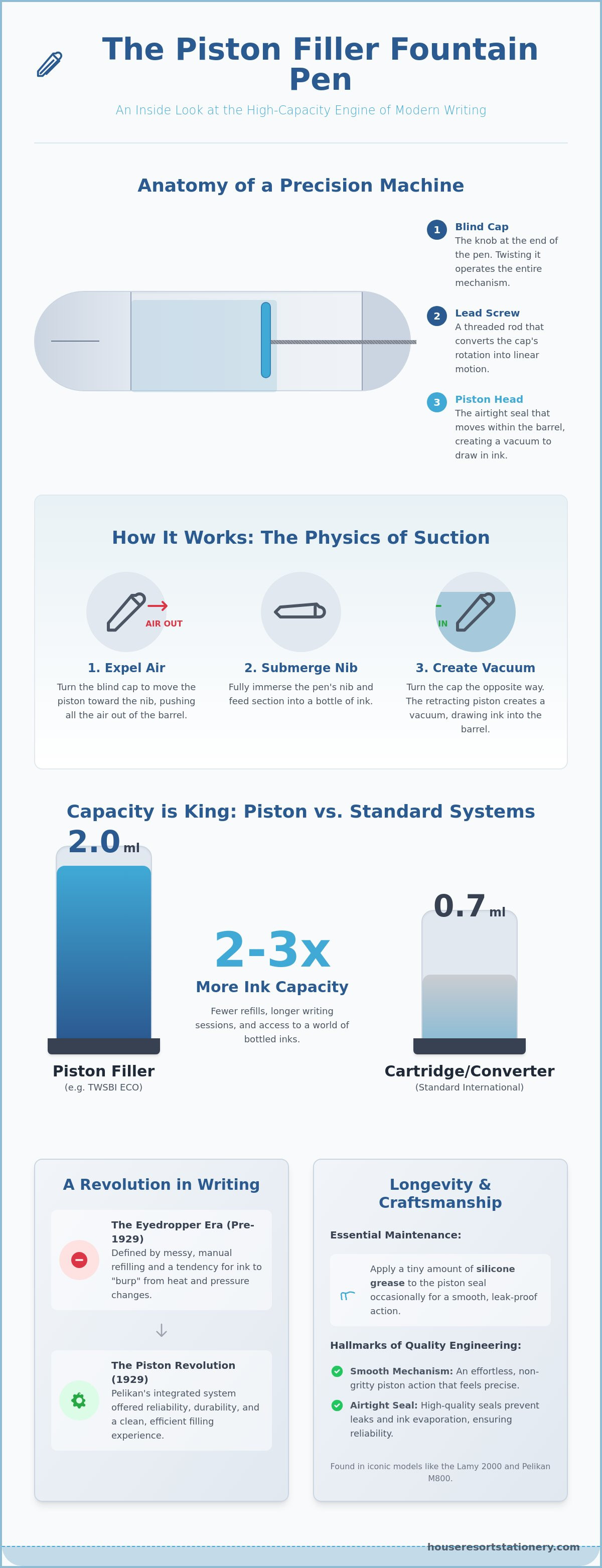
- Capacity: A standard piston reservoir holds between 1.0 ml and 2.0 ml of ink. This is often double or triple the volume of a standard cartridge.
- Visual Appeal: The rise of "demonstrator" pens, clear-bodied instruments like the TWSBI ECO, turned the internal mechanics into a visual centerpiece.
There is a deep tactile satisfaction in the analog "twist" of the piston knob. In a digital world, this mechanical interaction provides a grounding moment of preparation before the nib touches the paper. It transforms the act of refilling from a chore into a ritual of craftsmanship. Knowing how does a piston filler fountain pen work allows you to appreciate the vacuum physics that make this high-capacity engine possible.
The Mechanics of Suction: How a Piston Filler Works Internally
The piston filler is a sophisticated, integrated screw-driven plunger system housed directly within the barrel. Unlike pens that rely on external cartridges, this design utilizes the entire body of the instrument as an ink reservoir. To understand how does a piston filler fountain pen work, you must look at the interaction between its three primary components. First, the blind cap at the rear of the pen serves as the manual interface. Second, the lead screw acts as the mechanical spine, translating your rotational force into linear movement. Finally, the piston head creates the necessary airtight seal against the barrel walls to fight gravity through pure physics.
The Anatomy of the Lead Screw and Plunger
The magic of the piston filler lies in the conversion of torque. When you rotate the blind cap, you engage the lead screw. This threaded rod drives the plunger forward toward the nib or pulls it back toward the tail. This mechanical principle was refined in documents like the 1939 Piston Filler Patent, which detailed how these internal threads ensure a smooth, controlled motion. The piston head itself is usually made from rubber or a high-grade synthetic polymer. In high-end heritage pens, you'll often find a "double seal" design. This redundancy ensures that even if one edge of the seal experiences microscopic wear, the vacuum remains intact. This meticulous engineering is why many collectors prefer to browse curated fountain pens that prioritize mechanical longevity and tactile feedback.
Vacuum Physics: Boyle’s Law in Your Pocket
The operation of a piston filler is a practical application of Boyle’s Law. This law states that as the volume of a gas increases in a closed system, its pressure decreases. When you twist the knob to retract the piston, you rapidly increase the empty space inside the barrel. This creates a partial vacuum, meaning the air pressure inside the pen is now lower than the atmospheric pressure outside. Knowing how does a piston filler fountain pen work transforms a simple refill into a masterclass in fluid dynamics.
Atmospheric pressure then does the heavy lifting. It pushes the ink from the bottle into the lower-pressure chamber inside your pen. For this to be successful, the breather hole on the nib and the feed's air channels must be clear. This hole allows air to escape as ink enters, maintaining the delicate balance required for a consistent flow. The nib must be fully submerged in the ink bottle to prevent air leakage during suction, as any gap will break the vacuum and result in an incomplete fill.
Piston Fillers vs. Converters: A Connoisseur’s Comparison
Choosing between a removable converter and an integrated piston system is a defining moment for any collector. While a converter offers a convenient bridge between cartridges and bottled ink, it often feels like a modular compromise. Once you master how does a piston filler fountain pen work, the benefits of a built-in reservoir become undeniable. The mechanical integration of a piston filler provides a sense of solidity that a plastic converter simply cannot replicate. There's no risk of the unit shaking loose or the seal between the section and the converter failing over time. The pen becomes a singular, cohesive instrument of craftsmanship.
The visual experience also differs significantly. In a "demonstrator" pen, the ink sloshes freely against the barrel walls, turning the fluid itself into a dynamic design element. In a converter-fed pen, the ink remains hidden behind a secondary layer of plastic, which often mutes the vibrancy of your chosen shade. While some critics argue that pistons are harder to flush, this is largely a misconception. A few rapid cycles of the piston knob can clean a barrel just as effectively as a bulb syringe, provided the ink hasn't been left to dry into a crust.
Capacity and the Long-Distance Writer
For novelists, students, or anyone who writes for hours at a time, ink capacity is the primary metric of success. A standard converter typically holds about 0.7ml of ink. A dedicated piston filler, however, often boasts a capacity of 1.5ml or more. This high-volume engine pairs perfectly with premium fluids like pilot iroshizuku bottled ink, ensuring that the rich, nuanced colors remain consistent throughout long sessions. It's helpful to remember that the weight and balance of the pen will shift subtly as the reservoir depletes. This dynamic feedback is something seasoned writers often use to gauge their remaining ink level without ever glancing at the barrel.
Durability and Failure Points
A converter is a replaceable part designed for convenience. If it leaks, you simply buy another. A piston filler is a permanent mechanical choice. This creates a different psychological relationship with the tool. It feels like a heritage piece. Understanding how does a piston filler fountain pen work is key to its longevity. "Stiff" pistons are the most common failure point, usually caused by microscopic ink residue or a lack of internal lubrication. By maintaining the seal before resistance builds, you ensure the lead screw and plunger operate smoothly for decades. It's a mechanism built for the long haul, rewarding the meticulous owner with a lifetime of reliable service.
Maintenance and Longevity: Keeping Your Piston Smooth
Understanding how does a piston filler fountain pen work is only half the battle; the other half is preservation. Because the piston mechanism is integrated directly into the barrel, any mechanical failure is more complex to resolve than simply replacing a disposable cartridge. The absolute golden rule of piston maintenance is simple: never force a stuck knob. If you feel significant resistance while twisting, it's a signal that dried ink or a lack of lubrication has compromised the seal's movement. Forcing the mechanism can strip the internal threads of the lead screw, leading to permanent damage. Patience is the collector's greatest virtue.
The Art of the Internal Flush
A thorough cleaning is essential for maintaining the vacuum integrity of your pen. To perform an internal flush, submerge the nib in a container of room-temperature distilled water and cycle the piston several times. This action draws water in and expels it, slowly dissolving any ink particulates trapped behind the piston head. This process is particularly vital if you enjoy high-sheen or shimmering inks, as the microscopic glitter particles can settle into the seal's crevices. Once the water runs clear, you can confidently transition to a new ink color. Using high-quality paper like the refills found in a traveler's notebook ensures that your freshly cleaned pen performs with the precise flow intended by the manufacturer.
Lubrication: The Secret to a Lifetime of Writing
Over time, the factory lubricant on the internal barrel walls will dissipate. You'll recognize a drying seal by a "jumping" or "stuttering" motion when you twist the blind cap. To fix this, you must apply a microscopic amount of 100% pure silicone grease to the piston head. Many manufacturers, such as TWSBI, include a small vial of this grease and a wrench with their pens. Avoid petroleum-based lubricants at all costs; these can chemically react with and melt the plastic or resin barrel. A tiny bead of silicone grease, no larger than a grain of salt, is usually enough to restore a silky, effortless glide to the mechanism. This small act of meticulousness ensures your instrument remains a reliable companion for decades.
When it's time to store your pen, the consensus among connoisseurs is to store it empty and clean. Leaving ink in a piston filler for months can lead to evaporation, which leaves behind a crusty residue that is difficult to flush. If you must store it filled, keep the nib pointed upward to prevent ink from settling in the feed. By respecting the engineering behind how does a piston filler fountain pen work, you elevate your writing experience from a simple chore to a curated ritual of quality. To ensure your collection stays in peak condition, shop our collection of professional writing tools and maintenance accessories.
Selecting Your Signature Tool: Iconic Piston Fillers for 2026
Choosing the right instrument requires a balance between aesthetic preference and mechanical appreciation. Now that you understand how does a piston filler fountain pen work, you can select a tool that matches your specific writing rhythm. The TWSBI ECO, priced at $36.99, remains the entry-level champion for 2026. Its transparent barrel acts as a live diagram of the vacuum physics we discussed earlier. It is the perfect 'teaching' pen for those who want to see the internal plunger in action before moving to opaque heritage models.
For those who value minimalist engineering, the Lamy 2000 ($279) is a masterclass in design. Its Makrolon body features a piston seam so precisely machined that it is virtually invisible to the naked eye. If you prefer the weight of history, the Pelikan Souverän series, such as the M800 ($740 to $925), offers the gold-standard differential screw mechanism. This system uses two different thread pitches to move the piston faster than the knob turns. It is a subtle, sophisticated detail that defines the luxury writing experience. Whether you choose a fine nib for detailed notes or a broad nib for expressive signatures, matching the ink capacity to your nib's "wetness" is the final step in customization.
Why Buy from an Authorized Retailer?
Piston fillers are complex machines with multiple moving parts. Purchasing from an authorized retailer like HouseResort Stationery ensures that your investment is protected by a genuine manufacturer warranty. We curate only the most reliable piston systems from heritage makers. This meticulous filtering process means you don't have to worry about the quality of the internal seals or the alignment of the lead screw. Our expert support is always available to guide you through your first lubrication or deep clean. We help you turn a technical challenge into a rewarding ritual of ownership.
Final Recommendation: Your Next Step in Analog Mastery
If you're ready to move beyond cartridges, we suggest starting with a demonstrator model. Seeing the ink levels and the plunger movement helps you visualize the internal pressure balance as you write. To truly test the high capacity of your new reservoir, try pairing your pen with fountain pen doodle journaling. This creative practice allows you to explore the nuances of your nib and ink while appreciating the engineering that makes long sessions possible. Explore our curated collection of piston-filler fountain pens at HouseResort Stationery.
Master the Art of the Integrated Ink Reservoir
Mastering internal mechanics transforms a simple pen into a lifetime companion. You now understand how does a piston filler fountain pen work by utilizing vacuum physics to increase ink capacity far beyond standard cartridges. By following expert-led maintenance guides, you can ensure your instrument remains reliable for decades. Whether you choose the TWSBI ECO or a Pelikan Souverän, the ritual of refilling celebrates craftsmanship and engineering precision. These tools don't just write; they connect you to a heritage of tactile excellence.
HouseResort Stationery has provided premium stationery for enthusiasts since 2022. As an authorized retailer for Lamy, TWSBI, and Pelikan, we curate only the most reliable piston systems. We invite you to explore our boutique and discover tools that respect tradition while meeting modern standards of performance. Shop Our Expertly Curated Fountain Pen Collection and find the signature tool that speaks to your personal style. Your journey into analog mastery is just beginning.
Frequently Asked Questions
Is a piston filler better than a cartridge/converter pen?
It depends on your writing volume and preference for integrated engineering. Piston fillers offer superior ink capacity, often holding 1.5ml to 2.0ml compared to the 0.7ml typically found in converters. While converters are easier to replace if they fail, a dedicated piston system provides a more solid, balanced feel that connoisseurs prefer for long writing sessions. It is a choice between modular convenience and integrated craftsmanship.
How often should I clean my piston filler fountain pen?
You should clean your pen every four to eight weeks or whenever you change ink colors. Regular flushing prevents pigment buildup and maintains the vacuum seal's integrity. If you use high-maintenance shimmering or document inks, more frequent cleaning is required to ensure the mechanical plunger moves without resistance. Consistent maintenance is the simplest way to protect the internal threads from wear over time.
Can I change ink colors easily in a piston filler?
Yes, but it requires a more thorough flushing process than a cartridge pen. Because the entire barrel acts as the reservoir, you must cycle water through the mechanism until it runs completely clear. This ensures that remnants of the previous color don't contaminate the new ink or affect the chemical balance of the fluid. It is a rewarding ritual that keeps your colors vibrant and pure.
What should I do if my piston knob feels stuck or hard to turn?
Stop immediately and do not force the mechanism. Understanding how does a piston filler fountain pen work helps you identify that resistance usually indicates the internal seal needs lubrication or that dried ink is obstructing the lead screw. To resolve this, flush the pen with room-temperature water. If the stiffness persists, apply a microscopic amount of 100% pure silicone grease to the piston head to restore smooth motion.
Do piston filler pens leak more than other types?
No, they are actually less prone to leaking because they are fully integrated systems with fewer connection points. Leaks in other pens often occur at the junction between a cartridge and the section. Because the engineering behind how does a piston filler fountain pen work relies on a robust internal vacuum, these instruments are remarkably secure. A well-maintained seal manages internal pressure effectively, making it a reliable choice for travel.
Can I use any bottled ink in a piston filler?
You can use any bottled ink specifically formulated for fountain pens. Avoid India inks, calligraphy inks, or acrylic-based fluids, as these contain binders that will permanently clog the feed and damage the internal plunger. High-quality bottled inks from heritage manufacturers are designed to lubricate the mechanism while providing consistent flow. Always choose reputable brands to ensure the longevity of your pen’s internal components.
How do I know when my piston filler is completely full?
You can verify the ink level by looking through the ink window or the transparent body of a demonstrator pen. If your pen is opaque, you'll feel the physical stop of the piston reaching the top of its stroke. A full fill is achieved when the plunger is retracted completely while the nib remains fully submerged in the ink bottle. This ensures no air is drawn into the reservoir.
Is it possible to replace the piston seal if it wears out?
Yes, many high-quality piston fillers are designed to be user-serviceable. Brands like TWSBI include specific tools for disassembly, allowing you to replace the seal or apply grease easily. For more complex heritage models, we recommend consulting an authorized retailer for guidance on professional servicing. This ensures the internal vacuum continues to function perfectly for decades of reliable writing.