
How to Change Fountain Pen Ink Colors: The Connoisseur’s Guide to a Fresh Palette
The true soul of a fountain pen isn't found in its nib or barrel; it lives in the vibrant flow of the ink that brings your words to life. You likely appreciate the tactile joy of a fresh bottle of Sailor Sei-boku or the rich depth of Lamy Black, yet the thought of switching from a dark sapphire to a delicate pastel can be daunting. No one wants to risk a permanent stain on a vintage feed or settle for a muddy, greyish mess because of an incomplete cleaning. Mastering how to change fountain pen ink colors is the difference between a frustrating chore and a rewarding ritual of renewal.
It's natural to worry that a previous shade will haunt your next page, but a meticulous maintenance routine eliminates that fear. This guide provides the precise steps to safely transition between palettes while protecting your pen's delicate internal components. You'll learn effective flushing techniques, the benefits of specialized tools like the Sailor Fountain Pen Maintenance Kit, and which specific ink properties require a deeper level of care to ensure your next color remains as vivid as the maker intended.
Key Takeaways
- Prevent "muddy" colors and color contamination by mastering the mechanics of a complete flush before transitioning to a new palette.
- Follow a precise, step-by-step method for how to change fountain pen ink colors without risking damage to the delicate feed or nib.
- Learn to safely manage stubborn shimmer particles and high-sheen pigments using mild additives or professional pen flushes.
- Optimize your writing performance by matching ink flow properties and "wetness" to your specific nib grade and paper choice.
- Discover why curated collections from authorized heritage manufacturers, such as Pilot, provide the most reliable experience for collectors.
The Mechanics of a Fresh Start: Why You Must Clean Before You Color
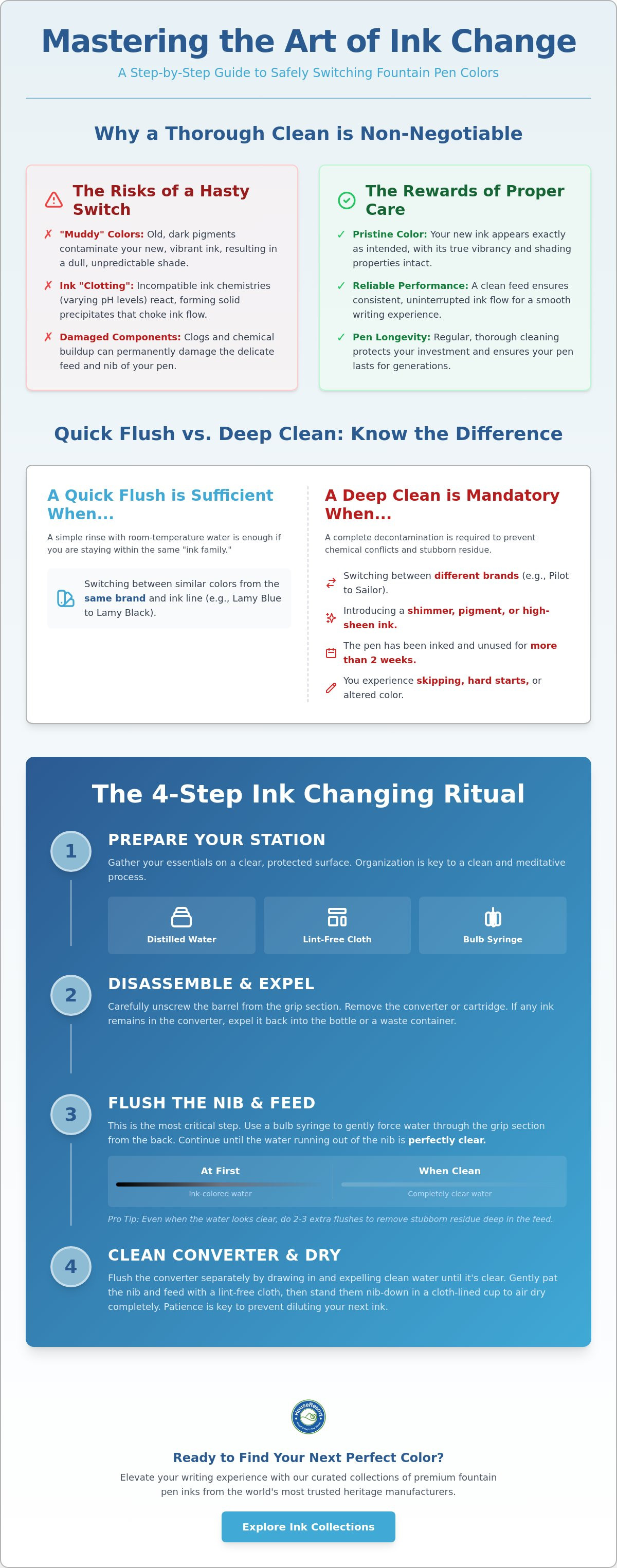
A pristine writing experience depends on the purity of your tools. Transitioning between hues is a process of purification, not just a refill. Understanding how to change fountain pen ink colors begins with a fundamental understanding of flushing. This process involves the systematic removal of residual dyes, lubricants, and micro-particles that settle within the pen's internal architecture. Without a thorough flush, your next ink choice will suffer from contamination, compromising both the color and the mechanical reliability of the instrument.
This level of preparation is common in any craft where color and quality are paramount; for instance, a professional team like Brush Hour LLC understands that the secret to a high-quality residential or commercial paint job lies in the meticulous cleaning and priming of the surface before the first drop of color is ever applied.
The most common consequence of a hasty transition is the "muddy ink" phenomenon. Even a trace amount of a dark pigment, such as Lamy Black, can dramatically alter the profile of a lighter shade like Teranishi’s Nostalgic Honey. Beyond aesthetics, the chemical reality of Fountain pen ink composition presents a more serious risk. Inks vary in pH levels and chemical additives. When two incompatible formulas meet within the feed, they can react to create a solid precipitate. This "clotting" effectively chokes the ink flow, requiring a labor-intensive restoration to fix. Regular cleaning prevents this build-up, ensuring the longevity of the gold or steel nib and the intricate plastic fins of the feed.
Understanding Capillary Action and Residue
Fountain pens rely on capillary action to move liquid from the reservoir to the paper. The feed is designed with narrow channels that use surface tension to hold onto ink. While this provides a consistent flow, it also means the feed acts like a sponge for high-saturation dyes. A simple rinse often leaves behind a concentrated layer of pigment deep within these channels. This is particularly true for pens equipped with a breather tube, a component found in many vintage and modern filling systems. The tube can trap air and old ink, requiring multiple cycles of water to fully clear the internal path.
When to Perform a Deep Clean vs. a Quick Flush
A quick flush with room-temperature water is usually sufficient when you stay within the same brand or color family. However, a deep clean becomes mandatory in several scenarios. If you're switching between manufacturers, such as moving from a Pilot ink to a Sailor ink, a complete decontamination is necessary to avoid chemical conflict. Look for signs of trouble:
- Visible ink "skipping" or hard starts.
- A noticeable change in the ink's intended shade.
- The pen has been stored with ink inside for more than two weeks.
- You are introducing a shimmering or pigmented ink for the first time.
The Step-by-Step Guide to Changing Your Ink Color Safely
A successful color transition begins with organization. Clear your desk and gather a few essentials: two containers of room-temperature distilled water, several lint-free microfiber cloths, and a bulb syringe if you have one. Avoid standard paper towels for the initial wipe down, as tiny fibers can easily snag on a delicate nib or clog the feed. This preparation ensures that the process of how to change fountain pen ink colors remains a meditative ritual rather than a messy chore.
Begin by unscrewing the barrel to reveal the internal filling system. For most modern enthusiasts, this involves removing a converter or a cartridge. If you're using a more complex vintage model, you may find a detailed guide to fountain pen mechanisms helpful for identifying specific parts like bladders or plungers. Set the cap and barrel aside; these rarely require more than a light dusting unless ink has leaked into the cap liner. Focus your attention on the grip section, which houses the nib and feed.
Hold the grip section under a slow stream of room-temperature water or use a bulb syringe to force water through the feed. Continue this until the water exiting the nib runs perfectly clear. It's often surprising how much pigment lingers even after the water appears clean. Perform two or three additional flushes to be certain. When mastering how to change fountain pen ink colors, this extra minute of rinsing prevents the ghost of your previous ink from haunting your next page.
Mastering the Converter Flush
If your pen utilizes a removable converter, submerge the opening in clean water and twist the piston to draw liquid in. Expel the water and repeat. The cycle method is the repeated intake and expulsion of clean water. For ink trapped behind the piston seal, a gentle soak may be required. If you find your current filling system is becoming difficult to maintain, you might choose to browse our selection of fine fountain pens to find a model with a more easily serviced integrated piston.
Drying and Reassembly Best Practices
Patience is the final ingredient. While it's tempting to re-ink immediately, any residual moisture will dilute your new ink, leading to a dry or faded writing experience. Place the nib unit "nib-down" in a small glass lined with a folded paper towel. This wicks moisture out of the feed via capillary action. Allow the components to air-dry for at least four hours, or ideally overnight, before reassembling the pen and introducing your fresh palette.
Beyond the Basics: Handling Stubborn Pigments and Shimmer Inks
Standard dye-based inks are generally forgiving. However, the complexity of your maintenance routine must evolve when you introduce specialty fluids like shimmering inks or high-saturation pigments. Shimmering inks, such as the Jacques Herbin 1670 series, utilize tiny mica particles to create their signature sparkle. While beautiful, these particulates are physical matter that can settle into the narrow channels of your pen's feed. Learning how to change fountain pen ink colors when transitioning away from these "heavy" inks requires a more rigorous approach than a simple water rinse.
The fear of clogging is a common hurdle for collectors. It's a valid concern, but it shouldn't prevent you from enjoying a diverse palette. If water alone doesn't clear the residue, safe additives are your best ally. A single drop of mild, additive-free dish soap in a cup of distilled water works as a gentle surfactant to break the surface tension of stubborn dyes. For professional-grade results, a dedicated solution like Monteverde Pen Flush, typically priced between $12 and $14, is engineered to dissolve dried ink without harming the internal seals. Avoid household glass cleaners or ammonia-based products. These can cause irreparable damage to vintage materials and certain modern plastics.
Permanent inks and iron gall formulas require a strict maintenance schedule. These inks are designed to be archival, meaning they bond with the paper and, if left too long, the pen itself. If you're using a pigmented ink like Platinum Carbon Black, don't let the pen sit idle for more than a week. A proactive flush every seven to ten days prevents the pigment from drying into a hard crust that is difficult to remove without complete disassembly.
Special Care for Shimmer and Sheen
Tiny mica particles often hide in the "fins" of the feed or the slit of the nib. Even after a thorough flush, you might see a stray sparkle in your next ink. To prevent this, use a soft-bristled toothbrush to gently brush the surface of the nib and the exposed parts of the feed while rinsing. This mechanical agitation dislodges particles that water pressure alone can't reach. Shimmering inks require more frequent cleaning cycles, ideally every time you refill the reservoir, to ensure the particulate matter doesn't accumulate over time.
Tools for the Advanced Collector
A bulb syringe is perhaps the most valuable tool for speeding up the flushing process. It allows you to push a high volume of water through the grip section with controlled pressure, clearing the feed in seconds. For pens with significant buildup, an ultrasonic cleaner provides professional results by using high-frequency sound waves to vibrate ink particles loose. Exercise caution here. Ultrasonic cleaners are generally safe for modern stainless steel and gold nibs, but they can be too aggressive for vintage celluloid, ebonite, or pens with delicate plated finishes. Always verify the material of your instrument before using advanced cleaning machinery.
Curating Your Next Palette: Matching Ink Properties to Your Style
The ritual of cleaning your instrument serves as the gateway to a new creative chapter. Once you've mastered how to change fountain pen ink colors, the focus shifts from maintenance to the aesthetic harmony of your next selection. Choosing a new ink isn't merely about picking a favorite shade; it's a technical decision that involves balancing the physical properties of the fluid with the specific characteristics of your nib and paper. A mismatched pairing can result in a frustrating writing experience, characterized by dry starts or excessive bleed-through.
Consider the visual progression of your writing. Transitioning between colors offers an opportunity to create a cohesive narrative in your archives. If you're documenting a long-term project, moving from a deep professional blue like Sailor Sei-boku to a sophisticated grey creates a subtle, intentional shift in tone. This progression is particularly rewarding when captured in a high-quality Midori MD notebook journal, where the paper is designed to showcase the true depth of every pigment.
Nib Size and Ink Saturation
Your nib grade is the primary factor in how an ink presents on the page. Shading inks, which display varying degrees of color intensity within a single stroke, perform best in medium or broad nibs. These wider tips provide the necessary surface area for the ink to pool and dry at different rates. Conversely, extra-fine nibs require high-contrast, saturated colors to ensure your handwriting remains legible. Nib width determines the volume of ink deposited and thus the visible depth of the color. When using a fine Japanese nib, a vibrant ink like Pilot Iroshizuku Asa-gao provides the clarity needed for detailed notations without appearing washed out.
Paper Compatibility: The Secret to True Color
The interaction between ink and paper is where the chemistry of writing truly happens. Standard office paper is often too porous, causing "feathering" where the ink spreads along the paper fibers. Fountain-pen-friendly paper, as discussed in our Japanese Stationery Guide, features a specific surface sizing that keeps the ink on top of the page. This prevents distortion and allows specialized properties like sheen and shimmer to manifest correctly. The "tooth," or texture, of the paper also affects dry-time; smoother papers like those from Midori or Tomoe River allow for longer dry times, which is essential for capturing the complex color shifts in modern boutique inks.
Selecting the right tools is the final step in elevating your analog experience. Explore our curated selection of authorized heritage pens and premium journals to find the perfect foundation for your next palette.
Elevating the Experience with HouseResort Stationery’s Curated Collections
The meticulous process of cleaning your pen is a small investment for the sensory reward of a fresh ink bottle. Mastering how to change fountain pen ink colors grants you the freedom to explore our entire catalog without hesitation. At HouseResort Stationery, we act as a specialized filter for the market. We are an authorized retailer of fine fountain pens and premium inks, selecting only heritage manufacturers that uphold the highest standards of craftsmanship. This curation ensures that every bottle of ink you purchase is authentic, well-behaved, and worthy of your finest nibs. By focusing on authorized manufacturers, we eliminate the risk of poorly formulated fluids that can degrade your internal filling systems over time.
Choosing a boutique curator means moving beyond a simple transaction. It's about joining a community that values the tactile nature of analog tools. Our inventory is organized by maker and material, allowing you to jump directly to the creators you trust. Whether you are looking for professional blue-blacks or vibrant, shimmering pigments, our selection is designed to be a relaxing, enjoyable escape for the enthusiast. We provide the tools, but you create the legacy.
Spotlight on Pilot Iroshizuku Bottled Ink
For many collectors, the Pilot Iroshizuku line represents the gold standard of bottled ink. This iconic Japanese collection features a nature-inspired palette that captures the fleeting beauty of the seasons. These inks are celebrated for being exceptionally well-behaved, which simplifies the process of how to change fountain pen ink colors. High-quality lubricants in the formula ensure a smooth glide across the paper while making the internal flushing process faster and more efficient. While some beloved shades like Kiri-same were discontinued in May 2026, the remaining catalog continues to offer sophisticated depth. You can explore the full range of swatches and properties in our Pilot Iroshizuku Bottled Ink Guide.
The Complete Writing Ritual
A fresh palette deserves a dedicated home. We recommend pairing your newly inked pen with a Traveler’s Notebook for a modular journaling experience that evolves with your needs. This system allows you to swap inserts as easily as you swap ink colors, maintaining a consistent rhythm in your creative practice. Our commitment is to provide the professional writing tools and storage solutions that define a shared passion for quality. We encourage you to experiment with color as a form of creative escape; every new fill is an opportunity to rediscover the joy of the written word. Your next favorite shade is waiting to be discovered.
Master the Art of the Fresh Start
Mastering the technical nuances of how to change fountain pen ink colors is more than just maintenance. It's a commitment to the longevity of your writing instruments and the purity of your creative expression. By prioritizing a thorough flush and matching your ink’s unique properties to your nib and paper, you ensure each new entry in your journal is as vivid as the last. Protecting your feed from muddy contamination allows the true character of boutique pigments to shine through without compromise.
As an authorized retailer for heritage brands like Pilot, Sailor, and Lamy, we take pride in offering a selection curated by enthusiasts for enthusiasts. We handle the hard work of filtering the market so you can focus on the tactile joy of the pen. With national shipping on all premium stationery, your next favorite bottle is never out of reach. Explore our curated collection of fine fountain pen inks and find the perfect companion for your next project. Your pens are ready for their next transformation, and we're here to provide the tools for the journey.
Frequently Asked Questions
Do I need to clean my fountain pen if I am using the same color ink?
Yes, you should clean your pen even if you aren't switching shades. Over time, water evaporates from the ink sitting in the feed, which increases the concentration of dyes and lubricants. This can lead to a sluggish flow or "hard starts" where the pen struggles to write immediately. A quick rinse every two months ensures your favorite color remains consistent and the pen’s internal channels stay clear.
Can I use tap water to change my fountain pen ink colors?
Distilled water is the superior choice for a meticulous cleaning routine. While tap water is convenient, it often contains minerals like calcium or additives like chlorine that can leave microscopic deposits inside the feed over time. These deposits may eventually restrict ink flow. If you live in an area with particularly hard water, using distilled water is a small but effective way to protect your heritage writing instruments.
How often should I flush my fountain pen even if I don’t change colors?
A maintenance flush every four to eight weeks is ideal for pens in regular use. This frequency prevents the buildup of dried ink particles that naturally occur as air enters the reservoir. If you use permanent or iron gall inks, you should shorten this interval to every two weeks. Consistent care is much easier than performing a deep restoration on a pen that has been neglected for months.
Is it safe to mix two different colors of fountain pen ink in the pen?
Mixing inks directly inside your pen is generally discouraged due to potential chemical reactions. Different manufacturers use unique pH levels and chemical stabilizers. When incompatible formulas meet, they can create a sludge or solid precipitate that is incredibly difficult to remove. If you want to experiment with custom shades, always mix them in a separate vial first and let the mixture sit for 24 hours to check for any unusual reactions.
What should I do if the ink has dried inside my fountain pen?
Patience is essential when dealing with dried ink. Submerge the nib and grip section in a glass of room-temperature distilled water and allow it to soak for several hours or even overnight. This slowly rehydrates the hardened pigment without damaging the delicate feed. Avoid using boiling water or rubbing alcohol, as these can melt plastic components and strip the finish off your pen’s barrel.
Can I change ink colors without a converter?
You can certainly learn how to change fountain pen ink colors even if your pen uses a cartridge system. Simply remove the spent cartridge and flush the nib and feed as you would with any other pen. Many enthusiasts use a blunt-tip syringe to clean out an empty cartridge and refill it with bottled ink from a different manufacturer. This allows you to enjoy a vast palette of colors without purchasing a separate converter for every pen.
Will changing ink colors frequently damage my fountain pen nib?
Frequent color changes are perfectly safe as long as you follow a gentle cleaning process. The nib and feed are designed to withstand regular contact with water and mild cleaning solutions. The primary risk comes from unnecessary disassembly. You don't need to pull the nib and feed out of the housing every time you change colors. Focus on thorough flushing rather than physical teardowns to maintain the structural integrity of your pen.
How do I know if I have flushed all the old ink out of the feed?
The "paper towel test" is the most reliable way to confirm your pen is clean. After the water from your flush runs clear, gently press the nib against a clean, white paper towel. If you see any trace of color wicking into the fibers, there is still residual ink trapped in the feed. Repeat the flushing process until the paper towel remains perfectly white. This ensures your next color choice stays true to its original shade when you decide how to change fountain pen ink colors for your next writing session.