
How to Choose a Journal for Writing: The Connoisseur’s Guide for 2026
What if the notebook you use today is the only physical legacy your grandchildren ever hold? It's a heavy thought, but for the collector, a journal is far more than a stack of paper. It's a curated environment where paper chemistry and binding architecture dictate the flow of your thoughts. If you've ever felt the frustration of a rare ink feathering into a fuzzy mess or a spine that refuses to lay flat, you know that not all notebooks are created equal. Learning how to choose a journal for writing is about moving past the mass-market stationery aisle and into the realm of technical specifications and heritage craftsmanship.
You likely want a writing experience that feels like a luxury escape rather than a struggle against scratchy, thin materials. We promise to help you find a portable yet durable companion that preserves your ink colors with archival precision. We'll examine the tactile differences between 52gsm Tomoe River paper and 100gsm master-grade sheets. We'll also explore the structural integrity of thread-bound systems and help you decide between a fixed Leuchtturm1917 or a modular Traveler’s system for your 2026 reflections.
Key Takeaways
- Identify your journaling intent to determine if a fixed volume for reflection or a modular system for productivity best serves your creative workflow.
- Master technical paper specifications like GSM and sizing to understand how to choose a journal for writing that prevents ink bleed-through and ghosting.
- Evaluate book architecture, prioritizing lay-flat thread binding to ensure your journal remains open and durable for years of use.
- Compare the psychological satisfaction of finishing a fixed-volume notebook against the versatile customization of modular refillable systems.
- Learn why sourcing from an authorized retailer ensures access to authentic heritage brands and fountain-pen-approved materials.
Defining Your Journaling Intent: The First Step in Selection
When you search for how to choose a journal for writing, you'll often encounter advice tailored for academic researchers looking to publish in peer-reviewed periodicals. This guide isn't about impact factors or submission guidelines. Instead, we focus on the physical bond between pen, paper, and hand. Understanding your intent is the foundational step in this process. A journal isn't merely a commodity; it's a curated environment. The choice between a pocket-sized companion and a heavy desk volume depends entirely on whether you're capturing fleeting thoughts or building a lifelong archive.
Frequency also dictates your selection. If you write daily, a high page count is essential to avoid the disruption of switching volumes every few weeks. Conversely, a traveler who records only during excursions might prefer a modular system with thinner inserts. Your environment matters too. A rugged, leather-bound book feels at home in a personal sanctuary—much like the serene spaces curated by hudsonlinepainters.com—while a sleek, minimalist hardback might better suit a professional boardroom. Before looking at technical specs, ask yourself what role this object will play in your daily life.
The Role of the Journal in the Analog Escape
Physical writing provides a cognitive slow down that digital notes simply can't replicate. When you engage with heritage materials, you're participating in a tradition that spans centuries. Looking at the history of the notebook, we see a transition from functional wax tablets to the sophisticated, acid-free paper of today. This evolution reflects our desire for legacy. A digital file can be deleted or corrupted, but a well-bound journal becomes a physical artifact. It's a legacy object that preserves your ink colors and your unique handwriting for future reflection.
Categorizing Use Cases for 2026
Your specific habit should lead your search. Different goals require different architectures:
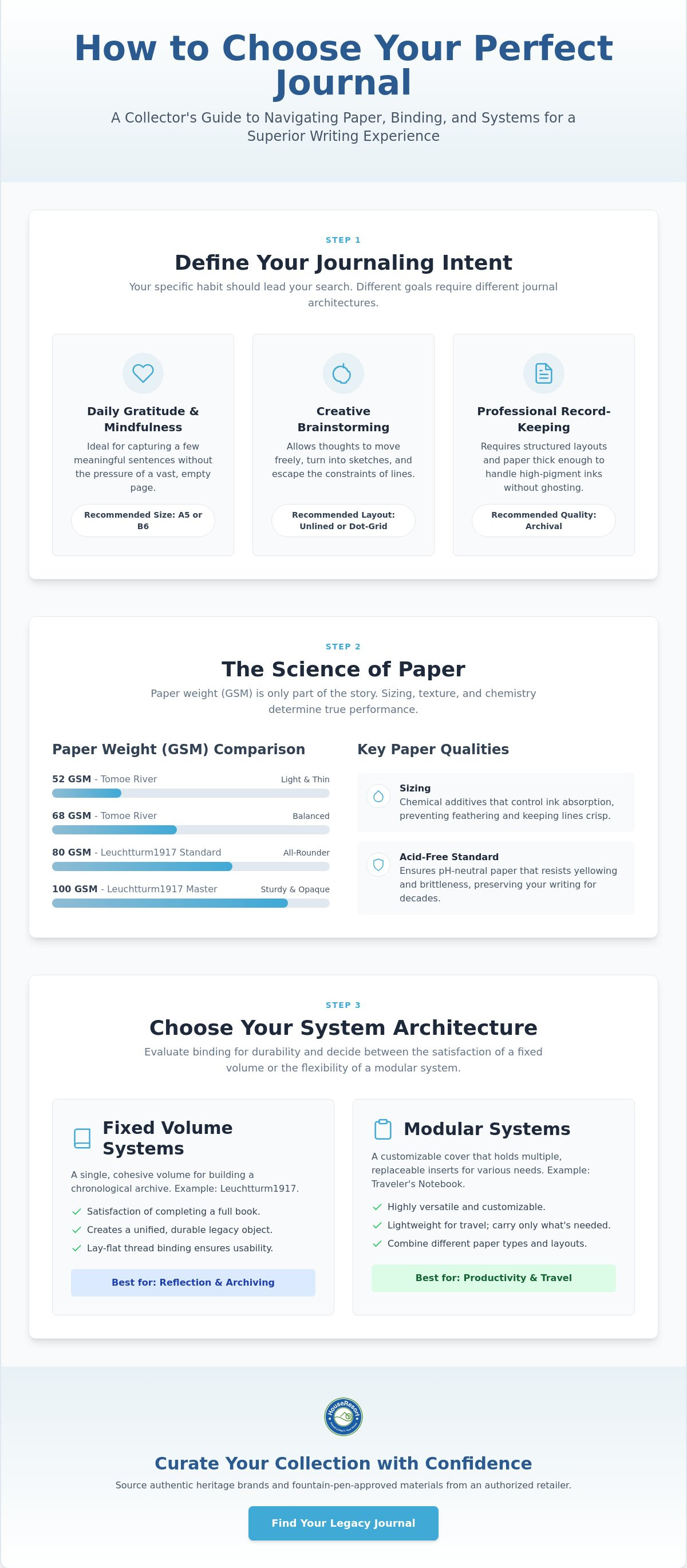
- Daily Gratitude and Mindfulness: Small formats are ideal here. They're less intimidating and easy to keep on a nightstand. A5 or B6 sizes provide enough space for a few meaningful sentences without the pressure of a vast, empty page.
- Creative Brainstorming: Look for the freedom of unlined or dot-grid pages. These layouts allow your thoughts to move diagonally or turn into sketches without the rigid constraints of horizontal lines.
- Professional Record-Keeping: This requires structured layouts and archival-quality paper. You need a book that stays open during meetings and uses paper thick enough to handle high-pigment inks without ghosting onto the next page.
By defining these needs early, you ensure that your investment supports your habit rather than hindering it. Knowing how to choose a journal for writing starts with knowing exactly what you intend to say.
The Science of Paper: GSM, Texture, and Fountain Pen Synergy
While many believe a thick page is the only sign of quality, the reality is more nuanced. When researching how to choose a journal for writing, you'll find that GSM (Grams per Square Meter) is the primary metric for weight, but it's the "sizing" that determines performance. Sizing refers to the chemical additives used during manufacturing to control ink absorption. Without proper sizing, even the heaviest paper will allow ink to feather into the fibers like a paper towel. A truly connoisseur-grade journal balances weight with a surface treatment that keeps ink crisp and vibrant.
For 2026, the market offers a wide range of weights tailored to specific habits. Tomoe River paper remains a favorite at 52gsm and 68gsm. Even at these low weights, it handles ink beautifully because of its dense structure. In contrast, the Leuchtturm1917 2026 collection uses 80gsm for standard notebooks and 100gsm for its Master size, offering a sturdier, more opaque feel. Your choice of texture, or "tooth," also changes your writing speed. Smooth finishes allow a nib to glide effortlessly, while toothy papers provide tactile feedback that helps control your pen stroke.
Archival Quality and Acid-Free Standards
Premium journals must be acid-free. Acid in paper causes yellowing and brittleness over time, eventually destroying the very thoughts you're trying to preserve. By selecting pH-neutral paper, often found in high-end Japanese stationery, you ensure your writing remains legible for decades. This chemical stability is non-negotiable for anyone viewing their journal as a legacy object rather than a temporary notepad.
Ink Performance: Sheen, Shading, and Ghosting
The paper's coating dictates how ink behaves. A well-coated page allows the ink to sit on the surface, which is essential for seeing the "sheen" or "shading" of premium inks. For example, pairing a high-quality paper with pilot iroshizuku bottled ink reveals the subtle color shifts that cheap paper would absorb and dull. If you want to avoid "ghosting" (seeing the shadow of your writing on the back), look for higher GSM or specific coatings designed for opacity. You can browse our collection of ink-tested journals to find a surface that brings out the best in your favorite colors.
- GSM: Determines the weight and opacity of the page.
- Sizing: Controls ink absorption to prevent feathering.
- Texture: Influences the friction and "feel" of the writing experience.
- Archival Grade: Ensures the paper won't degrade over time.
Architecture of the Book: Binding and Form Factor
Once you understand paper chemistry, the physical structure of the book becomes the next priority. The architecture of a journal dictates how it sits on your desk and how it survives the rigors of daily travel. Many enthusiasts struggle with notebooks that fight to close while they write. This is why learning how to choose a journal for writing requires a close look at binding techniques. A poorly constructed spine creates a literal barrier between your hand and the page, leading to hand fatigue and a disjointed creative experience.
Durability is often found in the details of the cover materials. Hardcover journals provide a built-in writing surface, offering much-needed stability when you don't have a desk available. Softcover versions are lighter and more flexible, conforming to the shape of your bag or pocket. Whether you choose genuine leather, reinforced cloth, or high-density cardboard, the material should reflect your environment. In the hospitality industry, where tactile quality is a key part of the guest experience, you can check out Infinity Hotel Supplies to see how luxury environments are outfitted with professional-grade standards.
The Engineering of Lay-Flat Binding
The hallmark of a professional-grade journal is lay-flat binding. This is achieved through Smyth-sewn (or thread-bound) construction, where groups of pages are stitched together before being attached to the spine. Unlike mass-produced glued bindings that eventually crack and lose pages, thread-bound systems allow the book to rest completely open. This is a critical feature for left-handed writers who need a level surface to avoid smudging fresh ink. To preserve your journal, don't force the spine open at the center immediately. Gently open it in small sections from the front and back to "break in" the binding architecture without damaging the spine.
Sizing for Your Lifestyle
Form factor is about balancing your need for space with your daily mobility. Your lifestyle should dictate the dimensions of your tool. While pocket sizes offer unmatched convenience, they can feel cramped during deep reflection sessions. Consider these standard formats for 2026:
- A5 (148 x 210mm): The gold standard for a reason. It provides ample room for long-form reflection while fitting easily into most bags.
- B6 Slim and Pocket: These are the tools for the urban explorer. They're designed for quick capture and portability, fitting comfortably in a jacket pocket or small clutch.
- Large/A4+: Best for desk-bound work. These formats give your ideas room to breathe, making them ideal for complex project planning or expansive sketching.
When you know how to choose a journal for writing based on these structural elements, you're investing in a tool that won't fail you mid-sentence. The right architecture ensures that the act of writing remains a pleasure rather than a chore.
Modular vs. Fixed Systems: Finding Your Workflow
Choosing between a fixed-volume notebook and a modular system is a decision about how you view time and progress. A single-subject notebook offers a linear, unchangeable narrative. It provides the immense psychological satisfaction of a "finished" book, where every page represents a specific era of your life. If you're wondering how to choose a journal for writing that matches your pace, consider whether you prefer the finality of a bound volume or the evolving nature of a customizable dashboard.
A multi-insert system functions more like a modular operating system for your thoughts. It allows you to carry different types of paper for different tasks, all contained within a single high-quality cover. This approach is ideal for those who juggle professional record-keeping with personal reflection. It eliminates the need to carry multiple books, allowing you to swap out individual refills as they reach capacity while keeping your primary cover for years.
The Modular System Framework
Modular systems excel at versatility. You can integrate planners, sketchbooks, and lined paper inserts into one cohesive unit. For enthusiasts of this style, the traveler's notebook remains the gold standard for 2026. These systems use elastic bands to hold various refills, allowing you to curate a tool that is uniquely yours. Over time, the leather covers develop a rich patina that reflects your specific usage patterns. This durability makes the cover a permanent companion, while the internal paper remains a flexible, expendable resource. You can explore our curated selection of modular systems to find a setup that fits your mobile lifestyle.
The Case for Bound Notebooks
Fixed volumes provide a sense of security and chronological order that modular systems can't replicate. There is a distinct beauty in a shelf filled with identical, completed journals. This traditional format encourages a focused, deep-dive approach into a single subject. Storage and indexing become simpler when every volume is a self-contained archive of a specific time period. If you value heritage craftsmanship and the tactile feel of a permanent spine, our Japanese stationery online store guide highlights premium bound options from makers like Midori and Kokuyo.
Transitioning between journals often brings a touch of "blank page" anxiety. To manage this, many connoisseurs use the final pages of an old journal to outline the goals for the new one. This creates a bridge between the two volumes, ensuring your habit remains consistent. Whether you choose the flexibility of a modular system or the permanence of a bound book, the key is to select a framework that removes friction from your daily writing ritual.
Curating Your Collection at HouseResort Stationery
Selecting the right writing surface is a personal journey that shouldn't be left to chance or mass-market algorithms. At HouseResort Stationery, we act as a boutique curator for the analog enthusiast. We understand that knowing how to choose a journal for writing is as much about the retailer's standards as it is about the paper's weight. Every item in our catalog undergoes a rigorous filtering process. We only offer tools that are "fountain pen approved," ensuring that your ink never feathers and your nib never snags. By focusing on authorized partnerships with heritage brands, we provide a sense of security that the materials you buy today will remain archival-quality for decades.
Our manufacturer-first approach allows you to shop by the names that define the industry. We prioritize creators who value tradition and technical precision. This strategy respects your time, allowing you to jump directly to the makers who have earned your trust through years of consistent performance. Whether you're looking for the 1970s-inspired "Sunflower" or "Indigo" shades from the Leuchtturm1917 2026 collection or the modular flexibility of Traveler's Company, our inventory represents the pinnacle of stationery engineering. We believe the shopping experience should be a relaxing escape, not a chore.
Why Manufacturer Heritage Matters
The story of your journal begins long before you pick up a pen. It starts in the iconic paper mills of Japan and Europe, where centuries of craftsmanship meet modern chemistry. Enthusiasts stick with specific makers because of the predictable consistency in paper sizing and binding strength. Supporting these heritage manufacturers ensures the survival of the analog industry in an increasingly digital world. When you choose a book from a legacy maker, you're investing in a tool that's been refined over generations to handle the most demanding writing instruments.
Final Recommendations and Next Steps
A new journal is only the beginning. To truly elevate your experience, you must pair your selection with a writing instrument that complements the paper's texture. For those looking to push their creativity beyond standard notes, you might explore fountain pen doodle journaling to find new ways to fill your pages. Before you finalize your choice, use this checklist for a perfect 2026 purchase:
- Verify the paper weight: Ensure the GSM matches your ink's saturation.
- Check the binding: Confirm it features thread-bound, lay-flat architecture.
- Identify the system: Decide if a fixed volume or a modular refillable cover fits your workflow.
- Select the size: Match the form factor to your specific environment, from A5 to B6 Slim.
We invite you to explore the HouseResort catalog, where we've already done the hard work of filtering the market for you. Your next legacy object is waiting to be discovered.
Elevating Your 2026 Writing Ritual
Finding the perfect notebook is a balance of chemistry and architecture. You've learned that paper weight is only half the story; technical sizing and surface texture are what truly define how your ink behaves. Whether you prefer the archival permanence of a thread-bound book or the modular freedom of a refillable system, your choice should reflect your unique creative intent. Mastering how to choose a journal for writing ensures that your analog tools never become a source of friction, acting instead as a sanctuary for your most important thoughts.
HouseResort Stationery is dedicated to the heritage of analog writing tools. As an authorized retailer of world-class stationery brands, we provide expert-vetted paper quality for fountain pen enthusiasts. We've done the hard work of filtering the market so you can focus on the act of creation. Explore our curated collection of premium journals and notebooks to find the companion that will preserve your legacy for years to come. Your next great idea deserves a surface that honors its importance.
Frequently Asked Questions
What is the best paper weight (GSM) for journaling with fountain pens?
The ideal paper weight for fountain pen users typically ranges between 80 GSM and 100 GSM. While higher weights offer better opacity, specialty papers like Tomoe River perform exceptionally at 52 GSM or 68 GSM due to their dense structure and specialized surface coating. These technical specifications prevent feathering and allow the ink to sit on the surface, showcasing the color's true depth and shading without soaking through the page.
Should I choose a lined, dotted, or blank journal for writing?
Your choice depends on your specific journaling intent and need for structure. Lined pages provide the necessary guidance for long-form reflection and maintaining consistent handwriting. Dotted grids offer a versatile middle ground, supporting both structured text and creative layouts or bullet journaling. Blank pages remove all constraints, making them the preferred choice for sketching and brainstorming. Consider your need for guidance versus freedom when deciding how to choose a journal for writing.
What is the difference between Smyth-sewn and glued binding?
Smyth-sewn binding involves stitching groups of pages together with thread before attaching them to the spine. This technique allows the journal to lay completely flat on a desk, providing a superior writing surface for the user. Glued bindings use adhesives to secure pages directly to the spine, which often results in a stiffer book that fights to stay open. For long-term durability and ease of use, thread-bound architecture is the connoisseur's standard.
How do I prevent ink from bleeding through my journal pages?
Preventing bleed-through requires a combination of sufficient paper weight and proper surface sizing. Sizing is a chemical treatment used during manufacturing that controls how quickly paper fibers absorb liquid. Look for journals specifically labeled as fountain pen friendly, as these have the necessary coatings to keep ink on the surface. Using a finer nib or a drier ink can also help mitigate issues when you are learning how to choose a journal for writing on thinner materials.
Is a leather-covered journal worth the investment over a cardboard cover?
A genuine leather cover is a worthwhile investment for those seeking a legacy object that lasts for years. Leather provides superior protection for the internal paper and develops a unique patina over time, especially in modular systems where the cover is reused. Cardboard covers offer a lighter, more portable alternative for daily carry. If you view your journal as a permanent archive, the structural integrity and aesthetic aging of leather justify the higher initial cost.
What does "acid-free" mean and why is it important for journals?
Acid-free paper is manufactured with a neutral or basic pH level to prevent chemical degradation over time. This standard is critical for preserving your writing, as acidic paper becomes yellow and brittle within a few decades. By choosing pH-neutral materials, you ensure that your journals remain intact and legible for future generations. Most heritage Japanese and European manufacturers prioritize these archival standards for their premium collections to ensure your thoughts are preserved indefinitely.
Can I use a modular journal for professional work and personal reflection?
Modular systems are specifically designed to bridge the gap between professional and personal use through customizable inserts. You can integrate a structured planner insert for meeting notes alongside a separate lined or blank refill for private reflection. This flexibility allows you to maintain multiple workflows within a single, high-quality cover. It's an efficient way to organize your life without carrying several disparate notebooks, making it a favorite for modern professionals and collectors.
How do I choose between a hardbound and softbound notebook?
Choosing between hardbound and softbound depends on your primary writing environment and mobility needs. Hardbound journals provide a rigid, built-in writing surface, which is essential for capturing thoughts while standing or traveling. Softbound notebooks offer a more flexible, lightweight form factor that conforms to the shape of a bag or pocket. If you frequently write at a desk, a hardbound volume offers the stability and presence of a classic library book that stands upright on a shelf.