
How to Start and Maintain a Travelers Journal: The Ultimate 2026 Guide
Your digital calendar is a tool for survival, but a travelers journal is a vessel for a life well-lived. In 2026, the analog comeback is more than a trend; it's a commitment to mindful curation and tactile quality. You've likely felt the hesitation of starting a new system. You worry about your first leather scratch or the frustration of fountain pen ink bleeding through a sub-par refill. It's common to feel overwhelmed by the modular possibilities of bands, folders, and paper weights.
This professional guide transforms that uncertainty into expert knowledge. You'll learn to master the art of the modular ecosystem, from selecting the right 2026 weekly vertical refills to performing essential leather maintenance. We'll examine the technical precision of Japanese MD Paper and the durability of heritage materials. We've filtered the market to present a clear path toward a functional daily carry. By the end, you'll have a curated stationery setup that acts as a reliable, sophisticated companion for your most important thoughts.
Key Takeaways
- Master the modular mechanics of a travelers journal to build a personalized system that balances daily functionality with aesthetic appeal.
- Learn expert leather maintenance techniques to transform surface scratches into a distinguished patina through years of consistent use.
- Gain a clear understanding of the internal elastic system and how to utilize connecting bands for a secure, multi-insert configuration.
- Explore the technical benefits of heritage paper, specifically Japanese MD Paper, to ensure a bleed-free experience with your favorite fountain pens.
- Understand why sourcing your tools from an authorized boutique protects the authenticity and craftsmanship of your analog collection.
What is a Travelers Journal? Defining the Modular Notebook System
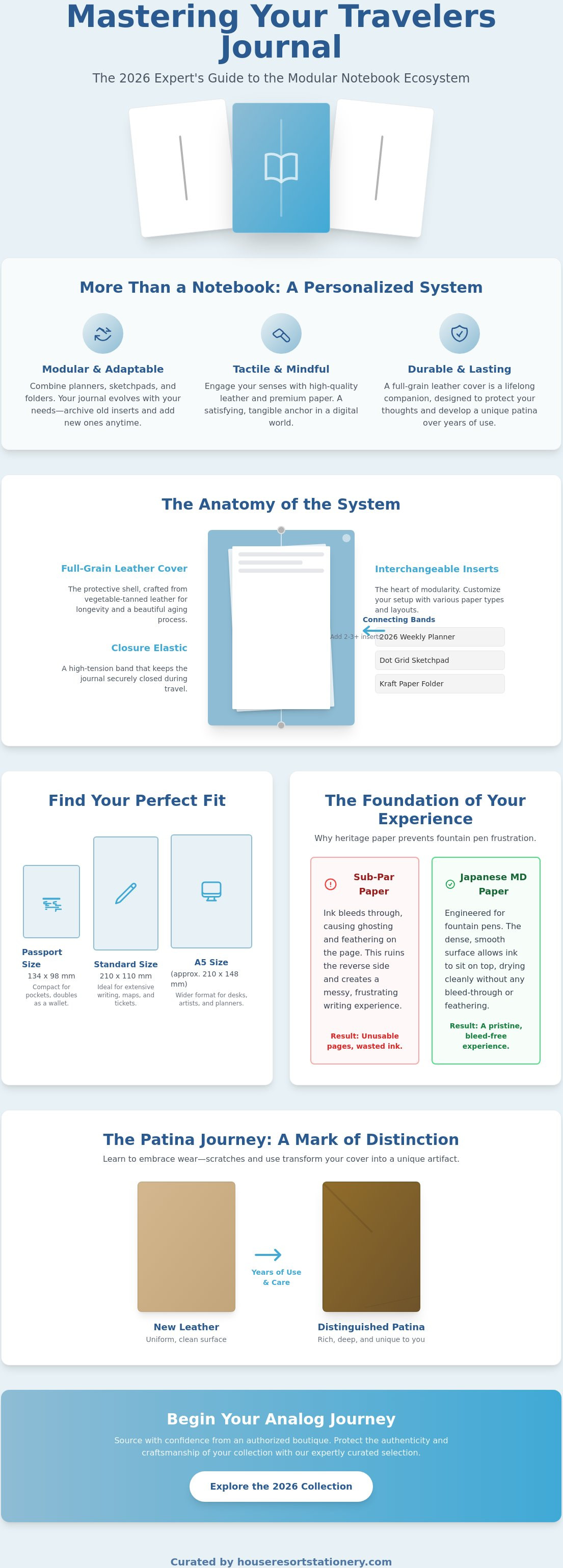
A travelers journal is far more than a simple bound notebook. It is a sophisticated, modular ecosystem comprised of a durable leather cover, an internal elastic binding system, and interchangeable paper refills. Unlike traditional notebooks that dictate your organization through fixed pages, this system allows you to curate a bespoke tool that evolves with your needs. You can combine a 2026 weekly planner, a dot grid sketchpad, and a kraft folder within a single protective shell. This flexibility makes the travelers journal a preferred choice for connoisseurs who value both form and function.
The modern iteration of this format owes its popularity to the Traveler’s Company, a Japanese brand that turned a minimalist leather sleeve into a global stationery phenomenon. While the history of travel journals dates back centuries to explorers and literary figures, the contemporary modular design focuses on the "everyday traveler." This philosophy suggests that even a commute or a quiet afternoon in a café is a journey worth documenting. The brand's influence has established a standard for quality that emphasizes heritage materials and analog craftsmanship.
Modularity offers a distinct advantage over fixed-binding notebooks. When a single insert is full, you simply remove it and slide in a fresh one. This ensures your leather cover remains a permanent companion while your data and memories are archived separately. Choosing the right size is the first step in this curation process:
- Standard Size: A tall, slim format (210mm x 110mm) ideal for maps, tickets, and extensive writing.
- Passport Size: A compact pocket-sized option (134mm x 98mm) that doubles as a wallet or a quick logbook.
- A5 Size: A wider, more traditional desk format favored by artists and those who require significant horizontal space.
The Philosophy of Analog Portability
The format encourages a "daily carry" habit. Its slim profile fits easily into a bag, making it accessible for spontaneous creativity or rapid note-taking. By utilizing multiple inserts, you can mentally separate work projects from personal reflections while keeping them physically together. It is a system designed for the journey of life, providing a tactile anchor in an increasingly digital world.
Choosing Your First Cover Material
Quality begins with the hide. We recommend full-grain, vegetable-tanned leather for its longevity and ability to develop a unique patina. Synthetic alternatives often lack the structural integrity required to support multiple inserts over several years. Look for a cover with a robust, high-tension elastic binding system. The spine should feel secure, and the leather should have enough thickness to protect your paper from the rigors of daily handling.
The Anatomy of a Travelers Journal: Covers, Inserts, and Elastics
Understanding the travelers journal requires looking past the leather exterior to the mechanical logic of its design. The system functions as a modular chassis. The outer cover, typically crafted from a single piece of thick, vegetable-tanned leather, serves as a protective shell for your thoughts. It is designed to endure decades of handling. While the material is resilient, referring to a leather care guide ensures the hide remains supple and resists cracking over time. This shell is held together by a simple yet effective internal elastic system.
A central vertical elastic cord runs along the inner spine. This cord is the primary anchor for your first notebook insert. However, the true power of the system lies in expansion. By using connecting bands; small, high-tension silicone loops; you can join two or three notebooks together. You simply slide the band around the centers of two notebooks and tuck them under the main spine elastic. This technique allows for a high-capacity daily carry without compromising the slim profile of the journal. To complete the setup, connoisseurs often add functional hardware. Brass clips hold pages flat for sketching, while adhesive pen loops and zipper pouches transform the journal into a mobile workstation.
Navigating Notebook Inserts
The interior of your journal is entirely customizable. Lined inserts provide structure for traditional journaling, while dot-grid and grid patterns offer the precision needed for bullet journaling or architectural sketching. Specialized refills, such as watercolor paper or kraft paper, cater to specific creative needs. For 2026, many enthusiasts favor the weekly vertical layout for time-blocking. Choosing the right ruling ensures your layout matches your cognitive style.
The Importance of Paper Quality
Paper performance is measured by GSM (grams per square meter) and surface sizing. High-performance Japanese stationery often sets the benchmark for ink resistance. These papers are engineered to prevent ghosting and feathering, even when using wet-writing fountain pens. We recommend performing a small ink test on the back page of any new insert brand to observe how the paper handles your specific nib and ink viscosity. If you are looking for a reliable starting point, you can browse our curated selection of journals and notebooks to find a paper weight that suits your writing instruments.
Leather Care: Maintaining Your Travelers Journal for 2026 and Beyond
The first scratch on a pristine travelers journal often feels like a catastrophe. This initial mark is actually the beginning of a transformation. High-quality, vegetable-tanned leather is reactive by design; it absorbs the environment and records the history of its user. Over time, the oils from your hands interact with the hide to create a rich patina. This natural darkening and softening process is what distinguishes a heritage tool from a mass-produced accessory. Instead of fearing wear, you should view each scuff as a layer of character that makes the journal uniquely yours.
Consistency is the secret to a long-lasting cover. We recommend conditioning your leather every four to six months. If you live in a particularly dry climate, you might increase this frequency to prevent the fibers from becoming brittle. Proper storage is equally vital. Avoid leaving your journal in direct sunlight for extended periods, as UV rays can bleach the leather and leach out essential moisture. When you aren't using your system, keep it in a breathable cotton dust bag. Never store leather in sealed plastic; it can trap humidity and encourage mold growth.
A Step-by-Step Cleaning Routine
A professional cleaning routine preserves the leather's structural integrity without stripping its natural beauty. Follow these steps for the best results:
- Dusting: Use a soft horsehair brush to gently remove debris from the surface and the stitching.
- Hydration: Apply a small amount of pH-balanced leather cream using a lint-free cloth. Creams provide deeper hydration than wax-based products, which often sit on the surface.
- Buffing: After the cream has dried for ten minutes, buff the cover with a clean cloth. This creates a soft, natural sheen and ensures no tacky residue remains.
Managing Scratches and Scuffs
Most minor surface marks don't require chemical intervention. The "finger rub" method is the most effective tool for light scuffs. Simply use the warmth and natural oils of your thumb to rub the scratch in a circular motion. The friction redistributes the waxes within the leather and often makes the mark disappear entirely. For deeper gouges, it's best to accept them as part of the journal's history. High-quality leather is incredibly resilient. It doesn't need constant pampering; it just needs to be used. The more you handle your travelers journal, the better it will look.
How to Set Up Your Travelers Journal: A Practical Guide
The assembly of a travelers journal is a tactile ritual that transforms a leather cover into a functional tool. To begin, open your primary notebook insert to its center page. Slide this notebook under the main spine elastic until the cord rests securely in the fold. This single-insert setup provides the most streamlined profile for pocket carry. However, the system's true versatility emerges when you expand your capacity to hold multiple modules for different areas of your life.
Expanding your system requires the use of connecting bands. These are high-tension silicone loops designed to link two notebooks into a single unit. Slide a band around the center of your first and second inserts so they sit back-to-back. You then tuck this joined pair under the main spine elastic. For a three-insert configuration, thread a third notebook through the spine elastic first, then let the connected pair sit on either side of it. This balanced arrangement ensures the cover closes evenly and protects the edges of your paper.
Strategic placement of accessories enhances daily utility. Adhesive card holders and PVC zipper pockets should be positioned at the very front or back of the stack. This prevents uneven surfaces from interfering with your writing flow. If your journal feels excessively bulky, consider alternating the orientation of your pockets. Using a specialized lightweight paper refill can also help maintain a slim profile while providing more pages for your notes. Keeping the journal flat is essential for a comfortable writing experience, especially when using a desk or a firm surface.
Mastering the Multi-Insert Configuration
A well-organized configuration usually follows a logical thematic structure. Many collectors dedicate one notebook to a daily log, another to creative sketching, and a third to a wallet or receipt holder. This "Jump Band" technique allows you to swap out a full notebook without disturbing the rest of your system. It ensures that your most active modules remain at the center of your carry while archived thoughts are safely moved to a storage binder.
Pairing with the Right Writing Instrument
The tactile feedback of high-quality Japanese paper makes the travelers journal the ideal companion for a fountain pen. To carry your tool securely, select a pen loop that matches the diameter of your pen's barrel. We recommend using a sheet of blotting paper between pages to protect your inserts from fresh ink and prevent accidental smudging during quick transitions. If you're ready to build your own system, you can view our complete collection of authorized stationery tools to find the perfect components for your daily carry.
Curating Your Expert Stationery Collection at HouseResort Stationery
Sourcing a travelers journal is a deliberate choice for the discerning collector. When you select your tools from an authorized retailer, you're investing in the certainty of authentic materials and heritage craftsmanship. HouseResort Stationery functions as a specialized boutique. We've done the heavy lifting of filtering the global market to present only the most reliable fountain pens, journals, and planners. This commitment ensures that your leather cover is genuine, your paper is fountain pen friendly, and your accessories are engineered to fit the modular system perfectly.
Our philosophy centers on the tactile relationship between your instruments. A journal is only as good as the paper inside it, and that paper is only as good as the pen that touches it. We prioritize manufacturers who maintain traditional production methods. This focus allows us to offer a curated experience where every component works in harmony. You can build a comprehensive traveler's notebook kit through our expert-led curation, ensuring your setup is both functional and aesthetically cohesive from day one.
The Boutique Experience for Connoisseurs
We respect your time and your passion. Our digital storefront utilizes a manufacturer-first navigation strategy. This allows you to shop by the makers you trust, whether you're seeking specific Japanese paper or luxury leather finishes. If you're new to the analog subculture, our curated recommendations act as a helpful guide. We understand the nuances of ink dry times and leather grain, providing a level of expertise that general retailers simply cannot match. By focusing on quality over volume, we maintain a collection that speaks to the enthusiast.
Next Steps for Your Journaling Journey
The journey doesn't end with a single purchase. To stay informed about 2026 product releases and limited editions, we invite you to register for our newsletter. It's a direct line to the latest innovations in the stationery world. You can also explore our recurring video series, which features deep dives into creative journal layouts and technical pen reviews. If you require personalized advice for your specific writing style, the team at HouseResort Stationery is available to provide tailored stationery suggestions. We're here to help you refine your daily carry into a professional, lifelong ecosystem.
Embarking on Your Analog Journey with Confidence
Your transition into a modular journaling system is more than a change in stationery; it's a commitment to a more mindful, tactile way of living. By mastering the configuration of elastics and prioritizing the technical precision of Japanese paper, you've built a system that adapts to your specific needs. A travelers journal is a heritage vessel that records your growth while protecting your most valuable thoughts. You now have the expert knowledge required to care for your leather and curate a professional daily carry that lasts for decades.
At HouseResort Stationery, we act as a trusted curator for the analog community. As an authorized retailer of fine fountain pens and heritage notebooks, we ensure every item in our inventory meets the highest standards of craftsmanship. Our specialized knowledge in fountain pen compatibility takes the guesswork out of building your collection. We invite you to Explore our curated collection of Travelers Journals and Inserts to find your next essential tool. We look forward to seeing how your system evolves as you document the journeys of 2026 and beyond.
Frequently Asked Questions
Can I use a travelers journal as a wallet and a notebook simultaneously?
You can easily integrate wallet functionality into your travelers journal by adding specialized accessories like card file or zipper case refills. These inserts allow you to store credit cards, cash, and receipts alongside your paper modules. This consolidated setup reduces pocket bulk and ensures your essential tools are always within reach. It's a practical choice for those who value a streamlined, all-in-one daily carry system.
How many inserts can a standard travelers journal comfortably hold?
A standard cover comfortably accommodates three notebook inserts while maintaining a professional, slim profile. While it's possible to squeeze in a fourth module using multiple connecting bands, the leather may struggle to wrap around the increased thickness. This extra bulk can make it difficult for the journal to lie flat; this often compromises the comfort of your writing experience. Stick to three modules for the best balance.
What is the best way to clean a leather travelers journal cover?
The most effective way to clean your cover is to use a soft horsehair brush to remove surface dust followed by a pH-balanced leather cream. Apply the cream sparingly with a lint-free cloth to maintain the hide's natural oils. This process prevents the leather from drying out and ensures that the patina develops evenly. Avoid using harsh chemicals or excessive water, as these can damage the delicate fibers.
Are all travelers journal inserts compatible with fountain pen ink?
Not all paper refills are created equal; you must check the technical specifications for fountain pen compatibility before purchasing. High-quality Japanese MD Paper is specifically engineered to resist feathering and ghosting. If you use wet-writing luxury pens, avoid generic or low-GSM paper inserts that lack the proper surface sizing. These lower-quality options often lead to significant ink bleed, which can ruin the pages of adjacent notebook inserts.
How do I stop my travelers journal inserts from sliding out?
To prevent inserts from sliding, ensure your spine elastic maintains high tension and that your notebooks are centered correctly. If the elastic has stretched over time, you can easily replace it with a fresh cord from a repair kit. Using connecting bands to link multiple notebooks also creates a wider, more stable base. This base grips the internal spine elastic more effectively and keeps your modules from shifting during use.
What is the difference between a Travelers Company journal and other leather journals?
The primary difference lies in the specific dimensions and the vast ecosystem of official accessories designed for this modular system. While many leather journals use fixed bindings, the Travelers Company focuses on longevity and customization. The leather is sourced for its specific aging properties, and the community-driven design ensures that every refill and brass accessory integrates perfectly. This creates a cohesive aesthetic that generic leather covers often fail to replicate.
How do I use connecting bands to add more notebooks?
Adding notebooks requires a simple back-to-back technique. You slide a connecting band around the center of two notebooks so they are joined at the spine. Then, you tuck this pair under the main elastic of your travelers journal. This method allows the notebooks to sit side-by-side without overlapping. It keeps the overall system organized and prevents the paper edges from becoming damaged or folded during your daily travels.
Is the passport size or regular size better for daily journaling?
Your choice depends on your priority between writing space and portability. The regular size is superior for long-form journaling and planning because it accommodates maps and standard tickets without folding. The passport size is better suited for those who prioritize mobility. It acts as a compact wallet and quick-entry logbook that fits effortlessly into a jacket pocket. Consider how much you write daily before selecting your first cover.