
Mastering the Art of Clean Writing: A Guide to Blotting Paper Sheets (2026)
Why should a five-minute reflection in your journal require a ten-minute wait for the ink to dry? You've likely felt that sharp sting of regret after closing a notebook too soon, only to find a beautiful passage ruined by ink transfer. For the enthusiast using high-sheen or chromatography-rich inks, waiting for a page to set is a tedious hurdle in an otherwise fluid creative process. High-quality blotting paper sheets offer a sophisticated solution; they act as a precision tool to manage drying dynamics without compromising the integrity of your work.
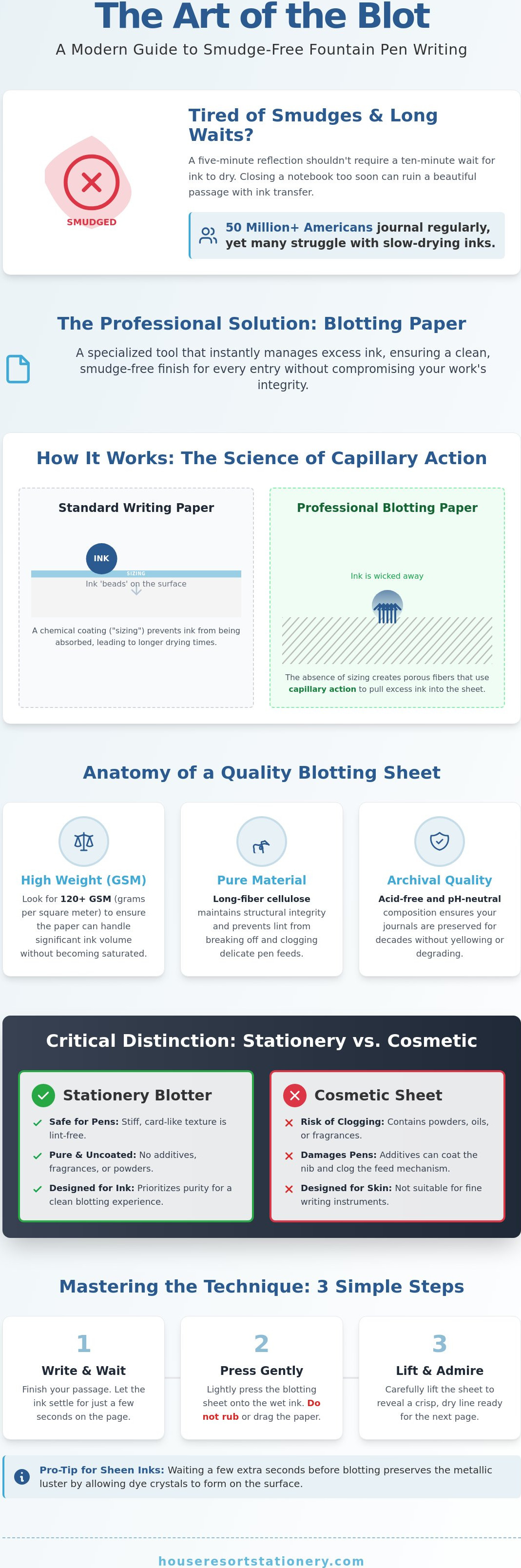
We agree that the tactile joy of fountain pens shouldn't be overshadowed by the fear of a smudged signature or a stained page. ZipDo reports that an estimated 50 million Americans engage in regular journaling, yet many still struggle with the limitations of slow-drying inks on premium paper. By choosing the right absorbent materials, you'll maintain a faster writing pace and ensure the archival preservation of your notebooks. This guide identifies professional-grade sheets for premium papers and examines 2026 market trends to ensure a clean, smudge-free finish for every entry.
Key Takeaways
- Understand how unsized, high-porosity paper utilizes capillary action to draw excess ink away from premium journal pages.
- Master the timing of your blot to maintain the visual richness of high-sheen inks while preventing accidental transfer.
- Protect your fountain pen feeds by avoiding lint-heavy household alternatives that risk clogging delicate internal mechanisms.
- Learn how to select the correct weight and color of blotting paper sheets to complement your specific writing style and ink collection.
What are Blotting Paper Sheets for Writing?
Blotting paper is a specialized, unsized medium characterized by its high porosity and exceptional liquid absorption. While standard writing paper features a chemical coating known as "sizing" to prevent ink from spreading, professional-grade blotting paper sheets intentionally omit this barrier. This allows the paper matrix to pull excess liquid into its fibers through capillary action. For the analog enthusiast, this tool represents the difference between a pristine document and a smudged catastrophe. It is a functional necessity for anyone who values the tactile experience of a wet fountain pen nib on premium paper.
Historians observe that the practice of drying wet ink has evolved significantly over centuries. Before the widespread adoption of absorbent paper, writers used "pounce" or sand-casters to dry their work. Blotting paper eventually replaced these abrasive methods; providing a cleaner and more efficient way to manage liquid ink. This transition marked a shift toward the archival quality we value in modern stationery. By the mid-19th century, the paper blotter became a standard desk accessory, evolving from a purely functional item into a refined tool for collectors and professionals alike.
Today's fountain pen revival has reintroduced the need for this vintage staple. Modern "wet" nibs and high-sheen inks often require longer drying times on non-absorbent premium papers. If you close a notebook too soon, you risk ghosting or transfer that ruins hours of work. Using an absorbent sheet provides an immediate solution, allowing you to move through your journaling workflow without the frustration of forced pauses.
The Anatomy of a Quality Blotting Sheet
Professional sheets are defined by their weight and material composition. Most high-quality options range around 120 GSM or higher to ensure they can handle significant ink volume without becoming saturated. Meticulous manufacturers utilize long-fiber cellulose to maintain structural integrity. This is vital because short, cheap fibers can break off and enter the delicate feed of a fountain pen. Additionally, selecting acid-free and pH-neutral materials ensures that your journals remain preserved for decades without yellowing or degrading over time.
Stationery vs. Cosmetic Blotting: A Critical Distinction
It is a common mistake to assume that cosmetic oil-absorbing sheets are interchangeable with stationery tools. Facial sheets often contain fragrances, powders, or mineral oils designed for skincare. These additives can coat a fountain pen nib or clog the feed mechanism, leading to poor ink flow and skipped lines. Stationery-grade blotting paper sheets are easily identified by their stiff, card-like texture and lack of chemical coatings. They prioritize the purity of the paper to ensure a clean, lint-free experience every time you press them to the page.
The Science of Ink Absorption and Capillary Action
Capillary action is the silent engine behind every successful blot. It occurs when the adhesion of a liquid to the walls of a narrow tube is stronger than the cohesive forces between the liquid molecules. In professional blotting paper sheets, the absence of sizing creates millions of these microscopic channels within the cellulose fibers. This structural void allows the paper to "wick" away excess moisture with surgical precision. While standard stationery uses sizing to keep ink on the surface, blotting paper relies on the lack of it to protect your work.
When writing on premium, hard-surfaced papers, ink often sits in a "bead" on top of the page. This is particularly true for high-saturation fluids like pilot iroshizuku bottled ink. These inks are celebrated for their vibrant colors and complex shading, but their high dye concentration means they remain wet for significantly longer. A well-timed blot removes the risk of a smear while allowing the underlying color to bond with the page. This process is essential when using broad or stub nibs that lay down a heavy volume of liquid.
How Blotting Affects Ink Characteristics
A common concern among collectors is whether blotting destroys the unique properties of boutique inks. Sheen is the result of dye crystals forming on the paper surface as the solvent evaporates. If you blot immediately, you may lift the very components that create that metallic luster. The goal is to wait just long enough for the primary layer to set. Over-blotting can lead to faded lines or ghosting, as you're essentially stripping the pigment from the paper's surface. Precision is key to maintaining the aesthetic depth of your fine fountain pens and their respective inks. Many enthusiasts find that a light "touch" blot preserves shading while removing the surface moisture that causes transfer.
Absorbency Levels: Cotton vs. Wood Pulp
The material composition of your sheet dictates its performance. 100% cotton linters offer the highest absorbency capacity and are generally favored for their soft, lint-free texture. Wood pulp sheets are a more accessible alternative, though they are often thinner and may saturate quickly. To test a sheet's quality, place a single drop of water on a corner. A superior sheet will pull the moisture outward in a perfect circle within seconds. If the water beads or sits on top, the sheet lacks the necessary porosity for heavy ink flow. This simple test ensures your chosen tool won't fail you during an important signing or journaling session.
How to Use Blotting Paper Sheets: A Step-by-Step Guide
Using blotting paper sheets correctly requires more than just a quick pat on the page. It's a deliberate practice. It ensures your thoughts remain crisp and your journals stay pristine. Before you begin, clear your desk of any loose debris that might catch on the paper fibers. A clean environment prevents unwanted texture from interfering with the ink absorption process. This preparation is the first step toward a professional finish.
- Timing the blot. Don't act the millisecond the nib leaves the paper. For high-sheen inks, allow five to ten seconds for the primary layer to settle. This brief pause lets the ink bond with the page fibers while keeping the excess liquid on the surface ready for removal.
- The "Press and Lift" technique. When using loose blotting paper sheets, place the sheet flat over the wet text. Apply gentle, even pressure with your palm. Don't rub or slide the sheet. Sliding creates the very smears you're trying to avoid. Lift the sheet straight up to reveal a dry, clean finish.
- Post-blot storage. An often overlooked step is how you handle the sheet after it's done its job. Designate an ink-side and a clean-side to prevent accidental transfer. Many collectors keep a small folder or a dedicated pocket in their planner for this purpose.
Using Sheets as Journal Interleaving
Interleaving is the practice of placing a protective layer between pages to prevent ink transfer. You can easily cut your sheets to fit specific notebook dimensions. This is particularly effective for modular systems like traveler's notebooks, where the thin paper is prone to ghosting. By keeping a sheet between your current and previous entries, you create a permanent barrier. It protects your archival work from the pressure of a closed book and keeps your writing space organized.
The Blotting Rocker Technique
For those who prefer a more traditional aesthetic, a wooden blotting rocker is the gold standard. To install a new sheet, unscrew the handle and wrap the paper tightly around the curved base. The rocking motion is a smooth, side-to-side roll that applies consistent pressure without the risk of dragging. This tool is superior for correspondence and signatures because it handles concentrated pools of ink with ease. It's a rhythmic, satisfying conclusion to any writing session. The rocker turns a functional chore into a moment of analog appreciation.
Blotting Paper vs. Household Alternatives
Reaching for a paper towel in a moment of ink-induced panic is a common mistake. It is often called the "Paper Towel Trap." While these household items are designed for kitchen spills, they lack the refinement required for fine stationery. The embossed texture of a paper towel can actually push wet ink into the surrounding paper fibers. This causes feathering rather than a clean lift. Professional blotting paper sheets provide a flat, uniform surface that draws liquid vertically without disturbing the letterforms. They are engineered to be a precision tool; not a generic absorbent.
The risk of using alternatives extends beyond the page itself. Tissues and napkins are engineered to break down easily, which means they shed microscopic lint. These fibers are the natural enemy of a precision instrument like a twsbi fountain pen. When lint enters the feed or gets caught between the tines of the nib, it disrupts the capillary flow of the ink. This leads to frustrating skips and a scratchy writing experience. Using dedicated tools ensures your collection remains in peak condition for years of reliable service.
Why Household Paper Fails the Fountain Pen Test
Micro-fibers act like tiny wedges that can slowly misalign your nib tines over time. This "dust factor" is invisible to the naked eye but felt in every stroke. Many household papers also lack the density to stop ink from bleeding through to the next page. They are too porous in the wrong way; acting as a bridge for the ink rather than a reservoir. For those investing in luxury writing tools, specialized blotting paper is a non-negotiable requirement for maintaining equipment health and page clarity.
Cost-Per-Use: The Longevity of Professional Sheets
The economic argument for professional materials is surprisingly strong. A single sheet can be used dozens of times before it reaches full saturation. You don't need a fresh sheet for every word. Instead, you can move to a clean spot on the paper until the entire surface is patterned with dried ink. This longevity makes a small pack of blotting paper sheets far more sustainable and cost-effective than a roll of disposable towels. When the paper no longer pulls moisture instantly or begins to transfer old ink back onto the page, you'll know it's time for a replacement. Explore our curated selection of high-quality journals and planners to find the perfect companion for your writing ritual.
Selecting the Best Blotting Paper for Your Collection
Choosing the right blotting paper sheets depends entirely on your specific ink and paper combination. If you favor a "wet" writer with a broad nib, you'll require a higher absorption capacity to handle the increased fluid volume. Conversely, those using finer nibs on more absorbent paper may prefer a lighter, more portable sheet. The selection process is a balancing act between functional necessity and the aesthetic harmony of your desk setup. Heritage matters here. The choice is personal.
Color choices often serve both practical and traditional purposes. White sheets offer the highest contrast. They allow you to see exactly how much ink is lifted from the page. Pink blotting paper is a nod to heritage stationery, often preferred by those who enjoy the historical weight of the analog experience. Ivory sheets are a sophisticated choice for enthusiasts who use cream-colored paper. They maintain a consistent visual tone within a journal or planner without the harsh contrast of bright white.
Weight and Thickness: Finding Your "Sweet Spot"
The thickness of your paper is measured in grams per square meter (GSM). For daily journaling, lightweight sheets ranging from 120 to 140 GSM are ideal. These are thin enough to act as interleaving without adding unnecessary bulk to your notebook. If you use a desktop rocker, look for heavyweight sheets of 200 GSM or more. Before installing a sheet into a rocker, perform a "Flex Test." Gently bend the paper. Ensure it has the structural integrity to curve without cracking or losing its absorbent properties. This ensures a smooth, rolling blot every time.
Curating Your Desk: Heritage Brands at HouseResort Stationery
Heritage manufacturers from Japan and Europe lead the market because they prioritize fiber purity. Japanese makers often focus on high-performance, thin fibers that excel with chromatography-rich inks. European brands frequently emphasize traditional cotton compositions that offer a soft, luxurious feel. We select specific manufacturers for our curated catalog based on their commitment to archival quality and craftsmanship. This ensures that every tool you use enhances the ritual of writing rather than complicating it. Explore our curated selection of writing accessories to find the perfect match for your collection. Whether you're a seasoned collector or a new enthusiast, the right blotting paper is the final touch in a well-organized writing experience.
Elevating Your Analog Ritual
Mastery over ink dynamics is a skill that distinguishes the casual writer from the dedicated connoisseur. By understanding the capillary action of professional-grade materials and adopting the precise "press and lift" technique, you protect your journals from the frustration of smudges and transfer. High-quality blotting paper sheets are more than a functional necessity; they're a bridge between traditional craftsmanship and modern efficiency. These tools ensure that your reflections remain as crisp and clear as the moment they were written.
HouseResort Stationery is an authorized retailer of premium brands, providing a boutique experience for those who value the tactile nature of handwriting. Our inventory is expertly curated for fountain pen enthusiasts who demand both aesthetic beauty and archival reliability. We provide fast shipping across the United States to ensure your desk is always equipped with the finest materials. Your writing deserves the clarity and permanence that only the right tools can provide. Shop Our Curated Collection of Fine Writing Accessories today and experience the satisfaction of a truly clean page. We're here to help you refine every stroke of your creative journey.
Frequently Asked Questions
Can I reuse blotting paper sheets multiple times?
Yes, you can reuse these sheets until the fibers are fully saturated with dried ink. Simply move to a clean, unused section of the paper for each new application. You'll know it is time to replace your blotting paper sheets when they no longer pull moisture instantly or if they begin to transfer old ink back onto your clean pages.
Does blotting paper change the color of fountain pen ink?
Blotting does not chemically alter the ink's hue, but it can impact the visual depth of specific boutique fluids. By lifting the excess liquid, you might reduce the intensity of "sheen" or "shading" effects that rely on a heavy accumulation of pigment. The underlying color remains consistent, though the finish may appear slightly more matte than a naturally dried line.
Is blotting paper the same as watercolor paper?
No, they are engineered for different artistic requirements. Watercolor paper is often sized with gelatin or starch to allow for pigment manipulation and layering. Blotting paper is intentionally unsized to maximize its porosity. This lack of sizing ensures the paper pulls liquid deep into its matrix immediately upon contact, which is the opposite of the "workable" surface watercolorists need.
How do I know if my blotting paper is acid-free?
Check the manufacturer's technical specifications for a "pH-neutral" or "acid-free" label. Most premium brands curated for fountain pen enthusiasts prioritize archival safety. Using acid-free materials is vital for long-term journaling. It prevents the yellowing and fiber degradation that can occur when acidic materials press against your notebook pages for extended periods.
Can I use blotting paper with gel pens or rollerballs?
Yes, these tools are highly effective for any liquid-based writing system. While gel pens generally dry faster than fountain pens, they can still smear on non-porous, coated papers. A quick press with blotting paper sheets ensures a clean finish for signatures or quick notes in a planner. It is a versatile accessory for any heavy-flowing ink instrument.
Where do I store my blotting sheets when not in use?
Store your sheets in a flat, dry environment like a dedicated folder or the back pocket of your notebook. Keeping them away from humidity is essential to maintain their absorbent properties. Many writers keep a single sheet as an interleaving bookmark between their most recent pages. This provides immediate protection and easy access during a writing session.
Will blotting paper scratch my fountain pen nib?
Professional blotting paper is made from soft cellulose or cotton fibers and will not scratch your nib. The surface is designed to be gentle on delicate metal tines. Always ensure your sheet is free of desk debris or grit before use. Using dedicated stationery materials avoids the abrasive textures found in some recycled household papers or rough towels.
Why is some blotting paper pink?
The pink color is a traditional aesthetic that dates back to the 19th century. Historically, this distinct shade helped writers distinguish their absorbent sheets from standard white writing paper on a crowded desk. Today, it remains a popular choice for collectors who appreciate the heritage and vintage ritual of a well-organized analog workspace.