
Pilot Iroshizuku Bottled Ink: The Definitive Connoisseur’s Guide for 2026
The physical sensation of a nib gliding across paper changes entirely when you transition to pilot iroshizuku bottled ink. It's more than a dye. This collection acts like a high-performance lubricant, transforming even temperamental pens into reliable instruments. For the collector, choosing a shade is a ritual that balances technical precision with the evocative beauty of the Japanese landscape.
You likely appreciate fine analog tools but worry about clogging a prized heirloom or choosing the wrong shade from a catalog of twenty-four poetic names. This guide demystifies the lineup for 2026. You'll learn to select a "safe" first color that performs beautifully on your favorite journals and planners. We'll explore the chemistry behind its legendary flow, introduce the latest additions like Syun-gyo and Rikka, and show you how to use the iconic 50ml bottle effectively. It's time to elevate your writing ritual.
Key Takeaways
- Uncover the poetic origins of the Iroshizuku name and how Pilot’s century of heritage informs their meticulous manufacturing process.
- Understand why the PH-neutral composition of pilot iroshizuku bottled ink ensures long-term safety for your most valuable vintage and modern pens.
- Identify the "Big Three" starter shades, Kon-peki, Tsuki-yo, and Take-sumi, to establish a versatile foundation for your personal collection.
- Learn the technical synergy between high-flow Japanese inks and premium papers like Tomoe River to unlock maximum color depth and shading.
- Gain practical tips for using the hand-blown bottle’s internal V-shaped well to make the filling process efficient and mess-free.
What is Pilot Iroshizuku Bottled Ink?
The name itself reveals the brand's intent. "Iro" translates to coloring, while "Shizuku" signifies a droplet. Together, they represent a philosophy where every drop of ink carries the weight of Japanese aesthetic tradition. This isn't a happy accident of marketing. The Pilot Corporation, established in Tokyo in 1918, spent decades perfecting the chemistry of writing before launching this premium line. While their standard offerings focus on utilitarian reliability, pilot iroshizuku bottled ink is designed for the enthusiast who views writing as a tactile ritual. It's earned its reputation as the gold standard of luxury inks through a combination of high-performance flow and a sophisticated color palette that mimics the natural world.
The Philosophy of Japanese Landscape Colors
The core collection consists of 24 standard colors, each pulling directly from the scenery of Japan. Whether it's the vibrant blue of a summer sky or the deep green of a forest floor, the chemistry is tuned to evoke a specific mood. These aren't just pigments. They're emotional writing tools. Pilot chose to keep the primary names in Japanese, such as Kon-peki or Shin-kai, to maintain the cultural connection to the landscapes that inspired them. This decision forces the writer to slow down and engage with the heritage of the tool. In a fast-paced digital era, this intentionality makes each bottle feel like a curated artifact rather than a mass-produced consumable.
The Premium Positioning in the Stationery World
Distinguishing between standard Pilot Namiki ink and the Iroshizuku line is essential for any collector. Standard inks are functional; they're made for office work and student notebooks. Iroshizuku is a different beast altogether. It features a specific pH-neutral formula that behaves beautifully in both modern and vintage pens. As we see a massive analog revival in 2026, more writers are seeking these premium experiences. Because of this high demand, it's vital to purchase from an authorized retailer of fine fountain pens and journals. The market has seen an influx of diluted or counterfeit products; an authorized source ensures you're getting the genuine, high-lubricity formula that Pilot intended. This ink isn't just a liquid. It's the primary component that determines how your nib interacts with the page.
Technical Performance: Why Iroshizuku is "Well-Behaved"
Enthusiasts often describe an ink as "well-behaved" but rarely explain the technical reality behind that phrase. With pilot iroshizuku bottled ink, this behavior is a result of precise Japanese engineering. It isn't just about the aesthetic of the color. It's about how the liquid moves through the feed of your pen. While traditional Japanese ink historically relied on animal glues and soot for calligraphy, modern Iroshizuku uses advanced surfactants to manage surface tension. This creates a lubrication effect that significantly reduces friction between the metal nib and the paper fibers.
This lubrication is why Iroshizuku is the industry's favorite troubleshooting ink. If you have a pen that feels "scratchy" or suffers from "hard starts," this is the formula that usually fixes the issue. It's also remarkably safe. The PH-neutral composition means you don't have to worry about it corroding the internal components of a 1950s vintage heirloom or a modern luxury Namiki. Maintenance is simple. Unlike pigmented or iron gall inks that leave stubborn residue, these dye-based formulas flush out with plain water, making them ideal for collectors who enjoy rotating through different shades frequently.
The Lubrication Effect on Fountain Pen Nibs
The chemistry inside each bottle acts as a microscopic buffer. When the nib touches the page, the ink creates a layer that allows the point to glide rather than drag. Flow is the rate of capillary action. Because pilot iroshizuku bottled ink has such high flow, it saturates the feed quickly and provides a consistent line even in pens with tight tolerances. It effectively turns a mediocre writing experience into a professional one by compensating for minor nib misalignments.
Dry Time and Smudge Resistance
High-flow inks often require a slight adjustment in your writing habits. A fine nib might dry in under ten seconds, but a broad or stub nib laying down a heavy line of saturated Yama-budo will take longer. This is particularly true on non-absorbent, high-quality papers. If you're using a wet writer, you might consider Using Blotting Paper to Prevent Fountain Pen Smudging when you need to close your journal quickly. To ensure the best results, we suggest pairing these inks with the curated journals and notebooks available in our boutique, which are specifically chosen for their ink-handling properties.
Navigating the Palette: Choosing Your First Iroshizuku Color
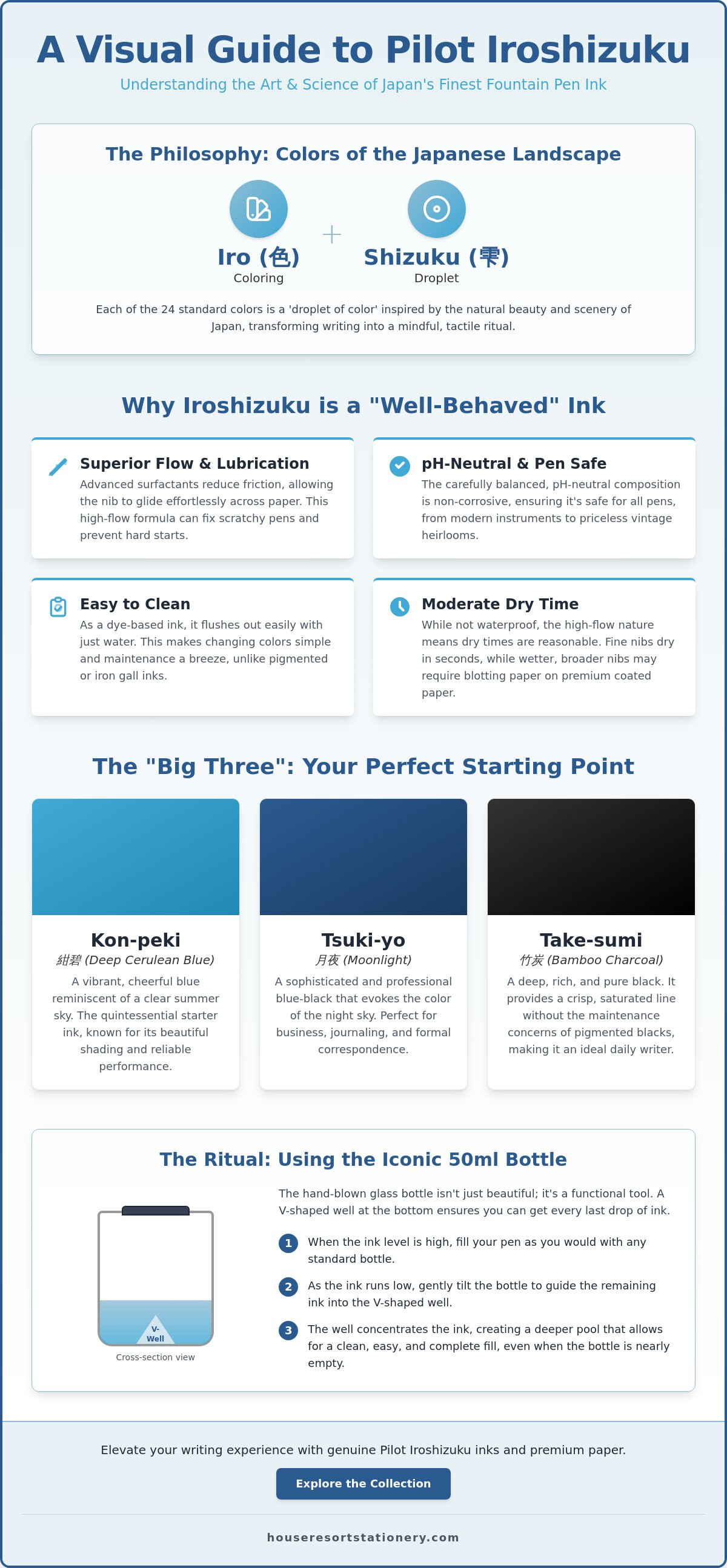
Selecting a single bottle from a collection of twenty-four distinct shades can feel daunting. The sheer variety of Japanese landscape-inspired tones is designed to accommodate every writing mood, from formal correspondence to creative journaling. For those beginning their collection, we recommend starting with the "Big Three." These foundational colors represent the core DNA of pilot iroshizuku bottled ink: Kon-peki (Cerulean Blue), Tsuki-yo (Moonlight), and Take-sumi (Bamboo Charcoal). These shades are celebrated for their extreme reliability and high-contrast legibility on almost any paper stock.
Beyond these starters, you can categorize the palette by the emotional resonance of the writing task. Professional settings demand clarity and permanence, while creative sessions allow for the exploration of sheen and shading. For a deeper look at the cultural significance of these choices, see our Pilot Iroshizuku: The Ultimate Guide to Japan’s Most Iconic Fountain Pen Ink (2026). Choosing the right shade is about more than just color; it's about matching the ink's personality to your specific ritual.
Professional Blues and Blacks
Kon-peki remains the most famous azure in the world. It provides a vibrant, cheerful blue that stays professional without being boring. If you prefer a more traditional office blue, Asa-gao (Morning Glory) offers a deeper, royal tone. For those who require absolute formality, Take-sumi is a rich, neutral black that avoids the grey undertones found in cheaper alternatives. If you want a hint of mystery, Shin-kai (Deep Sea) transitions from a wet blue to a dry, sophisticated grey-blue that mimics the ocean's depths.
Vibrant and Creative Shades
Creative writing benefits from inks that show "character." Yama-budo (Crimson Glory Vine) is legendary for its deep burgundy color and its ability to produce a bright gold sheen on high-quality paper. If you prefer greens, Chiku-rin (Bamboo Forest) offers incredible shading. Shading occurs when the ink pools at the end of a stroke, creating a gradient from light to dark green. For a balanced teal, Ku-jaku (Peacock) provides both shading and a subtle red sheen. These inks transform a standard letter into a visual experience. As you plan your 2026 rotation, consider using Rikka (Vibrant Blue) for the cool winter months and Syun-gyo (Black Cherry) to celebrate the arrival of spring.
Paper and Nib Pairings for Optimal Results
The performance of pilot iroshizuku bottled ink is deeply tied to the surface it touches. Because this formula features high lubricity and superior flow, it requires a paper that can manage its "wet" nature. Standard office paper is often too absorbent; its loose fibers pull the ink deep into the page, which causes feathering and bleed-through. To unlock the true potential of the 2026 color palette, you must pair these inks with paper that has a specific surface sizing. This sizing allows the ink to sit on the page momentarily before drying, which is exactly what creates the legendary sheen and shading enthusiasts expect from a premium Japanese product.
Pairing the right nib with the right paper is a technical balancing act. A high-flow ink like Iroshizuku can make a scratchy nib feel smooth, but it can also make a broad nib feel uncontrollable on low-quality journals. Understanding how Japanese nibs differ from European ones is the first step. Generally, a Japanese Medium nib (like those from Pilot) writes a line similar to a European Fine. This distinction is vital when you're trying to calculate ink consumption and dry times for your daily writing ritual.
Pairing with Midori and Traveler’s Notebooks
Midori MD paper is perhaps the most reliable companion for pilot iroshizuku bottled ink. Its cream-colored finish complements the natural landscape tones of the collection, and its resistance to ghosting is unmatched. For those who prefer a modular system, the Traveler’s Notebook refills offer various paper weights. The lightweight paper inserts are particularly famous for showing off the "sheen" in colors like Yama-budo. If you're new to these systems, explore The Traveler’s Notebook Starter Kit: A Comprehensive Guide to Modular Journaling to find the best configuration for your needs.
Nib Size Considerations
Your nib choice determines how much "character" the ink displays. Extra Fine (EF) nibs are excellent for precision and prevent feathering on less-than-ideal paper, but they often hide the subtle shading of lighter colors. To see the full gradient of a shade like Chiku-rin, you should utilize Broad (B) or Stub nibs. Wider nibs lay down more "wet" ink, which allows the pigments to pool at the end of each stroke. This pooling is what creates the beautiful light-to-dark transition known as shading. If you're ready to upgrade your setup, we invite you to browse our boutique's collection of fine fountain pens and journals to find a pairing that fits your hand perfectly.
The Ritual: Using and Storing Your Glass Bottle
The experience of using pilot iroshizuku bottled ink extends beyond the writing itself; it begins with the physical interaction with the vessel. For many collectors, the heavy, hand-blown glass bottle is a centerpiece of the desk. While competitors often focus purely on the aesthetic of their packaging, Pilot has integrated specific mechanical advantages into their design. Whether you are using the standard 24-color collection in 50ml bottles or the 15ml "mini" versions, the glass serves as a protective environment for the sophisticated chemistry within. Proper handling ensures that the ink remains uncontaminated and vibrant for years of use.
Understanding the ergonomics of these bottles is essential for the modern connoisseur. For those building a diverse library of shades in 2026, the 15ml bottles offer a way to experiment with high-sheen or vibrant colors without a significant volume commitment. However, the 50ml bottle remains the definitive choice for daily writers due to its unique internal geometry. Managing your collection effectively requires a balance of proper hygiene and strategic storage to maintain the ink's legendary flow properties.
The Functional Elegance of the 50ml Bottle
The "divot" at the bottom of the 50ml bottle is a masterclass in functional design. This V-shaped internal well is specifically engineered to solve the problem of low ink levels. When the bottle is nearly empty, you simply cap it tightly, tip it forward, and then return it to an upright position. The ink collects in the narrow well, providing enough depth for even the largest fountain pen nibs to achieve a full submerged fill. This design minimizes waste and allows you to enjoy every last drop of pilot iroshizuku bottled ink without needing to decant into smaller containers. It is a thoughtful detail that respects the value of the material and the time of the writer.
Long-term Ink Care
Proper storage is the only way to protect the delicate dye balance of your ink. UV light is the primary enemy of ink longevity; it can cause vibrant blues to fade or complex greens to shift in hue. We recommend keeping your bottles in their original silver and white boxes or inside a dark drawer when not in use. Maintaining hygiene is equally vital to prevent "Slime in the Bottle" (SITB), which occurs when mold or bacteria are introduced via a dirty nib. Always ensure your pen is clean before dipping it into the bottle. For those who frequently travel, decanting small amounts into sample vials is a safer alternative than carrying the glass bottles.
Building a collection of high-performance tools is a journey that requires the right resources. To find the best accessories to complement your ink, consult our Japanese Stationery Online Store Guide: Essential Tools for your 2026 Collection. As an authorized retailer of fine fountain pens and journals, we curate only the items that meet the standards of the most discerning enthusiasts.
Elevating Your 2026 Writing Ritual
The transition to pilot iroshizuku bottled ink is a commitment to the tactile quality of your analog experience. You've discovered how the specific lubrication effect can revive a dry nib and how the V-shaped well of the iconic bottle ensures you use every drop. By pairing these Japanese landscape-inspired colors with high-quality paper, you transform a simple note into a sophisticated ritual that respects the heritage of the craft.
As an Authorized Pilot Retailer, HouseResort Stationery provides the expert curation you need to build a meaningful collection. We focus on heritage manufacturers and offer fast national shipping so your desk is always equipped with the finest materials. Whether you're starting with a foundational blue or exploring a creative, high-sheen burgundy, the right chemistry makes your writing feel effortless.
Explore the Curated Pilot Iroshizuku Collection at HouseResort Stationery and select the next shade for your fountain pen. Your favorite tools deserve the gold standard of Japanese engineering. Enjoy the process of finding a color that truly speaks to your personal style.
Frequently Asked Questions
Is Pilot Iroshizuku ink waterproof or document-safe?
Most pilot iroshizuku bottled ink colors are not waterproof or document-safe because they utilize a dye-based formula. These inks prioritize vibrant color and superior flow over permanent water resistance. If your writing gets wet, the ink will likely smudge or wash away. For archival documents or legal signatures, we suggest checking specialized permanent inks instead of these landscape-inspired shades.
Can I use Iroshizuku ink in non-Pilot fountain pens?
You can safely use these inks in any fountain pen from any manufacturer. The PH-neutral composition ensures it won't damage modern or vintage components. Many enthusiasts actually use it to improve the performance of European pens that feel too dry. It is a universal solution for anyone seeking a smoother writing experience regardless of the brand of pen they choose to carry.
Why is Pilot Iroshizuku more expensive than other bottled inks?
The premium cost reflects the high-purity ingredients and the sophisticated engineering behind the lubrication formula. Unlike standard utility inks, this line uses complex dye blends to achieve unique shading and sheen. Additionally, the heavy glass bottle with its functional internal well adds to the manufacturing expense. You are investing in a product that acts as both a high-performance tool and a decorative desk artifact.
Does Pilot Iroshizuku ink expire or go bad over time?
Fountain pen ink doesn't have a formal expiration date, but it can degrade if stored improperly. If you keep the bottle away from direct sunlight and extreme temperatures, it should remain usable for many years. Always check for a strange smell or floating particles before filling your pen. Proper hygiene is the best way to ensure your pilot iroshizuku bottled ink stays fresh and free of contaminants.
Which Iroshizuku color is best for everyday office use?
Take-sumi (Bamboo Charcoal) and Shin-kai (Deep Sea) are the most reliable choices for professional environments. Take-sumi offers a neutral, deep black that looks formal on any document. Shin-kai provides a sophisticated blue-black tone that is interesting but still conservative enough for corporate settings. Both shades offer high contrast and reliable dry times on standard business stationery and planners.
Will Iroshizuku ink stain my clear demonstrator fountain pen?
Most colors in this collection are very easy to clean and won't stain clear demonstrator pens. However, highly saturated shades like Yama-budo or vibrant reds can occasionally leave a temporary tint on internal plastic parts. This is usually solved by a thorough flush with water or a mild pen cleaning solution. If you're concerned about staining, we recommend sticking to the lighter blues and greens for your clear pens.
What is the difference between the 50ml and 15ml bottles?
The primary difference is the volume and the bottle design. The 50ml bottle features the iconic V-shaped internal well that helps you fill your pen when the ink level is low. The 15ml "mini" bottles are simpler glass cylinders without that specific internal well. These smaller sizes are ideal for building a diverse palette of colors without committing to a full volume for every shade.
How do I clean my pen after using highly saturated Iroshizuku colors?
Cleaning your pen is straightforward because these inks are dye-based rather than pigmented. Simply flush the nib and converter with room-temperature water until it runs clear. For more saturated shades like Ku-jaku, you might need to repeat the process a few extra times. Avoid using hot water or harsh chemicals, as the PH-neutral formula is designed to rinse away easily with standard maintenance routines.