
The Anatomy of a Fountain Pen: Parts and Functions Explained (2026 Edition)
What if your most effective tool for deep work wasn't a digital distraction, but a precision-engineered instrument from a global market now valued at $1.05 billion? For many enthusiasts, the transition from a standard ballpoint to a heritage brand like Kaweco or J. Herbin feels like entering a new world of tactile luxury. You probably already value the ritual of writing on the improved 2026 Tomoe River paper, but having the parts of a fountain pen explained is the only way to truly master the medium. It's common to worry about damaging a specialized tool or feeling lost when a retailer asks about your preferred filling system.
Understanding these mechanics removes that barrier, turning a complex object into a familiar companion. This article promises to decode the intricate components that make these pens the ultimate vehicle for analog expression. We'll examine the specific roles of the nib, feed, and reservoir. You'll also learn the functional differences between a $6.00 Lamy Z 28 converter and the integrated piston fillers found in the latest TWSBI Eco models. By the end, you'll have the fluency to shop for premium brands and the confidence to perform basic maintenance on your collection.
Key Takeaways
- Learn why treating your writing instrument as a precision tool transforms every note into a curated analog escape.
- Understand the engineering behind the nib and feed to ensure consistent ink flow and a smoother writing experience.
- Master the parts of a fountain pen explained by comparing the modern convenience of cartridges with the heritage mechanics of integrated filling systems.
- Discover how specific barrel materials and section designs impact your grip and long-term ergonomic comfort.
- Identify the role of the inner cap in maintaining an airtight seal to protect your nib and prevent ink from drying out.
The Core Anatomy: Why Understanding Fountain Pen Parts Matters
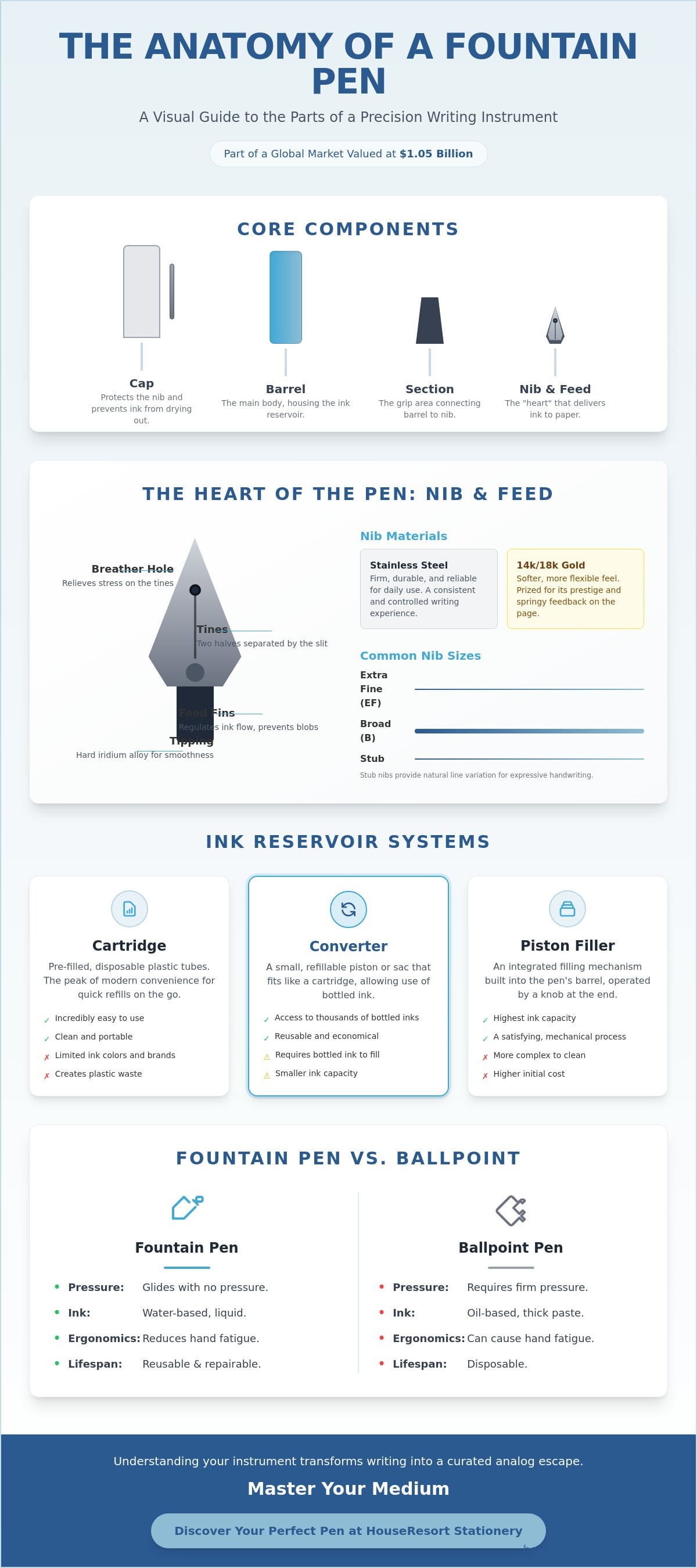
A fountain pen is a precision instrument that uses a sophisticated liquid ink delivery system to provide a superior writing experience. Unlike mass produced tools, these pens are curated assemblies designed for longevity and a specific tactile feel. Having the parts of a fountain pen explained is the first step toward mastering your collection and embracing a true analog escape. This knowledge moves you beyond a simple transaction and into a shared passion for heritage craftsmanship. By understanding how the three primary assemblies, the Cap, the Barrel, and the Grip Section, interact, you gain the ability to maintain your tools for decades. This anatomical fluency is essential for troubleshooting minor issues and ensuring your pen remains a reliable companion for deep work. As the global market reached a $1.05 billion valuation in 2024, more enthusiasts are discovering that these instruments offer a level of intentionality that digital tools cannot replicate.
The Fountain Pen vs. The Ballpoint
The fundamental difference between these two tools lies in the pressure required to write. A ballpoint pen uses a thick, oil based ink that requires the writer to press down firmly to rotate an internal ball. The history of the fountain pen shows a reliance on water based ink and capillary action to glide across the page. This lack of pressure is a significant ergonomic advantage that prevents hand fatigue during long sessions. Fountain pens are also inherently modular. While you discard a plastic ballpoint when the ink runs out, a fountain pen is designed for repair and customization. You can replace a damaged nib or swap a converter easily. This heritage aspect ensures that your investment, whether it is a $29.60 Lamy Safari or a luxury gold nib model, remains a permanent fixture of your desk.
A Boutique Perspective on Craftsmanship
Choosing a writing instrument is an exercise in curation. At HouseResort Stationery, we believe that every component serves an aesthetic and functional purpose. Heritage brands like Kaweco or Lamy prioritize specific part designs that define their brand identity. For example, the Lamy Safari has used the same robust, functional architecture since 1980, while the 2026 Special Edition in Neon Yellow continues this legacy. When you buy from an authorized retailer like HouseResort Stationery, you are guaranteed authentic parts that fit perfectly. This commitment to quality ensures your pen works harmoniously with your journals and planners. Every brass sharpener, leather cover, and nib assembly contributes to a writing experience that is both professional and deeply personal. 🎁
The Nib and Feed: Engineering the Perfect Ink Flow
The nib is the metal heart of the pen. It's the only part that makes contact with your paper. While earlier sections introduced the general assemblies, having the parts of a fountain pen explained at this granular level reveals the true complexity of heritage engineering. The nib consists of two tines separated by a narrow slit. This slit allows ink to travel from the reservoir to the tip via capillary action. A small circular opening called the breather hole sits at the end of the slit. It acts as a stress relief point for the metal tines, preventing them from cracking under the pressure of your unique writing style. Underneath the nib lies the feed, a critical component made of plastic or ebonite that manages the delicate exchange of ink and air. Without a properly designed feed, your pen would either leak or fail to write entirely.
Nib Materials and Sizes
Stainless steel nibs offer a firm, durable experience for daily note-taking. These are common in entry-level heritage pens and provide a reliable, consistent line. In contrast, 14kt or 18kt gold nibs provide a softer, more flexible feel that many collectors prize for its prestige and springy feedback. Every nib features a hard metal pellet at the tip, usually an iridium alloy, which ensures a smooth glide across high-quality paper. You can choose from various sizes, including Extra Fine (EF) for precise planning or Broad (B) for bold signatures. Specialty stub nibs are also available for those who want to add natural line variation to their journals. This variety allows you to customize the tool to your specific hand pressure and paper choice.
The Mechanics of the Feed
The feed is responsible for preventing blobbing by regulating the flow of liquid. It features visible ridges known as fins that act as a temporary overflow reservoir. These fins hold excess ink during changes in temperature or air pressure, keeping the ink from dripping onto the page. An internal air channel is equally important; air must enter the pen as ink leaves to prevent a vacuum from stopping the flow. This precision is a hallmark of the manufacturers we feature. You can explore these technical details further in our Japanese stationery online store guide. If you're looking for a new instrument, browse our curated collection of fine writing instruments at HouseResort Stationery. 🎁
Choosing between a plastic and an ebonite feed can also change your experience. Plastic feeds are injection-molded for extreme consistency, while ebonite feeds are often preferred by enthusiasts for their superior ink-clinging properties. This technical knowledge helps you understand why some pens feel wetter than others. By mastering how the nib and feed interact, you'll gain a deeper appreciation for the tactile nature of your analog tools. This understanding is essential for any collector who views their stationery as more than just a simple transaction.
Section and Barrel: The Tactile Experience of Fine Materials
While the nib and feed manage the internal flow, the section and barrel define the physical connection between the writer and the instrument. Having the parts of a fountain pen explained involves more than just listing components; it's about understanding how materials like brass or high-grade resin influence the balance of your tool. The grip section is the specific area where your fingers rest, while the barrel serves as the protective housing for the internal reservoir. Securing these two assemblies are the threads, the screw-like grooves that ensure an airtight seal when the pen is capped. The design of these exterior parts directly impacts how fountain pens work during long writing sessions. A heavy brass barrel shifts the center of gravity toward the back, which might feel substantial but can lead to fatigue if the pen is posted. In contrast, a lightweight plastic barrel, like those found on the Lamy Safari, offers a nimble feel for quick notes in your planners.
The Grip Section and Ergonomics
The grip section comes in various shapes to accommodate different hand sizes. Some writers prefer a flared section that prevents fingers from sliding toward the nib, while others look for a straight section for more flexible positioning. Pay attention to the "step," the transition point between the barrel and the section. If you hold your pen further back, a sharp step can cause discomfort after twenty minutes of writing. Material choice here is critical for the enthusiast. A textured metal grip provides extra friction for those with a firm hold, while smooth resin feels warmer to the touch and offers a softer tactile experience. 🎁
Barrel Materials and Durability
The barrel is the primary canvas for a pen’s aesthetic identity and durability. Collectors often gravitate toward brass barrels because they age with a unique patina, much like the appeal of vintage brass sharpeners. High-grade resins offer vibrant colors and lightweight durability, while "Demonstrators" feature clear barrels that allow you to see your ink level at a glance. The 2026 TWSBI Eco in Black Marble with Bronze is a perfect example of how barrel aesthetics and material choice define a pen’s character. There is a distinct tactile joy in matching a brass or leather-wrapped pen barrel to a Traveler’s Notebook. This coordination creates a cohesive kit for your modular journaling practice, ensuring your tools are as beautiful as they are functional.
Choosing the right barrel material is a personal decision that affects the "swing" of the pen. A well-balanced instrument should feel like an extension of your hand rather than a heavy weight. By understanding how the section and barrel interact with your grip, you can select a heritage piece that remains comfortable for decades of analog escape.
Ink Reservoirs: Comparing Cartridges, Converters, and Piston Fillers
The ink reservoir is the internal chamber that stores your writing fluid. While previous sections focused on the external body and the nib, having the parts of a fountain pen explained requires a deep dive into how the pen holds its ink. This system dictates how often you refill and which inks you can use. Choosing between a simple cartridge and a complex piston filler is one of the most personal decisions a collector makes. It changes the pen from a mere stationery item into a customized instrument for analog expression. The reservoir system you choose defines your daily writing ritual and your commitment to the craft.
Cartridges vs. Converters
Cartridges are pre-filled, disposable units. They're perfect for the modern professional who needs a quick swap during a meeting without the risk of a spill. However, they limit your color choices and create plastic waste over time. Converters are removable mechanisms that allow you to use bottled ink in pens that usually take cartridges. This opens up a world of boutique colors, such as the Ferris Wheel Press "Twilight Symphony" released for 2026. Most brands use "Standard International" sizes, but heritage makers like Lamy or Sailor require proprietary versions. For example, the Lamy Z 28 converter is a specific $6.00 investment that transforms a standard Safari into a versatile tool for bottled ink. 🎁
Advanced Filling Mechanisms
For those who write extensively in their journals and planners, integrated systems offer superior capacity. Piston fillers use a rotating knob at the end of the barrel to move an internal plunger, drawing ink directly into the pen body. The TWSBI Eco is a famous example of this engineering, making large ink capacities accessible at an affordable price point. Vacuum fillers utilize air pressure to pull in even more fluid, while eyedropper pens allow you to fill the entire barrel directly. These systems are favored by collectors who appreciate the mechanical complexity and the visual appeal of ink sloshing inside a demonstrator barrel. If you're looking for a specific aesthetic, the 2026 TWSBI Eco in Black Marble with Bronze showcases this integrated system beautifully.
Selecting the right reservoir system depends on your lifestyle. If you value the ritual of the "analog escape," filling from a bottle provides a tactile satisfaction that cartridges can't match. You can shop our curated selection of fountain pens and bottled inks to begin your own collection. Whether you prefer the efficiency of a cartridge or the heritage feel of a piston filler, each mechanism offers a different way to engage with the art of writing. Understanding these internal parts ensures you choose a tool that fits your specific needs for years to come.
The Cap and Clip: Balancing Protection with Heritage Design
The cap and clip serve as the final guardians of your writing instrument. While the nib and reservoir perform the heavy lifting of ink delivery, having the parts of a fountain pen explained requires looking at the protective exterior that ensures your pen is ready to write at a moment's notice. The cap is essential for preventing nib dry-out and protecting the delicate tines from accidental drops. Inside most high-quality caps, you'll find an inner cap. This secondary seal creates an airtight environment around the nib, which is why your pen starts instantly even after days of sitting on your desk. At the very top, the finial acts as the decorative crown of the pen. It often features the brand logo, such as the classic Kaweco coin, providing a subtle touch of heritage craftsmanship.
Screw Caps vs. Snap Caps
The choice between a screw cap and a snap cap is a matter of personal rhythm. Screw caps are the traditional choice for heritage pens. They provide a secure, mechanical connection that prevents the pen from accidentally opening in a bag. For many, the act of unscrewing the cap is a meditative start to the writing ritual. Snap caps offer quick-deploy convenience for fast note-taking. A well-engineered snap cap, like those found on the Lamy Safari, provides a satisfying "click" that signals a perfect seal. This sensory experience is a hallmark of boutique stationery, where even the sound of the tool contributes to the overall analog escape.
The Clip and Portability
The clip is a functional tool that secures your pen to a pocket, a pencil board, or a leather cover. Spring-loaded clips offer more flexibility for thicker materials, while rigid metal clips provide a streamlined, classic look. A high-quality clip is a signature of brand identity. For instance, Kaweco’s octagonal design is instantly recognizable to enthusiasts. When you slide your pen into the loop of a modular journal, the clip ensures it stays in place during your daily commute. This portability is vital for the 2026 collector who carries their tools everywhere. Whether you're using the 2026 Neon Yellow Lamy Safari or a TWSBI Eco in Black Marble, the cap and clip complete the aesthetic and functional harmony of your fine writing instrument. 🎁
Understanding these final components allows you to appreciate the pen as a complete object of design. A cap that seals perfectly and a clip that holds securely are just as important as the nib itself. When every part works together, the fountain pen becomes more than a tool; it becomes a reliable partner for your creative journey. By mastering the anatomy of your collection, you gain the confidence to shop for premium brands and maintain your heritage pieces for a lifetime of analog expression.
Master Your Analog Writing Instrument
Mastering the parts of a fountain pen explained in this guide transforms your writing from a simple task into a curated ritual. You now understand how a $6.00 Lamy Z 28 converter enables the use of heritage inks and why the inner cap is vital for a consistent, airtight seal. This knowledge turns a technical tool into a lifelong companion for your Tomoe River paper journals and planners. Whether you prefer the $29.60 Lamy Safari or an integrated piston filler, your fluency in pen anatomy ensures you can shop with confidence and maintain your collection for years.
HouseResort Stationery acts as a trusted boutique curator for enthusiasts seeking the best analog tools. We're an authorized retailer of heritage brands, providing a calm and organized shopping experience for the global community. Our team offers national shipping across the United States to help you build your perfect writing kit. Your journey into the $1.05 billion global fountain pen market starts with a single, well-chosen instrument that reflects your personal style.
🎁 Discover our curated collection of fine fountain pens at HouseResort Stationery. We look forward to helping you find a tool that brings joy to every page.
Frequently Asked Questions
What is the most important part of a fountain pen?
The nib and feed assembly is the most critical component of any writing instrument. Often called the heart and brain of the pen, these parts work together to deliver ink to the page. The nib provides the tactile feel and line variation, while the feed regulates the flow of fluid and air. Without this precision engineering, the pen would be unable to maintain the consistent capillary action required for smooth writing.
How does a fountain pen work without a pump?
Fountain pens rely on capillary action and gravity rather than mechanical pumps. Ink travels from the reservoir through narrow channels in the feed to reach the nib tines. As you write, the vacuum created in the reservoir is filled by air entering through the breather hole or feed channels. This constant exchange of air and fluid ensures a steady flow, a principle that has defined the industry since the first successful patents in 1884.
What is the difference between a nib and a tip?
The nib is the entire metal piece that attaches to the feed, while the tip refers specifically to the point of contact with the paper. Most quality nibs feature a small pellet of hard metal, such as an iridium alloy, welded to the tip for durability. This "tipping material" prevents the softer gold or steel of the nib from wearing down. Choosing the right tip size is essential for matching your handwriting style in your planners.
Can I change the parts of my fountain pen?
Yes, many heritage models are designed to be modular and customizable. For example, the Lamy Safari has featured easily interchangeable nibs since its 1980 debut. This allows you to switch from an Extra Fine to a Broad nib in seconds. Some brands, like TWSBI, even include a wrench and silicone grease in the box to encourage enthusiasts to maintain their tools. This repairable nature is a key reason for the market's 5% projected growth through 2035. 🎁
Why is there a hole in my fountain pen nib?
The small hole, known as a breather hole, acts as a stress relief point for the metal tines. It prevents the nib from cracking or snapping when you apply pressure during writing. Additionally, it assists in the exchange of air and ink within the feed system. While some modern designs omit this feature for aesthetic reasons, it remains a hallmark of traditional engineering found in most professional writing instruments.
What is a fountain pen converter and do I need one?
A converter is a refillable reservoir that allows you to use bottled ink instead of disposable cartridges. You need one if you want to access the thousands of boutique ink colors available in the global market. Using a converter is also more sustainable, as it reduces the plastic waste associated with single-use cartridges. Most enthusiasts consider a $6.00 converter an essential investment for any pen that accepts a modular filling system.
How often should I clean the internal parts of my pen?
You should clean the internal parts of your pen every 4 to 8 weeks to ensure peak performance. Regular maintenance is vital after having the parts of a fountain pen explained, as dried ink can clog the narrow channels of the feed. If you use permanent inks like the 2026 Ferris Wheel Press "Twilight Symphony," monthly flushing with room temperature water prevents pigment buildup. This simple ritual preserves the heritage quality of your instrument.
What part of the pen is most likely to leak?
The grip section and the feed are the most common areas for leaks to occur. This is often caused by a loose ink cartridge or a converter that hasn't been seated firmly against the feed. Temperature changes can also cause air in the reservoir to expand, pushing ink out through the nib. Ensuring that all parts of a fountain pen explained in this guide are properly tightened will prevent 90% of common leaking issues.