
The Ultimate Guide to the Kakimori Glass Dip Pen: Elevating Fountain Pens for Drawing in 2026
What if the primary obstacle to using fountain pens for drawing isn't the quality of your ink, but the technical limitations of the pen's internal feed? You've likely experienced the frustration of a shimmer ink clogging a delicate nib or the exhaustion of deep-cleaning a pen just to switch between colors. It's a common struggle for enthusiasts who appreciate the tactile nature of analog tools but feel restricted by the maintenance they require. We understand that your creative rhythm depends on tools that are as reliable as they are beautiful.
The Kakimori glass dip pen offers a sophisticated solution to these creative hurdles. With the global arts and crafts market reaching 56.26 billion USD in 2026, there's a clear shift toward high-quality, heritage craftsmanship. This guide reveals how Kakimori's precision-engineered system provides a smooth, reliable line and effortless cleaning between ink changes. You'll learn how this tool handles specialty chromatography inks with ease, allowing you to focus on your art rather than your equipment. We'll explore the technical excellence of these Japanese instruments and how they complement your collection of fine fountain pens and specialty journals.
Key Takeaways
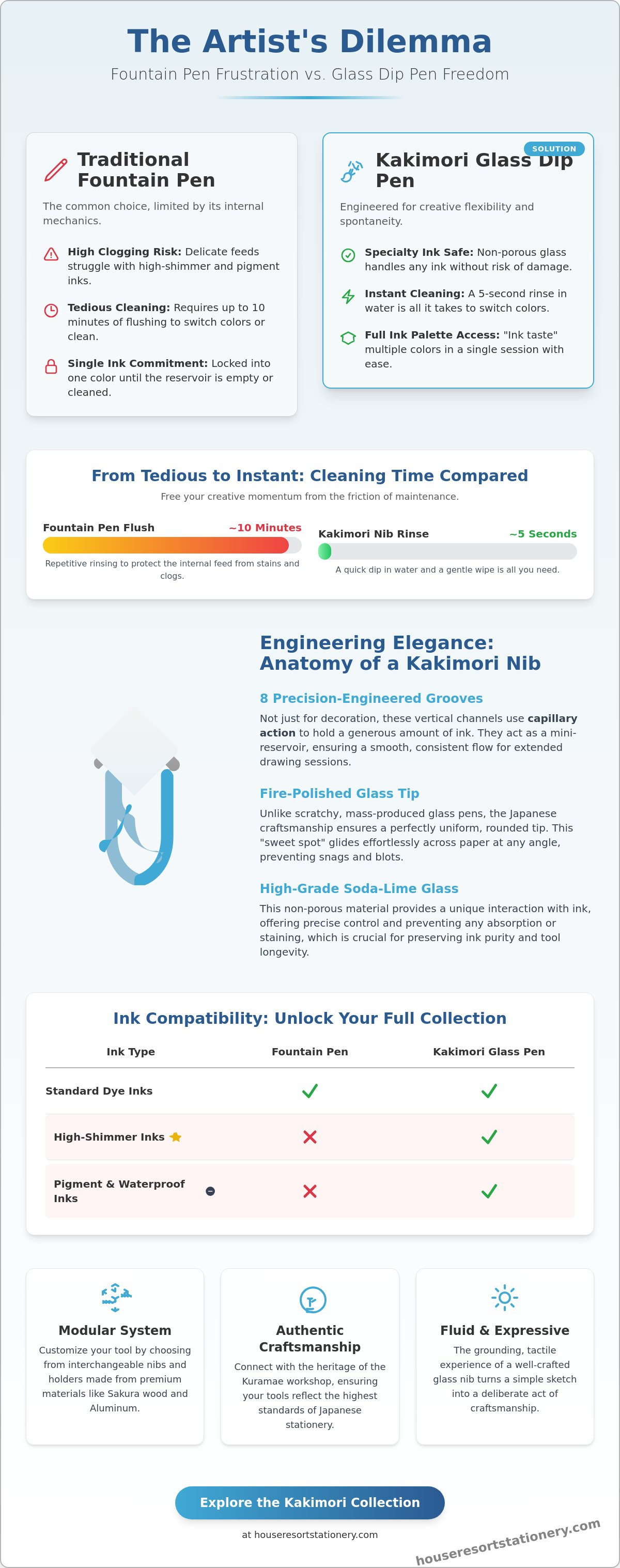
- Learn how to transition between ink colors in seconds with a quick rinse, removing the need for the tedious flushing required by traditional tools.
- Discover the science behind the eight vertical grooves that utilize capillary action to provide a smooth, reliable ink flow for extended sessions.
- Safely utilize high-shimmer and pigment inks that often clog standard fountain pens for drawing while protecting your delicate internal feeds.
- Build a customized writing instrument by selecting from modular nibs and specialized holders crafted from premium materials like Sakura wood and Aluminum.
- Connect with the heritage of the Kuramae workshop to ensure your tools reflect the highest standards of authentic Japanese stationery craftsmanship.
Why the Kakimori Glass Pen is the Secret Weapon for Fountain Pens for Drawing
Standard fountain pens for drawing often impose a rigid structure on the creative process. You choose a color, fill the converter, and you're committed to that ink until the reservoir runs dry or you face the sink for a lengthy cleaning session. The Kakimori glass dip pen breaks this cycle. It represents a sophisticated evolution of the traditional dip pen, reimagined for the modern illustrator. Professional artists are shifting away from standard feeds because they demand spontaneity. This tool allows you to access your entire ink collection simultaneously. In a high-speed digital world, the weight of a well-crafted glass nib offers a grounding, tactile experience. It turns a simple sketch into a deliberate act of craftsmanship.
Eliminating the Frustration of Constant Cleaning
The primary friction in analog art is maintenance. A thorough fountain pen flush often requires ten minutes of repetitive rinsing to protect the feed from staining. The Kakimori glass nib reduces this chore to a five-second dip in clean water followed by a gentle wipe. This speed enables a unique "ink tasting" workflow. You can test multiple shades for a single shadow or highlight without the commitment of a full fill. For illustrators working on multi-color pieces, this efficiency is a revelation. You can move from a heavy pigment ink to a light wash in seconds. It removes the mechanical barriers that often stifle creative momentum during long sessions.
The Artist’s Companion for Ink Exploration
True ink connoisseurs understand that some formulas are too risky for expensive internal feeds. Pairing the Kakimori nib with pilot iroshizuku bottled ink unlocks the vibrant shading and complex chromatography of these Japanese dyes without any risk of clogging. The glass surface is non-porous; it's the ideal partner for shimmering or waterproof inks that would typically ruin other fountain pens for drawing. This modular system also travels beautifully. When paired with a traveler's notebook, the setup becomes a portable studio. The aesthetic appeal of these Japanese-designed instruments reflects a commitment to quality that transcends simple utility. It's an investment in a more fluid, expressive way of working.
Engineering Elegance: The Anatomy of a Japanese Glass Nib
The Kakimori nib is a masterpiece of material science. Unlike the steel or gold alloys found in traditional fountain pens for drawing, this instrument uses high-grade soda-lime glass. This material offers a unique interaction with liquid, allowing for precise control over ink flow. The secret lies in the eight vertical grooves etched into the glass. These channels aren't just decorative; they are precision-engineered to manage fluid dynamics. This level of craftsmanship is essential for serious pen and ink drawing, where a sudden blot can ruin hours of work. While mass-produced glass pens often feel scratchy due to uneven surfaces, the Japanese approach ensures a perfectly fire-polished finish that glides across the page.
Capillary Action and Ink Retention
The science of capillary action dictates how the ink behaves within these grooves. When you dip the nib, surface tension pulls the ink upward, filling the channels. The depth of each groove is calculated to prevent the ink from rushing out all at once. Instead, it releases gradually as the tip touches the paper. This physics-based approach means one single dip can often sustain a full paragraph of text or a complex series of cross-hatching lines. The eight vertical grooves act as a temporary ink reservoir, ensuring a consistent supply to the tip. This reliability allows you to focus on your composition rather than worrying about constant re-dipping or ink starvation.
The 'Sweet Spot' and Ergonomics
Consistency is the hallmark of a Japanese glass nib. Many artists find pointed metal nibs temperamental, requiring a specific angle to avoid snagging the paper fibers. The Kakimori nib features a uniform rounded tip that provides a consistent line regardless of your writing angle. It offers a feedback profile similar to the 'tooth' of high-end fountain pens for drawing, yet it remains more forgiving for rapid sketching. The sensation is velvety. You can adjust your grip to manipulate line width and ink saturation, allowing for a dynamic range of expression. If you're looking to upgrade your studio kit, you can explore our curated selection of Japanese writing tools to find the perfect match for your style.
Beyond the Swatch: Drawing with High-Shimmer and Pigment Inks
Standard fountain pens for drawing often come with a silent warning: avoid shimmer and high-pigment inks. The intricate internal feeds of these pens are designed for fluid, dye-based liquids. When you introduce suspended glitter or heavy pigments, the narrow capillary channels act as a filter, trapping particles and causing immediate clogs. The Kakimori glass pen removes this limitation. Its surface-level grooves allow even the most particle-heavy inks to flow without resistance. This makes it the superior choice for artists who want to explore the full spectrum of modern ink technology without risking their specialized equipment.
Mastering Shimmer and Glitter Particles
Fountain pen feeds trap shimmer because they rely on internal tension and narrow pathways. Once a particle settles in the feed, it's difficult to dislodge without a sonic cleaner. With a glass nib, you have a completely open system. You can use the nib itself as a stirring tool, gently swirling it in the ink bottle to ensure the particles are evenly suspended before you begin. This technique ensures a consistent shimmer on the page. When working with waterproof pigment inks, a quick rinse is all that's required. You don't have to worry about ink drying inside a hidden reservoir; every part of the glass nib is accessible and easy to maintain.
This reliability is why we recommend the Kakimori for fountain pen doodle journaling for beginners. It allows new artists to experiment with vibrant, complex inks without the steep learning curve of pen maintenance. You can create accurate, saturated swatches that truly represent the ink's sheening and shading properties, providing a clear reference for your future illustrations.
Paper Synergy and Performance
The interaction between glass and paper is a unique sensory experience. For the best results, pair your nib with premium japanese stationery like Midori MD. These papers are specifically sized to handle high ink volumes without excessive feathering. On thinner sheets, you'll need to manage the flow by adjusting your pressure. A lighter touch prevents ghosting, while a slower stroke allows the ink's secondary colors to emerge during the drying process. Unlike some fountain pens for drawing, the glass tip glides over textured watercolor or mixed-media papers without catching. It offers a smooth, uninterrupted line that adapts to the character of the paper beneath it.
The Modular System: Choosing Holders and Protecting Your Investment
The Kakimori ecosystem is a masterclass in modular design. It respects the artist's need for a personalized experience, which is something often missing from mass-produced fountain pens for drawing. By separating the nib from the body, this system allows you to curate a tool that fits your specific hand weight and grip preference. You aren't locked into a single plastic shell; instead, you can swap the glass nib into various holders designed for different creative environments. This versatility ensures that your favorite nib evolves alongside your artistic style.
Selecting the Right Pen Holder for Your Style
The choice of material significantly impacts your drawing endurance and the character of your lines. We've observed that artists often prefer different materials based on the length of their sessions:
- Sakura Wood: These holders are prized for their warmth and organic feel. They're exceptionally lightweight, making them the ideal choice for long sketching sessions where hand fatigue is a concern.
- Aluminum: Weighted metal holders provide a sense of stability and gravity. The extra mass helps guide the hand during high-precision work, offering a level of control that mimics professional technical tools.
This modularity extends beyond the brand's own catalog. Because the nib interface is standardized, these glass nibs are often compatible with third-party holders. This allows you to integrate Japanese precision into a vintage or custom-made handle you already own. If you're ready to build your custom setup, you can browse our collection of Japanese pen holders to find a material that speaks to your aesthetic.
Long-term Maintenance and Nib Care
While glass is durable, it's also brittle. A common hazard in the studio is the "desk roll," where a round pen rolls off a flat surface and chips the tip upon impact. To prevent this, professional artists use dedicated pen rests or trays to secure their tools between strokes. If you do experience a micro-chip that causes the nib to feel scratchy, you don't necessarily need a replacement. You can often restore the smoothness by using 1,000 to 2,000-grit sandpaper or micro-mesh. Gently rotate the tip on the abrasive surface to reform the rounded edge and eliminate snags.
Deep cleaning is rarely a chore with this system, but stubborn pigment buildup in the grooves might require a brief soak in a specialized pen flush or an ultrasonic cleaner. These methods ensure that your ink channels remain clear for optimal capillary action. To ensure the longevity of your instrument, always store your glass pens in a horizontal position when they're not in use to prevent unnecessary pressure on the nib. By following these simple protocols, your glass nib will remain a reliable alternative to standard fountain pens for drawing for years to come.
The HouseResort Curation: Why Authentic Craftsmanship Matters
HouseResort Stationery stands as a curated sanctuary for those who value the intersection of form and function. While many retailers offer standard fountain pens for drawing, our selection process focuses on the soul of the instrument. We prioritize heritage manufacturers who view stationery as an extension of the artist's hand. The Kakimori glass pen fits perfectly into this high-end analog lifestyle. It's a tool that doesn't just perform; it invites a slower, more deliberate pace of creation. When you step away from mass-produced fountain pens for drawing, you enter a space where quality is non-negotiable. Our boutique curation process filters the noise of the market to present only the best options. This commitment to excellence is why we've partnered with the Kuramae workshop. We believe that a well-organized desk, filled with authentic materials, fosters a sense of belonging for the enthusiast and the collector alike.
A Heritage of Craft in Every Nib
Kakimori operates out of the Kuramae district in Tokyo, an area known for its concentration of traditional workshops. Each glass nib is a product of this environment, where artisans balance technical precision with a deep respect for materials. The production process in Tokyo is a testament to the "Boutique Curator" philosophy we uphold. These artisans don't rush. They understand that a glass nib must be fire-polished to perfection to avoid the scratchiness found in lower-grade alternatives. This meticulousness is what allows the pen to handle complex techniques like delicate layering and fine cross-hatching. We choose these tools because they're designed to age beautifully with the user. The Sakura wood holders develop a unique patina over time, reflecting your specific grip and usage patterns. As an authorized retailer, we handle these instruments with the care they deserve. We ensure that every piece in our catalog is authentic, protecting you from the inconsistencies of the secondary market.
Completing Your Creative Kit
A professional artist's desk is an ecosystem of complementary tools. We suggest pairing your glass pen with blackwing 602 pencils for initial layout work and sketching. The graphite's smooth response provides a perfect foundation before you commit to the permanent lines of a glass nib. To elevate your dipping ritual, consider selecting a dedicated inkwell that allows for controlled access to your favorite pigments. This holistic approach to your workspace turns every session into a relaxing escape rather than a chore. We invite you to View Kakimori at HouseResort Stationery and explore our full range of curated writing tools, papers, and specialty inks designed for the modern connoisseur.
Refine Your Analog Creative Process
The Kakimori glass pen represents a significant shift for artists who feel limited by the maintenance of traditional fountain pens for drawing. By adopting this precision-engineered tool, you gain the freedom to explore complex shimmer and pigment inks without the constant fear of clogs or the exhaustion of deep-cleaning. The modular system ensures your setup is as unique as your artistic style, offering a tailored balance of weight and warmth through curated holders. It's a professional instrument that honors the tactile nature of your work while providing modern reliability.
HouseResort is proud to be an Authorized Retailer of Premium Japanese Stationery. Our curated selection of professional artist tools is chosen for those who appreciate heritage and quality. We ensure your delicate glass nib instruments are protected with secure national shipping, arriving ready for your next session. Shop the Kakimori Glass Pen Collection at HouseResort Stationery to discover how these authentic tools can elevate your studio practice. Your creative vision deserves the clarity and consistency that only masterfully crafted Japanese instruments can provide.
Frequently Asked Questions
How long can you write with a single dip of a Kakimori glass pen?
One dip typically lasts for an entire paragraph of text or a series of detailed sketches. The eight precision-etched grooves act as a reservoir, holding significantly more ink than a standard metal nib. This capacity allows you to maintain your creative flow without the constant interruption of re-dipping. It's an efficient choice for artists who value uninterrupted focus during long sessions.
Is the Kakimori glass nib compatible with standard universal pen holders?
Yes, the Kakimori glass nib is designed with a standardized base that fits most universal dip pen holders. This modularity allows you to pair the nib with your preferred handle, whether it's a vintage wood holder or a modern ergonomic design. While we recommend Kakimori’s own Sakura wood or Aluminum holders for the best fit, the flexibility to use third-party tools is a major advantage for collectors.
What is the best way to clean a glass dip pen when switching ink colours?
Swirl the nib in a glass of clean water for five seconds and wipe it dry with a lint-free cloth. This simple process removes all traces of ink, allowing you to switch colors instantly. Unlike traditional fountain pens for drawing, there are no internal feeds to flush. This speed is essential for "ink tasting" and creating multi-colored illustrations without the delay of deep cleaning.
Can I use heavy calligraphy or acrylic inks with a Kakimori glass pen?
You can safely use calligraphy and pigment-based inks, though acrylic inks require extra caution. Because the glass surface is non-porous, these heavy fluids won't clog an internal mechanism. You must rinse the nib immediately after use to prevent acrylics from drying and hardening in the grooves. This versatility makes glass nibs superior to standard pens for experimenting with diverse, high-viscosity media.
What should I do if my Kakimori glass nib feels scratchy on paper?
You can restore the smoothness by gently rotating the tip on 1,000 to 2,000-grit sandpaper or micro-mesh. Small chips or rough spots can occur over time, but they don't necessitate a replacement. A few light strokes on a fine abrasive surface will reform the rounded edge. This simple maintenance ensures the nib glides across your paper with the velvety feedback professional artists expect.
How does the glass nib compare to the Kakimori stainless steel nib for drawing?
The glass nib offers a smoother, more consistent line, while the stainless steel nib provides more tactile feedback and durability. Glass is ideal for shimmering inks and effortless cleaning between color changes. Steel nibs are often preferred for high-pressure work or when traveling, as they're less prone to breakage. Both options surpass typical fountain pens for drawing by offering specialized performance for different artistic needs.
Is the glass nib durable enough for daily professional use?
Yes, these nibs are crafted for longevity and can withstand daily use in a professional studio. The soda-lime glass is resilient against the chemical properties of various inks and doesn't corrode like metal. The primary risk is physical impact, so we recommend using a pen rest to prevent the instrument from rolling off your desk. With proper storage and handling, a single nib can last for years.
Does the Kakimori glass pen work well for left-handed artists?
Left-handed artists often find glass nibs more forgiving than metal ones because the rounded tip writes at any angle. There's no sharp edge to catch or "dig" into the paper during a pushing stroke. The consistent ink flow also helps prevent the skipping that sometimes occurs with left-handed grips. It provides a reliable, smudge-free experience that adapts naturally to different hand positions and drawing styles.