
The Ultimate Midori Buying Guide 2026: Elevate Your Analog Experience
Your desk is more than a place to work; it is a modular ecosystem where the paper provides the canvas and the accessories provide the character. You've likely experienced the disappointment of a favorite fountain pen feathering on low-quality paper or felt overwhelmed by the sheer volume of Japanese stationery lines available today. It is difficult to find that perfect balance between a curated aesthetic and high-quality organization tools that actually perform under pressure.
This guide helps you master the midori collection to find the specific tools that elevate your unique writing workflow. You will discover how the 2026 lineup, including the iconic MD Paper and the minimalist 1-Day 1-Page diaries, can transform your daily planning. We'll break down the differences between structured layouts and flexible notebooks; this gives you the clarity needed to build a desk setup that feels professional, polished, and deeply personal. Whether you are a dedicated collector or a newcomer to fine stationery, these insights will help you choose the right materials to find your analog flow.
Key Takeaways
- Explore the technical heritage of MD paper and why its unique texture provides the ideal tooth for precision writing.
- Identify the core differences between cream and white paper stocks to match your specific ink colors and visual preferences.
- Use our selection framework to build a customized midori suite that balances portability with professional desk utility.
- Learn how to pair heritage journals with modular accessories like D-Clips to create a cohesive, organized workspace.
- Preview the essential 2026 standouts that define the current standard for functional Japanese design and craftsmanship.
The Midori Philosophy: Why Japanese Design Stationery Leads the Market
Midori represents a legacy of precision that began in 1950. While many brands prioritize mass production, this heritage manufacturer focuses on the "pleasure of writing." This isn't just a marketing slogan; it's a design mandate. The concept of "functional beauty" defines every product. It means that an object's aesthetic appeal should never compromise its utility. Instead, the design should enhance the user's experience. Every curve of a brass pen or the specific weight of a notebook cover is calculated to improve your daily workflow. This focus on the tactile experience makes Japanese stationery a world leader in the analog space.
The brand's commitment to original paper development is what sets it apart. Since the 1960s, they've refined their proprietary MD Paper to ensure it handles fountain pen ink without feathering or bleed-through. You might recognize the name from the "Traveler’s Company." While that line began as a midori product, it eventually became its own distinct brand focused on travel. Today, Midori remains the home for professional-grade materials and minimalist journals. These tools are designed for those who view their desk as a sanctuary for productivity and creative thought. By choosing these tools, you are investing in a decades-long tradition of paper engineering.
The 70-Year Evolution of Analog Tools
The journey started with simple letter pads in the 1950s. Over seven decades, the catalog has evolved into a sophisticated collection of 2026 innovations. You can trace this growth through the History of Midori, which highlights how the company transitioned from basic office supplies to high-end lifestyle tools. Even with this professional shift, they've kept their personality. The "Ojisan" character, introduced in the 1990s, remains a beloved symbol of the brand's approachable nature. He represents the simple joy of using a well-made tool. This blend of technical excellence and whimsical character is rare in the stationery world.
The Intersection of Mindfulness and Stationery
Writing by hand is a deliberate act. Midori tools encourage a slower, more intentional pace that digital devices cannot replicate. The tactile feedback of the paper tells you when to speed up or slow down. This sensory experience is vital for true organization. If you're looking to expand your toolkit beyond journals, checking a Japanese stationery online store guide can help you find complementary desk accessories. High-quality paper texture isn't a luxury; it's a functional requirement for anyone who values their writing experience. Using these tools turns a mundane task into a moment of mindfulness.
MD Paper vs. The World: A Technical Deep Dive
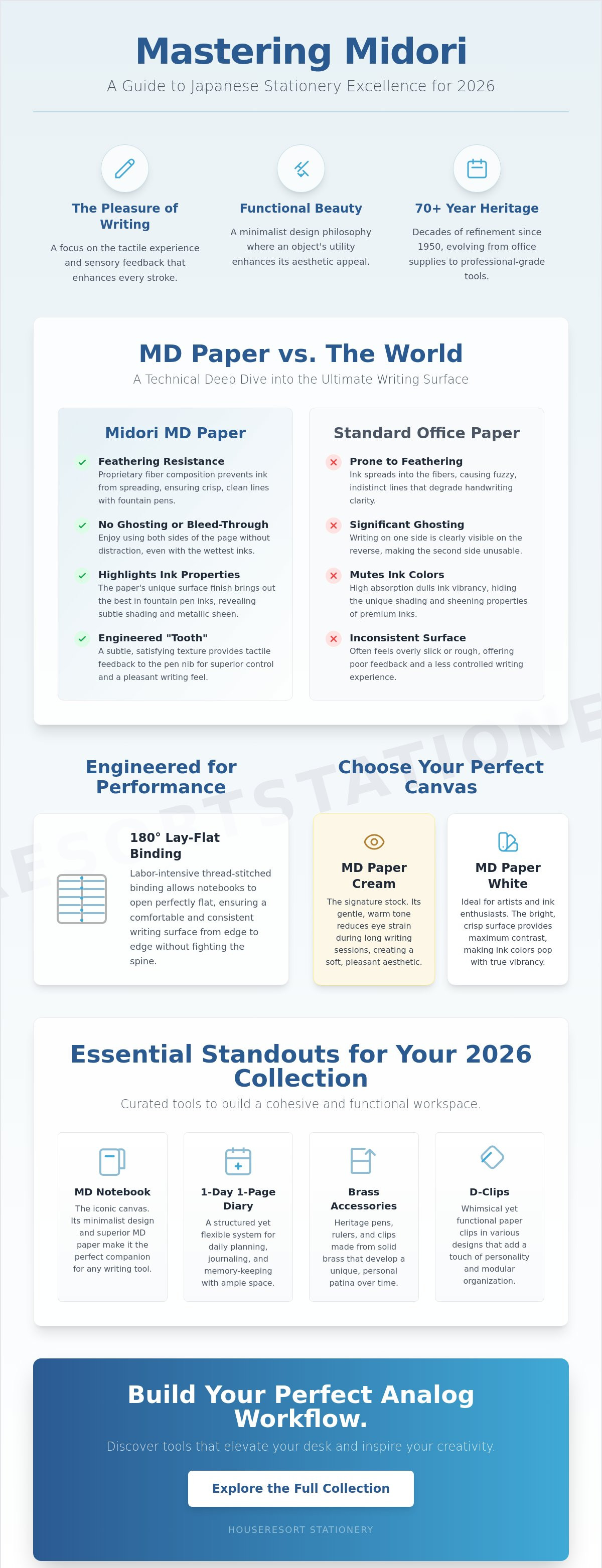
MD Paper is the soul of the midori lineup. Unlike mass-market paper that feels slick or glassy, MD Paper is engineered with a specific "tooth." This texture provides subtle feedback to your pen tip. It allows for greater control over your handwriting. The proprietary development process focuses on how ink interacts with the fibers. It strikes a precise balance between absorption and drying time. Most enthusiasts prefer the signature cream stock; it reduces eye strain during long writing sessions. However, the white variant remains a favorite for those who want their ink colors to pop with maximum contrast.
The physical construction is just as deliberate. Every notebook features thread-stitched binding. This method is labor-intensive but necessary. It ensures the journal opens 180 degrees and stays flat on your desk. You won't have to fight the spine while writing near the center margin. This reliability is why professionals choose these tools for deep work and creative drafting. If you want a consistent writing surface that respects your time and your tools, this technical foundation is unmatched.
Fountain Pen Compatibility and Ink Performance
Premium fountain pen inks behave differently on high-quality paper. Standard office paper often causes feathering; the ink spreads like a spiderweb across the page. MD Paper resists this. It also prevents ghosting, which is the "see-through" effect on the reverse side of the page. This paper is particularly famous for highlighting "sheen" and "shading." Sheen occurs when ink dries on the surface to create a metallic glisten. Shading shows the variation of color within a single stroke. If you want to test these properties, our fountain pen doodle journaling guide offers excellent starting points. For those who prefer a softer feel, this Midori MD Cotton paper review explains the nuances of their cotton-blend alternative.
The Minimalist Aesthetic of MD Notebooks
The design philosophy is "naked." Most MD notebooks lack a heavy cardstock cover. Instead, they feature a cheesecloth-reinforced spine and a simple paraffin paper wrap. This minimalist approach serves a purpose. It allows the notebook to remain lightweight and flexible. It also places the focus entirely on your content. You can choose from grid, ruled, or blank formats. The grid is ideal for technical layouts, while blank pages offer total freedom for sketching. To begin your collection, you can EXPLORE our curated MD Paper selection to find the format that fits your style.
Essential Midori Collections: Finding Your Perfect Match
Building a cohesive desk aesthetic requires more than a single journal; it requires a suite of tools designed to work in harmony. The midori ecosystem is built on three specific pillars: MD Paper, D-Clips, and the XS Series. These collections aren't isolated products. They're designed to function as a unified system where the paper provides the foundation and the accessories provide the organization. In 2026, the collectability of limited edition releases has reached a new peak. To ensure you are receiving genuine Japanese craftsmanship, always source your tools through authorized retailers. This protects the integrity of your collection and guarantees the technical performance you expect from heritage manufacturing.
Midori D-Clips: Precision-Etched Character
D-Clips represent a masterclass in stainless steel etching. Unlike standard wire clips that can lose their shape, these are precision-cut to maintain a firm grip on your pages. The series offers a choice between playful animal motifs and professional geometric shapes. The animal series adds a touch of personality to personal journals, while the geometric options provide a clean, architectural look for office documents. Every set comes in a signature "slide-to-open" case. This packaging is as functional as the clips themselves; it keeps your desk tidy while providing a satisfying, tactile opening mechanism.
The XS Series: Engineering in Miniature
The XS (Extra Small) Series proves that compact size doesn't mean flimsy performance. This collection includes staplers, scissors, and cutters that fold down into incredibly small footprints. They've become a staple for the Everyday Carry (EDC) community and mobile professionals who work from varying locations. The engineering is remarkably precise. For example, the XS stapler features a locking mechanism that allows it to lay flat in a pencil case but snap into a sturdy, functional tool when needed. These tools are built for those who refuse to sacrifice quality for portability.
The Modular Connection
The true strength of these collections lies in how they integrate with other analog systems. Midori products are the perfect companions for the Traveler’s Notebook system. You can use D-Clips to index specific sections of your MD paper inserts or keep loose receipts secure within your leather cover. This modularity allows you to customize your workflow based on your current project. By combining the XS tools with your favorite journal, you create a mobile office that is both aesthetically pleasing and technically superior. This level of integration is why the brand remains a favorite for connoisseurs who value a streamlined, efficient workspace.
Selection Framework: How to Build Your Midori Suite
Choosing the right analog tools requires a logical approach to your specific writing habits. A midori suite is not a one-size-fits-all solution; it's a customized kit built for performance. To build a setup that actually improves your workflow, follow this five-step selection framework. This process ensures that every item on your desk serves a distinct purpose while maintaining a cohesive aesthetic. You'll move from the foundation of the paper to the technical precision of the accessories.
- Step 1: Identify your primary writing instrument. If you use fountain pens, you'll need the ink resistance of MD paper. For those who prefer lead, the paper's natural tooth provides excellent grip for graphite.
- Step 2: Choose your paper size. A5 is the gold standard for desk-bound deep work. If you travel frequently, the B6 Slim or A6 formats offer portability without sacrificing too much writing surface.
- Step 3: Select organizational accessories. Use D-Clips for temporary indexing or brass clips for a permanent, heavy-duty hold on your notebook sections.
- Step 4: Add functional tools. Integrate the XS series for on-the-go utility. These miniature tools ensure you're never without a stapler or scissors during a mobile work session.
- Step 5: Finalize your aesthetic. Decide if you prefer the "naked" minimalist look of the standard MD line or the more playful, character-driven style of the animal series.
The Executive Setup
The professional workspace demands clean lines and high-performance materials. For this setup, we recommend the MD A5 Notebook paired with a brass fountain pen and geometric D-Clips. This combination projects a sense of "heritage" and reliability. To complete this iconic analog kit, consider integrating Blackwing 602 pencils for drafting and sketching. The dark graphite of the 602 contrasts beautifully against the cream MD paper, creating a sophisticated environment for high-level planning.
The Creative Journaler Setup
Creative journaling often prioritizes personal expression and "kawaii" functionality. The MD Diary is the ideal centerpiece here, offering enough structure for dates but enough blank space for washi tape and sketches. Use animal-shaped D-Clips as bookmarks for your monthly spreads; they provide a quick visual reference while adding a touch of whimsy to the page. This setup turns a standard midori journal into a dynamic scrapbooking canvas that captures your daily inspirations with style.
Ready to curate your own workspace? SHOP our full collection of Midori journals and planners to find the perfect foundation for your 2026 organizational goals.
Top 5 Midori Standouts for Your 2026 Collection
Selecting the right tools from a heritage catalog requires an eye for both technical performance and aesthetic longevity. The 2026 midori lineup balances these needs with precision, offering items that serve as both functional assets and collector's pieces. These five standouts represent the pinnacle of the brand's current offerings, curated specifically for those who value the tactile nature of analog work. Each tool is designed to integrate seamlessly into a professional desk setup or a mobile creative kit.
- The MD Notebook Journal: This is the classic foundation of the brand. Its thread-stitched binding and signature cream paper provide a reliable canvas for fountain pens. It remains the gold standard for those who want a notebook that stays flat and respects their ink.
- Midori D-Clips (Animal Series): These are the perfect entry-level pieces. They add character to your organization without sacrificing the firm grip required for professional documents.
- XS Compact Scissors: A marvel of miniature engineering, these scissors fold down to fit into the smallest pencil case. They maintain a sharp, precise edge that belies their compact size.
- MD Paper Pad: Top-bound for quick sketches or ink testing, this pad uses the same high-quality stock as the journals. It's an essential desk companion for rapid ideation.
- Midori Brass Ruler: This tool is built to last a lifetime. The solid brass material develops a unique patina over time, reflecting your personal history of use. It's a legacy piece that improves with age.
Highlighting the D-Clips Collection
D-Clips often serve as the "gateway" product for new enthusiasts. Their intricate, etched shapes provide a level of detail that standard clips cannot match. In 2026, keep an eye out for limited edition shapes that feature celestial motifs and rare wildlife. These small additions transform a standard stack of papers into a curated collection. They're as much a conversation starter as they are a functional tool. If you're ready to add some character to your files, you can Browse our curated selection of Midori D-Clips to find your favorite designs.
Why Shop at HouseResort Stationery?
As an authorized retailer, we guarantee the authenticity of every midori product in our inventory. Our selection is curated by enthusiasts who understand the nuances of paper weight and ink compatibility. We don't just sell stationery; we provide the tools for a superior writing experience. Every order is handled with specialized packaging to ensure your delicate paper products arrive in pristine condition. We prioritize fast shipping and meticulous quality control because we know that for a collector, the details matter. Trust your analog journey to a boutique curator who shares your passion for quality materials and Japanese craftsmanship.
Refining Your Analog Journey for 2026
Mastering the midori ecosystem means moving beyond simple paper and ink. It's about selecting tools that respect your time and your creative process. You've learned how the specific tooth of MD paper enhances ink performance and how a modular selection framework allows you to build a suite tailored to your executive or creative needs. These tools are more than desk accessories; they're the foundation of a more intentional writing practice that prioritizes quality over volume.
As an authorized retailer of fine stationery, HouseResort Stationery offers a curated boutique experience where every item is chosen for its technical excellence. Our expert-tested fountain pen compatibility ensures your journals and planners perform exactly as expected. We've done the work of filtering the market to bring you only the most reliable heritage materials. Explore the full Midori D-Clips Collection at HouseResort Stationery to find the final pieces for your 2026 setup. Your desk should be a place of inspiration and precision. We look forward to helping you find the tools that make every word a pleasure to write.
Frequently Asked Questions
Is Midori the same as Traveler’s Company?
Traveler’s Company is a separate brand that originated as a line within the midori catalog. In 2015, it became an independent entity to focus specifically on travel-themed tools. While both brands are owned by Designphil, they maintain different design philosophies. Midori focuses on the technical "pleasure of writing" and minimalist desk tools. Traveler’s Company prioritizes modularity and the rugged aesthetic of travel.
Does fountain pen ink bleed through Midori MD paper?
Fountain pen ink rarely bleeds through MD paper because of its proprietary sizing and fiber density. The paper is specifically tested to resist feathering and bleed-through even with wet ink flows. While you might see some light ghosting or show-through on the reverse side, the ink remains crisp on the surface. This resistance allows you to use both sides of the page without compromising your content.
What makes Midori D-Clips different from standard paper clips?
D-Clips use a precision stainless steel etching process that creates intricate, flat shapes standard wire clips cannot achieve. This method ensures the clip maintains its tension over repeated use. Unlike bulk office supplies, these clips are designed to lay flat against the page. This prevents bulk in your notebook and ensures your documents look curated and professional rather than cluttered.
What is the best Midori notebook for a beginner?
The MD A5 Notebook is the ideal starting point for any analog enthusiast. Its size offers a perfect balance between portable convenience and ample writing space for deep work. The minimalist design allows you to focus on your handwriting without the distraction of heavy branding. It serves as a versatile foundation that works equally well for daily journaling, professional meeting notes, or creative sketching sessions.
Are Midori XS tools actually functional for daily use?
XS tools are fully functional instruments engineered for precision and durability. While they are small enough to fit in a pocket, the staplers and scissors use high-grade materials that handle standard office tasks with ease. The stapler features a locking mechanism for stability, and the scissors use a sliding blade system. These are not novelties; they are technical tools built for mobile professionals and EDC collectors.
How do I care for Midori brass stationery?
Brass stationery requires minimal maintenance beyond regular use. The natural oils from your hands help the material develop its signature dark patina over time. If you prefer the original bright shine, you can clean the surface with a specialized metal polish or a soft cloth. Most collectors choose to leave the brass untreated to reflect the unique history and age of their specific tools.
Where can I buy authentic Midori products in the US?
Authentic products should be sourced through an authorized retailer to guarantee Japanese manufacturing standards. HouseResort Stationery maintains a curated inventory of genuine midori journals, clips, and XS tools. Buying from a specialized boutique ensures you receive expert-tested materials and specialized packaging. This protects your delicate paper products from damage during transit and guarantees you are not purchasing counterfeit or gray-market items.
Why is Midori paper cream-colored instead of bright white?
The signature cream tint is a deliberate choice to reduce eye strain during long writing or reading sessions. Bright white paper reflects more light, which can cause fatigue over time. The warm tone also provides a sophisticated background that complements a wide range of fountain pen ink colors. It creates a classic, heritage aesthetic that distinguishes these journals from standard, bleached office stationery.