
What to Write in Your Midori MD Journal: A 2026 Creative Checklist
The most intimidating thing about a pristine MD PRODUCT notebook isn't its heritage; it's the silence of the cream-colored pages. You've invested in this iconic paper, yet you find yourself paralyzed by the fear of a stray ink blot or a wasted entry. If you are staring at your desk wondering what to write in your midori md journal, you aren't alone. Many enthusiasts feel the weight of expectation when opening a notebook that celebrates Yohaku, the concept of reflective margins in time introduced by Designphil. Since the brand's official transition to the independent MD PRODUCT name in early 2026, the focus on minimalist mindfulness has only deepened.
It's natural to want your layouts to match the sophisticated, Japandi aesthetic of the MD line. We understand that the pressure to be artistic often gets in the way of actual analog mindfulness. This guide provides a curated collection of functional and creative prompts designed specifically for the unique texture and fountain pen performance of MD paper. You'll discover how to build a beautiful, functional record through simple drawing exercises and structured logs. We will preview a 2026 checklist that turns your journal into a curated sanctuary for your thoughts.
Key Takeaways
- Understand how the specific tooth and cream tint of MD paper encourage a slower, more intentional writing pace for better analog mindfulness.
- Discover exactly what to write in your midori md journal to transform it into a minimalist 2026 strategic planner using the Do vs. Get framework.
- Master simple line art techniques that pair perfectly with fountain pens to overcome artistic hesitation and the fear of making mistakes.
- Build a lasting analog archive by integrating commonplace book entries and curated 2026 reading logs into your daily routine.
- Identify the most compatible fountain pens and inks to optimize the tactile feedback and performance of the MD PRODUCT paper.
The Midori MD Philosophy: Why the Paper Dictates the Content
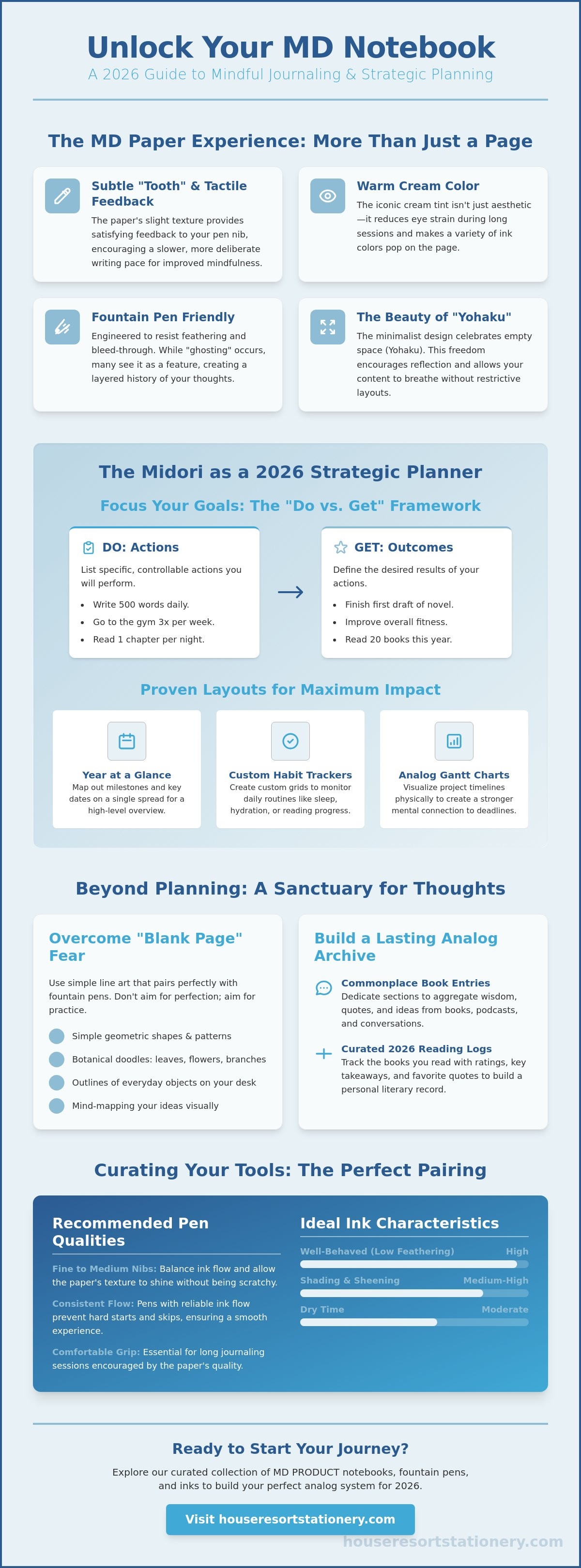
The material choice of your notebook influences every stroke of the pen. MD PRODUCT paper, developed originally in 2008 and rebranded as an independent line in early 2026, carries a legacy of intentionality. Unlike mass-produced paper that feels slick or plastic-like, this Japanese-made stock offers a specific "tooth." This slight texture provides tactile feedback to your nib. It resists the urge to rush. When you consider what to write in your midori md journal, the paper itself suggests a slower, more deliberate pace. It's a surface that rewards focus rather than speed.
The iconic cream tint isn't just an aesthetic choice. It provides a warm, high-contrast background for various ink colors while reducing eye fatigue during long journaling sessions. This paper is famous for being fountain pen friendly, resisting feathering and bleed-through even with heavy ink flow. However, it does allow for "ghosting," where a faint shadow of the previous page's writing is visible. For many enthusiasts, this is a feature rather than a flaw. It creates a layered, lived-in feel that marks the passage of time. It shows the history of your thoughts without the frustration of ruined pages.
The minimalist design, often lacking traditional margins or heavy headers, offers boundless flexibility. You aren't confined by a manufacturer's idea of a layout. Instead, the paper acts as a specialized canvas. Whether you are sketching or logging data, the absence of rigid structure allows your content to breathe. This freedom is central to the MD experience, making the notebook feel like a personal sanctuary rather than a chore.
Setting Intentions for Your 2026 Journal
Before you ink your first page, define the role this notebook will play in your life. Will it be a structured daily planner, a private diary, or one of those historical Commonplace books used to aggregate wisdom and quotes? Your choice of format matters here. The A5 is a versatile standard for most desks. The B6 Slim offers portability for those on the move. The A4 provides a massive canvas for sprawling layouts. We recommend starting with a dedicated "Pen Test" page at the back to see how your specific ink collection interacts with the 2026 paper stock.
Minimalist Layouts That Honor the Grid
The MD design philosophy centers on "Yohaku," or the beauty of empty space. The subtle grid or dot grid options allow you to align text and headers without the need for heavy rulers. This minimalist approach encourages you to leave margins open for reflection. For busy professionals, a "One Line a Day" log is a manageable way to maintain a habit. Use the white space as a design element. Don't feel pressured to fill every square millimeter. In the world of high-end stationery, the space you leave empty is just as important as the words you write.
Functional Productivity: The Midori as a Strategic Planner
A blank notebook acts as the ultimate productivity tool when approached with a clear system. For 2026, start by designing a minimalist Year at a Glance spread. This layout provides a high-level view of your upcoming twelve months on a single opening. Use the grid to map out key milestones, travel dates, and recurring deadlines. When deciding what to write in your midori md journal, consider the "Do" vs. "Get" framework for quarterly goal setting. List specific actions you must perform under "Do" and the intended outcomes under "Get." This distinction helps you focus on the habits within your control rather than just the final results.
The MD PRODUCT paper handles intense habit tracking with ease. You can create custom grids that monitor daily water intake, sleep cycles, or reading progress without fear of ink bleeding into the following week. Professional project management also finds a home here. Use a simplified Gantt chart to visualize project timelines. This analog approach forces you to confront the reality of your schedule. It often leads to better time management than digital apps provide because the physical act of writing creates a stronger mental connection to your goals.
The 2026 Bullet Journal Framework
The original Bullet Journal (BuJo) method feels natural on this paper. Its flexibility allows you to adapt the system as your needs change throughout the year. If you are choosing the best journals for bullet journal success in 2026, the MD series stands out for its lay-flat binding and archival quality. Use the Rapid Logging technique to capture tasks and events as they happen. This method prevents the paralysis of a blank page by providing a functional structure for every entry.
Monthly and Weekly Spreads
Maximize your space with a "Dutch Door" layout. This involves cutting a portion of a page to reveal part of the previous or next spread. It allows you to keep a monthly overview visible while working on your weekly tasks. Incorporate time-blocking for deep work sessions to protect your most productive hours. Beyond just tasks, use weekly reflection prompts to evaluate your progress. Citing research on the benefits of journaling, these sessions help manage stress and improve mental clarity by processing the week's events. To find the right tools for these layouts, explore our curated selection of planners at House Resort Stationery.
Creative Checklist: Easy Things to Draw in Your Midori MD
Staring at a blank page of MD PRODUCT paper can feel like standing before a silent audience. The weight of its quality often creates a barrier to entry. If you're struggling with what to write in your midori md journal, remember that this paper isn't just for text. It's a specialized canvas for simple line art. Fountain pens are the ideal tool for this. The nib's precise control allows you to create delicate strokes that won't feather. Because the paper is rooted in the rich history of Japanese papermaking, it possesses a unique soul that complements hand-drawn elements. You don't need to be an artist to leave your mark.
Try using washi tape to create intentional borders for your illustrations. This frames your work and makes even the smallest doodle look like a curated piece of art. If you're feeling stuck, commit to a 30-day "Easy Drawing" challenge. Dedicate a small corner of your daily spread to one tiny sketch. Over time, these small additions transform your journal into a visual archive of your 2026 experiences. It's about the process of analog mindfulness, not the perfection of the final image. It's a way to practice drawing simply while enjoying the tactile feedback of the paper.
Nature-Inspired Doodles for Beginners
Botanical elements are forgiving and naturally elegant. Start with these simple drawing prompts:
- Eucalyptus sprigs: Draw a central stem and add alternating oval leaves.
- Succulents: Create a small circle and layer teardrop shapes around it.
- Mushrooms and acorns: Use basic domes and caps to fill small gaps in your layout.
The "Continuous Line" technique is particularly effective here. Keep your pen on the paper for the entire sketch. It creates an organic, loose feel that pairs beautifully with the minimalist MD aesthetic. It's a low-pressure way to build artistic confidence without needing complex tutorials.
Geometric and Abstract Patterns
The MD grid is your best friend for geometric work. You can create intricate patterns without a ruler by following the subtle lines. Try Zentangle-inspired fillers for corner decorations. These repetitive shapes are meditative to draw and help you understand how your ink pools on the page. Use light ink washes to add depth to simple shapes. This highlights the paper's ability to handle moisture without significant warping or bleed-through.
Daily Life Icons
Capture the "stuff" of your day with minimalist icons. These quick sketches add character to your logs. Draw a tiny coffee cup next to your morning entry or an open book to mark your reading time. Illustrate your weather tracker with simple suns or clouds. You can even draw your "Outfit of the Day" using basic stick-figure frames. These icons provide a visual shorthand for your life, making it easy to scan through your journal months later and recall specific moments with a single glance.
The Analog Archive: Long-Term Collections and Trackers
Your journal serves as more than a temporary planner. It's a permanent repository for your intellectual life. When deciding what to write in your midori md journal for the long term, consider the tradition of the commonplace book. This isn't a diary of daily events. It's a curated collection of quotes, lyrics, and snippets of wisdom that resonate with you. Because MD PRODUCT paper is archival-grade, these entries remain legible and vibrant for decades. You're building a personal library of thought that grows alongside your experiences.
Fountain pen enthusiasts should dedicate space to an Ink Swatch Library. The specialized texture of MD paper reveals the true shading and sheen of high-end inks. Create small blocks of color and label them with the manufacturer name and nib size used. This becomes a technical reference for your future layouts. Similarly, travel logs allow you to preserve memories through more than just text. Tape in museum tickets or cafe business cards. The paper's weight supports these additions without becoming excessively bulky. To start your own collection, view our selection of premium journals at House Resort Stationery.
A well-organized archive helps you track personal evolution. By dedicating specific pages to recurring themes, you turn a simple notebook into a sophisticated reference tool. This practice moves beyond simple record-keeping; it's a way to witness your own changing tastes and priorities over the course of 2026. The minimalist design of the MD series ensures that your content remains the primary focus of every page.
The Media Tracker: Books, Movies, and Podcasts
A 2026 Reading Log transforms a simple list into a visual journey. Draw a series of blank book spines on a single spread. Fill in the titles and authors as you finish each book, adding a star rating beneath the spine. This provides immediate visual satisfaction. For those who consume digital media, create a section for Podcast "Aha!" moments. Don't just list episodes. Transcribe the specific ideas that shifted your perspective. This turns passive listening into active learning and ensures you don't lose valuable insights to a digital feed.
Personal Growth and Wellness Collections
Consistency is the foundation of growth. Gratitude logs are a proven method for improving mental well-being. Dedicate three lines each evening to specific things you're thankful for. Health and fitness trackers should focus on the frequency of your habits rather than just the metrics. Finally, maintain a "Brain Dump" page. This is a designated space for clearing mental clutter. Write down every nagging thought or unfinished task. Once it's on the page, your mind is free to focus on deep work and creative projects.
Curating Your Tools: Pens and Inks for the MD Experience
The tactile pleasure of writing is amplified by the choice of instrument. While generic guides suggest any pen will do, the connoisseur knows that fountain pens are the intended partner for MD PRODUCT paper. This stock is specifically engineered to prevent ink from spreading or soaking through. Understanding fountain pen doodle journaling for beginners is the ultimate pairing for this surface. It allows you to experiment with line weight and ink flow without compromising the integrity of the page. When you decide what to write in your midori md journal, the pen you hold dictates the final aesthetic outcome.
Selecting the right fountain pen for planner decoration requires matching the tool to your specific journaling style. For those who prefer intricate, minimalist layouts, a Japanese Extra Fine nib offers the precision needed for tight grids. If you enjoy expressive headers, a broad stub nib showcases the paper's ability to handle high ink volumes. Pilot Iroshizuku inks are particularly effective here. They are celebrated for their consistent flow and vibrant colors, which excel on the warm cream tint of MD paper. Always keep blotting paper tucked into your journal. It protects your long-term entries from accidental smudges as you move between spreads.
The Fountain Pen Advantage
Nib size selection is a technical decision that impacts your daily experience. Japanese nibs generally run finer than Western counterparts, offering a crisp line that honors the "Yohaku" philosophy of reflective margins. MD paper is unique in how it reveals ink characteristics. You will notice distinct sheen and shading that lower-quality papers often absorb and dull. To maintain this high-performance experience, establish a simple maintenance routine. Flush your pens every few weeks to prevent ink buildup and ensure they are always ready for your next session.
Essential Accessories for the Midori MD
Protection is vital for a notebook intended to serve as a lifelong archive. MD Paper covers are available in various materials to suit different aesthetic preferences. Clear vinyl provides a modern, utilitarian look, while goat leather develops a rich patina over time. For those seeking precise layouts, the "Clip Ruler" is an essential tool that attaches directly to your page. Finding these specialized items is easier when you use a trusted Japanese stationery online store to source authentic manufacturer products. These accessories transform a simple notebook into a professional-grade analog system.
Elevate Your 2026 Analog Journey
Mastering the art of the blank page begins with a deep appreciation for your materials. The intentional "tooth" and cream tint of MD PRODUCT paper provide a unique foundation for both strategic planning and artistic expression. Whether you're building a resilient 2026 strategic planner or curating a collection of nature-inspired doodles, the key is to let the paper guide your pace. By integrating functional trackers with creative line art, you transform a simple notebook into a sophisticated personal archive.
When you reflect on what to write in your midori md journal, remember that every entry is a deliberate step toward a more mindful daily routine. As an authorized retailer of premium Japanese stationery, we provide the tools you need to make every page count. Shop our curated collection of Midori MD Journals and Fountain Pens to find the perfect pairing for your style. We offer expert curation and national shipping across the United States for all fountain pen enthusiasts. Your journal is a living record of your growth. Trust the process, embrace the empty space, and let your pen find its rhythm.
Frequently Asked Questions
Is the Midori MD notebook good for fountain pens?
Yes, it is widely considered one of the premier surfaces for fountain pen enthusiasts. The paper resists feathering and bleed-through; even with wet nibs or heavy ink flow. While the 2026 rebranding to MD PRODUCT focuses on minimalist aesthetics, the paper quality remains consistent with its legacy of high performance. You'll notice that the ink sits on the surface, which allows for exceptional shading and sheen visibility.
What is the difference between Midori MD and Traveler’s Notebook inserts?
The primary difference lies in the binding and form factor. MD notebooks are thread-bound to lie flat on a desk, making them ideal for long-form writing or detailed planning. Traveler’s Notebook inserts are stapled and designed for a modular leather cover system. Both products use the same high-quality paper manufactured by Designphil, but the MD series offers more page real estate in standard sizes like A5 and B6 Slim.
How do I stop my fountain pen ink from smearing on Midori paper?
Use a sheet of blotting paper to absorb excess ink before closing your journal. Because this paper is less absorbent to prevent bleed-through, ink takes longer to dry on the surface. If you are frequently on the go, consider using faster-drying inks or finer nib sizes. These adjustments reduce the volume of ink sitting on the page and significantly decrease the risk of accidental smudges during busy sessions.
Can I use watercolors in a Midori MD notebook?
Yes, you can use watercolors if you apply them with a light touch. The standard paper handles light washes without significant warping or pilling. For those who plan to use heavy saturation or wet-on-wet techniques, the MD Cotton version is a superior choice. It features a higher cotton content that provides better absorbency and structural integrity for artistic media beyond traditional ink.
What should I do if I make a mistake in my Midori journal?
Embrace the error as part of the journal's history or use a cream-colored correction tape. Many collectors prefer the "wabi-sabi" approach; they simply strike through the mistake and continue. If you prefer a cleaner look, washi tape acts as an excellent decorative patch. This allows you to cover errors while adding a touch of personal style to your layout without damaging the delicate paper surface.
How do I start a commonplace book in my Midori MD?
Begin by dedicating the first few pages to an index and then aggregate quotes or ideas that resonate with you. When you are deciding what to write in your midori md journal, a commonplace book serves as a perfect long-term project for 2026. Use the grid or dot grid versions to separate different themes such as literature, philosophy, or technical notes. This practice turns your notebook into a personalized encyclopedia of inspiration.
Is the grid or blank Midori MD better for drawing?
The blank version offers an unrestricted canvas for freeform art, while the grid provides essential structure for technical or geometric sketches. If your work involves architectural elements or precise patterns, the subtle 5mm grid is incredibly helpful. For organic subjects like portraits or landscapes, the blank pages prevent visual distractions. Many artists find the dot grid to be the perfect middle ground for both text and illustration.
What are the best pens for Midori MD paper if I don’t use fountain pens?
Gel pens with archival ink and high-quality felt-tip markers perform exceptionally well on this paper. The Uni-ball Signo and Zebra Sarasa series are excellent choices because their ink flows smoothly over the paper's slight texture. Avoid using cheap ballpoint pens that require heavy pressure, as they can leave indentations. High-quality drawing pens like the Pigma Micron are also popular for adding fine details to your creative checklist.