
Fountain Pen for Beginners Guide 2026: The Essential Entry into Fine Writing
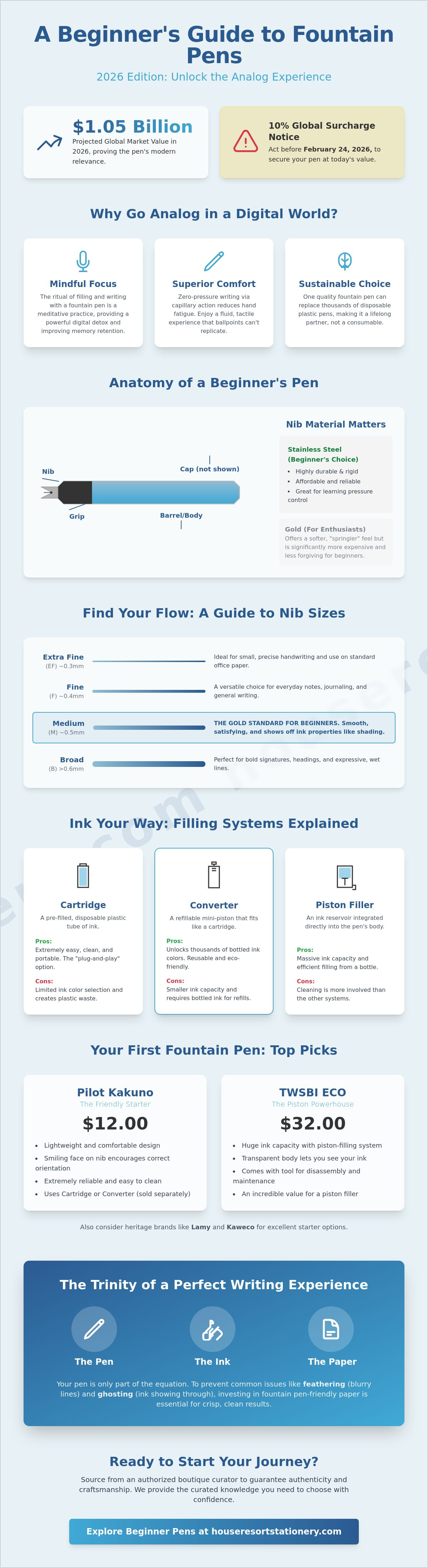
The $1.05 billion global market value for 2026 proves that the fountain pen isn't a relic of the past, but a modern essential for the overstimulated digital mind. You likely want a writing experience that feels more intentional than a scratchy ballpoint, yet you're worried about ink leaks or the technical learning curve. It's a common hesitation. This fountain pen for beginners guide 2026 will demystify the maintenance process and help you select a reliable starter pen before the 10% global surcharge effective February 24, 2026, impacts your budget. We'll explore heritage brands like Kaweco and Pilot, break down nib sizes for every handwriting style, and show you how to turn daily note-taking into a grounding ritual. You'll learn how to fill a TWSBI ECO for $32.00 or start with a $12.00 Pilot Kakuno to find your perfect flow. This guide provides the curated knowledge you need to choose a tool that offers both heritage and lasting value.
Key Takeaways
- Discover why the analog revival makes the fountain pen a vital tool for digital detox and tactile writing.
- Learn to navigate technical specs like stainless steel nibs and piston-filling systems to find your ideal starter pen.
- Identify why heritage brands like Lamy, Kaweco, and TWSBI remain the gold standard in this fountain pen for beginners guide 2026.
- Master the "Trinity of Writing" by selecting specialized paper that prevents common issues like feathering and ghosting.
- Understand the value of sourcing from an authorized boutique curator to guarantee the authenticity and craftsmanship of your tools.
The Analog Escape: Why Start with a Fountain Pen in 2026?
In an era defined by haptic feedback and screen fatigue, the fountain pen represents a physical anchor. It is a precision writing instrument that utilizes a metal nib to deliver liquid ink from an internal reservoir to the page. To truly understand the history and anatomy of the fountain pen, you must see it as more than a pen. It is a mechanical marriage of gravity and physics. This fountain pen for beginners guide 2026 highlights a significant shift toward these tools as the global market value hits $1.05 billion this year. Writers are no longer satisfied with disposable office supplies; they want instruments that offer a sensory connection to their work.
Choosing a fountain pen is a move toward sustainability. A single high-quality pen replaces thousands of plastic ballpoints that would otherwise end up in landfills. It's a lifelong partner rather than a consumable. While a standard gel pen is discarded the moment it runs dry, a fountain pen is designed to be cleaned, refilled, and maintained for decades. This longevity transforms the act of writing from a mundane task into a curated experience. You aren't just buying a tool; you're investing in a piece of functional heritage that grows more personal with every page you fill.
The Tactile Difference: Fountain Pen vs. Ballpoint
The secret to the superior feel of a fountain pen lies in capillary action. While ballpoints require significant downward pressure to roll a thick, oil-based paste onto paper, a fountain pen allows ink to flow the moment the nib touches the surface. This zero-pressure writing experience significantly reduces hand fatigue during long sessions. You'll find that your handwriting becomes more deliberate and fluid. The tactile feedback from the nib provides a "grip" on the paper that slick ballpoints cannot replicate, creating a unique ink flow that displays beautiful shading and depth.
Fountain Pens as a Mindful Ritual
Analog writing is a powerful tool for focus and memory retention. In our fast-paced digital environment, the act of slowing down to write by hand is a luxury. The ritual of maintenance, such as flushing the nib or selecting a new ink color, serves as a meditative practice. At HouseResort Stationery, we believe in the power of Boutique Curation. We help you build a collection that reflects your personal aesthetic and values. By engaging with this fountain pen for beginners guide 2026, you're starting a journey where every tool in your kit is vetted for quality and craftsmanship. It's about creating a personal sanctuary through the simple, elegant act of putting pen to paper.
Decoding the Anatomy: Key Features of a Beginner-Friendly Pen
Understanding the mechanical components of a writing instrument is the first step in this fountain pen for beginners guide 2026. While modern pens look sleek, their design is a result of the long evolution of writing tools. Every part, from the visible nib to the hidden feed, works in harmony to ensure ink reaches the paper without mess or interruption. For a novice, focusing on durability and ease of maintenance is more important than luxury materials.
The nib is the soul of the pen. Most entry-level pens feature stainless steel nibs because they're rigid, durable, and affordable. Gold nibs offer a softer, springier feel, but they often double or triple the price of the instrument. Beneath the nib sits the feed. This component regulates the air and ink exchange. A well-engineered feed prevents the "burping" of ink caused by temperature changes. The body of the pen usually consists of ABS plastic, aluminum, or resin. ABS plastic is incredibly impact-resistant, making it a favorite for students, while aluminum offers a professional weight and cool touch.
Choosing Your First Nib Size
Nib sizes aren't universal, but they generally follow four categories. Extra Fine (EF) and Fine (F) nibs produce thin lines, usually between 0.3mm and 0.4mm. These are ideal for those with small handwriting or those using standard 20lb office paper. Medium (M) nibs are the gold standard for beginners. They provide a smoother glide and allow the unique properties of your ink, such as shading, to shine. Broad (B) and Stub nibs are wider, creating bold strokes that are perfect for signatures or introductory calligraphy. You can explore our curated collection of heritage pens to see how different nib sizes look in practice.
Filling Systems Simplified
How you get ink into the pen determines your daily workflow. Cartridges are the simplest "plug-and-play" option. They're small, disposable plastic tubes filled with ink, making them perfect for travel. If you want access to the thousands of bottled ink colors available, you'll need a converter. This is a small, refillable reservoir that fits into the pen like a cartridge but uses a twist or slide mechanism to draw ink from a bottle. For those who write extensively, a piston filler like the TWSBI ECO is a superior choice. It uses the entire body of the pen as a reservoir, holding approximately 1.76ml of ink, which is more than double the capacity of a standard international cartridge.
The Best Beginner Fountain Pens: A 2026 Comparison Framework
Selecting your first instrument is an exercise in curation. The "Big Three" of the entry-level market, Lamy, Kaweco, and TWSBI, represent the pinnacle of functional design and reliability. In this fountain pen for beginners guide 2026, we focus on these icons because they offer consistent performance despite the evolving economic landscape. Since the 10% global surcharge took effect on February 24, 2026, and the de minimis rule was suspended in August 2025, choosing a pen with a high price-to-value ratio is essential. These brands don't just provide a writing tool; they offer a piece of heritage that justifies the investment through decades of use.
Ergonomics play a vital role in your daily writing experience. Beginners often struggle with how to hold a nib correctly. Lamy addresses this with a forced triangular grip that naturally aligns your hand. Conversely, Kaweco and TWSBI utilize traditional round barrels that allow for more flexible finger placement. Each design has its merits. A triangular grip is excellent for training your hand, while a round barrel accommodates various writing angles. When you shop by maker, you're choosing a specific philosophy of how a pen should feel in the hand. HouseResort Stationery curates these specific brands because they've proven their worth through rigorous community testing and historical significance.
The German Icons: Lamy Safari and Kaweco Sport
The Lamy Safari is a Bauhaus-inspired workhorse. Its functional spring-loaded clip and easily swappable nibs make it incredibly versatile. If you damage a nib or want to try a different line width, you can simply slide a new one on. It's constructed from the same ABS plastic used in Lego bricks, ensuring it survives the rigors of a daily commute. At approximately $35.00 including a converter, it remains a benchmark for durability. The Kaweco Sport offers a different kind of utility. Based on a 1911 design, its "Small in the pocket, large in the hand" philosophy is perfect for the modern minimalist. It's a pocket-sized pen that feels substantial when the cap is posted on the back. For under $30.00, you get a compact tool that carries over a century of German engineering.
The Modern Innovator: TWSBI Eco
TWSBI has disrupted the market by making high-capacity filling systems accessible. The "Eco" is a demonstrator pen, featuring a clear barrel that showcases the inner workings and the ink itself. This transparency isn't just a design choice; it's a functional benefit that lets you see exactly how much ink remains. While many pens at this price point require separate cartridges, the TWSBI Eco features a built-in piston-filling mechanism. This allows it to hold 1.76ml of ink, which is significantly more than a standard cartridge. Priced at approximately $32.00, the TWSBI Eco is the premier choice for ink enthusiasts who want to explore bottled colors with maximum efficiency. It's a modern classic that bridges the gap between technical innovation and everyday affordability.
Beyond the Pen: Mastering the Trinity of Ink and Paper
A fine writing instrument is only as effective as the surface it touches. This fountain pen for beginners guide 2026 emphasizes that your experience depends on the "Trinity of Writing": the pen, the ink, and the paper. Most beginners feel frustrated when their new pen performs poorly on standard 20lb copier paper. This happens because office paper is designed for dry toner or oil-based ballpoint ink. When you apply water-based fountain pen ink to these porous fibers, the paper acts like a sponge. This leads to three common issues that ruin the tactile ritual of writing.
- Feathering: The ink spreads along the paper fibers, creating a fuzzy, spider-web effect around your letters.
- Bleed-through: The ink soaks completely through the sheet, making the reverse side unusable and staining the pages beneath.
- Ghosting: Also known as show-through, this occurs when the paper is too thin. You can see the shadow of your writing on the other side even if the ink hasn't physically bled through.
To avoid these frustrations, a traveler's notebook provides the ideal paper for fountain pen ink. These specialized notebooks use refined, fountain pen friendly paper that allows the ink to dry on the surface rather than soaking into the core. This surface-level drying is what unlocks the true beauty of bottled ink, including shading (color variation within a stroke), sheening (a metallic secondary color), and shimmering (added particulate that glitters in the light).
Stationery Science: Choosing Fountain Pen Friendly Paper
High-quality paper brands like Rhodia, Clairefontaine, and Midori MD use specific "sizing" or coatings to regulate ink absorption. A standard A5 Rhodia notebook ranges from $7 to $29 and offers a smooth, coated finish that prevents feathering. When ink sits on top of the paper, it retains its vibrancy and crisp edges. If you're serious about your writing ritual, don't settle for cheap pads. Start with a dedicated notebook to ensure your pen glides effortlessly without the ink spreading uncontrollably.
Your First Bottle of Ink
Bottled ink offers a world of color that cartridges can't match. Heritage brands like J. Herbin have produced ink for centuries, offering "well-behaved" formulas that won't clog your feed. For daily journaling, you'll need to decide between waterproof and non-waterproof options. Most luxury inks, like the Pilot Iroshizuku series, aren't waterproof but offer incredible flow and shading. If you're a professional who needs permanent records, look for "pigmented" or "iron gall" inks. However, for most beginners, a standard dye-based ink is the safest choice for easy cleaning and maintenance. You can BUY premium bottled inks from our curated collection to start your color journey today.
Starting Your Journey with HouseResort Stationery
Entering the world of fine writing is a transition into a deliberate, analog lifestyle. This fountain pen for beginners guide 2026 has provided the technical foundation you need to understand nibs, feeds, and filling systems. Now, you need a trusted partner to help you navigate the vast catalog of makers and materials. HouseResort Stationery acts as your Boutique Curator. We filter the noise of the global market to present only instruments that meet our strict standards for performance and heritage. Every pen in our inventory is a vetted tool designed to transform your daily tasks into a grounding ritual.
A fountain pen is a gateway. It often leads to a broader appreciation for paper textures, leather covers, and the rhythmic flow of bottled ink. By choosing your first pen today, you're rejecting the disposable culture of plastic office supplies. You're investing in a piece of functional art that develops character as you use it. Our goal is to make this transition frictionless and rewarding. We believe that the shopping experience should be a relaxing escape, much like the act of writing itself. This is why we focus on brands with deep roots in stationery culture.
The HouseResort Difference: Authorized Heritage Retail
HouseResort Stationery is an authorized retailer for every brand we carry. This status is critical in 2026. Since the 10% global surcharge took effect on February 24, 2026, and the de minimis rule was suspended on August 29, 2025, the market has seen an influx of unauthorized gray-market goods. Buying from an authorized boutique ensures your manufacturer warranty is valid and your product is authentic. We prioritize the meticulous precision of Japanese engineering and the Bauhaus-inspired durability of German craftsmanship. If you feel stuck, our "Looking For Gift Ideas" video series provides clear signposts to help you find the perfect starter set.
Building Your First Analog Kit
Creating a cohesive writing kit prevents the frustration of mismatched tools. Follow these three steps to ensure a smooth start to your journey.
- Step 1: Pick a pen that fits your hand. The Lamy Safari offers an ergonomic triangular grip, while the Kaweco Sport provides a compact, pocket-sized profile.
- Step 2: Pair your pen with a converter. This allows you to bypass disposable cartridges and use heritage bottled inks from makers like J. Herbin.
- Step 3: Secure a high-quality notebook. As discussed, specialized paper is the final piece of the trinity that prevents ink feathering and ghosting.
Your first kit is the beginning of a lifelong passion for quality and craft. Don't let technical jargon or market changes keep you from the joy of a smooth-writing nib. Explore our curated collection of beginner fountain pens at HouseResort Stationery and discover the tool that will define your writing for years to come. 🎁
Embrace Your Analog Future
The transition from disposable plastic to a permanent writing instrument is a significant step toward a more intentional lifestyle. This fountain pen for beginners guide 2026 has shown that mastering the basics isn't about technical complexity. It's about understanding the synergy between a precision nib, quality bottled ink, and the right paper surface. By choosing heritage brands like Lamy or Kaweco, you're investing in tools that bypass the temporary nature of modern office supplies. You now have the knowledge to select nib sizes and filling systems with total confidence.
HouseResort Stationery is your destination for this journey. As an authorized retailer for Lamy, Kaweco, TWSBI, and Sailor, we provide the peace of mind that comes with authentic craftsmanship and valid warranties. Our boutique collection is curated for those who value tradition and tactile feedback. With fast worldwide shipping, your first professional writing kit is closer than you think. Shop our curated selection of beginner-friendly fountain pens and start your collection today. Your handwriting deserves a tool that lasts as long as your ideas. We're excited to help you find your perfect match. 🎁
Frequently Asked Questions
Is fountain pen ink permanent?
Most standard fountain pen inks are water-soluble and will wash away if they get wet. If you need permanence for legal documents or archival journaling, you should look for pigmented or iron gall inks. These specialized formulas are designed to resist water and fading over long periods. However, they require more frequent cleaning to prevent micro-particles from clogging the feed of your instrument.
How often do I need to clean my fountain pen?
You should clean your pen approximately every 4 to 8 weeks to ensure optimal performance. A thorough flush with cool water removes dried ink particles and prevents flow issues. If you're switching between different ink brands or colors, a cleaning session is mandatory to avoid chemical reactions. This simple maintenance ritual keeps the internal engine of your pen running smoothly for years of daily use.
Can I use regular notebook paper with a fountain pen?
You can use standard paper, but the results are often disappointing due to high absorption rates. Most 20lb office paper causes the ink to spread or "feather" across the fibers. For the best experience, this fountain pen for beginners guide 2026 recommends using 80gsm or higher coated papers. Brands like Rhodia or Midori MD create a surface that allows the ink to sit on top, preserving crisp lines.
What happens if I don't use my fountain pen for a few weeks?
If a pen sits idle for more than 14 days, the water in the ink may evaporate, leaving behind concentrated dye that clogs the feed. You might experience "hard starts" where the pen refuses to write immediately. To fix this, dip the nib in a bit of cool water or give it a quick flush. Storing your pen horizontally when not in use helps maintain a consistent moisture level.
Do fountain pens leak when flying on a plane?
Changes in cabin pressure can force air behind the ink, causing it to leak into the cap. To prevent this, store your pen vertically with the nib pointing upward during takeoff and landing. Alternatively, ensure the pen is either completely full or completely empty to minimize the amount of air inside the reservoir. Modern designs like the TWSBI ECO are remarkably resilient to these pressure shifts during travel.
Is my handwriting good enough for a fountain pen?
Your handwriting doesn't need to be perfect to enjoy a fine writing instrument. In fact, the zero-pressure nature of a fountain pen encourages more deliberate movements and better posture. Many users find that their script becomes more legible within 30 days of consistent use. A fountain pen is a tool for personal expression, not a test of calligraphy skills, making it accessible to every writer.
What is the difference between a steel nib and a gold nib for a beginner?
Steel nibs are the ideal choice for this fountain pen for beginners guide 2026 because they're rigid, durable, and affordable. They provide a consistent writing experience at a lower price point. Gold nibs, often 14k or 18k, offer a softer, "springier" feel that absorbs more vibration. While gold is a hallmark of luxury, a well-tuned steel nib from a brand like Kaweco performs just as reliably for daily tasks.
How much should I spend on my first fountain pen?
You don't need to spend a fortune to get a reliable tool. Excellent entry-level options like the Pilot Kakuno are available for approximately $12.00, while the iconic Lamy Safari is priced around $35.00. Investing in this price range ensures you receive a pen with a high-quality feed and a durable body. Sourcing from an authorized boutique curator guarantees you're paying for genuine heritage and craftsmanship rather than a disposable imitation.