
Fountain Pen Sketching for Beginners: The 2026 Essential Guide
What if the most intimidating tool on your desk is actually the key to unlocking your daily creative flow? Many aspiring artists hesitate to start because they fear damaging a precision instrument or feel frustrated when ink feathers across a page. It's a common hurdle, but the barrier to entry is much lower than you might think.
This 2026 guide to fountain pen sketching for beginners promises to demystify the process by focusing on the fundamental relationship between a reliable nib, waterproof ink, and fountain-pen-friendly paper. You don't need a vast collection to succeed. You need a curated selection of tools that work in harmony. We'll show you how to master the basics of line work while protecting your investment in quality craftsmanship.
We'll provide a refined list of reliable starter pens, such as the Lamy Safari, and explain how different nib sizes impact your artistic style. You'll also learn to distinguish between waterproof and non-waterproof inks so you can layer washes with confidence. This guide gives you the technical knowledge and the curated toolkit needed to turn every sketch into an intentional act of creative expression.
Key Takeaways
- Discover the "Sketching Triad" and why the synergy between your nib, ink, and paper choice is the foundation of a successful creative practice.
- Learn to navigate technical specifications, from the stiff precision of steel nibs to the expressive line variation offered by specialized Fude nibs.
- Master the essential difference between pigment-based and dye-based inks to ensure your artwork remains permanent or allows for beautiful water-soluble washes.
- Gain the confidence to begin fountain pen sketching for beginners by adopting a minimalist "One Pen, One Ink" philosophy that prioritizes intentionality over clutter.
- Explore professional techniques like cross-hatching and value building to transform simple sketches into sophisticated analog art.
Why Fountain Pen Sketching is the Ultimate Analog Creative Outlet
Choosing a fountain pen for your creative work is an intentional act. It marks a shift from the utilitarian to the artisanal. For those exploring fountain pen sketching for beginners, the primary draw is often the unparalleled tactile feedback. Whether you choose a rigid steel nib or a more expressive gold one, the sensation of metal meeting paper is distinct. It's a dialogue between the artist and the medium. This feedback provides better control over line weight and direction, making the drawing process feel more deliberate and connected.
Beyond the sensory appeal, the move toward analog tools reflects a growing commitment to sustainability. The global art materials market is estimated to be valued at $27.67 billion in 2026, yet the trend is moving away from mass-produced disposables. High-quality fountain pens replace the need for endless plastic fineliners. By investing in a single, well-crafted instrument, you reduce plastic waste significantly. It's a more responsible way to create, focusing on longevity and heritage rather than convenience.
The permanence of ink also changes your psychological approach to art. When you sketch with ink, there is no "undo" button. You learn to work with every stroke. Mistakes aren't failures; they're textures. This mindset shift is vital for growth. It builds confidence and forces you to look closer at your subject. One tool serves multiple roles. Your professional note-taking pen during the day becomes your artistic companion in the evening, bridging the gap between work and play. Mastering fountain pen sketching for beginners starts with this appreciation for the tool's versatility.
The Tactile Nature of Fine Writing Instruments
The secret to the fountain pen's grace is capillary action. Ink flows from the reservoir through the feed to the nib with almost no pressure. This creates a fluid, effortless drawing experience that felt-tip pens cannot replicate. The hand, pen, and paper become a single circuit. For long sketching sessions, the weight and balance of a premium pen are essential. A well-balanced pen sits comfortably in the hand, allowing the nib to do the work while you focus on the composition.
From Writing to Drawing: A Natural Transition
Many artists begin their journey through spontaneous doodling with their everyday carry (EDC) pen. Fountain pen ink possesses a depth and luminosity that ballpoint ink lacks. It settles into the paper fibers, creating rich values and subtle shading. This versatility allows you to build a visual journal directly alongside your daily planners. You don't need a separate kit to start. Your favorite writing tool is already a professional-grade sketching instrument waiting to be used.
The Beginner’s Sketching Triad: Pen, Ink, and Paper
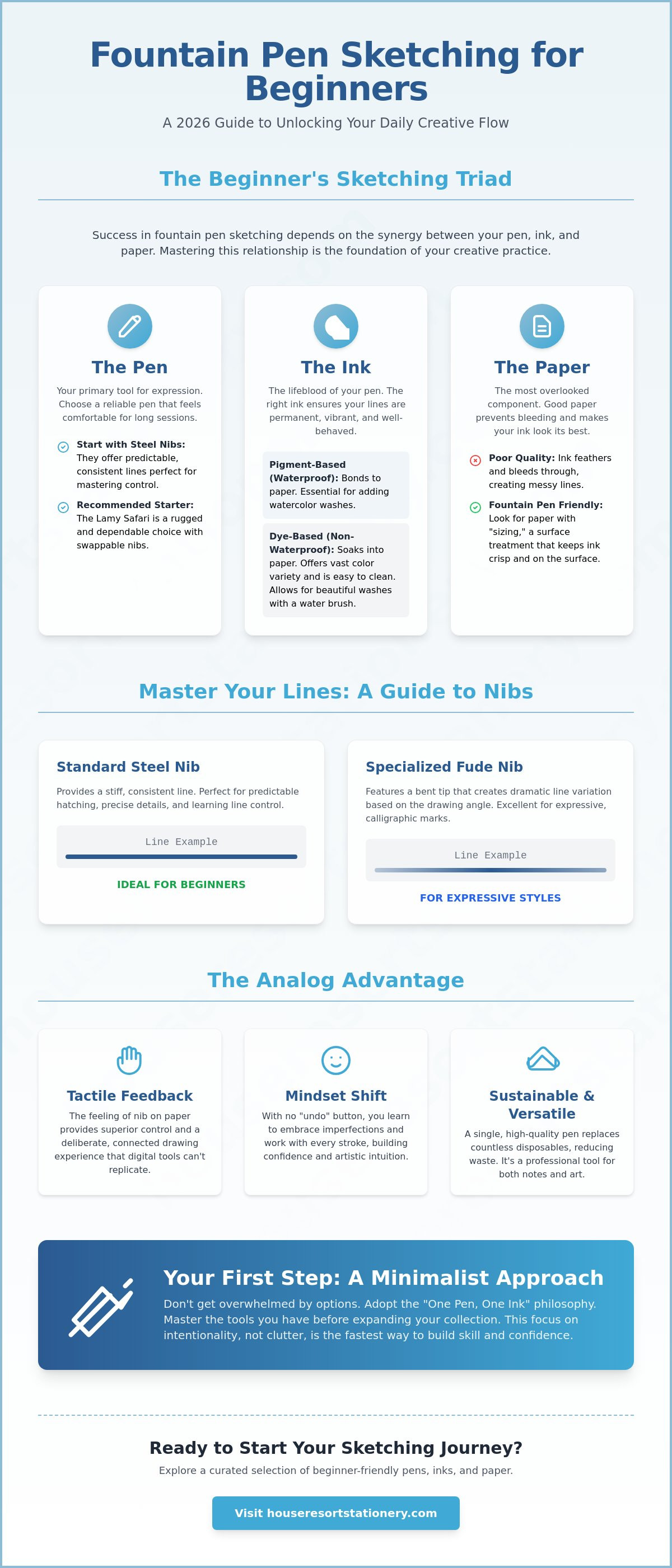
Success in fountain pen sketching for beginners depends on more than just a steady hand. It's about the technical synergy between three specific components: the pen, the ink, and the paper. If one element fails, the entire experience suffers. You might have a world-class pen, but if you pair it with absorbent, low-quality paper, your lines will feather and bleed. Understanding how these tools interact is the first step toward creating professional-grade analog art.
The pen is your primary interface. Most beginners should start with a stiff steel nib. These provide a predictable, consistent line that helps you focus on composition. Flexible nibs are tempting for their expressive line variation, but they require a delicate touch and a steeper learning curve. The ink you choose is equally vital. Dye-based inks offer a vast spectrum of colors and are generally easier to clean, but they'll smear if they get wet. If you intend to add watercolor washes to your sketches, you must use a pigment-based, waterproof ink that bonds permanently to the paper fibers.
Paper is the most overlooked part of the triad. Many people assume that a high GSM (grams per square meter) ensures quality, but for fountain pens, "sizing" is the critical factor. Sizing is a surface treatment that prevents the ink from being sucked into the paper's core. Proper sizing keeps the ink on the surface, allowing for crisp lines and vibrant colors. Finding the right balance between these three tools allows you to develop a signature style that feels both intentional and effortless.
Choosing Your First Sketching Pen
The Lamy Safari is a rugged, dependable choice for those entering the hobby. Its ergonomic grip encourages proper hand positioning, and the nibs are easily swappable if you want to experiment with different line widths. For artists who prefer long drawing sessions without refilling, the TWSBI Eco features a transparent body and a high-capacity piston filling system. If portability is your priority, the Kaweco Sport offers a compact, faceted design that fits easily into a pocket or a small EDC pouch.
The Importance of Fountain-Pen-Friendly Paper
Japanese stationery often leads the market in paper quality. Midori MD notebooks are widely regarded as a gold standard because their paper handles heavy ink loads with minimal ghosting. For those who prefer a modular system, the Traveler’s Notebook allows you to carry multiple paper types in one leather cover. This is ideal for urban sketchers who need to switch between smooth writing paper and textured sketching inserts. You can explore our curated selection of paper and pens to find the perfect match for your creative needs.
Understanding Nibs and Line Variation for Artists
The nib is the most critical point of contact between your creative vision and the paper. For anyone starting fountain pen sketching for beginners, the choice between an Extra Fine (EF) and a Medium (M) nib often defines their early style. An Extra Fine nib provides the surgical precision required for tight hatching and intricate architectural details. Conversely, a Medium nib allows more ink to flow. This showcases the shading properties of your chosen ink while providing a smoother glide across the surface. It's a balance of detail versus expression.
If you desire dramatic line variation without the complexity of a flexible nib, the Fude nib is your secret weapon. These nibs are bent upward at a specific angle. This design allows you to change line thickness simply by varying the pen's angle to the paper. Holding the pen vertically produces a thin line; a lower angle creates a broad, brush-like stroke. It mimics the behavior of a traditional brush but maintains the mechanical control of a technical pen. It is a versatile choice for capturing both fine textures and bold silhouettes in a single sketch.
For those moments requiring microscopic detail, many artists use the "reverse writing" trick. By flipping the pen over and writing with the top of the nib, you can achieve an ultra-fine line. This line is often thinner than a standard Extra Fine. It is a useful technique for adding highlights, distant background elements, or tiny annotations without switching pens. It requires a light touch, but it adds a professional layer of depth to your work.
Handle your tools with respect. A common mistake is applying excessive downward pressure in an attempt to force line variation. This can "spring" the nib. Springing occurs when the metal tines are pushed too far apart, permanently ruining the ink flow and the nib's alignment. Fountain pens are designed to write under their own weight. Let the tool do the work. If you find yourself pressing hard, it may be time to explore a different nib size or a wetter ink.
Nib Sizes and Their Artistic Uses
- Extra Fine (EF): Use this for microscopic textures, cross-hatching, and rendering distant subjects in a landscape where subtlety is key.
- Broad (B): This size is perfect for bold, confident outlines and quickly blocking in large areas of shadow or solid color.
- Stub Nibs: These have a flat, rectangular tip. They create natural variation between horizontal and vertical strokes, adding a unique calligraphic texture to your art.
The Myth of the Flexible Nib
Many beginners are drawn to the romantic idea of a flexible nib that swells with every stroke. However, consistency is the foundation of skill. Stiff steel nibs are far more forgiving for those learning fountain pen sketching for beginners. They provide a stable baseline for your hand to develop muscle memory. As you progress, you might transition to gold nibs. While not always flexible in the vintage sense, gold is a softer material. It offers a cushioned drawing feel, absorbing paper vibrations for a more luxurious experience than steel can provide.
Basic Fountain Pen Sketching Techniques
Mastering the physical tool is only half the journey. The true character of your work emerges through specific mark-making techniques that leverage the unique flow of a nib. For those practicing fountain pen sketching for beginners, the goal is to move beyond simple lines and start creating form, depth, and texture. Unlike a pencil, you cannot rely on varying pressure to create lighter or darker shades. Instead, you build value through the density and frequency of your strokes.
Hatching and cross-hatching are the cornerstones of ink art. Hatching involves drawing parallel lines to create a tonal area. Cross-hatching adds a second layer of lines at an angle to the first, deepening the shadow. The closer the lines, the darker the value. This technique requires patience and a light touch. It's an excellent way to practice the precision of your steel or gold nib. You can also experiment with contour drawing. By using a continuous line to follow the edges of an object, you improve your hand-eye coordination and develop a more fluid, confident style.
Creating texture adds a professional finish to any sketch. Stippling uses small dots to build up shadows, while scumbling involves loose, loopy scribbles to suggest foliage or rough surfaces. These techniques take advantage of the fountain pen's consistent ink delivery. They allow for a level of detail that felt-tip pens often struggle to match. Every mark is permanent. This encourages you to be intentional with every stroke you place on the page.
Building Value and Shading
To achieve professional results, you must practice drills that focus on consistent line spacing. Try filling a page with small squares, each representing a different tonal value from light gray to deep black. If you're looking for inspiration, you can explore these easy drawing ideas to practice your shading in a low-pressure environment. Layering ink is an additive process. Start light and build up your mid-tones slowly to avoid over-saturating the paper fibers.
Working with Waterproof Inks
The "Ink Wash" technique is a favorite among urban sketchers. By using a water brush over non-waterproof ink, you can pull the pigment across the page to create soft, painterly shadows. For this effect, Pilot Iroshizuku is a top recommendation due to its vibrant colors and beautiful solubility. However, if you plan to layer watercolors over your lines, you must use a dedicated permanent ink. Remember that pigment-based waterproof inks require more frequent pen cleaning to prevent clogs. A quick flush every two weeks keeps your feed performing perfectly. To find the right tools for these techniques, shop our curated collection of professional sketching supplies.
Curating Your Professional Sketching Kit
Building a professional kit is an exercise in restraint. For those mastering fountain pen sketching for beginners, the temptation is to acquire every available nib size and ink color. However, the most effective path to skill is the "One Pen, One Ink" philosophy. By limiting your tools, you learn the exact capabilities of your instrument. You discover how it reacts to different paper textures and how the ink flows under various environmental conditions. This focus builds a level of intimacy with your tools that a cluttered kit of cheaper alternatives cannot provide.
Reliability comes from investing in heritage brands known for their consistency. These manufacturers prioritize craftsmanship over mass production, ensuring that your tool performs perfectly every time it touches the paper. A professional kit also requires specific accessories to manage the unique properties of liquid ink. Blotting paper is a practical necessity for preventing smudges during quick sessions. Brass storage components provide a durable, aesthetic solution for protecting your investment. These items age beautifully, developing a patina that reflects your personal journey as an artist.
Storage and Portability
Urban sketching demands a mobile, organized setup. A dedicated pen roll protects various nib sizes from scratching against each other. For your most prized writing instruments, a brass pencil case offers a rigid, protective shell that withstands the rigors of travel. When sketching on the go, consider your ink supply. Cartridges offer convenience and mess-free changes. If you prefer bottled ink, a traveling inkwell provides a secure way to refill your piston-fill pens without carrying a fragile glass bottle. This organization ensures that your focus remains on the subject rather than your equipment.
Next Steps in Your Creative Journey
Your creative journey doesn't end with the purchase of a pen. Setting up a daily "sketching nook" at home creates a dedicated space for practice. Fill it with premium stationery that inspires you to create. Joining the analog community allows you to share progress and learn from fellow enthusiasts who value the tactile nature of these tools. This shared passion for quality materials transforms fountain pen sketching for beginners from a simple hobby into a lifelong pursuit of excellence. Explore our curated collection of fine writing tools to find the heritage pieces that will anchor your daily practice for years to come.
Begin Your Analog Creative Journey
Transitioning from digital convenience to the tactile world of ink and paper is a transformative experience. You've learned that the success of your work relies on the synergy of the "Sketching Triad" and the disciplined "One Pen, One Ink" philosophy. By understanding how specific nibs like the Fude or Extra Fine interact with sized paper, you gain the technical confidence to express your unique vision. Mastering fountain pen sketching for beginners isn't about having the most tools. It's about having the right ones that speak to your hand and heart.
As an authorized retailer of heritage brands like Lamy, TWSBI, and Kaweco, we provide the instruments that turn a simple sketch into a lasting legacy. Our curated selection of fountain-pen-friendly Japanese stationery ensures your ink behaves exactly as intended. We take pride in offering expert support for analog enthusiasts to help you navigate the nuances of nibs and ink flow with ease.
SHOP our curated collection of fine fountain pens and professional journals to find tools that will anchor your practice for years to come. Your next masterpiece begins with a single, intentional stroke.
Frequently Asked Questions
Is fountain pen sketching difficult for beginners?
Fountain pen sketching for beginners is not inherently difficult, though it requires a shift in mindset regarding pressure. Unlike pencils or ballpoints, these pens require almost no downward force to leave a mark. This light touch prevents hand fatigue during long sessions. Once you embrace the permanence of ink and stop trying to erase, the process becomes a relaxing and intuitive form of creative expression.
Can I use any fountain pen for sketching?
You can technically use any fountain pen, but models with reliable feeds and durable steel nibs are ideal for artistic work. Sketching involves rapid strokes and varying angles that can stress a delicate vintage instrument. Modern heritage brands like Lamy or TWSBI provide the ruggedness needed for field use. Look for a pen that feels balanced in your hand and offers a secure cap to prevent the ink from drying out.
What is the best ink for fountain pen sketching?
The best ink depends on whether you plan to use water washes in your art. Pigment-based waterproof inks are the gold standard for artists who want to layer watercolors over their drawings. These inks bond permanently with the paper fibers once dry. If you prefer a painterly "ink wash" effect, choose a dye-based ink that remains water-soluble. Always ensure the ink is specifically labeled for fountain pen use to avoid clogging.
Will drawing with my fountain pen ruin the nib?
Drawing is perfectly safe for your fountain pen as long as you don't force the tines apart. A common mistake is "springing" the nib by pressing too hard to get a thicker line. Let the pen glide under its own weight. If you follow this rule, a high-quality nib will last for decades. Using specialized nibs like the Fude allows for varied line weights without risking any mechanical damage.
What kind of paper should I use for fountain pen art?
High-quality Japanese stationery is the preferred choice for ink artists because of its superior surface treatment. Look for paper that is specifically designed to handle liquid ink without bleeding through to the next page. While weight matters, the "sizing" of the paper is what keeps your lines crisp and your colors vibrant. Brands like Midori offer a smooth experience that showcases the true character of your fountain pen sketching for beginners.
Do I need a waterproof ink for sketching?
You only need waterproof ink if you plan to apply watercolor or water-brush washes over your finished lines. Non-waterproof inks offer a wider range of expressive colors and are generally easier to maintain. Many artists keep two pens: one filled with permanent black for outlines and another with a water-soluble ink for creating soft, atmospheric shadows. This dual-pen approach provides the most versatility for your toolkit.
How often should I clean my sketching fountain pen?
A thorough flush every two weeks is recommended if you use waterproof or pigment-based inks. These inks contain small particles that can settle in the feed if the pen sits unused. If you use standard dye-based inks, you can extend this to once a month. Regular maintenance ensures a consistent flow and prevents the nib from skipping during critical moments of your creative process.
What is a fude nib and why is it popular for drawing?
The fude nib features a tip bent upward at a 40 or 55-degree angle to mimic a brush. It is popular because it allows for incredible line variation based on the angle of the pen. Holding it vertically creates fine details, while a flatter angle produces broad, sweeping strokes. This versatility makes it a favorite for urban sketchers who want the expressiveness of a brush with the convenience of a pen.