
Fountain Pen Troubleshooting: A Curator’s Guide to Solving Common Problems
What if the frustration you feel with a skipping nib isn't a sign of a broken tool, but a call for a deeper connection with your instrument? With over 15 million fountain pens sold worldwide in 2024, more enthusiasts than ever are encountering the nuances of nib performance. Mastering fountain pen troubleshooting common problems is less about repair and more about a ritual of calibration between your ink, the paper, and the nib.
It's incredibly disheartening when a premium writing session is interrupted by inconsistent flow or the scratchy feedback that plagues even expensive stationery. You've invested in quality materials because you value the tactile nature of analog tools, so you shouldn't have to settle for a temperamental experience. This guide promises to help you master the art of maintenance, offering professional techniques to resolve performance issues and restore that signature smoothness you expect from heritage manufacturers.
We will explore the nuances of tine alignment, the importance of specialized pen flushes, and the technical descriptors that help you identify exactly what's wrong. You'll gain the confidence to perform basic maintenance at home while learning the precise moment to stop and consult a professional nibmeister for a specialized tune and smooth service.
Key Takeaways
- Identify the subtle differences between a hard start and true mechanical skipping by mastering the anatomy of capillary action.
- Resolve persistent ink flow issues by evaluating cap air-tightness and identifying genuine blockages versus dry-writing characteristics.
- Master professional techniques for fountain pen troubleshooting common problems like tine misalignment to eliminate scratchiness while preserving intentional nib feedback.
- Apply the "Variable Isolation" method to determine if performance issues are caused by the tool or external factors like hand oils and paper quality.
- Recognize critical structural damage and the "Point of No Return" to protect your fine writing instruments from permanent amateur damage.
Diagnosing the Issue: The Anatomy of a Flawless Stroke
Writing with a fine instrument is a delicate physics experiment. It relies on a precise balance between capillary action and surface tension. When this balance breaks, the results are frustrating. Mastering fountain pen troubleshooting common problems begins by learning to "read" your pen before you ever reach for a tool. You must observe how the ink behaves as it meets the paper surface. Is the line thin and dry, or does it fail to start entirely? These subtle clues tell a story of what's happening inside the feed.
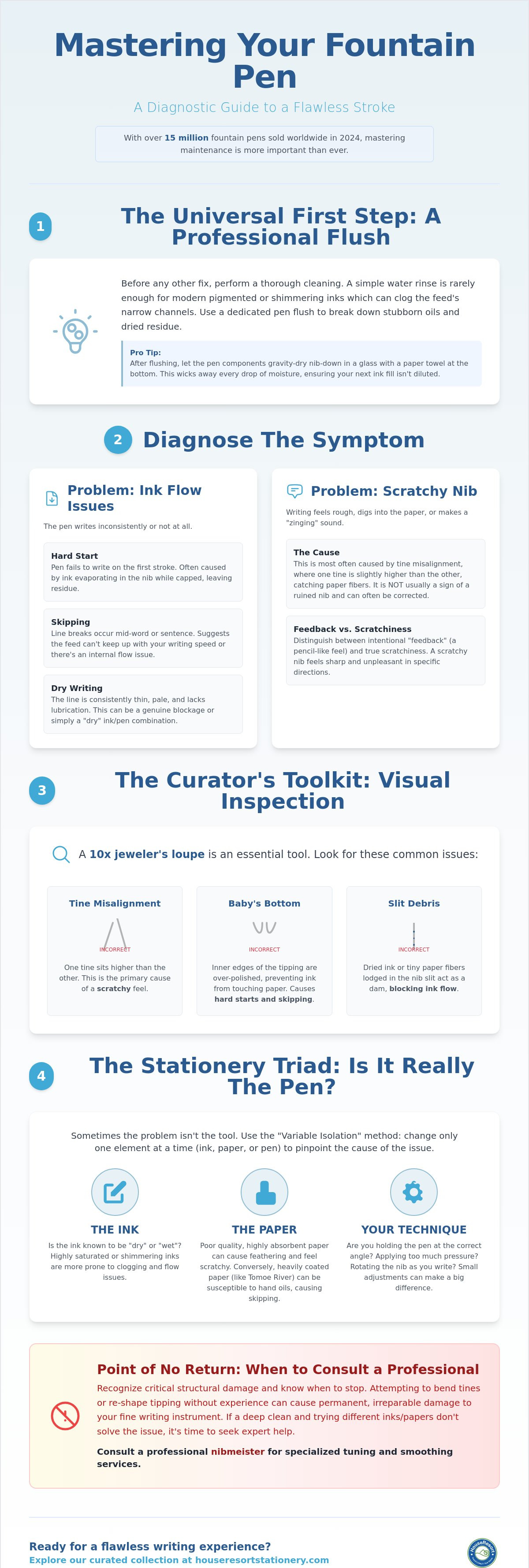
Distinguishing between a hard start and true mechanical skipping is your first diagnostic hurdle. A hard start usually happens because ink has evaporated in the nib while the pen was capped or resting. This leaves behind a concentrated residue that blocks immediate flow. True skipping, however, occurs mid-sentence. It suggests the feed cannot keep up with your writing speed or that the nib has lost contact with the ink's surface tension. Diagnosing these issues requires a clean, well-lit environment. Use a dedicated desk lamp to catch the reflection of the ink on the tipping material.
Modern heritage pens require a different diagnostic perspective than vintage models. While an older pen might suffer from a perished latex sac, a new luxury instrument often faces issues related to modern ink chemistry or tight factory tolerances. Understanding the Anatomy of a Fountain Pen is essential here. You need to know how the nib, feed, and reservoir interact to create a consistent vacuum. If any part of this triad is compromised, the writing experience will suffer regardless of the pen's prestige.
The Visual Inspection: What Your Nib is Telling You
A 10x magnification loupe is a curator's best friend. Use it to check for tine alignment; if one tine sits even a fraction of a millimeter higher than the other, it will catch on the paper fibers. This creates a "scratchy" sensation that many users mistake for a ruined nib. You should also look for "baby's bottom," where the inside edges of the tipping are over-polished. This prevents the ink from actually touching the paper. Finally, inspect the slit for dried residue or tiny paper fibers that act as physical dams against the ink flow.
The First Step: The Professional Flush
Before you attempt any mechanical adjustments, perform a thorough cleaning. A simple water rinse is rarely enough for modern pigmented or shimmering inks. These formulations contain particulates that can lodge deep within the feed's narrow channels. Use a dedicated pen flush to break down stubborn oils and dried dyes. This maintains the long-term health of the feed and ensures the capillary channels remain open. Once flushed, gravity-dry the pen in a glass with a paper towel at the bottom. This draws out every drop of moisture, preventing your next ink fill from being accidentally diluted.
Resolving Ink Flow Issues: From Hard Starts to Dry Writing
The distinction between a naturally "dry" writing nib and a genuine blockage is a fundamental lesson in fountain pen troubleshooting common problems. A dry writer is often a design choice, favored by those who use absorbent paper or write in small, tight scripts. However, when a pen that previously performed well begins to stutter, you're likely facing a disruption in the ink's path. Identifying the root cause requires looking beyond the nib. Often, the culprit is the cap's air-tightness. If the inner seal is compromised, the ink in the feed evaporates, leaving behind a crust of dye that prevents immediate flow.
Troubleshooting varies significantly between filling systems. Piston-fillers offer impressive capacity and a robust vacuum, but they're more difficult to deep clean. Conversely, cartridge-converter systems are modular and easy to maintain, though they're more prone to surface tension issues. You might experience "ink starvation" during a long writing session where the pen gradually pales and then stops. This occurs when the feed's buffer is exhausted faster than the reservoir can replenish it. If you're looking for a tool that balances beauty with mechanical reliability, you can browse our curated collection of fine fountain pens from heritage makers.
Deep Cleaning the Feed and Housing
When a standard flush fails, you may need to remove the nib and feed. For many modern brands, this involves a gentle "friction fit" pull, but you must be cautious. Use a piece of rubber grip to ensure even pressure and avoid bending the delicate fins of the feed. An ultrasonic cleaner is a lifesaver for stubborn, dried ink in metal sections, but it's a risk for vintage celluloid or certain fragile resins. Always ensure the "breather hole" on the feed is clear. This tiny aperture is the lung of your pen, allowing air to enter the reservoir as ink leaves, maintaining the vital pressure balance.
Priming and Saturation Techniques
You don't always need to disassemble your instrument to fix a flow issue. The "gentle dip" method involves touching the nib to a drop of distilled water or ink to break the surface tension of a dry start. If your converter has a persistent air bubble that causes skipping, it's often due to residual manufacturing oils. To eliminate variables during testing, we recommend using pilot iroshizuku bottled ink. Its superior lubricity and consistent flow characteristics make it the gold standard for determining if a problem is mechanical or simply a result of "dry" ink chemistry.
Smoothing the Path: Addressing Scratchy Nibs and Feedback
Distinguishing between intentional feedback and mechanical scratchiness is a hallmark of a seasoned collector. Feedback is a tactile characteristic often found in precision instruments from Japanese heritage manufacturers. It provides a controlled, pencil-like sensation that many writers prefer for detailed work. Scratchiness, however, is a performance failure where the nib's tipping material literally catches on the paper fibers. This physical snagging is one of the most frequent fountain pen troubleshooting common problems, and it usually stems from a lack of alignment rather than a need for abrasion.
The physics of tine alignment requires a meticulous "dry" check. Before you introduce any abrasives, ensure the pen is empty of ink. Lubrication from ink can mask minor misalignments, leading you to over-correct. Perform a 12 o'clock and 6 o'clock check under a loupe. This involves looking at the nib head-on to see if the tines are level and then from the side to check for vertical deviations. If one tine sits higher than the other, it will scrape the paper on every side-stroke. This simple calibration often resolves 90% of "scratchy" complaints without ever touching a polishing sheet.
Tine Alignment: The Micro-Adjustment Ritual
Proper alignment is achieved through the "fingernail technique." By using a thumbnail to gently nudge the high tine downward, you can bring the tipping material back into a parallel state. It's a delicate process that demands patience. You shouldn't ever adjust tines while the pen is inked; the fluid creates a false sense of smoothness that disappears once the pen dries. You must check for both vertical and horizontal misalignment. Horizontal gaps affect ink flow, while vertical offsets are the primary cause of that unpleasant "toothiness" on expensive paper.
Refining the Writing Surface
If the tines are perfectly aligned but the nib still feels rough, you may need to remove microscopic burrs. Skip the common advice of using brown paper bags. Their fibers are inconsistent and can actually worsen alignment issues. Instead, use professional-grade 12,000 grit micro-mesh. Follow these steps for a safe result:
- Perform light "figure-eight" motions on the micro-mesh surface.
- Use absolutely no downward pressure; the weight of the pen is sufficient.
- Test the nib frequently on high-quality paper to monitor your progress.
- Stop immediately once the scratchiness vanishes to avoid creating a "baby's bottom" effect.
Over-polishing is a permanent mistake. It rounds off the "sweet spot" of the nib, leading to the flow issues we discussed in previous sections. Meticulous care at this stage ensures your instrument remains a reliable companion for years.
The Stationery Triad: When the Problem Isn’t the Pen
Isolating the source of a writing failure requires a disciplined approach. Often, enthusiasts spend hours adjusting a nib only to realize the issue was never mechanical. The most overlooked aspect of fountain pen troubleshooting common problems is the interaction between the nib and the writing surface. To find the culprit, you must use the "Variable Isolation" method. Change only one element at a time. If you switch your ink and your paper simultaneously, you'll never identify which component caused the stutter. Start by testing your pen on a known, high-quality surface to see if the symptoms persist.
Phantom skipping is a frequent frustration that has nothing to do with ink flow. It's often caused by natural hand oils. As you write, your palm rests on the page, leaving behind a microscopic barrier of lipids. When the nib reaches that section, the ink cannot penetrate the oil to bond with the paper fibers. This creates a skip that feels like a mechanical failure. Using a simple "writing mat" or a clean piece of paper under your hand can instantly resolve this issue. If you find your current journals aren't meeting these standards, you can shop our selection of fountain pen friendly notebooks to ensure a consistent experience.
Paper Synergy: Beyond the Standard Sheet
The choice of paper significantly dictates how a nib feels and performs. Standard office paper is highly absorbent, which can pull too much ink from the feed and lead to "feathering," where the ink wicks into the fibers like a spiderweb. Conversely, some coated papers are so smooth that they resist the ink entirely. A traveler's notebook or Midori MD paper provides the ideal testing ground for troubleshooting. These surfaces are designed to showcase ink properties without bleeding through. If your pen writes perfectly on Midori but skips on a generic notepad, the pen isn't the problem. You can also use blotting paper to diagnose excessive flow. If the blotter reveals a puddle rather than a crisp line, your ink may be too "wet" for that specific nib and feed combination.
Ink Chemistry and Performance
Ink is the lifeblood of the instrument, but not all fluids are created equal. You must never use calligraphy or India ink in a fountain pen. These contain shellac or acrylic binders that will permanently clog the feed once they dry. Modern "sheening" inks are beautiful, but their high dye concentration means they require more frequent maintenance. They evaporate quickly on the nib, leading to the hard starts we discussed in previous sections. When you're in the middle of a diagnostic check, switch to a standard blue-black ink. These are generally the most well-behaved and serve as the perfect "control" to determine if your pen's issues are chemical or mechanical.
Professional Curation: When to Consult a Nibmeister
Even the most dedicated enthusiast must eventually recognize when a tool requires the hand of a master. While many fountain pen troubleshooting common problems yield to a thorough flush or a minor tine adjustment, structural failures demand professional intervention. A cracked feed, often hidden beneath the nib, can cause inexplicable leaking or air bubbles that disrupt the vacuum. Similarly, a dropped pen with severely bent tines is rarely a candidate for home repair. Forcing these delicate components back into place without specialized tools often results in metal fatigue or snapping; this turns a repairable issue into a permanent loss.
The "Point of No Return" is a critical boundary for any collector. If you find yourself reaching for aggressive abrasives or pliers, it's time to stop. Modern heritage pens often come with manufacturer warranties that cover factory defects, but these are voided the moment you attempt unauthorized mechanical modifications. Third-party repairs from a trusted nibmeister are often the better choice for vintage finds or pens that simply need a personalized touch. These experts can solve ergonomic issues that a factory replacement cannot, such as adjusting a pen for a heavy-handed writer or a specific holding angle.
The Role of the Nibmeister
A professional nib tuning service is a transformative experience for your instrument. When sending a pen to a technician, be precise in your descriptions. Note the specific paper and ink you use, as well as the exact angle of your stroke. A nibmeister doesn't just "fix" a pen; they calibrate it to your unique hand. Beyond standard repairs, they offer customization through specialized grinds. An Architect grind provides sharp horizontal and thin vertical lines, while a Cursive Italic adds flair to daily correspondence. This level of curation moves the pen beyond a simple writing tool into a bespoke work of art.
Maintaining Your Collection for the Long Term
Longevity is the result of consistent, mindful habits. Implement a "Rotate and Rinse" schedule to ensure no pen sits with ink for more than a few weeks. Storing your pens properly is equally vital. Keep them horizontal for optimal flow during daily use, or nib-up if you plan to leave them for a few days to prevent ink from pooling in the cap. One of the most enjoyable ways to maintain health is through fountain pen doodle journaling. This practice keeps the ink moving through the capillary channels, preventing the clogs that lead to the fountain pen troubleshooting common problems we've explored throughout this guide. Meticulous care ensures your collection remains a source of joy rather than a list of chores.
Mastering the Art of Analog Maintenance
Mastering fountain pen troubleshooting common problems transforms a simple repair into a ritual of care for your collection. By understanding the delicate physics of ink flow and the vital role of paper synergy, you've moved beyond frustration toward a deeper appreciation of these heritage tools. Whether you're adjusting a misaligned tine or selecting a more lubricated ink, your commitment to the craft ensures that every word remains a tactile pleasure. You now possess the confidence to maintain your instruments while knowing exactly when to seek the precision of a professional nibmeister.
As an authorized retailer of heritage brands, we bring specialized knowledge in Japanese and European nibs to every enthusiast we serve. Our expertly curated selection of fountain-pen-friendly paper and professional maintenance tools provides the ideal foundation for a flawless writing experience. Explore our curated collection of fine writing instruments and maintenance tools to find your next heirloom or the perfect accessory for your routine. Your journey into the mindful world of analog writing is just beginning, and we're here to guide every stroke.
Frequently Asked Questions
Why does my fountain pen skip when I write fast?
Skipping during rapid writing occurs because the feed cannot keep up with the increased ink demand. This is usually a sign of a narrow capillary channel or a dry ink formulation that lacks the necessary flow. To resolve this, ensure your feed is free of residue and consider switching to a more lubricated ink that maintains constant contact with the paper surface.
Is it normal for a new fountain pen to feel scratchy?
A new instrument should write smoothly, although certain heritage brands incorporate intentional feedback for a precise writing experience. If the nib physically catches or snags on the paper, the tines are likely misaligned. This is a staple of fountain pen troubleshooting common problems that you can often identify with a 10x loupe and correct through gentle calibration.
How often should I clean my fountain pen if I use it daily?
You should perform a thorough cleaning every four to six weeks if you use the same ink consistently. Daily use keeps the ink moving, but microscopic evaporation still leaves behind dye particulates. If you prefer shimmering or high-pigment inks, you'll need to flush the feed with every refill to prevent these particles from obstructing the narrow ink channels.
Can I fix a bent nib at home?
You should avoid attempting home repairs on structural nib damage like severe bends or "crumped" tips. While minor tine alignment is a standard maintenance skill, straightening a bent nib requires specialized blocks and burnishing tools. Amateur attempts often cause metal fatigue; this leads to the nib snapping and necessitates a much more expensive professional replacement.
Why is ink leaking into the cap of my pen?
Leaking into the cap is typically caused by pressure changes or physical agitation. Carrying a pen in a pocket allows body heat to expand the air inside the reservoir, which forces ink out through the feed. To prevent this, always store your pen nib-up when you aren't writing; this ensures the air can escape without pushing ink ahead of it.
What is a "hard start" and how do I prevent it?
A hard start happens when ink dries on the nib's surface during a period of inactivity. It's often prevented by ensuring your pen cap has a functional inner seal to maintain a humid environment around the nib. If a pen consistently fails to start, a professional flush will remove any concentrated residue that has built up inside the feed's fins.
Does the type of ink I use really matter for troubleshooting?
Ink chemistry is a primary variable in fountain pen troubleshooting common problems because different brands have varying pH levels and surface tensions. A "dry" ink can make a perfectly aligned nib feel scratchy, while a "wet" ink might cause feathering on quality paper. Using a standard, well-behaved blue ink is the best way to isolate mechanical issues from chemical ones.
Can I use tap water to clean my fountain pen?
You can use tap water for routine rinses, but distilled water is the superior choice for long-term maintenance. Minerals found in tap water, such as calcium or lime, can leave deposits inside the feed over several years. For stubborn clogs or dried ink, a dedicated pen flush is significantly more effective than water alone at breaking down hardened dye.