
Gold Nib vs. Steel Nib: The Connoisseur’s Guide to Fountain Pen Performance
If you believe a gold nib is inherently smoother than a steel one, you might be paying a premium for a myth. Understanding the gold nib vs steel nib fountain pen differences is the key to finding a tool that responds to your unique handwriting style. Many enthusiasts assume that the price tag of a 14k or 18k alloy automatically guarantees a superior writing experience. You likely feel the pressure to upgrade but worry about whether the performance gains actually justify the investment.
This guide helps you look past the technical jargon to discover the tactile reality of each material. You'll learn exactly how nib composition affects ink flow and the subtle "soul" of the pen on paper. We provide a clear framework for deciding when to embrace the reactive nature of gold and when to rely on the steadfast precision of steel.
From the soft spring of a heritage manufacturer's nib to the consistent feedback of modern stainless steel, we'll help you choose the perfect instrument for your next journal entry. Discover the nuances of performance that define the connoisseur's collection and ensure your next acquisition is a source of lasting satisfaction.
Key Takeaways
- Distinguish between stainless steel and 14k or 18k gold alloys to understand how material composition influences the long-term value of your collection.
- Identify "bounce" and "spring" as the defining tactile characteristics of gold, which allow for subtle line variation and a more responsive writing experience.
- Discover why the tipping material, rather than the nib metal itself, is the true secret to smoothness when evaluating gold nib vs steel nib fountain pen differences.
- Compare the corrosion resistance of gold against the structural "stiffness" of steel to determine which material best suits your favorite boutique inks and daily habits.
- Develop a selection framework that matches specific nib materials to your writing pace, from rapid note-taking to slow, deliberate journaling.
Understanding the Material Difference: Gold vs. Steel Nibs
The nib is the soul of the pen. It translates thought into ink. For the enthusiast, the primary choice lies between stainless steel and gold alloys. These materials define the fundamental gold nib vs steel nib fountain pen differences that collectors prioritize. While steel offers a reliable, firm experience, gold provides a degree of elasticity that many find indispensable for long writing sessions.
Historically, gold's dominance wasn't purely aesthetic. Early fountain pen users relied on iron-gall inks. These formulas were highly acidic and corrosive. A steel nib would degrade quickly under such conditions. Gold, being a noble metal, remained inert and survived decades of use. Modern inks are gentler, yet the preference for gold persists due to its unique mechanical properties. 14k gold is frequently cited as the "sweet spot" for performance. It contains 58.5% pure gold, providing enough softness for character while maintaining the structural strength that 18k alloys sometimes lack.
The Metallurgy of the Nib
Pure 24k gold is unsuitable for writing. It's far too soft and would bend permanently under minimal pressure. To create a functional tool, makers alloy gold with metals like silver, copper, or brass. These additions provide the resilience needed for daily use. Modern stainless steel alloys have also evolved. High-grade steel can now offer a smooth, consistent flow that rivals entry-level gold. The springiness of gold is a structural memory of the metal. This allows Fountain pen nibs to flex during a downstroke and snap back to their original shape instantly.
A Brief History of Nib Craftsmanship
The transition from steel dip pens to self-contained fountain pens required a leap in durability. Heritage manufacturers like Lamy and Sailor built their reputations on mastering these material challenges. They moved beyond utilitarian production to treat the nib as a curated component. In the 21st century, the fountain pen has shifted from a basic office supply to a specialized analog tool. Collectors now value the distinct personality a specific alloy brings to their paper. Whether you prefer the unyielding precision of steel or the reactive nature of a gold alloy, understanding gold nib vs steel nib fountain pen differences remains the most significant factor in your pen's performance.
Flexibility, Softness, and the Bounciness of Gold
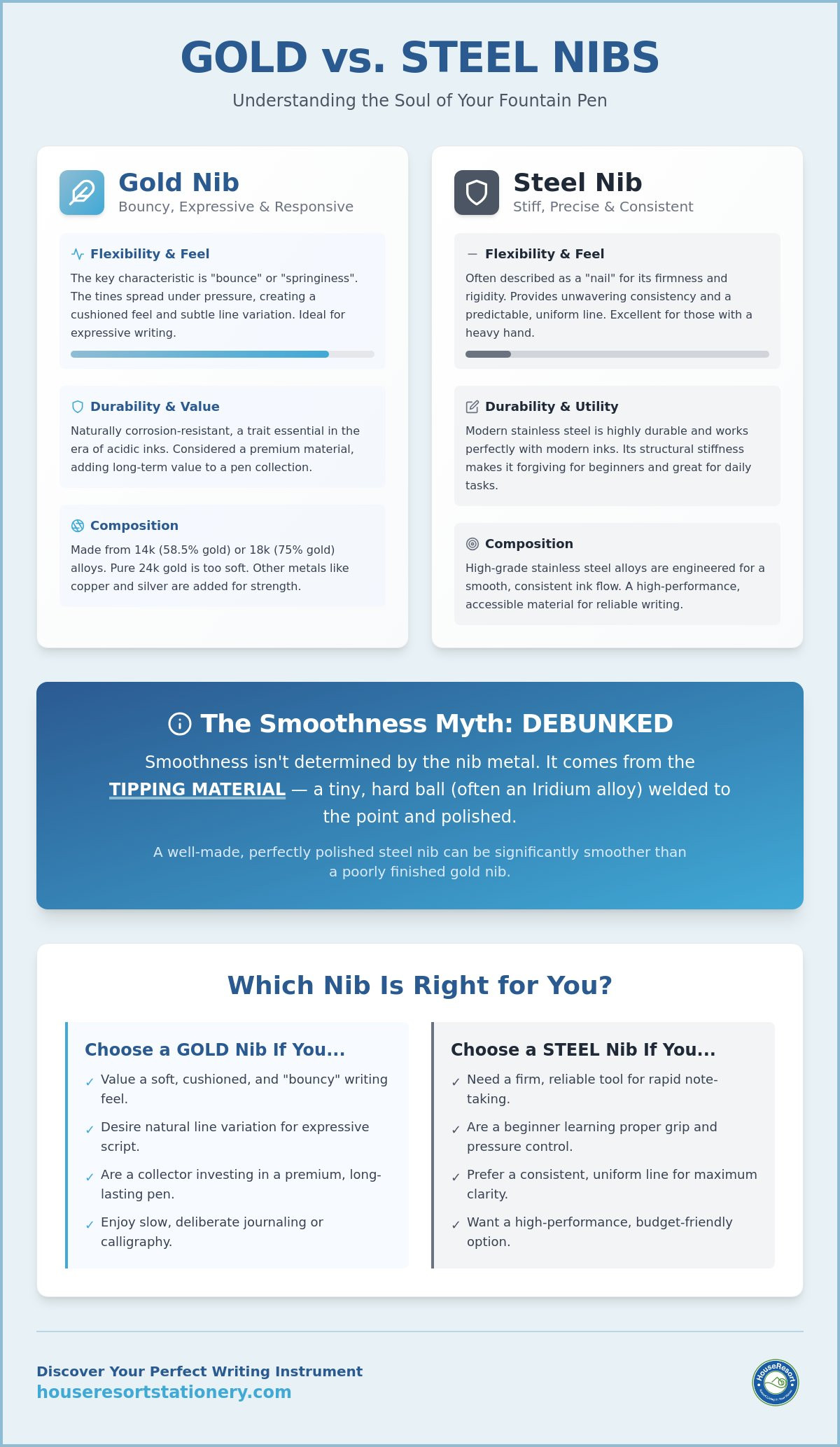
Tactile feedback defines the writing experience. When evaluating gold nib vs steel nib fountain pen differences, the concept of "bounce" is often the deciding factor for collectors. Gold is not inherently superior because of its price; it is preferred because of its elasticity. The metal allows the tines to spread and retract with a rhythmic memory. This creates a cushioned sensation on the paper that enthusiasts describe as springy or bouncy.
Steel nibs are often referred to as "nails" in the fountain pen community. This isn't a criticism; it's a description of their unwavering consistency. A steel nib provides a firm, reliable point that resists bending. For those who write with a heavy hand or require absolute line uniformity, this stiffness is a significant advantage. The choice between these materials often dictates how the ink interacts with the feed. Because gold tines move more freely, they can act as a subtle pump, encouraging a more generous ink flow during expressive strokes.
Line Variation and Expressive Writing
Gold nibs offer a degree of softness that translates into natural line variation. As you apply downward pressure, the tines separate. This allows more ink to reach the page, thickening the line. This characteristic is ideal for long-form journaling or creative prose where the writer wants their mood reflected in the script. Using a high-quality lubricant like Pilot Iroshizuku bottled ink enhances this expressive flow. It allows the nib to glide without resistance even during broader, more demanding strokes.
Consistency and Daily Utility
Steel nibs excel in environments where precision is paramount. They are the superior choice for high-pressure note-taking or filling out carbon copies that require a firm touch. Beginners often find steel more approachable because it's harder to accidentally "spring" or ruin the nib through improper grip. While the mechanical properties of gold alloys make them reactive, steel remains stoic. This makes steel a reliable companion for fast, unconsidered writing.
- Durability: Steel maintains its factory shape even under significant writing pressure.
- Reliability: It offers a predictable line width regardless of the angle of the pen.
- Accessibility: Steel allows enthusiasts to explore various brands without a massive initial investment.
The interaction between nib material and paper is a nuance often overlooked. A bouncy gold nib might feel too uncontrolled on very slick paper, while a firm steel nib provides the necessary "bite" to maintain control. Understanding these gold nib vs steel nib fountain pen differences helps you curate a desk that meets every writing need. If you're seeking a tool that balances these technical traits with artisan craftsmanship, BROWSE our collection of fine fountain pens to find your perfect match.
Debunking the Smoothness Myth: Why Tipping Matters Most
The smoothness of a nib has almost nothing to do with the metal it's made from. This is perhaps the most persistent misunderstanding in the community. Whether you are writing with a 14k gold alloy or a stainless steel unit, the material touching your paper is rarely the gold or steel itself. Instead, manufacturers weld a tiny ball of hard, wear-resistant alloy to the end of the tines. Historically referred to as "iridium," these modern tipping materials are complex blends of platinum-group metals like ruthenium and osmium. This hard ball is what determines the friction you feel on the page.
While the composition and properties of stainless steel provide excellent resistance to daily wear, even the highest grade of steel requires this specialized tipping to prevent the nib from wearing down against the abrasive surface of the paper. This technical reality levels the playing field. A well-tuned steel nib from a reputable maker can easily out-write a poorly finished gold nib. The psychological impact of gold often creates a "halo effect" where users perceive smoothness that stems from the pen's prestige rather than its actual tactile performance. Understanding these gold nib vs steel nib fountain pen differences helps you invest in genuine quality rather than just a material label.
The Role of the Nib Technician
The "buttery" feel often attributed to gold is usually the result of superior hand-polishing. Premium brands typically reserve their most rigorous quality control (QC) and hand-finishing for their gold models. A technician carefully aligns the tines and smooths the tipping with fine abrasives to ensure a skip-free experience. This human touch, rather than the gold content, creates the effortless glide enthusiasts crave. If a steel nib receives the same level of artisan tuning, the writing experience is often indistinguishable in terms of pure smoothness.
Tactile Feedback: Smooth vs. "Toothy"
Feedback is the vibration transmitted from the paper, through the nib, and into your hand. It's not the same as scratchiness. Some writers actively avoid a "greased lightning" feel, preferring the controlled, pencil-like feedback of a Sailor gold nib. This tactile response is highly dependent on your choice of paper. Discovering how Japanese stationery like Midori MD or Tomoe River interacts with different tipping grinds is essential for any collector. The toothy texture of certain papers can make a gold nib feel more grounded, while a smooth steel nib might feel too slick on coated surfaces.
Durability and Maintenance: A Long-Term Comparison
Investing in a fine writing instrument requires a perspective on longevity. While we've discussed the tactile gold nib vs steel nib fountain pen differences, their maintenance requirements offer another layer of distinction. Gold's status as a noble metal isn't just about prestige; it's about chemical stability. Gold is the ultimate choice for enthusiasts who enjoy experimenting with boutique inks. Many modern sheening or shimmering inks use high concentrations of dyes that can be slightly more reactive over long periods of stagnation. Gold remains unaffected by these chemical shifts. Steel is incredibly robust, but if you're the type of collector who leaves a pen inked for months, gold provides that extra margin of safety against corrosion.
The physical resilience of steel provides a different kind of durability. Steel nibs possess a stiffness advantage that makes them ideal for high-pressure environments. If you accidentally drop your pen, a steel nib is far less likely to suffer catastrophic deformation than a soft 18k gold counterpart. However, repairability is where the gold nib vs steel nib fountain pen differences become most apparent for the long-term owner. If you wear down a gold nib over twenty years of writing, a specialist can weld new tipping material onto the tines. This "re-tipping" service is a delicate artisan craft. Because gold is more malleable, it's easier for a nibmeister to reshape the metal after such a procedure. Steel nibs are rarely re-tipped. Their lower replacement cost usually makes it more practical to simply swap the entire unit. For a pen with sentimental value, the heirloom potential of gold is unmatched.
Caring for Your Investment
Maintaining your collection involves different risks for each material. Cleaning protocols remain largely the same, but the stakes differ. You should avoid high-acid inks in vintage pens with steel nibs to prevent permanent pitting. For gold, the primary risk is mechanical rather than chemical. Applying excessive pressure in an attempt to force line variation can "spring" the nib. This pulls the tines so far apart they no longer return to their original position. This is a costly mistake that rarely affects the rigid structure of a steel unit. Regular flushing with cool water every few weeks keeps both materials in peak condition.
The Resilience of Modern Steel
Modern manufacturing has closed the gap in environmental resistance. Many manufacturers now use PVD coatings or gold plating to protect steel from the elements. This makes steel the preferred choice for a travel pen or an everyday carry instrument. The modular nature of certain brands adds another layer of security. The ease of replacing steel nib units in modular pens like the Lamy Safari means a bent nib is a minor inconvenience rather than a total loss. Steel provides a worry-free experience for the active writer who needs a tool that survives the rigors of daily use.
Whether you seek the eternal stability of precious metal or the rugged utility of stainless steel, your choice defines how your pen will age. Explore our curated selection of fine fountain pens to find a durable companion for your daily writing rituals.
Curating Your Collection: When to Choose Gold or Steel
The final decision in the gold nib vs steel nib fountain pen differences debate depends on your specific writing ritual. A well curated collection doesn't require only one material; it requires the right tool for the task at hand. For rapid note taking in a professional setting, the unyielding nature of steel is often superior. For slow, deliberate journaling, the reactive bounce of a gold nib provides a level of character that steel cannot replicate. Choosing between them is a matter of matching the mechanical properties of the pen to the rhythm of your hand.
Brand heritage plays a significant role in this selection. Japanese manufacturers like Sailor and Pilot have spent decades perfecting the personality of their gold alloys, offering everything from stiff manifold nibs to soft, expressive points. If you're looking to upgrade without a massive investment, the entry level gold strategy is highly effective. Many heritage brands offer 14k gold options that provide the essential benefits of softness and corrosion resistance at a more accessible price point. Integrating these choices with modular journaling systems allows you to test how different nib materials respond to various paper textures and weights within a single leather cover.
The Case for Steel: Precision and Accessibility
Steel nibs offer a level of precision that is indispensable for technical work or sketching. They provide a clean line that remains consistent regardless of how much pressure you apply. If you're building a professional kit, a high quality steel nib is a logical partner for a Blackwing 602. Both tools prioritize reliability and performance over flair. Steel is also the ideal material for ink testing or office work where you might be writing on low quality copy paper. It offers a satisfying, low maintenance experience that allows the user to focus on the content rather than the instrument.
The Case for Gold: Character and Craftsmanship
A gold nib is frequently described as the soul of a fine writing instrument. It provides an emotional reward that goes beyond simple utility. Because gold is more malleable, it subtly adapts to your specific writing angle over years of use. This creates a tool that feels uniquely yours. A gold nib completes the sensory experience of analog tools, turning a routine task into a moment of reflection.
- Tactile Feedback: Gold offers a cushioned feel that reduces hand fatigue during long writing sessions.
- Aesthetic Value: The craftsmanship involved in engraving and finishing a gold nib reflects a commitment to tradition.
- Expressive Flow: The way gold interacts with the ink feed allows for a more dynamic and wet writing experience.
Ultimately, understanding the gold nib vs steel nib fountain pen differences allows you to shop with confidence. You can prioritize the nail like reliability of steel for your daily carry or invest in the artisanal heritage of a gold nib for your personal journals. Both materials have earned their place in the connoisseur's desk drawer. We invite you to explore our curated selection of fine fountain pens at HouseResort Stationery to find the next meaningful addition to your collection.
Refining Your Analog Experience
Selecting a fine writing instrument is a personal journey into the heart of craftsmanship. You now understand that while specialized tipping material dictates surface smoothness, the nib's body defines its unique character and response. Whether you prefer the rhythmic, springy soul of a 14k gold alloy or the unwavering precision of stainless steel, each material offers a distinct advantage for your daily rituals. Mastering the gold nib vs steel nib fountain pen differences ensures your next acquisition is a deliberate choice rather than a guess.
As an authorized retailer of heritage brands, we provide a meticulously chosen range of 14k and 18k gold nibs alongside professional steel options. Our expert-led recommendations are designed to help enthusiasts find tools that provide lasting satisfaction and functional beauty. We believe the right pen shouldn't just write; it should inspire every word you put to paper. This curated approach ensures that every addition to your desk serves as a reliable partner in your creative process.
Explore our curated collection of fine fountain pens and nibs to discover the perfect instrument for your collection. We look forward to helping you find a tool that brings your thoughts to life with effortless grace.
Frequently Asked Questions
Does gold really write smoother than steel?
No, smoothness is a function of the tipping material rather than the nib body. Both gold and steel nibs use hard, wear resistant alloys for the point that touches the paper. The "buttery" feel often associated with gold usually stems from the extra hand polishing and rigorous quality control that heritage brands apply to their premium gold models.
Is a 14k gold nib better than an 18k gold nib?
It depends on your preference for resilience. 14k gold is often considered the "sweet spot" for performance because it offers excellent structural memory and spring. 18k gold is softer and feels more luxurious under the hand, but it can be less responsive and more prone to permanent deformation if you apply too much pressure during a flourish.
Can I use any ink in a steel nib fountain pen?
Most modern fountain pen inks are perfectly safe for stainless steel. You should only exercise caution with high acid formulas, such as traditional iron gall inks, which can cause pitting in vintage steel nibs. Modern steel is highly resistant to corrosion, but regular flushing is still necessary to prevent clogging from heavy shimmering or sheening boutique inks.
Why are gold nibs so much more expensive than steel?
The price reflects the intrinsic value of the precious metal and the artisan labor required for assembly. Gold is a costly raw material compared to industrial steel. Additionally, manufacturers often task their most experienced technicians with the final tuning of gold units to ensure the gold nib vs steel nib fountain pen differences are evident in the writing experience.
Should a beginner start with a gold or steel nib?
A high quality steel nib is the most practical starting point for a beginner. Steel is far more forgiving of the heavy writing pressure common among those transitioning from ballpoint pens. It allows you to develop a proper fountain pen grip and explore various brands without the financial risk of accidentally "springing" a soft, expensive gold nib.
Do gold nibs wear down faster than steel nibs?
Neither material wears down significantly because the nib body doesn't actually make contact with the paper. The hard alloy tipping, typically a blend of ruthenium or osmium, provides the necessary wear resistance. Both gold and steel nibs are designed to last for decades of daily use provided they are cleaned regularly and not physically abused.
What is a "soft" steel nib, and is it the same as gold?
A soft steel nib uses specific cutouts or thinner metal to mimic the elasticity of gold. While these nibs provide a pleasant "bounce" and some line variation, they don't possess the same metallurgical memory as gold alloys. They are an excellent middle ground for writers who want a responsive feel without the investment required for a precious metal nib.
How can I tell if my fountain pen nib is gold or steel?
Look for stamped hallmarks on the surface of the nib. Gold nibs are almost always marked with their purity level, such as 14k, 585, 18k, or 750. Steel nibs are usually labeled "Stainless" or "Iridium Point," or they carry no purity mark at all. This is the simplest way to identify gold nib vs steel nib fountain pen differences in any collection.