
How to Choose Your First Fountain Pen: A Curator’s Guide for 2026
Why does a tool designed in the 19th century feel more essential in 2026 than your latest digital upgrade? It's because handwriting is a sensory refuge. However, learning how to choose your first fountain pen often feels like a technical hurdle. You might worry about making a mess with ink or ask yourself which beginner pen actually feels premium without leaking. With the global fountain pen market reaching $1.05 billion this year, it's clear that more people are seeking this tactile connection. You deserve a writing instrument that feels like a natural extension of your hand rather than a source of stress. 🎁
I've curated this guide to help you discover the essential framework for selecting a high-quality starter pen that matches your unique grip. You'll learn why a $37.00 Lamy Safari or a $34.00 Pilot Metropolitan is a superior investment compared to disposable options. We will break down the mechanics of nib sizes, explore the sustainability of refillable converters, and show you how to maintain your tool for a lifetime of use. This article provides a clear path to finding a reliable daily carry that reflects your personal style and handwriting goals. Let's find your perfect match.
- Learn the essential framework of how to choose your first fountain pen by understanding the technical roles of the nib, feed, and reservoir.
- Identify your ideal nib size and material, discovering why stainless steel is often the superior choice for a smooth entry into the stationery community.
- Compare the convenience of ink cartridges against the customization of converters to find the delivery system that matches your daily rhythm.
- Evaluate the balance and weight of different materials like resin or brass to find a tool that feels like a natural extension of your hand.
- Build a complete kit by pairing your pen with high-quality paper, ensuring a perfect writing experience without feathering or bleed-through. 🎁
Understanding the Anatomy and Appeal of the Modern Fountain Pen
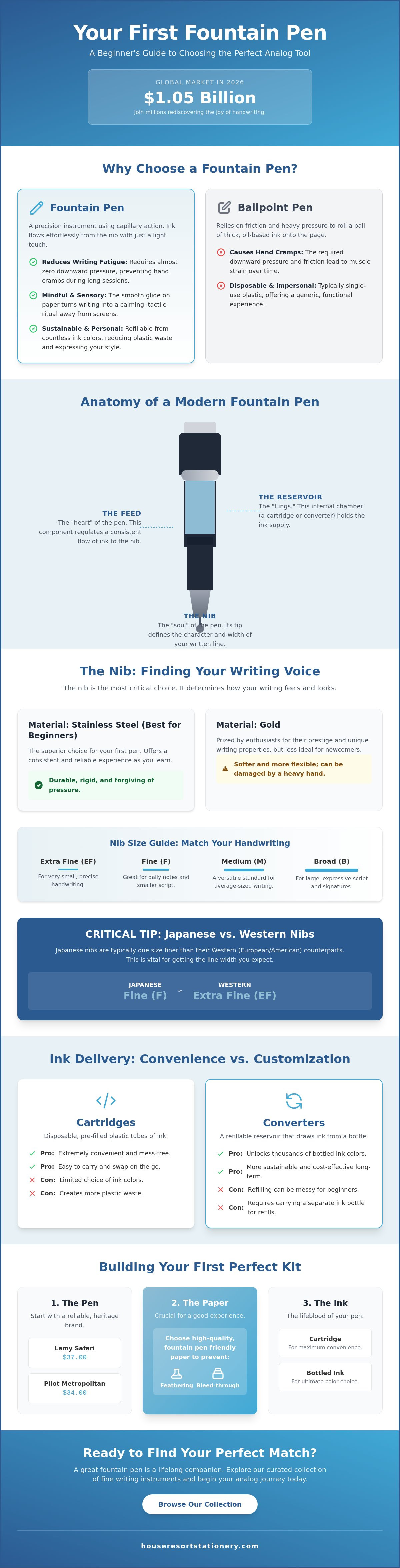
A fountain pen is far more than a simple writing tool. It is a precision instrument that relies on capillary action to draw ink from a reservoir to the page. Unlike a ballpoint pen that requires physical friction and heavy downward pressure to roll a ball, a fountain pen allows ink to flow naturally as soon as the nib touches paper. Understanding the anatomy of a fountain pen is the first step in learning how to choose your first fountain pen. This structure is often described through a biological metaphor. The nib is the soul, defining the character of your line. The feed is the heart, regulating the ink flow. The reservoir acts as the lungs, holding the lifeblood of your writing.
In 2026, the appeal of these tools is stronger than ever. The global market value of $1.05 billion reflects a growing desire for sustainability and tactile feedback. These instruments reduce writing fatigue because they require almost zero pressure to leave a mark. More than 15 million fountain pens were sold in 2024 alone, proving that analog tools remain essential in a digital age. Distinguish between mass-produced school pens and entry-level fine stationery. While school pens are functional, fine stationery instruments offer superior materials and precise nib tuning that lasts for decades. 🎁
The Sensory Advantage of Analog Writing
Digital fatigue is real. The "slow writing" movement encourages people to disconnect from screens and engage with paper as a form of mindfulness. Because fountain pens glide, you can write for hours without the hand cramps associated with standard pens. The physical sensation of a nib gliding across paper ranges from a tactile 'tooth' that offers feedback to a glassy 'smoothness' that feels effortless. This sensory experience turns a mundane task into a mindful ritual. It creates a sense of belonging in a community that values craft over convenience.
Heritage Brands for the First-Time Collector
When you research how to choose your first fountain pen, prioritize the manufacturer’s legacy. Icons like Kaweco from Germany and Sailor from Japan have spent decades refining their manufacturing processes. Buying from an authorized retailer is essential. It ensures you receive an authentic product with a nib that has passed rigorous quality control. These heritage brands maintain their value over time, unlike no-name alternatives that often suffer from ink leaks or scratchy nibs. They represent a shared passion for quality that transcends a simple transaction. Choosing a curated brand is the difference between a temporary purchase and a lifelong companion.
The Nib: Finding the Voice for Your Handwriting Style
The nib is the most intimate part of the pen. It's where your thoughts meet the paper. When learning how to choose your first fountain pen, the nib material is your first major decision. While gold nibs are prized for their prestige and flexibility, stainless steel is the superior choice for beginners. Steel nibs are durable, rigid, and far more forgiving if you accidentally apply too much pressure. They provide a consistent writing experience that helps you develop a proper 'light touch' without the risk of damaging an expensive gold tip. 🎁
Deciphering nib sizes can feel like learning a new language. Most brands offer four standard widths: Extra Fine (EF), Fine (F), Medium (M), and Broad (B). Your choice should reflect the size of your natural handwriting. If you write in small, precise characters, an EF or F nib will prevent your letters from closing up. If your script is large and expressive, a Medium or Broad nib allows the ink to show off its shading and character. You can find a curated selection of these varied options when you browse our collection of fine writing instruments.
A critical nuance in the stationery community is the discrepancy between Japanese and Western sizing. Japanese brands produce nibs that are approximately one size finer than their Western counterparts. A Japanese Fine writes like a Western Extra Fine. This distinction is vital for those seeking extreme precision in compact planners. Understanding this framework ensures your first purchase matches your expectations for line width and ink flow.
Western Nibs: For Flow and Smoothness
Western brands like Lamy and Kaweco are celebrated for their reliable, 'wet' writing experiences. These nibs tend to lay down more ink, which results in a smoother glide across the page. They are often more forgiving for those transitioning from ballpoints because they feel less restrictive. The Lamy Safari is a particular favorite for experimentation because it features a swappable nib system. You can easily switch from a Fine to a Broad nib without buying a new pen, making it a perfect tool for discovering your personal preference.
Japanese Nibs: For Precision and Detail
The craftsmanship of Sailor and Platinum entry-level pens is legendary. These nibs are designed for the intricate strokes of Japanese kanji, making them ideal for anyone who uses small-grid notebooks or detailed planners. Japanese nibs provide more 'feedback,' which is a tactile sensation similar to a sharp pencil on paper. This feedback offers greater control over your letterforms. If you value surgical precision over a glassy slide, a Japanese nib is your best entry point into the world of fine stationery.
Ink Delivery Systems: Convenience vs. Customization
Once you've selected a nib, the next step in how to choose your first fountain pen is deciding how to fuel it. The ink delivery system dictates how you interact with your pen on a daily basis. Most beginners start with ink cartridges because they're essentially "plug and play." However, as your passion grows, you'll likely explore converters or piston fillers. These systems allow you to access the vast universe of bottled inks. Understanding the difference between proprietary and standard international systems is vital. Some brands like Lamy and Pilot require their own specific refills, while others like Kaweco use a universal size that fits many different pens. 🎁
For those who write long-form, a piston filler like the TWSBI Eco ($36.99) is a game-changer. These pens don't use a separate cartridge. Instead, the entire barrel acts as a reservoir. This provides a much higher ink capacity, which is perfect for students or novelists who don't want to refill mid-sentence. It's a sophisticated mechanical experience that feels significantly more premium than a standard ballpoint. This high-capacity design is one of the top reasons why 45% of buyers in Europe and Japan now prefer refillable systems over disposable plastic cartridges.
The Case for Starting with Cartridges
Cartridges offer unmatched ease for travel and office environments. They're mess-free and portable. You can keep a spare pack in your bag without worrying about spills. During your first few weeks of learning, cartridges provide a consistent ink flow that helps you focus on your technique. Recommended starter brands like Kaweco and J. Herbin offer excellent cartridge colors. A 5-pack of Lamy T10 cartridges typically costs between $2.09 and $4.50, making it an affordable way to test different hues before committing to a full bottle.
Transitioning to the Converter and Bottled Ink
Bottled ink is where the real magic happens. While a 50ml bottle of Pilot Iroshizuku ink costs approximately $28.00 to $30.00, it's far more cost-efficient over time than buying individual cartridges. Using a converter, which is essentially a refillable cartridge, opens the door to specialty inks. You'll find inks with shimmer, sheen, and complex shading properties that cartridges simply can't replicate. Pilot Iroshizuku is widely considered the gold standard for beginner-friendly bottled ink because of its reliable flow and stunning color depth. It transforms your writing into a vibrant form of self-expression.
Ergonomics and Materials: The Physical Feel of the Pen
The physical body of your instrument determines how long you can write without discomfort. When researching how to choose your first fountain pen, don't overlook barrel materials. Most entry-level pens use high-grade resin or ABS plastic. These materials are lightweight, which is ideal for marathon journaling sessions. A resin pen like the TWSBI Eco ($36.99) feels nearly weightless in the hand. Conversely, metal pens like the Pilot Metropolitan ($34.00) utilize a brass barrel. This adds a substantial, premium weight that many professionals prefer for short notes and signatures. 🎁
Balance is equally critical. You must decide whether to write 'posted' or 'unposted.' Posting refers to placing the cap on the back of the pen while writing. This lengthens the pen and shifts the center of gravity toward the back of your hand. For smaller hands, an unposted pen often feels more nimble. The grip section also plays a role in your comfort. Some pens feature a triangular grip to train your fingers into a traditional tripod hold. Others offer a versatile round section or textured surfaces to prevent slipping. Knowing how to choose your first fountain pen involves testing these physical variables against your personal grip style.
Pocket Pens: The Kaweco Sport Philosophy
The Kaweco Classic Sport ($34.00) is a design icon that has remained largely unchanged since 1935. It follows a unique philosophy: small in the pocket, large in the hand. When closed, it measures just 10.5 cm, making it the ultimate everyday carry tool. Once you post the oversized cap, it transforms into a full-sized writing instrument. You can choose between lightweight ABS plastic for durability or the raw brass version that develops a unique patina over time. It's a perfect example of functional curation for the modern enthusiast.
Full-Sized Workhorses: Lamy Safari and TWSBI Eco
The Lamy Safari ($37.00) is famous for its ergonomic triangular grip. This design helps beginners maintain the correct nib angle. It's a functional feature that reduces hand strain during long periods of use. If you prefer a more visual experience, the TWSBI Eco is a 'demonstrator' pen. Its clear barrel shows the internal piston mechanics and the movement of your ink. Whether you prefer the matte finish of certain Lamy Special Editions or the high-gloss resin of the TWSBI, the tactile experience should guide your final choice. Shop our curated selection of ergonomic fountain pens to find your perfect daily carry.
Building Your First Kit: Beyond the Pen
Understanding how to choose your first fountain pen requires looking beyond the instrument itself. Your pen is one part of a delicate ecosystem often called the "Trifecta." This consists of the pen, the ink, and the paper. If any one of these elements is poor, the entire writing experience suffers. Standard 20lb copier paper is the primary enemy of the enthusiast. It's designed for laser printers and acts like a sponge, pulling ink deep into the fibers. This causes "feathering," where your crisp lines become jagged, and "bleed-through," where ink ruins the following page. 🎁
Protecting your investment is just as vital as the writing process. A simple leather pen sleeve or a sturdy brass pencil case prevents the resin or metal barrel from scratching against keys or other tools. Maintenance is equally straightforward. We recommend a monthly flush with room-temperature water to keep the feed clear of dried ink particles. This simple ritual ensures that the capillary action remains consistent and your pen stays ready for immediate use. Reliability is the hallmark of a well-curated stationery collection.
Selecting Fountain-Pen-Friendly Paper
Paper choice dictates how your ink behaves on the page. "Sized" papers like those from Midori MD or Rhodia feature a special coating that prevents ink from soaking in too quickly. This allows the ink to dry on the surface, showcasing the true color, sheen, and shading properties of your choice. Rhodia No. 16 A5 Dot Grid Notepads, priced between $7.00 and $10.00, are excellent entry points for their legendary smoothness. For those seeking a modular system, The Traveler's Notebook Starter Kit: A Comprehensive Guide to Modular Journaling offers the ultimate fountain pen companion for professionals on the move.
Final Checklist for Your First Purchase
When you're ready to commit, aim for the $30 to $60 "Sweet Spot." This price range offers the best balance of quality and value. Start with one reliable pen, such as a $37.00 Lamy Safari or a $34.00 Kaweco Sport. Pair it with one pack of cartridges for convenience and one high-quality notebook to ensure a smooth glide. This simple kit provides everything you need to join the growing community of analog enthusiasts. To start your journey today, browse our curated selection of authorized fountain pens and discover the joy of precision writing.
Begin Your Analog Journey Today
You now possess the essential framework for how to choose your first fountain pen. By prioritizing the balance between nib precision and ergonomic comfort, you've moved past the technical confusion that often stalls new collectors. You understand that the "Trifecta" of a quality pen, proper ink, and sized paper is the key to a frictionless writing experience. Whether you've chosen a design icon like the Kaweco Sport or a modern workhorse like the Lamy Safari, your choice represents a commitment to a more mindful, tactile way of living. 🎁
HouseResort Stationery acts as your boutique curator in this discovery. We're an authorized retailer for heritage brands including Kaweco, Lamy, and Sailor. Our collection is meticulously selected by stationery enthusiasts to ensure every tool meets our high standards for performance and aesthetic value. We provide worldwide shipping on all our premium writing instruments and journals. Explore our Boutique Collection of Authorized Fountain Pens and find the perfect match for your handwriting style. Your desk is waiting for its next great heirloom.
Frequently Asked Questions
Do fountain pens leak when you fly?
Fountain pens can leak during air travel because of air pressure changes in the cabin. To prevent this, fly with your pen either completely full or completely empty. Keep the nib pointed upward during takeoff and landing. Many modern pens, like those from Kaweco or TWSBI, are resilient, but following these steps ensures your leather cover or pencil board stays ink-free. 🎁
How often do I need to clean my first fountain pen?
You should clean your instrument every four to eight weeks to ensure consistent ink flow. If you're switching between different ink brands or colors, a thorough flush is mandatory. This process prevents old ink from drying and clogging the feed. Regular maintenance is a key part of learning how to choose your first fountain pen and keeping it in peak condition for years.
Can I use calligraphy ink in my fountain pen?
Never use calligraphy or India ink in a fountain pen. These inks contain shellac or acrylic binders that will permanently clog the delicate feed system. Only use inks specifically labeled for fountain pen use, such as J. Herbin or Pilot Iroshizuku. Using the wrong ink can ruin your investment within hours. This often necessitates a professional repair that could have been easily avoided.
Why is my new fountain pen scratchy?
A scratchy sensation usually indicates misaligned nib tines or the use of low-quality paper. If the tines are even, ensure you're using fountain-pen-friendly paper like Rhodia or Midori MD. Sometimes a new pen requires a quick flush with water to remove manufacturing oils from the feed. If the issue persists, an authorized retailer can often help with a simple nib adjustment or replacement. 🎁
Is a gold nib worth the extra cost for a beginner?
A gold nib is generally not worth the added expense for a beginner. Stainless steel nibs provide the durability and rigidity needed while you're mastering the "light touch" required for these tools. Gold nibs offer more flexibility and "bounce," which can be difficult to control initially. Stick to a high-quality steel nib from Lamy or Kaweco for your first purchase to build your confidence.
What is the best fountain pen for left-handed writers?
The Lamy Safari is an excellent choice for left-handed writers because Lamy offers a specialized "LH" nib. This nib is slightly oblique to accommodate the pushing motion of a left-handed stroke. Pair your pen with a fast-drying ink to prevent smudging your work. This combination allows lefties to enjoy the tactile experience without the mess associated with slower-drying specialty inks or broader nib sizes.
How long does a single ink cartridge last?
A standard ink cartridge typically lasts for 10 to 20 pages of A5-sized writing. This volume varies based on your nib size; a Broad nib consumes ink much faster than an Extra Fine nib. If you're a heavy writer, consider a high-capacity reservoir like the TWSBI Eco. Understanding ink consumption is a vital step in discovering how to choose your first fountain pen for daily professional use. 🎁
Do I need to press down hard when writing?
You don't need to apply any downward pressure when writing with a fountain pen. These instruments use capillary action to draw ink to the page, meaning the nib should glide effortlessly under its own weight. Pressing hard can spring the tines and damage the nib permanently. Transitioning to this lighter grip is one of the primary benefits for reducing hand fatigue during long writing sessions.