
How to Fix a Scratchy Fountain Pen Nib: A Connoisseur’s Troubleshooting Guide
A scratchy nib is rarely a permanent defect; it's usually a temporary misalignment that can be solved through observation rather than force. For the enthusiast who values the tactile nature of a fine writing tool, that sudden drag across the page feels like a betrayal of quality. You might worry that your investment is ruined or fear that a heavy hand will damage a delicate 14k or 18k gold nib. It's common to feel frustrated when you can't tell the difference between intentional feedback and a genuine mechanical flaw. Learning how to fix a scratchy fountain pen nib is a vital skill for any collector who wants to restore a luxurious, effortless writing experience.
We agree that your writing ritual should be a relaxing escape, not a chore. This guide helps you diagnose the root cause of nib friction and provides the confidence to perform basic maintenance safely. You'll learn how to use a 10x loupe for precise inspection, realign tines with gentle pressure, and use 12,000 grit micromesh to achieve a glassy finish. We also identify the specific moments when it's best to stop and consult a professional nibmeister to protect your most prized instruments.
Key Takeaways
- Distinguish between the intentional "feedback" of specific heritage manufacturers and genuine mechanical scratchiness that snags paper fibers.
- Utilize a 10x jeweler’s loupe and focused lighting to accurately diagnose tine misalignment before attempting any physical adjustments.
- Master the "Fingernail Method" to safely realign your pen’s tines without the need for specialized tools or the risk of over-correction.
- Learn how to fix a scratchy fountain pen nib using 12,000 grit micromesh and mylar sheets only after confirming perfect alignment.
- Maintain a luxurious writing experience by balancing your ink and paper choices with regular cleaning to prevent future flow issues.
Identifying the Root Cause of Nib Scratchiness
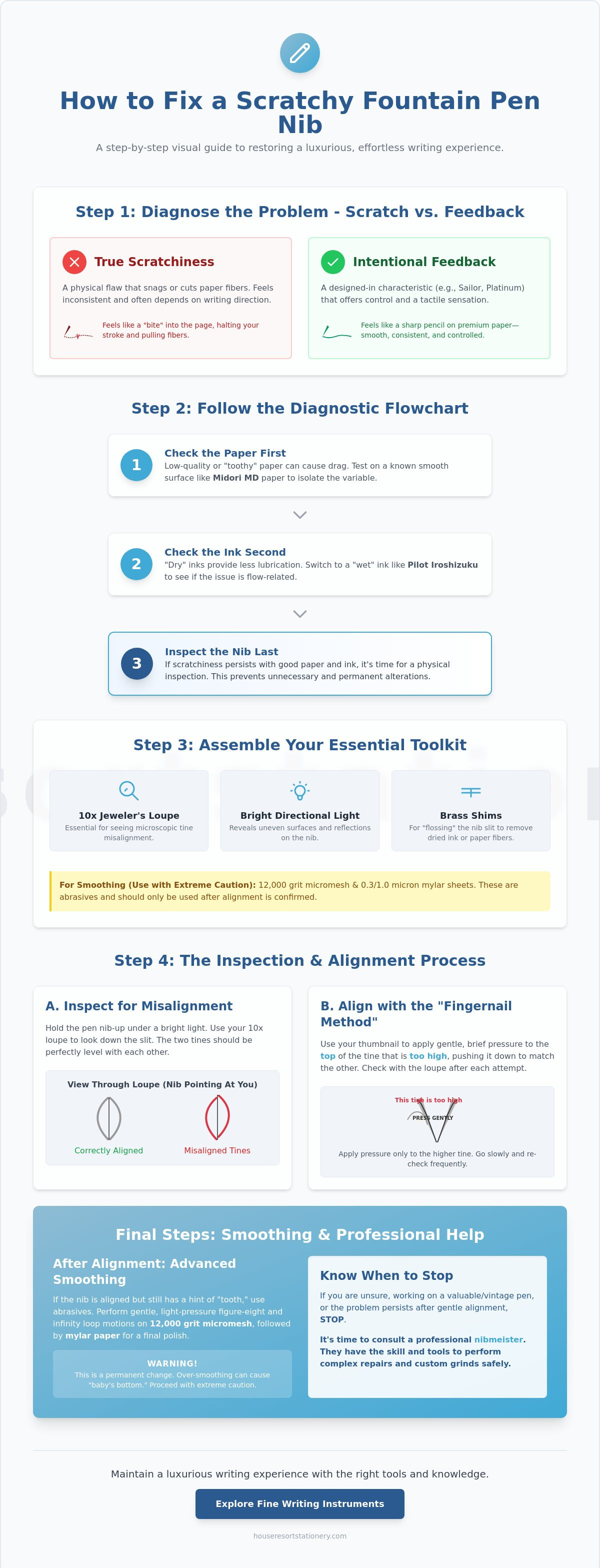
True scratchiness is a physical disruption, not just a tactile preference. It occurs when a sharp edge of the tipping material snags or cuts into paper fibers. This is distinct from "feedback," a characteristic intentionally designed into fountain pen nibs by heritage manufacturers like Sailor or Platinum. Feedback feels like a sharp pencil moving across high-quality bond paper; it provides control without halting the stroke. Scratchiness, however, feels inconsistent and directional. If your pen writes smoothly in one direction but bites into the page in another, you're dealing with a mechanical flaw rather than a design choice.
A systematic diagnostic process is the first step in learning how to fix a scratchy fountain pen nib. Many enthusiasts rush to use abrasives when the issue is actually a "dry nib" phenomenon. This happens when the ink flow is too restricted to provide necessary lubrication. Without a consistent film of ink, the metal tip grinds against the paper, mimicking the sensation of a sharp edge. We recommend checking your variables in a specific order: paper, then ink, then the nib itself. This cautious approach prevents you from making permanent, unnecessary changes to an expensive gold or steel nib.
The Role of Paper Texture and Quality
Paper is the foundation of the writing experience. Low-quality, recycled, or highly textured stocks often have loose fibers that catch on even the smoothest points. These "toothy" surfaces create artificial drag that can mask the true performance of your pen. To isolate the problem, always test your nib on a known standard of excellence. We suggest using Midori MD paper. This Japanese stationery is specifically engineered to handle fountain pen ink without feathering, providing a neutral surface that reveals whether the scratchiness is in the pen or the page. You should also check for "clogs" where tiny paper fibers have become wedged between the tines, acting like a physical brake during your writing sessions.
Ink Flow and Lubrication Issues
Ink acts as the vital lubricant between metal and paper. If you're using a "dry" ink, the nib will feel significantly more tactile and potentially scratchy. Some inks are formulated with higher surface tension or lower surfactant levels, which restricts flow. Switching to a highly lubricated, "wet" ink like Pilot Iroshizuku can often resolve perceived scratchiness instantly. If the pen still feels rough with a wet ink, inspect the nib for "baby's bottom." This is a condition where the tipping material is over-polished into a double-radius shape, preventing the ink capillary from making contact with the paper. It causes frustrating hard starts that many users mistake for a physical snag.
Essential Tools for Nib Inspection and Alignment
Precision requires the right instruments. You cannot understand how to fix a scratchy fountain pen nib if you cannot see the problem clearly. While a standard magnifying glass is helpful for reading fine print, it lacks the depth of field and magnification necessary for nib work. A dedicated jeweler's loupe is your most important investment. High-quality, illuminated loupes can range from $49.81 to $138.00, while basic 10x models are often available for approximately $12.00. This tool allows you to see the tipping material at a scale that reveals microscopic burrs or subtle shifts in alignment.
A bright, directional light source is equally non-negotiable. You need to see how light reflects off the slit and the tines to identify uneven surfaces. Alongside visual tools, keep a pack of brass shims (usually priced between $2.00 and $3.50) on your desk. These thin metal sheets are perfect for flossing the nib slit to remove stubborn paper fibers or dried ink. A well-lit workspace and a curated collection of fine fountain pens provide the ideal environment for these delicate maintenance rituals.
For the final stages of smoothing, you'll need specialized abrasives. We recommend a 12,000 grit micromesh pad and a set of mylar sheets. Mylar paper, typically sold in 1 micron and 0.3 micron variants for around $3.75 to $5.00, offers the gentlest possible polish. These tools should only be introduced after you've confirmed that the tines are perfectly aligned. Using abrasives to fix a misalignment issue will only result in a ruined nib.
Using a Loupe for Microscopic Analysis
Stability is the key to a clear view. Hold the loupe against your dominant eye's brow bone and bring the pen toward the lens until it snaps into focus. You should look at the tipping material head-on, as if the pen is pointing directly at your eye. This perspective allows you to see the horizontal and vertical relationship between the two tines. Rotate the pen slightly to check the "shoulders" of the tipping for any hidden sharp edges or flat spots.
Understanding Tine Alignment and Spacing
Under 20x magnification, you can see the precise geometry of the nib point. Tine alignment is the parity of the two halves of the nib point. If one tine sits even a fraction of a millimeter lower than the other, it creates a "knife edge" effect. As you move the pen across the page, this lower edge will slice into the paper fibers rather than gliding over them. Your goal is to ensure both halves of the tipping material meet the paper at exactly the same time and angle.
Step-by-Step Guide to Realigning Fountain Pen Tines
Alignment is the cornerstone of a smooth writing experience. Once you've used your loupe to identify a discrepancy in the height of your tines, you can begin the physical restoration. Learning how to fix a scratchy fountain pen nib requires patience and a gentle touch. Unlike the aggressive methods sometimes suggested in hobbyist forums, professional alignment relies on controlled, incremental shifts. You should never press the nib hard against paper to "force" it into place. This common mistake often leads to metal fatigue or a permanently sprung nib that requires professional repair.
Before you begin, ensure the pen is clean and the breather hole is clear of debris. You'll work primarily on the vertical axis, as this is where most snagging occurs. After every single adjustment, you must re-test the pen on high-quality paper. This repetitive cycle of "adjust and test" prevents over-correction and ensures you stop the moment the nib reaches parity. A final check of the slit symmetry will confirm that the ink channel remains consistent from the breather hole to the tip.
The Fingernail Method for Vertical Alignment
The safest way to adjust a nib is with your own fingernails. It's nearly impossible to over-stress the metal using this technique. First, draw a series of horizontal lines. If the pen scratches when moving left, the left tine is likely too low. If it scratches when moving right, the right tine is the culprit. Use the pad of your thumb to stabilize the top of the nib. With your other hand, use a fingernail to gently nudge the "high" tine downward. Apply pressure for only a second, then release. Test the pen immediately. Repeat this process until both tines meet the paper simultaneously.
Adjusting Ink Flow for Smoother Writing
If the alignment is perfect but the pen still feels "toothy," the issue may be restricted ink flow. You can use brass shims, which typically cost between $2.00 and $3.50, to gently floss the slit. Insert the shim at the breather hole and slide it toward the tip to clear any microscopic paper fibers. To safely "open" the tines for better lubrication, hold the shoulders of the nib and pull them apart with extreme caution. You only want to increase the gap by a hair's breadth. Stop immediately if you feel the metal begin to deform; your goal is a subtle increase in wetness, not a change in the nib's physical shape.
Advanced Smoothing: Using Micromesh and Mylar Sheets
Smoothing is the final, irreversible step in the restoration process. You must only proceed once you have verified perfect tine alignment under your loupe. If you attempt to smooth misaligned tines, you will grind a flat spot into the tipping material, permanently damaging the nib. When considering how to fix a scratchy fountain pen nib, remember that less is always more. Tipping material, especially on luxury gold nibs, is finite. Every stroke on an abrasive removes a layer of this precious metal.
Follow the "Ink-On" rule for all smoothing work. Keep the pen inked and ready to write. The ink acts as a lubricant and provides immediate feedback on your progress. It also ensures you are simulating the exact conditions of your daily writing ritual. If you need to refresh your collection before beginning your next project, EXPLORE fine fountain pens from heritage makers. This careful approach protects the integrity of your instrument while achieving the desired smoothness.
A 12,000 grit micromesh pad is the standard starting point for removing minor burrs or sharp edges. For the ultimate "glassy" finish, move to 0.3-micron mylar sheets. These sheets are so fine they feel like smooth paper, yet they are effective enough to refine the contact point to a mirror finish. Micromesh removes metal, while mylar merely polishes it. Always begin with the least aggressive tool possible to maintain the lifespan of the nib.
The Figure-Eight Technique for Polishing
Hold the pen at your natural writing angle. This ensures you are polishing the "sweet spot" where the nib actually touches the paper during use. Draw smooth, light figure-eights on the micromesh pad. Rotate the pen slightly between each figure-eight to ensure you aren't creating a flat surface. Micromesh removes metal, while mylar merely polishes it. Use very light pressure; the weight of the pen itself is often sufficient.
Safety Precautions to Avoid Over-Smoothing
The greatest danger in advanced smoothing is "Baby’s Bottom." This occurs when the inside edges of the tines become over-rounded, preventing ink from reaching the paper. This leads to hard starts and skipping. To avoid this, test the pen on paper every 3 to 5 strokes on the abrasive. Never use generic household abrasives or sandpaper. These materials are too aggressive and will ruin a fine nib in seconds. If the scratchiness persists after a few cycles, stop and re-examine the alignment under your loupe.
Maintaining a Smooth Writing Experience in 2026
A consistent maintenance ritual is the best defense against a poor writing experience. While you now understand how to fix a scratchy fountain pen nib through alignment and smoothing, prevention ensures your instruments remain a joy to use. Flow-related scratchiness is often caused by dried ink residue that has narrowed the slit or coated the tipping material. We recommend flushing your pens every 4 to 6 weeks, or whenever you change ink colors, to maintain optimal lubrication. A clean pen allows the ink to provide the necessary hydraulic cushion between the metal and the paper.
Storage also plays a vital role in preserving the work you've done. Always store your pens nib-up or horizontally in a dedicated case to prevent ink from pooling or leaking into the cap. Physical impact is the leading cause of tine misalignment. Even a minor drop on a desk can shift a delicate gold nib out of parity. By treating your pens as the precision instruments they are, you avoid the need for frequent mechanical adjustments.
Curating Your Collection for Optimal Performance
The "trinity" of writing consists of the nib, the ink, and the paper. Achieving a glassy feel requires matching these elements to your specific handwriting style. Extra Fine nibs require smoother, less absorbent paper to avoid snagging, while Broad nibs can handle more textured stocks. Japanese stationery is specifically engineered to enhance nib smoothness by providing a hard, coated surface that resists fiber lift. Incorporating a quick visual inspection with your loupe into your monthly cleaning routine allows you to catch minor misalignments before they become frustrating disruptions.
When to Consult a Professional Nibmeister
There is a clear boundary between enthusiast maintenance and professional restoration. If you encounter structural issues like cracked tines, missing tipping material, or a severely bent nib, stop immediately. Attempting a DIY fix on a compromised nib can lead to permanent metal failure. A professional "Nibmeister" possesses the specialized tools and years of experience required to rebuild tipping or perform complex grinds. This is especially important for vintage or heirloom pens where the metal may be more brittle. For those seeking a new benchmark in quality, we invite you to explore our curated collection of fine writing instruments to find your next perfect nib.
Elevating Your Writing Experience
Restoring a nib to its peak performance is a rewarding ritual for any collector. By prioritizing tine alignment over aggressive smoothing and making incremental adjustments with a jeweler's loupe, you preserve the longevity of your most cherished tools. You've learned that the secret to a glassy feel lies in the "trinity" of high-quality paper, lubricated ink, and precise mechanical parity. Mastering how to fix a scratchy fountain pen nib ensures that your focus remains on the creative flow of the page rather than the friction of the metal.
As an authorized retailer for heritage manufacturers, we're dedicated to supporting the analog enthusiast community with an expert-curated selection of Japanese and European stationery. Whether you're seeking a new daily writer or the perfect paper to complement your newly tuned nib, we invite you to browse our curated collection of fine fountain pens. With the right tools and a patient hand, every writing session becomes a luxurious, effortless escape. May your next stroke be your smoothest yet.
Frequently Asked Questions
Is it normal for a new fountain pen to feel scratchy?
It isn't normal for a new pen to snag, but it's common for certain brands to offer high tactile feedback. Brands like Sailor or Platinum design their nibs to feel like a sharp pencil. If the nib actually cuts into the paper or feels inconsistent in different directions, it's likely a factory alignment issue rather than intentional feedback.
Can I use a brown paper bag to smooth my nib?
You can, but we don't recommend it for high-value instruments. Brown paper acts as a very mild abrasive, roughly equivalent to a high-grit sandpaper. However, the texture of a bag is inconsistent and can result in uneven wear. For a predictable result, stick to 12,000 grit micromesh or mylar sheets to ensure the tipping remains symmetrical.
What is the difference between feedback and scratchiness?
Feedback is a consistent, controlled resistance that provides tactile communication between the nib and the page. Scratchiness is a mechanical flaw that causes the pen to catch, snag, or tear at paper fibers. If the sensation only happens when you move the pen to the left or right, it's a clear sign of scratchiness rather than feedback.
How do I know if my tines are misaligned without a loupe?
You can diagnose misalignment through directional writing tests. Draw a series of rapid "X" patterns and horizontal lines. If the pen catches only when moving in one specific direction, one tine is sitting lower than the other. While this confirms the problem, you still need a loupe to see which tine requires adjustment before you begin the repair.
Will smoothing my nib void the manufacturer warranty?
Yes, physical modifications like smoothing or grinding typically void the manufacturer's warranty. Most brands consider these permanent alterations to the factory specifications. If you're unsure how to fix a scratchy fountain pen nib without risking your warranty, consider sending the pen back to the authorized retailer for a replacement or professional adjustment first.
What should I do if my pen is scratchy only on certain types of paper?
This usually indicates that the issue is with the paper's texture rather than the nib itself. Recycled or "toothy" papers have loose fibers that snag on fine or extra-fine points. Try switching to a coated Japanese stationery to see if the scratchiness disappears. If it persists on smooth paper, the nib may be too dry and require better lubrication.
How often should I clean my fountain pen to maintain smoothness?
We recommend a thorough cleaning every 4 to 6 weeks to prevent ink from drying in the feed. Dried ink restricts flow, which removes the lubrication necessary for a smooth glide. Regular maintenance ensures the ink capillary remains open, providing the "wet" writing experience that many connoisseurs prefer for their daily journals and planners.
Can a scratchy nib be fixed if the tipping material is gone?
No, a nib without tipping material cannot be fixed with simple smoothing or alignment. The tipping is a hard alloy designed to withstand years of friction. If it's missing, the soft gold or steel of the nib will wear down quickly and feel incredibly rough. This requires a professional retipping service or a full nib replacement from the manufacturer.