
How to Improve Fountain Pen Ink Flow: A Connoisseur’s Guide to Perfect Performance
A fountain pen that refuses to start is more than a minor annoyance; it is a betrayal of the craftsmanship you have invested in. Whether you are using a standard steel nib or a gold Pelikan Souverän, the frustration of a dry, skipping nib can stall your creative momentum. Learning how to improve fountain pen ink flow is the essential bridge between owning a luxury object and enjoying a superior writing instrument. With over 15 million fountain pens sold in 2024 alone, the community of enthusiasts seeking perfection continues to grow, driven by a shared passion for quality materials and precise engineering.
You likely agree that the smooth, wet line of a well-tuned nib is the primary reason we choose these specialized tools for our journals and planners. It’s natural to feel hesitation when troubleshooting a high-end item, but consistent maintenance is what preserves heritage quality. This guide will help you master the art of pen care, from utilizing specialized cleaning kits to optimizing your ink choice. We will examine the delicate relationship between the feed, the nib, and the paper to ensure your collection provides a flawless, skip-free writing experience every time you put pen to page.
Key Takeaways
- Understand the essential mechanics of capillary action and how feed fins regulate the precise exchange of air and liquid.
- Learn how to improve fountain pen ink flow by implementing a disciplined 4-6 week cleaning cycle to remove residual manufacturing oils.
- Discover the role of surfactants in high-flow inks and how they interact with premium paper to create a wetter, more effortless stroke.
- Identify common mechanical issues like "Baby's Bottom" and learn to correct alignment without risking permanent damage to your nib.
- Establish long-term habits, including maintaining a secure cap seal, to prevent ink evaporation and ensure your pen is always ready for use.
Understanding the Mechanics of Capillary Action and Ink Flow
To master the art of writing, one must first master the tool. A fountain pen is not merely a vessel for ink; it's a sophisticated pressure management system. At its heart, capillary action in fountain pens serves as the primary force driving ink from the reservoir to the nib. This phenomenon allows liquid to flow through narrow spaces without the assistance of, and often in opposition to, external forces like gravity. When you understand this physics, learning how to improve fountain pen ink flow becomes a logical process of removing obstructions to this natural movement.
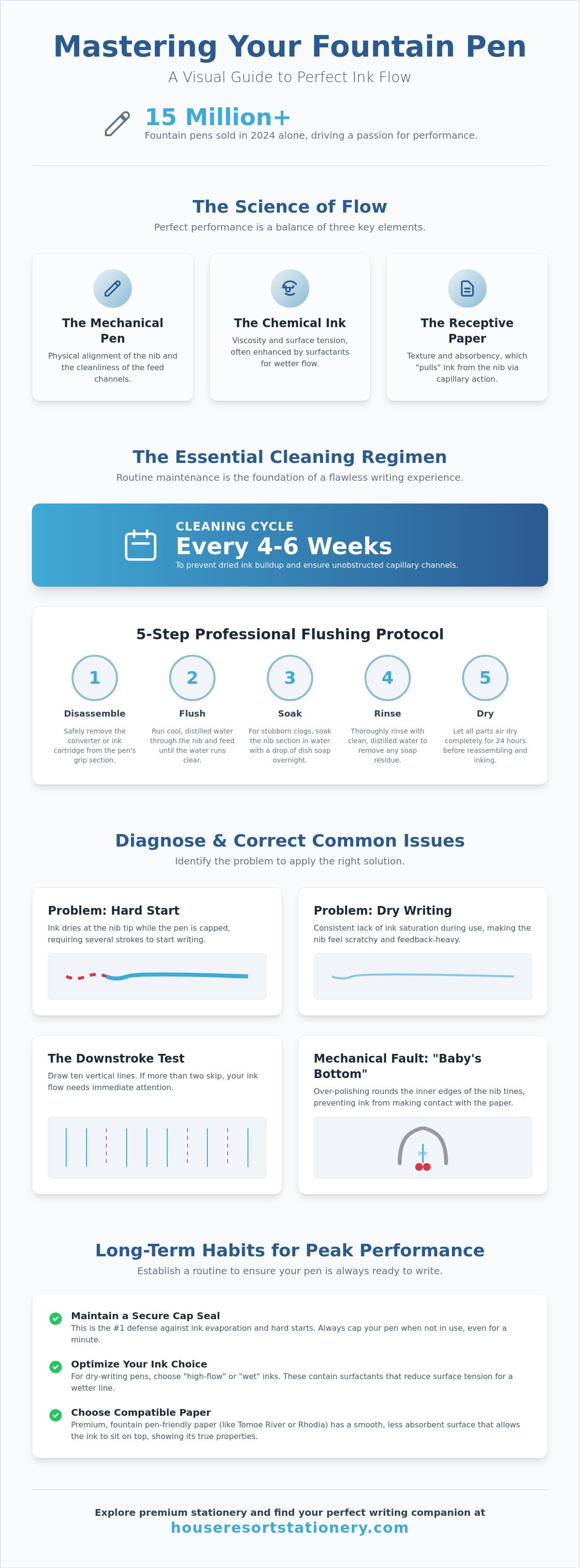
The feed is the unsung hero of this system. It features a series of delicate fins that regulate the air-to-liquid exchange. As ink leaves the reservoir, air must replace it to prevent a vacuum from forming. These fins act as a buffer, holding excess ink to prevent blotting while ensuring a steady supply reaches the nib. Achieving perfect performance requires a balance within the "Ink Flow Triad":
- The Mechanical Pen: The physical alignment of the nib and the cleanliness of the feed channels.
- The Chemical Ink: The viscosity and surface tension of the fluid, often influenced by added surfactants.
- The Receptive Paper: The texture and absorbency of the writing surface, which "pulls" the ink from the tip.
When this triad is out of balance, the writing experience quickly degrades. You might encounter skipping, where the line breaks mid-stroke, or railroading, where the tines spread but the ink fails to bridge the gap. Recognizing these symptoms early is the first step in diagnosing how to improve fountain pen ink flow before you resort to more aggressive mechanical adjustments.
The Role of the Feed and Breather Tube
The feed manages surface tension to prevent ink from flooding the page. Many high-end pens utilize ebonite feeds, a traditional hard rubber material. Ebonite is naturally hydrophilic, meaning it attracts water-based inks more effectively than modern injection-molded plastics. This often results in a wetter and more consistent flow. Within the assembly, the breather tube maintains internal pressure. It ensures the air-to-liquid exchange remains seamless even during long, contemplative writing sessions.
Identifying the 'Hard Start' vs. 'Dry Writing'
Diagnostic clarity is essential for effective troubleshooting. A "hard start" occurs when ink dries at the nib tip while the pen is at rest, requiring several strokes to get the ink moving again. In contrast, "dry writing" is a consistent lack of saturation during active use. This often makes the nib feel scratchy or feedback-heavy. To diagnose the severity, perform a simple downstroke test: draw ten vertical lines with minimal pressure. If the pen skips on more than two strokes, your ink flow requires immediate optimization.
The Essential Cleaning Regimen for Consistent Performance
Routine maintenance is the foundation of a flawless writing experience. For the modern collector, the 2026 standard for consistent performance dictates a thorough cleaning every four to six weeks. This ritual prevents the accumulation of dried particulates and ensures that the capillary system remains unobstructed. Many enthusiasts mistakenly assume that a brand-new pen is ready for immediate use. However, residual manufacturing oils often linger within the feed, creating a hydrophobic barrier that repels water-based inks. An initial flush is the most effective way to eliminate these oils and learn how to improve fountain pen ink flow from the very first stroke.
Water quality plays a significant role in long-term pen health. If you reside in a region with high mineral content, avoid using tap water for your cleaning sessions. Calcium and magnesium deposits can gradually build up within the microscopic channels of the feed, choking the flow over time. Distilled water is the safer, more sophisticated choice for preserving the intricate engineering of your fountain pen feed design. For professional-level decontamination, an ultrasonic cleaner can be used to vibrate away stubborn residues that a simple flush might miss, though this should be done with care regarding vintage materials.
A 5-Step Professional Flushing Protocol
To ensure your writing instruments perform at their peak, follow this disciplined protocol:
- Step 1: Safely disassemble the converter or remove the ink cartridge.
- Step 2: Use a bulb syringe to force room-temperature distilled water through the section.
- Step 3: If you've been using pigmented or iron-gall inks, introduce a dedicated pen flush solution to break down chemical bonds.
- Step 4: Rinse the section repeatedly until the water runs completely clear.
- Step 5: Rest the nib and feed on a soft, lint-free cloth and allow them to dry overnight.
While you refine your maintenance routine, you may find inspiration in our curated selection of fine fountain pens from heritage manufacturers who prioritize technical excellence.
Addressing Clogged Feeds and Dried Ink Residue
Sometimes, a simple flush isn't enough to remove "ink crud" or dried particles wedged deep within the feed fins. You can often identify these obstructions by inspecting the feed under a loupe. A soft-bristled toothbrush can be used to gently sweep the external fins of the feed, removing surface debris without scratching the material. This is a critical step in understanding how to improve fountain pen ink flow when a pen has been left capped for too long. However, for fragile heritage pens or vintage ebonite, it is always wise to seek professional restoration services rather than risking permanent damage to a rare piece.
Optimizing the Synergy: High-Flow Inks and Compatible Paper
Beyond the mechanical alignment of the nib and feed, the chemistry of your ink dictates the quality of your stroke. Surfactants are the secret agents in this process. These additives lower the surface tension of the fluid, allowing it to move more freely through the feed's microscopic channels. If you are researching how to improve fountain pen ink flow, you must understand that "wetter" inks are simply those with a higher concentration of these flow-aiding chemicals. This interaction is rooted in the scientific principle of capillary action, which ensures the ink remains in constant contact with the nib's slit through molecular attraction.
The relationship between the fluid and the channel material is delicate. While Section 2 focused on removing physical obstructions, this chemical synergy focuses on lubrication. A well-formulated ink doesn't just sit in the pen; it actively seeks the paper. However, this flow can be hindered by the very properties that make some inks attractive, such as heavy saturation or shimmering particles. Achieving perfect performance requires selecting an ink that matches the specific demands of your pen's feed system.
Choosing 'Wet' vs. 'Dry' Inks for Your Nib
Not all inks are created equal. Heritage brands often develop specific lubrication formulas to suit their nib designs. For example, Pilot Iroshizuku bottled ink serves as a benchmark for high-performance flow, offering a lush, wet experience even in finer points. Japanese inks are frequently engineered to compensate for the precision-ground, narrower nibs typical of Eastern manufacturers. While shimmer and sheen inks offer stunning visual effects, their physical particles can act as mechanical barriers within the feed. If you experience persistent skipping with these specialty fluids, switching to a standard dye-based ink is a quick way to diagnose if the fluid is the culprit. Always avoid India or calligraphy inks. Their binders are designed for dip pens and will destroy a fountain pen's internal system.
Paper Selection for Smooth Ink Delivery
The final piece of the performance puzzle is the paper itself. High-quality stationery features specific sizing, a surface treatment that controls how much ink the fibers absorb. If the sizing is too aggressive, the paper will resist the ink, creating a sensation of "dryness" that isn't the pen's fault. Premium brands facilitate a better capillary draw by balancing smoothness with receptivity. Our Japanese stationery online store guide highlights the best notebooks for maintaining a consistent line. Be mindful of hand oils as well. Touching the paper leaves invisible lipids that act as a repellent. Using a guard sheet under your palm can immediately fix flow issues that appear only at the bottom of a page.
Correcting Mechanical Obstructions and Nib Alignment
Mechanical precision is the silent partner of a smooth writing experience. When cleaning and ink selection fail to resolve a dry nib, the issue often lies in the physical geometry of the assembly. Many enthusiasts look for quick solutions online and encounter advice suggesting they "spread the tines" by pressing hard against a hard surface. You should avoid this aggressive maneuver. Such force can lead to permanent springing, a state where the metal tines are bent beyond their elastic limit and will no longer return to their original position. Learning how to improve fountain pen ink flow requires a more disciplined, surgical approach to alignment.
A 10x loupe is the most important tool in your maintenance kit. It allows you to verify the "sweet spot" of the nib and identify subtle manufacturing defects. One common culprit is "Baby's Bottom," a condition where the inner edges of the tines are over-polished into a rounded shape. This creates a gap that prevents the ink from actually touching the paper, leading to frustrating hard starts. Under magnification, you can also check if the tines are level. If one tine is even slightly higher than the other, the ink channel is disrupted, and the pen will feel scratchy and inconsistent.
Flossing the Nib with Brass Shims
Microscopic paper fibers or stubborn ink particulates can easily wedge themselves within the narrow slit of the nib. To clear these without widening the gap, use a 0.002-inch brass shim. Safely "floss" the nib by gently sliding the thin metal sheet from the breather hole down toward the tip. This process clears the path for the ink without altering the factory-set tension of the tines. If your pen feels "tight" or writes exceptionally dry out of the box, a single, careful pass with a shim can often provide the necessary relief for a wetter flow.
Explore our selection of fine fountain pens to discover instruments built with meticulous attention to nib geometry and mechanical reliability.
Checking the Nib-to-Feed Contact
Capillary action relies entirely on a physical connection. If there is a visible gap between the underside of the nib and the top of the feed, the ink flow will stop. This misalignment is a frequent cause of "railroading" during fast writing. For pens featuring heritage ebonite feeds, advanced users may utilize a "heat setting" technique. By submerging the feed in hot water for a few minutes, the material becomes pliable. You can then gently press the feed against the nib to ensure a perfect, airtight seal that guarantees consistent delivery to the tip.
Long-Term Prevention and Professional Maintenance
Prevention is the hallmark of a true connoisseur. While mechanical tuning and chemical synergy are vital, the longevity of your writing experience depends on your daily habits. A fountain pen is a tool designed for movement. Maintaining a consistent writing schedule prevents ink from stagnating and evaporating within the nib's slit. Even the most sophisticated cap seal cannot entirely stop the slow loss of moisture over months of neglect. If you are looking for long-term strategies on how to improve fountain pen ink flow, start by ensuring your pens are part of a regular rotation.
Storage orientation also dictates how your pen performs when you first pick it up. For pens in daily use, horizontal storage keeps the feed saturated and ready for immediate action. However, for long-term storage or travel, storing your pens nib-up is the professional standard. This orientation allows ink to drain back into the reservoir, reducing the risk of leaks and clogs at the tip. At HouseResort Stationery, we view ourselves as a destination for collectors who value these nuances. We provide only the finest fine fountain pens and accessories to ensure your analog journey remains uninterrupted.
The Impact of Environmental Factors
Environmental conditions significantly influence ink behavior. High humidity can slow the drying time on paper, while arid winter air accelerates evaporation at the nib. This often causes your pen to write differently as the seasons change. Traveling adds another layer of complexity. When flying, TSA regulations permit bottled ink in containers of 3.4 ounces (100 milliliters) or less within a clear bag. To manage pressure changes, either completely fill or completely empty your pen before a flight. Storing the pen nib-up during takeoff and landing prevents the air bubble in the reservoir from forcing ink out through the feed.
When to Consult an Authorized Retailer
There comes a point where DIY troubleshooting reaches its limit. If your pen continues to skip after a thorough flush and alignment check, it may require professional intervention. Purchasing from an authorized retailer ensures you have access to manufacturer warranty support for complex repairs. A professional "nibmeister" can perform specialized grinds or repairs that go beyond home maintenance. Recognizing when to seek expert help is part of the responsibility of owning a high-end collection. Treat your writing process as a curated escape, and don't let mechanical hurdles diminish the tactile joy of a well-maintained pen. Learning how to improve fountain pen ink flow is a journey of continuous refinement, ensuring every word you write is as flawless as the instrument itself.
Elevating Your Writing Experience Through Meticulous Care
Mastering how to improve fountain pen ink flow transforms a temperamental tool into a reliable extension of your thoughts. By understanding the physics of capillary action and maintaining a disciplined cleaning regimen, you ensure that every session begins with a perfect, skip-free line. Whether you're correcting a minor alignment issue with a brass shim or selecting a high-lubrication Japanese ink, these small adjustments preserve the heritage and performance of your collection.
As an authorized retailer of heritage brands, HouseResort Stationery is dedicated to the art of analog writing. We've done the work of filtering the market to present only the most reliable tools for the discerning collector. From precision-engineered nibs to expertly curated stationery, our inventory is designed for those who appreciate the tactile nature of a well-tuned pen. Explore our curated collection of fine fountain pens and high-flow inks to find your next favorite writing companion. It's time to reclaim the joy of a flawless stroke and turn every page into a celebration of craftsmanship.
Frequently Asked Questions
Why does my fountain pen stop writing after a few sentences?
This phenomenon usually indicates a failure in the air-to-liquid exchange or an "air lock" within the converter. If the ink clings to the back of the reservoir due to surface tension, the feed eventually runs dry. You can resolve this by gently agitating the pen or choosing an ink with better lubrication properties. It's a common challenge when learning how to improve fountain pen ink flow in pens with narrow converters.
Can I use dish soap to clean my fountain pen for better flow?
A single drop of mild, additive-free dish soap diluted in a cup of distilled water is an effective DIY surfactant. This solution helps break down stubborn manufacturing oils and lowers the ink's surface tension for a "wetter" write. However, you must rinse the pen thoroughly afterward. Avoid soaps with heavy perfumes or moisturizers, as these can leave residues that further obstruct the delicate channels of your feed.
Is it safe to leave ink in my fountain pen for a month?
Most modern fountain pens with high-quality cap seals can safely hold ink for a month. However, the risk of evaporation increases over time, which leads to higher dye concentration and potential clogging. If you don't plan to write daily, consider flushing the pen. Pigmented or iron-gall inks are the exception; these should never be left stagnant for more than a week to avoid permanent sediment buildup.
Why is my nib scratchy even though the ink flow seems fine?
Scratchiness often stems from misaligned tines rather than a lack of lubrication. If one tine sits lower than the other, it'll catch the paper fibers during horizontal strokes. While the ink may flow well, the mechanical friction creates a harsh tactile experience. Use a loupe to inspect the tip. If the alignment is perfect, the issue may be a lack of tipping material or exceptionally toothy paper fibers.
What is the best ink for a dry-writing fountain pen?
Highly lubricated "wet" inks from heritage Japanese manufacturers are the gold standard for dry-writing pens. Formulas like Pilot Iroshizuku are engineered with specific surfactants that encourage the fluid to seek the paper. These inks compensate for tight nibs or restrictive feeds by flowing more readily through the capillary system. They provide a lush, saturated line even in instruments that typically struggle with lighter, drier formulas.
How do I know if my fountain pen feed is clogged or if the nib is misaligned?
A clogged feed typically causes consistent skipping or a total lack of ink regardless of the stroke direction. In contrast, a misaligned nib will feel scratchy in one specific direction while writing smoothly in others. If the pen starts well but fades quickly, the feed is likely struggling to keep up. Use a 10x loupe to distinguish between these mechanical and chemical obstructions for a precise diagnosis.
Does the nib size (EF, F, M, B) affect the ink flow speed?
Broader nibs generally require and deliver a higher volume of ink because they have wider slits and corresponding feed channels. An Extra Fine (EF) nib is designed for a controlled, thin line and naturally uses less ink per second. While the "speed" is governed by capillary action, a Broad (B) nib provides less resistance, often resulting in a wetter feel that is more forgiving of minor flow issues.
Can I mix different brands of ink to improve flow?
Mixing different ink brands is generally discouraged because contrasting pH levels can cause a chemical reaction. This often results in a solid precipitate or "sludge" that can permanently damage your pen's internal components. If you must experiment, mix the inks in a separate vial and wait 24 hours to check for any unusual thickening or sediment. It's safer to use a dedicated flow-improving additive instead.