
How to Use an Architect Nib Pen: A Guide to Mastering the Hebrew-Arabic Grind
What if the secret to crisp, professional-grade lettering isn't in your hand's pressure, but in the precise geometry of your pen's rotation? Many enthusiasts seek out the architect nib for its unique ability to produce thin downstrokes and wide cross-strokes, yet they often struggle with a toothy feel or inconsistent lines. If you've spent more time hunting for the elusive sweet spot than enjoying your writing, you're not alone. It's a common hurdle when transitioning to the specialized Hebrew-Arabic grind.
We'll show you exactly how to use an architect nib pen to transform your handwriting into a smooth, tactile ritual. You'll discover the specific writing angles required to master this precision instrument and learn why heritage makers like Xezo and Tom's Studio have become community favorites for this style. We'll also break down the technical mechanics and essential techniques needed to achieve a sharp, architectural aesthetic without the scratchiness. By understanding how your nib interacts with the paper, you can finally move from frustration to a polished, professional finish.
Key Takeaways
- Understand the unique geometry of the Hebrew-Arabic grind, which creates dramatic line variation through wide horizontal and thin vertical strokes.
- Master how to use an architect nib pen by identifying your personal "sweet spot," the specific writing angle where the flat grind meets the paper for a smooth flow.
- Learn to distinguish between intentional nib feedback and problematic scratchiness to resolve common issues like skipping or toothiness.
- Optimize your writing experience by pairing your specialty nib with well-lubricated inks and smooth, high-quality paper to prevent drag.
- Extend the life of your fine instrument with proper maintenance techniques, including meticulous cleaning and critical nib-up storage.
What is an Architect Nib Pen?
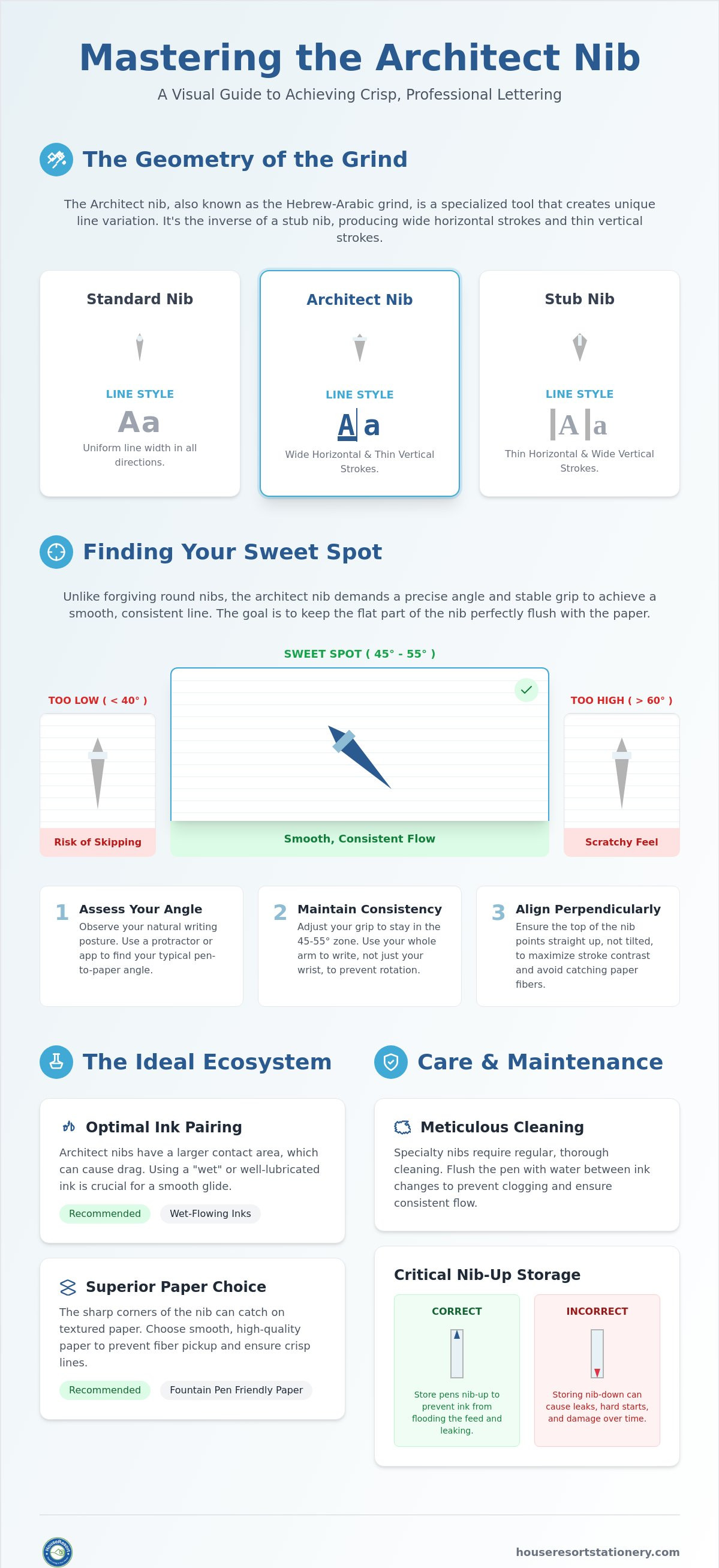
The architect nib is a precision instrument designed for those who appreciate the structural beauty of a written line. Unlike the ubiquitous round nib, the architect features a flat, rectangular tip that produces a specific visual rhythm. In this grind, your horizontal strokes are broad and expressive, while your vertical strokes remain hair-thin and sharp. It's often described as the "inverse stub" because it flips the traditional italic geometry on its head. While a stub nib creates thick downstrokes, the architect prioritizes the width of the cross-stroke.
This specialized tool earned its moniker from the world of architectural drafting, where blocky, legible lettering was once the industry standard. Understanding the various different types of fountain pen nibs is essential for any collector, and the architect stands out for its cultural heritage. It's frequently called the Hebrew-Arabic grind. The unique line weight perfectly complements the horizontal emphasis found in these scripts, allowing for a natural, authentic flow that standard nibs simply can't replicate. The result is a crisp, clean aesthetic that feels both vintage and modern.
Standard Architect vs. Inverted Architect
A standard architect grind is typically tailored to a specific writing angle. Most users find their sweet spot between 45 and 55 degrees. A significant trend in 2026 has seen the rise of the "Inverted Architect." This dual-purpose tool features the architect profile on the top of the nib, allowing you to flip the pen over for a different line weight or style. While factory nibs are more accessible, connoisseurs increasingly prefer custom grinds from specialists. A custom grind ensures the nib is tuned to your unique hand, which is vital when learning how to use an architect nib pen effectively.
Who Should Use an Architect Nib?
This grind isn't just for professional drafters. It's a favorite for several distinct groups:
- Lettering Enthusiasts: Those who want to emulate the crisp look of mid-century blueprints or vintage technical drawings.
- Left-Handed Writers: Specifically, "over-writers" often find the architect grind more forgiving. The horizontal width provides a stable contact point that reduces the digging sensation common with pointed nibs.
- Tactile Collectors: If you're looking for a unique tactile feedback not found in round nibs, the specific "toothy" engagement of an architect offers a more intentional writing experience.
Mastering how to use an architect nib pen transforms a simple note into a work of art. It requires patience and a steady hand, but the resulting character is well worth the effort.
Finding the Sweet Spot: How to Hold Your Pen
The "sweet spot" is the precise intersection where the flat-ground tipping material makes perfect contact with the paper surface. Unlike standard round nibs that offer a forgiving range of usability, architect nibs are notoriously less rotation-friendly. If you twist the pen even slightly along its axis, the sharp corners of the grind will catch the paper fibers. Mastering how to use an architect nib pen requires a commitment to a disciplined, stable hand and an understanding of your own writing geometry.
Before you invest in a custom piece or a stock model, observe how you naturally hold a pen. Most people write at an angle between 40 and 60 degrees. Because the architect grind is often cut to a specific elevation, knowing your baseline is essential for a smooth experience. Once you have the pen in hand, follow these three steps to find your rhythm:
- Step 1: Assess your natural elevation. Use a protractor or a phone app if you're unsure of your degree.
- Step 2: Adjust your grip to maintain a consistent 45 to 50-degree elevation. This is the "goldilocks" zone where the flat plane of the nib sits flush against the page.
- Step 3: Maintain a perpendicular alignment to the baseline. Ensure the nib face is pointing directly upward, not canted to the left or right, to maximize the contrast between strokes.
The Geometry of the Grip
Stability is your best friend. A classic tripod grip, where the pen rests on the middle finger and is held by the thumb and index finger, provides the necessary control. Avoid the "death grip" at all costs. Excessive pressure won't help the ink flow; it only increases friction and risks misaligning the tines. Instead, use your arm to move the pen across the page. Relying solely on your wrist often leads to unintentional rotation, which breaks the connection with the sweet spot. If you're looking to upgrade your desk setup, exploring our curated selection of fine fountain pens can provide the perfect canvas for your next specialty grind.
Testing the Line Variation
Use the "cross-hatch" method to verify your technique. Draw a series of vertical lines followed by horizontal ones. The horizontals should be significantly wider. If the nib feels "toothy," you've likely rotated the pen or drifted from the optimal angle. A slight adjustment of the barrel usually resolves this. A perfectly aligned nib produces a crisp, architectural line that feels like it's gliding on a thin film of ink. The closer you stay to the nib's intended angle, the more dramatic and crisp your line variation will become.
Troubleshooting Common Architect Nib Challenges
Learning how to use an architect nib pen involves a period of adjustment where you decode the tactile feedback coming from the paper. Even with a perfect tripod grip, you might encounter initial resistance. This isn't necessarily a sign of a defective tool; rather, it's often a signal that your alignment has drifted from the nib's precise sweet spot. As many enthusiasts note in their firsthand experience with a custom architect nib, the transition from a standard round nib requires patience to master the unique geometry of the grind.
The most frequent hurdle is the "rotation trap." Because the architect nib is ground to a flat, wide surface, any slight twisting of the pen barrel causes the sharp corners of the tipping to dig into the page. This ruins the architectural effect and creates a frustrating writing experience. Additionally, because the horizontal strokes are so wide, these pens require a generous ink flow. If your pen is skipping, it's often because the feed cannot keep up with the demand of the broad cross-stroke or the nib angle has lifted the feed too far from the paper fibers. A "wetter" ink or a feed adjustment is frequently the cure for these mechanical stutters.
Scratchiness vs. Feedback
It's vital to distinguish between a scratchy nib and intentional feedback. Feedback is a tactile signature that tells you the nib is engaged with the paper. Scratchiness, however, usually stems from misaligned tines. Use a 10x jeweler's loupe to inspect the flat surface of the grind. If one tine is higher than the other, the edge will catch. If the tines look level but the pen still feels rough, the angle of your hand might simply be off. When adjustments to your grip don't solve the issue, it may be time to consult a nibmeister for a professional smoothness tuning.
Dealing with Inconsistent Lines
Inconsistency often traces back to the paper surface or external factors like hand oils. Architect nibs are sensitive to the "tooth" of the paper. A textured sheet can cause the wide horizontal stroke to feather or feel sluggish. If you notice the ink "railroading" or thinning out during fast horizontal movements, slow down your stroke to allow capillary action to keep pace. To protect the paper from hand oils, which can cause the nib to skip or the ink to bead, consider using a simple guard or a clean sheet of paper under your writing hand. Mastering how to use an architect nib pen is as much about managing your environment as it is about the pen itself.
The Ideal Ecosystem: Ink and Paper Pairings
Mastering how to use an architect nib pen is only half the battle. The other half involves selecting the right materials to support the nib's unique geometry. Because an architect grind features a flat, rectangular contact point, it creates more surface friction than a standard round nib. This means the interaction between the metal and the paper fibers is much more sensitive. To achieve that effortless, gliding sensation, you must curate an ecosystem that prioritizes lubrication and surface smoothness.
Ink acts as the vital lubricant in this equation. Without proper flow, the flat surface of the grind can feel sluggish or "draggy" across the page. This is why ink selection is a critical component of the architectural lettering ritual. For those seeking high-performance options, our japanese stationery online store provides access to the essential tools required to maintain a crisp, professional aesthetic in your 2026 collection.
Best Inks for Architect Nibs
Prioritize inks with high lubrication. These formulas contain specific additives that reduce the tension between the nib and the paper. We frequently recommend pilot iroshizuku bottled ink for its legendary flow and consistent performance. It provides the necessary "wetness" to keep the wide horizontal strokes saturated and smooth. Be cautious with high-sheen inks. While visually stunning, their high resin and sugar content can create a sticky feel on a flat-ground nib, leading to inconsistent starts or a "tacky" writing experience.
Paper Selection for Precision
The role of paper tooth cannot be overstated. A rough or highly textured paper will catch the sharp corners of an architect grind, leading to frustration. Smoother paper is generally better. Hard-sized papers, such as the 52gsm Tomoe River, allow the ink to sit on the surface rather than soaking into the fibers. This prevents feathering, which is the enemy of architectural lettering. If the ink spreads, you lose the crisp contrast between your wide horizontals and thin verticals. Many collectors find that Midori MD notebooks offer the perfect amount of polite feedback, ensuring the nib stays on track without digging in.
When you align the right ink with a high-quality notebook, the learning curve for how to use an architect nib pen flattens significantly. You'll move from fighting the friction to enjoying the tactile feedback of a precision instrument. Explore our curated selection of premium fountain pen inks and paper to find the perfect pairing for your writing style.
Maintenance and Selection: Caring for Your Specialty Pen
Owning a specialty grind is a commitment to stewardship. The flat surface of an architect nib is a precision-engineered plane that requires more careful handling than a standard round nib. Because the tipping material is ground to a specific, sharp geometry, it is more susceptible to damage from drops or excessive pressure. Understanding how to use an architect nib pen involves more than just the writing angle; it requires a disciplined maintenance schedule to preserve the integrity of the grind.
Storage is your first line of defense. Always store your pen in a "nib-up" orientation when not in use. This prevents ink from pooling in the feed and drying out, which is particularly important for architect grinds that rely on consistent, heavy ink flow. When you are on the move, protection is non-negotiable. A dedicated Traveler's Notebook system provides an excellent modular solution for protecting your pen from scratches or impacts that could misalign the delicate tines.
Routine Cleaning Procedures
Specialty grinds should be flushed every 2 to 3 weeks to prevent sediment buildup. Pigment-heavy or permanent inks can clog the narrow channels of a feed tailored for an architect nib. A bulb syringe is the most effective tool for this task. It provides enough pressure to clear the feed without requiring you to touch the nib surface. Never use micro-mesh or abrasive polishing pads on a professional architect grind. These tools are designed to smooth round nibs and will quickly destroy the specific flat angle that creates your line variation.
How to Order Your First Architect Nib
Choosing your first architect nib depends on your intended use. A "Daily" architect is typically ground from a Medium nib, offering subtle variation suitable for standard journal entries. An "Artistic" architect is often ground from a Broad or Double Broad nib, resulting in dramatic, blocky strokes perfect for headers or calligraphy. When ordering from a nibmeister or an authorized fountain pen retailer, provide the following details for the best results:
- Writing Angle: Specify the degree at which you hold your pen (usually 45 to 55 degrees).
- Hand Dominance: Mention if you are left-handed, as this may require a slight adjustment to the grind's orientation.
- Writing Pressure: Indicate if you have a light touch or a heavy hand to help the technician tune the ink flow.
In 2026, the availability of stock architect nibs has made this specialty grind more accessible than ever. While a custom commission offers the most personalized experience, high-quality factory options provide a reliable starting point for those learning how to use an architect nib pen. By selecting the right tool and maintaining it with care, you ensure that your architectural lettering remains crisp and professional for years to come.
Elevate Your Writing Ritual
Mastering the architect nib is about more than just ink on paper; it's a dedicated practice of precision and patience. By finding your specific writing angle and pairing your pen with well-lubricated inks, you unlock a level of character that standard nibs simply can't match. Understanding how to use an architect nib pen transforms your daily notes into a tactile, architectural experience. This journey requires a deep appreciation for the synergy between your tool, your ink, and your choice of paper.
As an authorized retailer of luxury stationery brands, we take pride in offering tools curated by analog enthusiasts who value craftsmanship above all else. We provide national shipping on all premium writing instruments to ensure your next favorite pen reaches you in perfect condition. Explore our curated collection of fine fountain pens and specialty nibs to discover instruments that speak to your unique style. With the right technique and a steady hand, your journey into the world of specialty grinds will be a rewarding escape into the art of the written word.
Frequently Asked Questions
Is an architect nib good for everyday writing?
Yes, but its suitability depends heavily on your handwriting style. Architect nibs are exceptional for block printing, technical drafting, and print-heavy scripts where horizontal emphasis is desired. If you primarily write in cursive, the line variation may feel counterintuitive since the loops won't have the traditional thick downstrokes found in Western calligraphy. It's a specialized tool that rewards a structured, deliberate hand.
Can left-handed writers use an architect nib pen?
Many left-handed writers actually find the architect grind more comfortable than standard nibs. Specifically, "over-writers" benefit from the horizontal width of the tipping, which provides a stable contact point on the page. This stability often reduces the "digging" or catching sensation that lefties experience with fine or extra-fine pointed nibs. It simply requires a consistent grip to stay within the grind's optimal writing zone.
Why does my architect nib feel scratchy when I write fast?
Scratchiness during rapid writing is usually a sign that you've drifted from the nib's "sweet spot." When speed increases, it's natural for the hand to rotate the pen barrel or alter the elevation angle. Because the architect grind is a flat plane, even a slight tilt causes the sharp corners to snag the paper fibers. Mastering how to use an architect nib pen at high speeds requires maintaining a disciplined 45 to 55-degree elevation.
What is the difference between an architect nib and a stub nib?
An architect nib is the geometric inverse of a traditional stub or italic nib. A stub nib produces thick vertical downstrokes and thin horizontal cross-strokes, which is the standard for most Western lettering. In contrast, the architect grind creates thin vertical lines and wide horizontal lines. This unique orientation makes it the perfect choice for block lettering and architectural prints where horizontal weight is the primary aesthetic.
Do I need to hold my pen differently for an architect grind?
You must maintain a more consistent and fixed angle than you would with a standard round nib. Round nibs are forgiving of rotation, but an architect nib requires the flat surface of the tipping to stay flush against the paper. Using a stable tripod grip and moving your entire arm rather than just your wrist helps prevent the unintentional rotation that leads to scratchiness or ink skipping.
Can I use shimmering inks in my architect nib pen?
It's generally best to avoid heavy shimmering inks in specialty grinds. The metallic particles in these inks can settle and clog the precision-cut channels of the feed, which is often tuned for high flow in an architect pen. Since this grind relies on excellent lubrication for a smooth experience, sticking to well-behaved, dye-based inks ensures you don't encounter frustrating flow issues or difficult cleaning cycles.
How much does a custom architect nib grind cost?
The cost for a custom commission varies based on the nibmeister's expertise and the material of the nib unit. While some manufacturers now offer stock architect options, a custom grind is tailored to your specific writing angle and hand dominance. You'll need to consult individual artisans for their current service rates, as these professional adjustments are highly specialized and depend on the current market demand for custom nib work.
What happens if I rotate my pen while using an architect nib?
Rotating the pen barrel causes the sharp, rectangular corners of the grind to catch and "bite" into the paper. Unlike a round nib that can write at almost any rotation, the architect's flat face must remain parallel to the baseline. If you twist the pen, you'll experience immediate scratchiness and a loss of line variation. This is the most common hurdle when learning how to use an architect nib pen effectively.