
Kokuyo Campus Notebook Guide: Japan's Iconic Surface 2026
Could a single notebook series really sell over 3.7 billion units? This isn't just a surprising statistic; it's a testament to the meticulous Japanese engineering that has made the kokuyo campus notebook a global benchmark for quality. For the fountain pen enthusiast, it represents a rare intersection of affordability and high-performance paper that treats ink with the respect it deserves.
You likely appreciate the tactile joy of a smooth nib on paper, yet you're tired of bleed-through and rigid bindings that fight against your hand. We understand that a notebook should be a frictionless extension of your thoughts, not a source of physical discomfort. In this guide, you'll discover why Kokuyo paper is the gold standard for analog tools and how to choose the perfect format for your specific workflow. We'll break down the differences between the modular Smart Ring, the comfortable Soft Ring, and the classic flat-lay designs that define the 2026 lineup.
Key Takeaways
- Discover the heritage of the Campus philosophy and how its commitment to functional beauty has shaped Japanese paper culture since 1975.
- Master the technical differences between specialized paper variants like MIO and CYO-BO to ensure your fountain pen ink remains crisp without feathering.
- Compare the modularity of the Smart Ring system with the tactile comfort of Soft Ring bindings to find your ideal notebook structure.
- Identify the most effective kokuyo campus notebook ruling for your needs, from standard widths to the precision of the iconic Dot Ruled system.
- Transition these tools into a professional context by utilizing their unique features for organized project management and executive note-taking.
The Legend of the Kokuyo Campus Notebook: More Than Just School Supplies
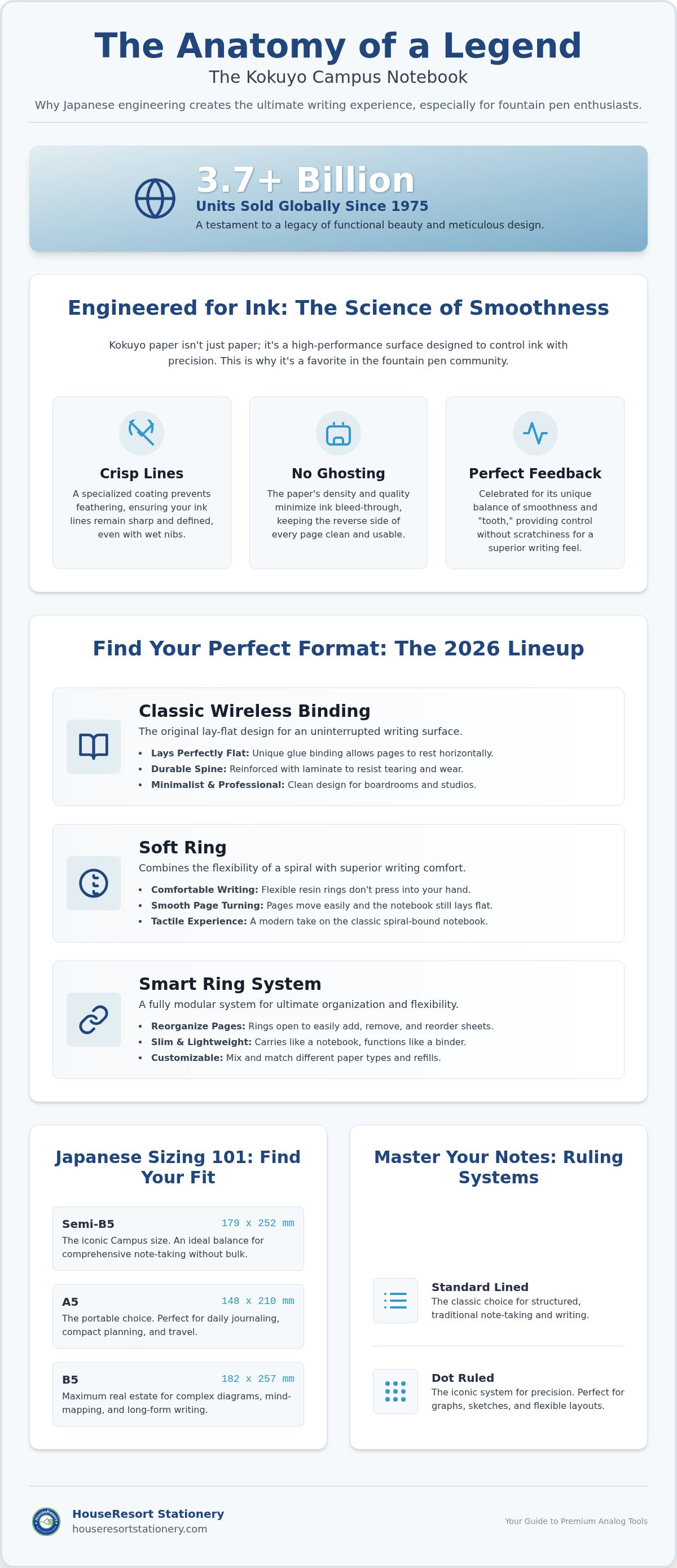
Kokuyo began as a ledger manufacturer in 1905, but the release of the first kokuyo campus notebook in 1975 changed the trajectory of analog culture forever. This isn't merely a paper product; it's a piece of industrial design history from a renowned Japanese manufacturing company. While many people first encounter these notebooks in a classroom setting, the "Campus" philosophy centers on functional beauty. This commitment to innovation has led to over 3.7 billion units sold globally, making it a staple for anyone who values a superior writing surface. For the boutique curator, it represents the perfect entry point into the world of high-performance Japanese stationery.
Professional writers and fountain pen enthusiasts often prioritize one specific feature: the ability to lay perfectly flat. Unlike standard notebooks that require force to stay open, the Campus series uses a specialized binding process. This allows the pages to rest horizontally across the desk, providing a consistent, uninterrupted flow for your hand. It's a small detail that makes a massive difference during a three-hour journaling session or an intensive project planning meeting. The minimalist aesthetic is intentional, allowing the quality of the materials to speak for themselves without unnecessary distraction.
The Anatomy of a Campus Notebook
The construction of a Campus notebook reveals a meticulous attention to detail. It's designed to survive the rigors of a daily commute while maintaining a slim, professional profile. Each element serves a specific purpose in the writer's workflow.
- Wireless Binding: Kokuyo utilizes a unique glue-binding method that eliminates the need for staples or bulky rings. This keeps the spine flexible yet incredibly strong, ensuring pages don't fall out over time.
- Laminated Spine: The spine is reinforced with a durable laminate material. It resists tearing and peeling, even after months of being pulled in and out of a crowded bag.
- Functional Cover: The clean cover design offers dedicated space for titles and dating entries. It's a professional look that fits just as well in a boardroom as it does in a studio.
Japanese Sizing 101: Understanding B5 vs. A5
Choosing the right size is the first step in optimizing your analog workflow. Japanese standards differ slightly from Western sizes, offering more ergonomic options for different tasks. Understanding these dimensions helps you find the sweet spot for your desk work.
- Semi-B5 (179 x 252 mm): This is the iconic kokuyo campus notebook size. It's larger than A5 but smaller than a standard US Letter sheet, providing the ideal balance for comprehensive note-taking without the bulk.
- A5 (148 x 210 mm): The portable choice for those who travel light. It fits comfortably in small bags and serves as an excellent companion for daily journaling or compact planning.
- B5 (182 x 257 mm): The full B5 size offers maximum real estate for complex diagrams and long-form writing, catering to those who need more space to think.
The Science of Smoothness: Why Campus Paper Loves Fountain Pens
The surface of a kokuyo campus notebook isn't chosen by accident; it's the result of decades of paper science. Unlike standard wood-pulp paper that acts like a sponge, Kokuyo utilizes a specialized coating that controls how ink sits on the page. This is why fountain pen users flock to the brand. The paper minimizes feathering, where ink spreads into the fibers, and ghosting, which often ruins the reverse side of a page. You get a crisp, clean line every time, even with broader nibs. It's a level of precision that turns a simple note into a tactile pleasure.
Within the fountain pen community, this paper is celebrated for its unique balance of "tooth" and feedback. It isn't so slick that your pen slides out of control, yet it's smooth enough to prevent any scratchiness or drag. This slight resistance gives you better control over your letterforms, making it a favorite for both calligraphy and rapid-fire brainstorming sessions. The paper's density ensures that your ink's true character shines through, rather than being swallowed by the page.
Fountain Pen Ink Performance
Handling wet nibs is a primary strength of the Campus line. Even when using a music nib that lays down a heavy volume of liquid, the paper remains resilient. It's specifically engineered to showcase the complex properties of premium inks, particularly shading and sheen. If you use a high-sheen ink, you'll see those vibrant metallic edges pop against the surface. For the best results, many enthusiasts recommend pairing this surface with pilot iroshizuku bottled ink. The color vibrance on this paper is unmatched. Dry times are slightly longer than on cheap, absorbent paper because the ink sits on the surface, but the visual payoff is worth the few extra seconds of patience.
The "MIO" Paper Advantage
If you're a left-handed writer or someone who takes notes at a rapid pace, the MIO (Mobile Ideal Optimized) variant is the superior choice. MIO paper is engineered for fast-drying performance without sacrificing the silkiness the brand is known for. It has a thinner profile than the standard sheets, allowing for a slimmer notebook that still contains a high page count. While the standard Campus paper feels crisp and substantial, MIO feels like polished silk under the nib. For those who need a more artisanal experience, the CYO-BO variant offers a thicker, more textured surface that feels like traditional ledger paper. You can explore our curated selection of these paper weights to find the one that complements your favorite nib size.
Navigating the Collection: Classic, Soft Ring, and Smart Ring Compared
Selecting the right kokuyo campus notebook depends entirely on your environment and how you interact with your notes. The 2026 collection isn't just a set of notebooks; it's a series of engineered solutions for specific analog workflows. Whether you're an executive documenting strategy or a creative sketching concepts, the choice of binding dictates your daily comfort. These tools are central to any well-curated Japanese stationery online store, offering a modular approach to professional productivity.
As boutique curators, we recognize that the tactile experience of a notebook is just as important as the paper quality. The way a notebook feels in your hand, or how it reacts when you fold it over on a cramped train, defines its utility. Kokuyo has spent decades refining these physical interactions, moving beyond simple paper and glue to create a sophisticated writing system. By understanding the three primary architectures, you can match a notebook to your specific lifestyle needs.
The Classic Glue-Bound Notebook
This is the purest expression of the Campus philosophy. It features the wireless binding technology that allows for a seamless, flat writing surface. This format is the best choice for chronological journaling or permanent project records where page security is paramount. The spine is designed for durability. It can be folded back 360 degrees without the cover detaching or the glue cracking. It's a reliable, low-profile companion for those who prefer a traditional, distraction-free writing experience that lasts for years.
The Innovation of the Soft Ring
Many writers avoid spiral notebooks because the rigid metal rings dig into the hand. Kokuyo solved this "ring-bruise" problem with the Soft Ring series. These notebooks feature squishy, flexible resin rings that compress under your hand as you write. It's a revolutionary design for left-handed writers who often struggle with standard ring bindings. Beyond comfort, these notebooks include micro-perforated pages. This allows you to tear out notes cleanly for scanning or sharing without leaving messy paper scraps behind. It's the ideal choice for students and fast-paced creatives who need both flexibility and portability.
The Smart Ring Binder System
The Smart Ring is a hybrid tool that bridges the gap between a notebook and a binder. It maintains an ultra-slim profile but features rings that can be opened to add, remove, or reorder pages. This modularity is perfect for professionals who manage multiple projects in a single volume. You can customize the interior with various loose-leaf paper types, from grids to specialized study planners. This system pairs exceptionally well with traveler's notebook inserts for those who want to build a truly bespoke, multi-layered journaling setup. It offers the flexibility of a traditional binder without the unnecessary weight or bulk.
Choosing Your Ruling: From Standard Lined to the Iconic Dot Ruled
Precision is a hallmark of the Japanese analog experience. When you open a kokuyo campus notebook, the first thing you notice isn't just the paper's silkiness, but the intentionality of its ruling. Ruling isn't a background detail; it's the invisible framework that guides your pen. Choosing between standard lines, dots, or grids determines how much information you can fit on a page and how legible that information remains over time. As curators, we've seen how the right ruling can transform a cluttered journal into a structured masterpiece.
Kokuyo offers two primary horizontal widths: A-Rule and B-Rule. A-Rule features 7mm spacing, providing a generous canvas. It's the preferred choice for those who use broad fountain pen nibs or have larger, more expressive handwriting. In contrast, B-Rule offers 6mm spacing. This tighter ruling allows for more lines per page, making it ideal for technical notes or users with small, precise script. For those doing design work, graph and grid rulings provide a 5mm matrix that supports both text and sketches with equal ease. Understanding these technical descriptors is essential for building a functional 2026 analog system.
Why Dot Ruled is a Game-Changer
The "Dot Ruled" system is perhaps the most significant innovation in the Campus lineup. By placing subtle dots at regular intervals along the horizontal lines, Kokuyo provides a guide for vertical alignment without the visual clutter of a full grid. These dots act as anchors. They allow you to draw perfect vertical lines, create structured headers, or align bullet points with mathematical precision. This layout is particularly useful for fountain pen doodle journaling for beginners, as it offers just enough structure to guide a drawing without being intrusive. It's the perfect middle ground for the writer who occasionally needs to sketch.
Ruling Widths and Handwriting Styles
Matching your ruling to your writing instrument is a hallmark of a true enthusiast. If you frequently reach for a 1.1mm stub nib or a double-broad point, the 7mm A-Rule prevents your ascenders and descenders from crashing into one another. Conversely, if you prefer the needle-thin lines of a Japanese Extra-Fine nib, the 6mm B-Rule ensures your page doesn't look sparse or underutilized. For designers and architects, the 5mm graph ruling offers a technical environment for scale drawings and bullet journaling. You can shop our full range of kokuyo campus notebook rulings to find the exact density that suits your hand and your favorite nib sizes.
The Boutique Curator’s Choice: Integrating Campus into a Professional Life
While many people first encounter the kokuyo campus notebook in an academic setting, its true potential is realized in the professional boardroom. It's a precision-engineered tool that bridges the gap between utilitarian school supplies and high-end executive stationery. In a professional context, the notebook becomes a repository for strategy, a space where tactile feedback meets cognitive clarity. Elevating your note-taking from a chore to a ritual starts with choosing a surface that respects your thoughts. This notebook isn't just for students; it's a foundational element for any organized professional workflow.
Using these tools for project management allows for a level of focus that digital apps often disrupt. The act of physically writing out a project timeline or meeting minutes on high-performance paper encourages deeper retention. Because the paper handles various inks so well, you can use color-coding systems with fountain pens to denote priorities or action items. It's a sophisticated way to manage complex information without the distractions of notifications and screen glare. When you choose a kokuyo campus notebook, you're investing in a reliable partner for your most important work.
The Professional Daily Carry
The Semi-B5 size is particularly well-suited for the modern professional. It slides effortlessly into slim laptop sleeves and briefcases without the awkward overhang of larger A4 pads. Many curators use a color-categorization system to manage multiple workstreams. By assigning a specific cover color to each client or project, you create a visual index that simplifies your desk organization. This modularity is further enhanced by the "Jibun Techo" system. Kokuyo designed these planning tools to complement the Campus line, ensuring your scheduling and long-form note-taking remain part of a cohesive, unified ecosystem.
Curating Your Writing Desk
A professional desk setup is incomplete without complementary tools. Pairing your notebook with high-performance instruments elevates the entire experience. For instance, the graphite of blackwing 602 pencils glides across Campus paper with a unique smoothness that ink cannot always replicate. The firm graphite holds its point, making it ideal for the margins of a 6mm B-Rule page. Choosing an authorized boutique retailer like HouseResort Stationery ensures you receive authentic, high-grade stock. Mass-market channels often prioritize volume, but a boutique curator inspects each batch for quality and paper consistency. There's a profound aesthetic satisfaction in seeing a uniform stack of Campus notebooks on a shelf. Each spine represents a completed project or a year of professional growth. Finding a tool that performs consistently provides a quiet sense of joy, allowing you to focus entirely on the work that matters most.
Elevate Your Analog Workflow for 2026
The right writing surface is more than just a background; it's a partner in your creative and professional process. By choosing a kokuyo campus notebook, you're selecting a legacy of Japanese engineering that prioritizes ink integrity and physical comfort. We've explored how the specialized paper coating prevents feathering and how the diverse range of rulings, from Dot Ruled to B-Rule, caters to every handwriting style. Whether you've settled on the modularity of the Smart Ring system or the silk-smooth performance of MIO paper, your analog experience is about to become significantly more refined.
HouseResort Stationery serves as your trusted guide in this journey. As an authorized retailer of Japanese heritage brands, our inventory is expertly curated for fountain pen enthusiasts who demand the highest quality. We take pride in filtering the market to present only the most reliable tools for your desk. You can expect fast shipping on all premium stationery orders, ensuring your new tools arrive exactly when inspiration strikes.
Shop our curated Kokuyo Campus collection today and discover the difference that precision-engineered paper makes. Your perfect writing session is just one page away.
Frequently Asked Questions
Is Kokuyo Campus paper fountain pen friendly?
Yes, Kokuyo Campus paper is exceptionally fountain pen friendly because of its specialized surface treatment. This coating prevents ink from feathering or spreading into the paper fibers, ensuring sharp lines even with wet nibs. The paper's density also resists ghosting, allowing you to use both sides of the page comfortably. It is a favorite among enthusiasts for its unique balance of smoothness and controlled feedback.
What is the difference between Kokuyo Campus and MIO paper?
The primary difference lies in dry time and paper weight. Standard Campus paper is crisp and substantial, while MIO (Mobile Ideal Optimized) paper is thinner and silkier to the touch. MIO is specifically engineered for faster ink absorption, making it the superior choice for those taking rapid notes. Despite its thinner profile, MIO paper maintains high resistance to bleed-through and ghosting for a clean writing experience.
Does Kokuyo Campus paper bleed through with heavy ink?
No, the kokuyo campus notebook is specifically designed to resist bleed-through, even when using heavy ink flows or broad nibs. High-density paper fibers and surface sizing keep the ink on the surface rather than letting it soak through to the reverse side. While you might see very slight ghosting with extremely dark, saturated inks, actual bleeding is rare under normal writing conditions with fountain pens.
What size is B5 in inches?
A standard Semi-B5 notebook measures approximately 7.0 by 9.9 inches (179 by 252 mm). This Japanese standard is slightly smaller than a traditional US Letter sheet but larger than an A5 journal. It offers an ideal middle ground for professional note-taking. You get ample space for diagrams and long-form writing while keeping the notebook portable enough for most laptop bags and executive briefcases.
Can you refill a Kokuyo Campus notebook?
Standard glue-bound and Soft Ring notebooks are not refillable, but the Smart Ring system is built for modularity. The Smart Ring binder-notebook hybrid features a slim plastic spine that opens, allowing you to add, remove, or reorder loose-leaf paper. This makes it a sustainable choice for professionals managing multiple projects simultaneously. You can easily swap out finished pages for fresh, high-quality Campus refills as needed.
Why are there dots on the lines of Campus notebooks?
The dots on the horizontal lines serve as a guide for vertical alignment without the visual noise of a full grid. They allow you to draw straight vertical lines, align bullet points, and create structured headers with mathematical precision. This innovation is particularly helpful for technical drawings and diagrams. It provides just enough structure to assist your hand without being intrusive to your creative flow.
What is the best Kokuyo Campus notebook for left-handed writers?
The Soft Ring series is the best kokuyo campus notebook for left-handed writers because the rings are made of flexible, squishy resin. Unlike traditional metal spirals that dig into the side of the hand, these rings compress comfortably as you write across the page. Pairing this binding with fast-drying MIO paper refills helps prevent ink smudging, which is a common frustration for southpaw enthusiasts during intensive writing sessions.
Where can I buy authentic Kokuyo Campus notebooks in the US?
You can purchase authentic Kokuyo products through authorized boutique retailers like HouseResort Stationery. Buying from a specialized curator ensures you receive genuine Japanese heritage stock rather than mass-market imitations. Authorized sellers provide quality assurance and a curated selection of specialized paper weights and rulings. We prioritize the enthusiast's experience by offering expert support and fast shipping on all premium stationery orders.