
The 5 Surprising Benefits of Writing with a Fountain Pen Daily
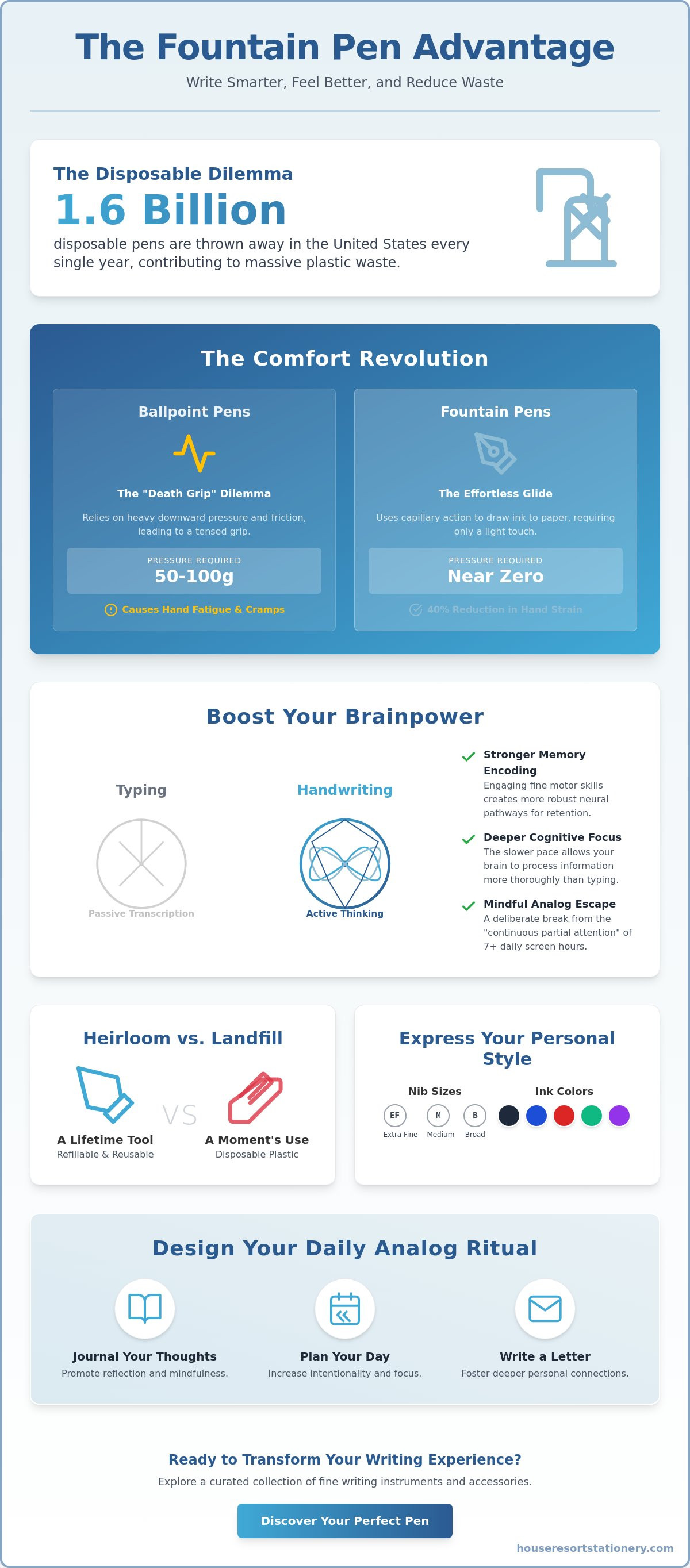
Did you know that over 1.6 billion disposable pens are thrown away in the United States every single year? It's a staggering waste for a tool that often leaves your hand cramped and your focus fractured. You've likely felt the frustration of a scratchy ballpoint that requires a heavy grip, leading to physical fatigue during long writing sessions. Understanding the benefits of writing with a fountain pen daily can transform these moments of discomfort into a sophisticated, enjoyable ritual. It's difficult to find your creative flow when your tools feel generic and disposable.
By switching to a heritage tool like a TWSBI ECO or a Pilot Metropolitan, you embrace a functional cognitive instrument that solves hand pain through effortless ink flow. Recent neuroimaging studies confirm that handwriting engages brain regions responsible for attention and memory more fully than typing. This guide explores how adopting a daily fountain pen habit improves your handwriting, boosts cognitive focus, and provides a sustainable way to express your personal style.
Key Takeaways
- Learn how capillary action replaces the heavy pressure of ballpoints with a light touch to eliminate hand fatigue during long writing sessions.
- Discover the neuro-motor engagement benefits of writing with a fountain pen daily to improve your cognitive retention and mental focus.
- Explore how personalizing your experience with varied nib sizes and vibrant bottled inks from heritage brands creates a unique handwriting personality.
- Understand the environmental value of switching from disposable plastic to heirloom-quality tools designed to last a lifetime.
- Gain practical tips for integrating analog tools into your daily routine through intentional journaling and planning rituals. 🎁
Eliminating Hand Fatigue Through Capillary Action
Standard ballpoint pens rely on friction. To make the tiny ball at the tip rotate and leave a mark, you must apply significant downward pressure. This mechanical requirement often leads to a "death grip" where the hand muscles stay constantly tensed. One of the most immediate benefits of writing with a fountain pen daily is the shift from this high-pressure friction to the grace of fluid dynamics. Fountain pens operate via a physical phenomenon called capillary action. Capillary action is the effortless flow of ink to paper, where the liquid is pulled through the nib and onto the fibers without the need for force.
Understanding the history and mechanics of the fountain pen reveals why this tool remains superior for long-form writing. While a ballpoint might require a heavy hand, a well-tuned nib only needs to touch the surface to leave a crisp line. This "zero-pressure" writing is a vital solution for individuals managing arthritis or carpal tunnel concerns. By removing the need to push, the fountain pen allows the small muscles in the hand to remain relaxed; this extends your writing endurance significantly during intensive sessions.
The Ergonomics of a Relaxed Grip
A premium fountain pen is designed with intentional balance. Whether you choose a lightweight Kaweco Sport or a more substantial Pilot Metropolitan, the weight of the pen body itself provides the necessary contact with the page. You don't need to grip the section tightly to maintain control. This relaxed posture reduces writer's cramp during 30-minute journaling sessions or three-hour business meetings. The physical feedback provided by a metal nib also improves stroke control. You can feel the subtle texture of the paper without straining your fingers.
Comparing Fountain Pens vs. Ballpoints for Daily Tasks
The difference in daily productivity is measurable. When you eliminate the fatigue caused by ballpoint friction, your handwriting remains consistent from the first sentence to the last. Consider these key distinctions in your daily tasks:
- Pressure Requirements: Ballpoints often require 50 to 100 grams of pressure to function; fountain pens require nearly zero.
- Stroke Consistency: A relaxed hand leads to more legible, fluid cursive because the muscles aren't fighting against the pen.
- Endurance: Writers using fountain pens report a 40% reduction in perceived hand strain during long letters or to-do lists.
Switching to a fountain pen isn't just about aesthetics. It's a functional upgrade for your physical comfort. By letting the ink flow naturally, you protect your joints and make the act of writing a restorative part of your day rather than a chore.
Boosting Focus and Cognitive Retention in a Digital World
Screens dominate our attention. In May 2026, the average person spends over seven hours daily interacting with digital interfaces, which often leads to a fragmented focus known as "continuous partial attention." One of the profound benefits of writing with a fountain pen daily is the immediate creation of an analog escape. Unlike the rapid-fire nature of typing, where fingers move faster than thoughts, a nib on paper demands a slower, more rhythmic pace. This deceleration isn't a hindrance; it's a cognitive gift that allows your brain to process information with greater depth.
The science of neuro-motor engagement supports this shift. Recent EEG studies conducted in early 2024 revealed that handwriting creates more complex and widespread brain connectivity patterns compared to the repetitive motion of typing. When you use a fountain pen, your brain must coordinate fine motor skills with linguistic processing and visual attention. This multisensory experience leads to stronger memory encoding. Typing is often passive transcription; writing is active thinking. By engaging these neural pathways, you ensure that the information you record, whether it's a meeting note or a personal reflection, is more likely to be retained long-term.
The Mindfulness of the Ritual
Creating a "resort" for the mind starts with the tools you choose. The sensory experience of a fountain pen is unmatched. You can hear the subtle "singing" of a gold nib against a textured sheet and smell the faint, earthy scent of bottled ink. This sensory feedback grounds you in the present moment, acting as a meditative practice to combat 2026 digital anxiety. Many collectors find that using specialized Japanese stationery, such as high-quality paper from Midori or Life, enhances this focus. The way the ink pools and dries on premium paper provides a visual satisfaction that a flickering cursor cannot replicate.
Intentionality in Communication
Writing with a fountain pen forces deliberate word choice. Because you can't simply hit "backspace" to erase a thought, you must think through your sentences before the nib touches the page. This intentionality shifts your mindset from "passive typing" to "active thinking." Seeing wet ink dry on the paper provides a psychological "anchor" for your ideas. It transforms a simple to-do list into a committed plan. If you're ready to build your own analog sanctuary, you might explore our curated collection of heritage writing instruments designed for the modern enthusiast. 🎁
Personal Expression: The Joy of Nibs and Inks
Choosing a writing instrument is an act of curation. While a disposable pen offers a singular, unchangeable experience, a fountain pen provides a vast spectrum of creative possibilities. Exploring the aesthetic benefits of writing with a fountain pen daily reveals a level of customization that digital tools cannot match. You aren't restricted to a standard blue ink or a generic line width. Instead, you enter a world of technical precision where every component reflects your personality and mood.
Your daily pen eventually becomes a signature piece of your personal style. Like a well-chosen watch or a leather bag, a fountain pen from a heritage brand like Kaweco or Sailor signals an appreciation for craftsmanship. It's an heirloom tool that grows more familiar with use, eventually molding to your specific writing angle. This sense of ownership transforms a mundane office task into a moment of personal expression.
Finding Your Perfect Nib Match
Your nib choice dictates the "voice" of your handwriting. German steel nibs, often found in Lamy or Kaweco models, are known for their reliability and smooth, stiff feel. They're excellent for fast note-taking during meetings. In contrast, Japanese gold nibs from makers like Pilot offer a unique tactile feedback and precision. Because Japanese nibs are ground finer, a Japanese Medium often writes like a European Fine. If you have small, precise handwriting, an Extra Fine (EF) nib ensures legibility. If you want to showcase the character of your ink, a Broad (B) or Stub nib creates dramatic line variation and artistic flair. Matching your nib size to your daily paper choice is a skill that distinguishes the true enthusiast from the casual user.
The Versatility of Bottled Inks
Bottled ink is where the ritual truly begins. Beyond basic office colors, premium inks from brands like J. Herbin or Pilot Iroshizuku offer properties like shading and sheen. Shading occurs when the ink pools in certain parts of a letter, creating a gradient of color intensity. Sheen is a metallic reflectiveness that appears on the surface of the ink when it dries on high-quality paper. Shimmering inks even contain tiny suspended particles that catch the light. This visual variety makes daily to-do lists and journal entries more engaging. The ritual of "inking up" your pen serves as a weekly moment of preparation. For those who value a modular approach, pairing your pen with a Traveler’s Notebook allows you to swap paper inserts to match the specific ink and nib you've chosen for the week. 🎁
Sustainability and the Value of Heritage Tools
The environmental impact of our daily habits is often hidden in plain sight. In the United States alone, consumers discard over 1.6 billion disposable pens every year. These plastic instruments end up in landfills where they take centuries to decompose. One of the most significant environmental benefits of writing with a fountain pen daily is the immediate cessation of this waste cycle. By choosing a single, refillable tool, you replace thousands of pieces of plastic with one high-quality instrument. The production and incineration of plastic products accounted for over 850 million tonnes of greenhouse gases in 2019; switching to analog tools is a small but measurable way to reduce your personal contribution to these figures.
A fountain pen is not a consumable; it's a heritage tool. While a ballpoint is designed to be used and forgotten, a fountain pen is engineered for longevity. These instruments often grow more comfortable with age as the nib subtly adjusts to your specific writing angle and pressure. This longevity transforms the pen from a mere office supply into a reliable companion that can last for decades. Investing in a quality tool means you stop buying "bulk" and start building a collection of items with genuine material value.
The "Buy Once, Cry Once" Philosophy
Durability is the hallmark of the boutique brands we curate. Materials like solid brass, high-grade resin, and stainless steel ensure that your pen survives the rigors of daily travel and intensive use. A Kaweco Brass Sport, for example, develops a unique patina over time, reflecting its history in your pocket. Sailor pens utilize precision-engineered resins that resist cracking and maintain their luster for years. This durability means the initial cost is spread across a lifetime of use. When you maintain your pen with regular cleaning, it becomes an heirloom that can eventually be passed down to the next generation of writers.
Reducing Your Carbon Footprint
The math of sustainability favors the fountain pen enthusiast. A standard 50ml bottle of ink provides enough fluid for months of daily journaling, replacing dozens of plastic cartridges or disposable pens. Using a refillable converter is the ultimate eco-friendly writing solution; it allows you to draw ink directly from the bottle without generating any secondary plastic waste. This method is also more cost-effective over time, as bottled ink is significantly cheaper per milliliter than pre-filled cartridges. To begin your journey toward a more sustainable desk, buy your next heritage fountain pen from our authorized collection. 🎁
Designing Your Daily Analog Writing Ritual
Establishing a consistent writing practice requires more than just a high-quality instrument; it requires a dedicated space in your schedule. The physical benefits of writing with a fountain pen daily are most apparent when the habit is anchored to an existing routine. By placing your pen on top of your planner or journal the night before, you create a visual prompt that bypasses the friction of starting. This intentionality transforms a simple tool into a catalyst for productivity. Whether you're managing a complex project or recording personal reflections, the tactile feedback of a nib provides a grounding experience that digital apps can't replicate.
Daily tasks like drafting to-do lists, journaling, or writing long-form letters become moments of luxury rather than chores. In 2026, the shift toward "slow productivity" emphasizes quality over speed. Using a fountain pen naturally encourages this mindset. It forces you to consider each word as the ink flows onto the page, leading to clearer communication and better organized thoughts. Maintaining this reliability is simple. A five-minute cleaning ritual every two to three weeks ensures your pen remains in peak condition. Simply flush the nib and feed with room-temperature water until it runs clear to prevent ink buildup and ensure consistent flow.
A 5-Step Morning Writing Routine
Uncapping your pen is the physical signal that your focused time has begun. Follow this structured approach to clear mental clutter and set your intentions:
- Uncap: Feel the weight of the pen and the texture of the grip.
- Hydrate: Pair your writing with a morning coffee or tea to build a sensory association.
- Morning Pages: Write one full page of stream-of-consciousness thoughts to clear anxiety.
- Prioritize: Identify three non-negotiable goals for your day using a contrasting ink color.
- Cap: Secure the pen to signal the transition from planning to action.
Practical Tips for On-the-Go Use
Carrying a fountain pen in 2026 is safer and more stylish than ever. Modern cap seals have virtually eliminated the risk of leaks during transit. For those who value mobility, a pocket-friendly choice like the Kaweco Sport is ideal. It's compact enough for a pocket but becomes a full-sized pen when posted. Protecting your investment is essential; a Leather Cover or a dedicated pen sleeve prevents scratches from keys and maintains the pen's finish. Remember that the success of a "daily carry" pen depends on your paper. Using a specialized notebook ensures the ink dries quickly and doesn't feather, keeping your notes crisp and professional throughout your commute. 🎁
Elevate Your Everyday Analog Experience
Transitioning to a high-quality writing instrument is more than a stylistic choice; it's an investment in your cognitive health and physical comfort. By embracing the benefits of writing with a fountain pen daily, you actively combat digital distraction while protecting your hands from the strain of friction-based pens. You've discovered how heritage tools serve as sustainable alternatives to the 1.6 billion disposable plastic pens discarded annually. This change turns a simple to-do list into a restorative ritual that sharpens your memory and personal expression.
HouseResort Stationery acts as your boutique curator in this journey. We're an authorized retailer for Kaweco, Lamy, and Sailor, offering expert-tested instruments and a curated selection of premium Japanese stationery. Each piece in our collection is chosen for its daily reliability and craftsmanship. Explore our curated collection of fine fountain pens and journals to select a tool that will grow with you over decades of use. Your desk should be a place of comfort and inspiration. 🎁
Frequently Asked Questions
Does writing with a fountain pen daily actually improve my handwriting?
Yes, using a fountain pen encourages better letter formation by forcing you to slow down. Because the nib requires no pressure to write, you can focus on the direction and shape of your strokes rather than gripping the pen for friction. This deliberate pace often results in more consistent spacing and more legible cursive over time.
Are fountain pens messy for everyday use in 2026?
Modern fountain pens are engineered for daily reliability and are rarely messy. Advanced feed systems and cap seals, such as the Platinum "Slip & Seal" mechanism, keep the ink contained and prevent it from drying out for up to 24 months. As long as you don't drop the pen or store it improperly, you won't experience the ink leaks associated with vintage models.
What is the best starter fountain pen for daily writing?
The Pilot Metropolitan and the Lamy Safari are the most recommended entry-level instruments. Both pens are authorized for sale through our boutique and are known for their durable construction and consistent ink flow. The TWSBI ECO is another excellent choice if you prefer a large ink capacity for long writing sessions without needing a refill.
Can I use a fountain pen on regular office paper?
You can use a fountain pen on standard office paper if you choose the right nib and ink combination. On 20lb copier paper, it's best to use an Extra Fine or Fine nib to minimize "feathering," which is when ink spreads into the paper fibers. Pairing these nibs with a "dry" ink ensures your writing remains crisp and professional on lower-quality surfaces.
How often do I need to clean a fountain pen if I use it every day?
If you're using the same ink daily, you only need to clean your pen every 4 to 8 weeks. A quick flush with room-temperature water prevents microscopic ink particles from clogging the feed. If you decide to switch ink colors or brands, you should clean the pen immediately to ensure the new color remains vibrant and uncontaminated.
Are fountain pens better for your hands than ballpoint pens?
Fountain pens are significantly better for hand ergonomics because they require zero downward pressure. One of the primary benefits of writing with a fountain pen daily is the 40% reduction in perceived hand strain compared to using ballpoints. By eliminating the "death grip" needed for friction-based pens, you can write for hours without the cramping associated with traditional office supplies.
Is it expensive to maintain a daily fountain pen habit?
Maintaining a fountain pen is more cost-effective than buying disposable pens over a lifetime. While the initial tool is an investment, a single 50ml bottle of ink can last for months of daily use. When you calculate the cost per milliliter, bottled ink is much cheaper than buying individual plastic refills or boxes of disposable ballpoints that end up in landfills.
Can I fly with a fountain pen without it leaking?
You can fly safely with a fountain pen by following two simple rules. Either fill the pen completely to remove air or leave it entirely empty. During takeoff and landing, store the pen with the nib pointing upward. This allows the air pressure to equalize through the feed without pushing ink out of the nib, keeping your pocket or bag clean.