
The Art of Japanese Stationery: A Comprehensive Guide to Craftsmanship and Innovation
The difference between a frustrating writing session and a meditative one often comes down to a single micron of paper coating. If you've ever watched a beautiful ink feather into a blurry mess on a standard notebook, you know that generic office supplies rarely respect the art of the handwritten word. This pursuit of tactile perfection is exactly why japanese stationery remains the undisputed world standard for quality and technical innovation.
You probably believe that the tools you use should be as intentional as the thoughts you record. We agree that a workspace should be a curated collection of heritage craftsmanship rather than a drawer full of disposable plastic. This guide will show you how to build a high-performance analog toolkit that lasts a lifetime. We'll explore the 2026 refinements to Tomoe River paper, the newly independent MD PRODUCT brand, and the Monozukuri philosophy that drives makers like Sailor and Pilot to create tools that feel like a natural extension of your hand.
Key Takeaways
- Discover the cultural roots of shodo and how the Monozukuri philosophy creates tools designed for a lifetime of use.
- Understand the science of paper sizing, a critical process that prevents ink from soaking into fibers and preserves the clarity of your handwriting.
- Learn why japanese stationery manufacturers prioritize finer nib widths and how to choose between the distinct writing profiles of Pilot, Sailor, and Platinum.
- Apply a practical two-step framework to identify your primary use case and select the ideal anchor notebook or planner for your daily workflow.
- Find out how to curate a high-performance workspace by sourcing authentic tools from an authorized retailer of heritage Japanese brands.
The Philosophy of Japanese Stationery: Understanding Monozukuri
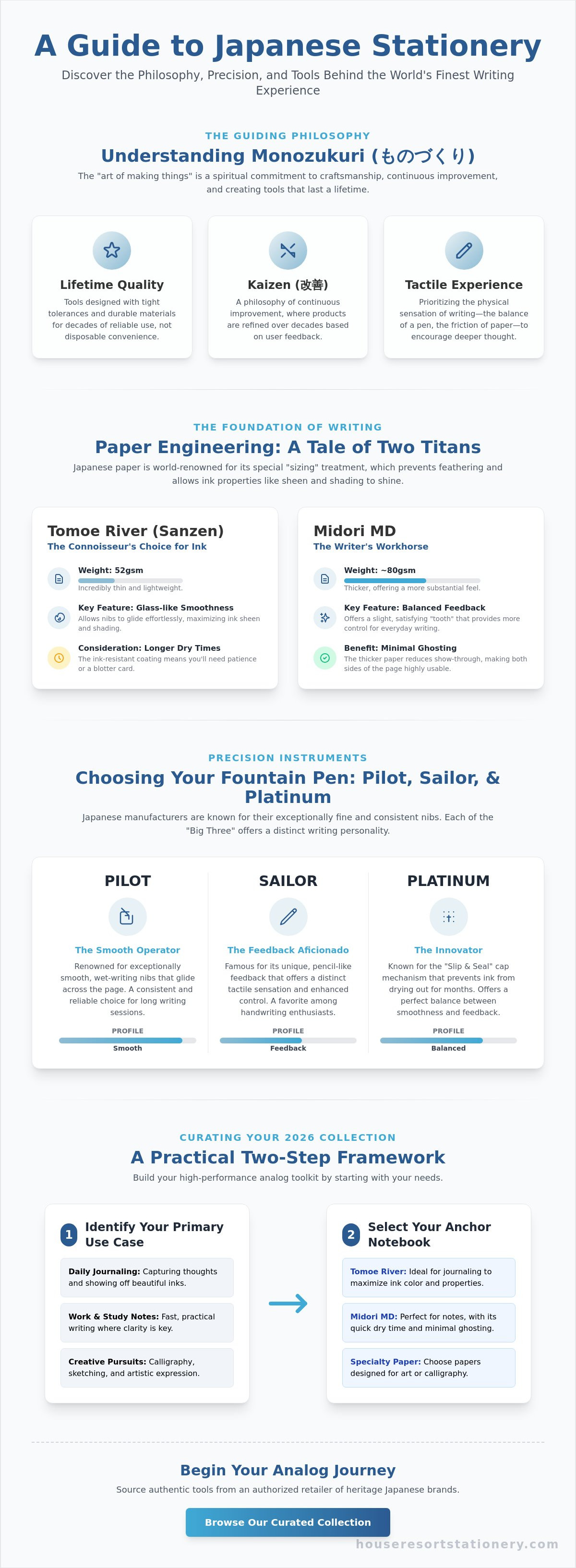
At its core, the global fascination with japanese stationery isn't about mere office supplies; it's about the philosophy of Monozukuri. This term translates to the "art of making things," but the definition goes much deeper. It represents a spiritual commitment to craftsmanship, where the maker takes immense pride in every iteration of a product. Unlike Western mass production that often prioritizes speed and cost reduction, Japanese manufacturers focus on kaizen, or continuous improvement. This means a notebook or a fountain pen isn't just a commodity. It's a tool refined over decades to achieve a state of functional beauty, where the aesthetic appeal is a direct result of its mechanical perfection.
This dedication stems from a deep cultural reverence for handwriting. In Japan, the practice of shodo, or traditional calligraphy, heavily influences modern design. Every pen stroke is expected to convey meaning through its weight, direction, and flow. Consequently, the tools must be capable of extreme precision. You'll find that a comprehensive overview of Japanese stationery often highlights how these historical roots dictate contemporary engineering. Manufacturers prioritize the tactile experience above all else. They ensure that the friction between a nib and paper feels deliberate, providing the user with a sense of control that mass-produced alternatives simply cannot replicate.
Precision as a Standard
Manufacturing tolerances in Japan are notoriously tight, often exceeding the standards of Western counterparts. While a standard ballpoint might be seen as a throwaway item elsewhere, heritage brands like Pilot or Platinum treat every component as a critical mechanical part. These companies maintain quality by maintaining a constant dialogue with the enthusiast community. Product evolution isn't driven by fleeting marketing trends, but by direct feedback from users who demand consistent ink flow and durable materials. This level of meticulousness ensures that your tools perform perfectly on day one and remain reliable for decades.
The Shift from Utility to Experience
Choosing high-quality analog tools is a lifestyle investment rather than a simple purchase. In a digital age where communication is instantaneous and often cold, the act of writing provides a vital psychological reset. High-end japanese stationery minimizes writing fatigue through superior ergonomics and material science. Pens are meticulously balanced to sit perfectly in the hand, while paper is engineered to provide the exact level of resistance needed for smooth gliding. This focus on the user's physical comfort transforms a routine task into a relaxing, sensory experience that encourages deeper thought and creativity.
Paper Engineering: The Science of Tomoe River and Midori
The global reputation of japanese stationery rests largely on its superior paper engineering. For fountain pen enthusiasts, the surface of the page is just as critical as the nib itself. Japanese manufacturers utilize a sophisticated "sizing" process, which involves treating the paper with specific chemical agents to control absorbency. This barrier prevents ink from soaking into the paper fibers, a common issue known as feathering. By keeping the ink on the surface, these papers allow for two prized visual effects: sheen and shading. Sheen refers to the metallic, light-reflecting layer that appears when certain inks dry on non-absorbent surfaces. Shading occurs when ink pools in different concentrations, creating beautiful color gradients within a single letter.
While thinness is a hallmark of premium Japanese paper, it often sparks a debate between ghosting and bleeding. Bleeding occurs when ink seeps through to the other side, rendering the reverse page unusable. Ghosting, or "show-through," is simply the shadow of the writing visible through the sheet. Most connoisseurs accept ghosting as a fair trade for the lightweight, portable nature of these notebooks. If you are looking to start your own collection, you can browse our curated selection of heritage notebooks to find the texture that suits your style.
Tomoe River: The Legend of Thinness
Tomoe River paper is famous for its improbable 52gsm weight and glass-like smoothness. As of 2026, the refined version produced by Sanzen has addressed previous quality concerns, offering improved resistance to ghosting and a slightly thicker tactile feel. This coating is what makes ink colors pop, though it does require patience. Because the ink sits on top of the page, dry times are longer. We recommend using a blotter card to prevent accidental smudges while journaling.
Midori MD: The Purist's Choice
The midori md notebook journal represents a different school of thought. Following the January 22, 2026, branding shift to "MD PRODUCT," these tools continue to prioritize the raw experience of writing. Unlike the slick surface of Tomoe River, MD paper has a slight "tooth" or texture. This provides subtle feedback to the writer, making it a favorite for both pencils and fountain pens. The signature cream tint reduces eye strain, while the minimalist, "blank" design philosophy removes all distractions between the author and the page.
Precision Instruments: Innovation in Pens and Pencils
The Big Three, consisting of Pilot, Sailor, and Platinum, form the bedrock of high-end writing instruments. While many brands focus on outward aesthetics, these manufacturers specialize in internal engineering. Platinum's "Slip & Seal" mechanism, for example, prevents ink from drying out for up to 24 months, a feat of airtight precision. Meanwhile, Uni-ball’s Kuru Toga mechanical pencil features a core rotation engine that keeps the lead sharp with every stroke. These aren't just pens; they're meticulously tuned machines designed for decades of use.
High-end models often utilize precious materials like Ebonite and Urushi lacquer. Ebonite, a hard rubber, provides a warm, organic feel that modern plastics don't match. Urushi is a natural resin harvested from trees and applied in dozens of layers to create a deep, durable luster. One of the most significant differences for new collectors is the nib sizing. Because Japanese characters are dense and complex, japanese stationery nibs are ground significantly finer than their Western counterparts. A Japanese Medium nib typically writes with the same line width as a European Fine. This precision allows for legible writing in compact spaces, making these tools indispensable for detailed journaling.
The Japanese Fountain Pen Nib
The choice between a gold and stainless steel nib often comes down to "bounce." Gold nibs, particularly the 21k options from Sailor, offer a soft, responsive feel that adjusts to your writing pressure. For those seeking artistic flair, specialty nibs like the Fude (brush-style) or Zoom (variable width) provide a level of expression that standard pens can't reach. These instruments are designed to perform best on high-performance paper, which is why they are the perfect match for your japanese stationery collection.
Mechanical Pencils and Engineering
Engineering excellence extends into lead management. Systems like Pentel’s Orenz and Zebra’s DelGuard virtually eliminate lead breakage by protecting the core with a sliding sleeve or internal springs. Even legendary American tools like the Blackwing 602 rely on Japanese graphite to achieve their signature "soft but firm" performance. To prevent writer's cramp during long sessions, brands incorporate ergonomic "Alpha Gel" grips, which use impact-absorbing silicone to minimize pressure on the fingers. This focus on the user's physical comfort ensures that the act of writing remains a pleasure rather than a chore.
Curating Your 2026 Collection: A Beginner’s Framework
Entering the world of premium analog tools doesn't have to be overwhelming. While the sheer variety of japanese stationery is vast, a structured framework helps you build a kit that actually serves your daily life. The most effective approach is to build from the ground up, starting with your surface and ending with your flourishes.
First, identify your primary use case. Are you tracking a busy schedule, recording long-form thoughts, or sending personal letters? This decision dictates your "anchor" paper. For daily organization, a Hobonichi Techo provides a structured layout. If you prefer a minimalist canvas, Midori’s MD series is ideal. For those who move between different projects, the modularity of a Traveler’s Notebook is unmatched. Once your paper is set, select a writing instrument that respects its texture. A slick, non-absorbent sheet like Tomoe River pairs beautifully with a fine-nib Sailor fountain pen. A toothier sheet like Midori MD provides a satisfying tactile response when paired with a soft-lead mechanical pencil or a broader nib.
Finally, add utility accessories to refine the experience. Brass clips hold your notebook open for hands-free writing, while blotting paper is essential for managing the longer dry times associated with high-performance paper. Before committing to full bottles, we recommend testing ink samples to see how specific colors interact with your chosen paper’s tint. This iterative process ensures you don't end up with a drawer full of tools that don't harmonize.
The Planner Enthusiast's Kit
The Hobonichi Techo is often the gateway into this world because it showcases the versatility of Tomoe River paper in a daily format. If you need more flexibility, consider pairing the traveler's notebook with specific inserts for modularity. This system allows you to swap out planners, sketchbooks, and folders within a single leather cover. Don't forget a dedicated pen case; protecting your investment is a key part of the curator's mindset.
The Creative Journaler's Kit
Creative journalers often find that japanese stationery provides the best canvas for mixed-media experimentation. Using fountain pen doodle journaling for beginners is an excellent way to explore the shading and sheen of different inks. You can use washi tape and stamps to build visual layers without adding significant bulk. Glass dip pens are particularly useful here. They allow you to switch between multiple ink colors with a simple rinse, making them the perfect tool for testing your growing collection.
Ready to begin your journey? Shop our full collection of authentic Japanese tools to start building your 2026 toolkit today.
Why HouseResort Stationery is Your Premier Boutique Curator
Selecting the right tools requires a partner who understands the nuance between a 14k and a 21k nib. HouseResort Stationery operates as an authorized retailer for the heritage brands that define the industry. We don't just stock shelves; we curate a selection that filters out the noise of mass production. This ensures that every item in our catalog, from fine fountain pens to archival-grade planners, meets the rigorous standards of Monozukuri we've explored in this guide.
Authenticity is the foundation of our collection. When you invest in japanese stationery, you are buying into a legacy of craftsmanship that spans generations. Buying from a specialized boutique means you receive expert support from people who actually use these tools. We understand the specific dry times of the 2026 Tomoe River paper and the unique feedback of a Sailor nib. This technical knowledge allows us to guide you toward tools that become lifelong companions rather than disposable office supplies.
Authenticity and Heritage
We vet our manufacturers to ensure they maintain the tight tolerances expected of premium Japanese engineering. By supporting independent retailers, you help sustain the "nib enthusiast" community and ensure that heritage brands like Platinum and Midori continue to thrive. Our focus remains on the tactile nature of analog tools. We prioritize materials like Urushi and high-grade resins because we believe your writing instruments should feel as substantial as the thoughts you record.
Join the Analog Community
The landscape of writing tools is constantly evolving. Staying updated on 2026 releases, such as the independent launch of the MD PRODUCT brand or the latest Sailor limited editions, is part of the joy of collecting. Our role is to act as your trusted expert, helping you find that "grail" pen or the perfect paper for your specific ink collection. We invite you to step away from the digital screen and rediscover the meditative power of a well-crafted pen on superior paper.
Explore our curated Japanese Stationery Collection today and begin building a workspace that inspires your best work.
Elevate Your Analog Experience for 2026
The transition from generic office supplies to a high-performance analog toolkit is a journey into the heart of Monozukuri. By understanding the mechanical precision of the "Big Three" manufacturers and the technical sizing of premium papers, you can eliminate the frustrations of ink feathering and writing fatigue. You now have the framework to curate a workspace that values heritage over mass production, ensuring every tool you own is a deliberate choice rather than a disposable convenience.
As an authorized retailer of Sailor, Pilot, and Platinum, we take pride in offering a curated selection of premium paper and expert-led recommendations for every level of enthusiast. Whether you are starting a Hobonichi for the first time or seeking a grail fountain pen, the world of japanese stationery offers a level of tactile satisfaction that digital alternatives can't replicate. We invite you to Shop our curated 2026 Japanese Stationery Collection and discover the difference that century-old craftsmanship makes in your daily workflow. Your best ideas deserve a canvas that respects the art of the handwritten word.
Frequently Asked Questions
Why is Japanese stationery so expensive compared to standard office supplies?
The cost reflects a commitment to Monozukuri, where manufacturers prioritize long-term durability and precision engineering over mass production speed. High-end tools often feature expensive natural materials like Urushi lacquer or Ebonite. Unlike disposable office supplies, these instruments are designed to be lifelong companions. You're investing in a tool that undergoes rigorous quality control and specialized manufacturing processes that standard brands simply don't implement.
Is Japanese paper really better for fountain pens?
Japanese paper is considered the gold standard because of its unique sizing process. This chemical treatment prevents liquid ink from soaking into the fibers, which stops feathering and bleed-through. It allows fountain pen inks to sit on the surface, showcasing properties like sheen and shading that are lost on absorbent Western paper. This technical superiority makes japanese stationery the preferred choice for anyone using wet writing instruments.
What is the difference between Japanese and Western fountain pen nib sizes?
Japanese nibs are typically one full size finer than their Western counterparts. This is because Japanese kanji characters are dense and require a thinner line for legibility. If you usually write with a European Fine, you should select a Japanese Medium to achieve a similar line width. Brands like Sailor and Platinum specialize in these ultra-fine tolerances, providing much more precision for detailed notes and compact planners.
What is Tomoe River paper, and why is it famous?
Tomoe River is a legendary 52gsm paper known for being incredibly thin yet remarkably resistant to ink bleed-through. It is famous among journalers because it allows for a high page count without adding bulk to a notebook. The 2026 version by Sanzen has further refined the surface to reduce ghosting while maintaining the glass-like smoothness that makes ink colors appear more vibrant and saturated than on standard sheets.
Can I use Japanese stationery for everyday office work?
You can absolutely integrate these tools into a professional environment to improve your daily workflow. While these products are often associated with hobbyists, their ergonomic designs and reliable ink flow make them perfect for long meetings and heavy note-taking. Using a high-quality mechanical pencil like the Kuru Toga or a smooth Midori MD notebook can turn a mundane office task into a more focused and enjoyable experience.
Which Japanese notebook is best for a beginner?
The Midori MD notebook is the ideal starting point for most beginners. It offers a balance of high-quality paper and a minimalist aesthetic that isn't intimidating. It handles various pen types well and provides enough tactile feedback to help you understand the benefits of premium paper. If you need more structure, the Hobonichi Techo is a fantastic entry into the world of daily planning and organized journaling.
What are the must-have Japanese stationery brands for 2026?
For 2026, keep a close eye on the newly independent MD PRODUCT brand and the latest releases from the "Big Three": Pilot, Sailor, and Platinum. These manufacturers continue to lead the market with innovations like the Slip & Seal cap and refined 21k gold nibs. Japanese stationery enthusiasts should also look for Sanzen-produced Tomoe River inserts, which have become the new standard for high-performance paper in modular notebook systems.
Does Japanese stationery work with any type of ink?
Most Japanese notebooks and planners are compatible with ballpoint, gel, and rollerball inks, but they are specifically engineered for fountain pen ink. The non-absorbent surfaces allow water-based inks to dry slowly and display their true color profile. While you can use any pen, you'll get the best results by pairing these papers with high-quality bottled inks that are designed to shade and sheen on coated surfaces.