
The Art of Journaling with a Broad Nib Pen: A Connoisseur’s Guide
Most journalers settle for the safety of a fine nib, fearing that a wider stroke will turn their private thoughts into an illegible, inky mess. It's a valid concern. You've likely dealt with the frustration of ink feathering on standard paper or the disappointment of smudging a beautiful sentence before the ink has a chance to dry. When your handwriting feels too cramped for those thick, expressive lines, the experience can feel more like a chore than a creative escape.
We understand that journaling with a broad nib pen is a deliberate choice to prioritize the tactile beauty of the craft. This guide will show you how to transform your practice into a luxurious, ink-centric experience by mastering the unique characteristics of wider fountain pen nibs. You'll learn to achieve maximum shading and sheen while maintaining a smooth, low-feedback writing session. We'll explore the essential pairings of paper and ink that allow you to create visually striking journal entries that reflect the true heritage of fine writing instruments.
Key Takeaways
- Experience a "buttery," low-friction writing session by understanding how the rounded geometry of a broad nib minimizes paper feedback.
- Select paper with high-quality sizing to ensure ink sits on the surface, preventing feathering while maximizing visual shading and sheen.
- Refine your technique for journaling with a broad nib pen by increasing your vertical scale to maintain legibility and prevent letter loops from closing.
- Create visual interest in your layouts by using broad nibs to establish a clear hierarchy between bold headers and standard body text.
- Distinguish between the generous ink flow of European nibs and the precision of Japanese broads to select the ideal tool for your specific writing style.
The Sensory Appeal of Journaling with a Broad Nib Pen
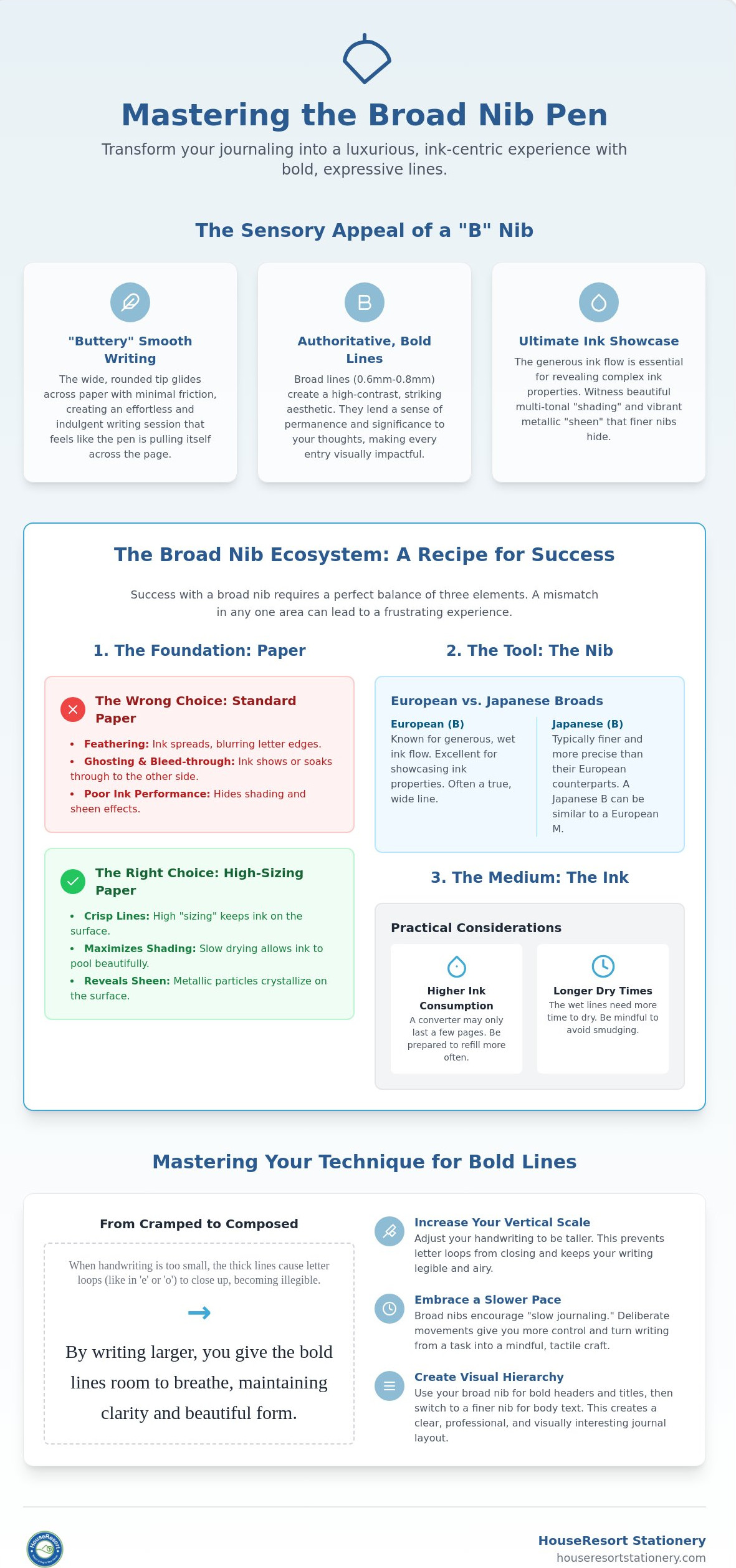
A broad nib, typically designated by the letter "B," features a larger piece of tipping material than its fine or medium counterparts. This increased surface area creates a wider line, often ranging between 0.6mm and 0.8mm depending on the manufacturer's specific grind. Understanding the different types of fountain pen nibs is a foundational step for any connoisseur looking to curate a versatile collection. While fine nibs are prized for their precision in small spaces, the broad nib is designed to prioritize the ink's character and the writer's comfort.
The tactile sensation of a broad nib is often described by enthusiasts as "buttery." Because the nib's contact point is wider and more rounded, it glides across the paper with significantly less feedback than a needle-point fine nib. This lower-friction experience makes journaling with a broad nib pen feel effortless and indulgent. It's a physical sensation that invites you to keep writing, as the pen almost pulls itself across the page with a smooth, liquid grace.
Visual presence is another hallmark of the broad nib experience. Bold lines demand attention. They lend a sense of authority and permanence to your journal entries, making every thought feel significant. On a high-quality cream or white page, the high contrast of a thick, wet line creates a striking aesthetic that fine lines simply cannot replicate. For the tactile writer, the luxury of flow is unparalleled; the higher ink volume provides a sensory richness that turns every letter into a small act of indulgence.
Why Broad Nibs are the Ultimate Tool for Ink Enthusiasts
For those who collect boutique inks, a broad nib is a non-negotiable tool. It's the most effective way to witness true "shading," a phenomenon where ink pools at the terminal points of a stroke to create beautiful multi-tonal effects. You might see a single word transition from a soft, dusty rose to a deep, saturated burgundy. Additionally, the generous ink flow allows metallic "sheen" to crystallize on the paper surface as it dries, revealing vibrant, contrasting colors that thinner nibs often mask. Broad nibs act as a wide canvas that showcases the technical complexity and artistry behind modern ink formulas.
The Emotional Shift from Task to Craft
Choosing a broad nib signals an intentional shift in your writing mindset. It isn't a tool designed for rapid-fire grocery lists or frantic meeting notes. It's a tool for "slow journaling." The physical requirements of managing a wider line, such as larger letter forms and more deliberate hand movements, naturally force you to slow your pace. This deliberate speed encourages a deeper sense of mindfulness. You aren't just recording data; you're engaging in a tactile craft. Transitioning from the clinical precision of a fine nib to the expressive, flowing nature of journaling with a broad nib pen allows your personality to emerge more clearly on the page. It's a relaxing escape that celebrates the process as much as the result.
The Broad Nib Ecosystem: Pairing Ink and Paper for Success
Success with journaling with a broad nib pen depends on a delicate balance. It's a technical triangle consisting of paper, ink, and the nib itself. If one element is poorly matched, the entire experience collapses. Standard 80gsm office paper is the most common culprit for failure. Because this paper is designed for rapid absorption, the high ink volume of a broad nib causes immediate feathering. The ink spreads along the paper fibers like a bruise, blurring the edges of your letters. Ghosting is equally problematic; the ink often bleeds through to the other side, rendering the reverse page of your journal useless.
Connoisseurs prioritize paper "sizing" above all else. This term refers to the chemical treatment applied to paper during manufacturing to reduce its porosity. High sizing keeps the ink on the surface rather than letting it soak into the core. This allows the liquid to dry slowly, which is exactly what's needed for colors to pop and for complex shading to develop. While you explore the mental health benefits of journaling, having a reliable surface ensures your focus remains on your thoughts rather than technical frustrations. A smooth, sized surface turns a simple writing session into a professional-grade tactile experience.
Be prepared for higher ink consumption. A broad nib can empty a standard converter in just a few pages of dense writing. You'll likely go through a 50ml bottle much faster than you would with a fine or medium nib. Dry times also increase significantly. On non-absorbent, high-quality paper, a wet broad stroke might take 45 to 60 seconds to dry completely. This requires a bit of patience before turning the page, but the visual payoff is worth the wait.
Selecting Inks that Shine in Broad Nibs
Broad nibs are the best way to showcase complex ink properties. High-shading and high-sheen formulas require the generous flow of a wider nib to reveal their true depth. For many, pilot iroshizuku bottled ink remains the gold standard for its consistent flow and vibrant colors. If your pen is a "wet" writer, consider a "dry" ink to maintain control over the line width. Conversely, a "dry" nib benefits from a lubricated, wet ink to ensure a skip-free experience. Balancing these characteristics is key to a frictionless session.
The Best Paper for Broad Nib Journaling
Coated Japanese papers are the preferred choice for enthusiasts of journaling with a broad nib pen. These surfaces are engineered to handle heavy ink loads without buckling or bleeding. Our Japanese stationery online store guide highlights several notebook options that excel with broad nibs. To manage heavy deposits, keep blotting paper sheets nearby. They absorb excess moisture instantly, allowing you to close your journal without smearing your work. Explore our curated selection of fountain pen friendly journals to find your perfect match.
Mastering Technique: Adjusting Your Handwriting for Bold Lines
Transitioning to journaling with a broad nib pen requires more than just a change in tool; it demands a shift in hand mechanics. The most fundamental rule is that larger nibs require a larger vertical scale. If you maintain the same small handwriting used with an extra-fine nib, your letters will inevitably collapse into illegible ink blots. This loss of clarity is known as "loop closure," where the counters of letters like 'e', 'a', and 'o' fill in completely because the stroke width exceeds the available white space. By scaling up your script, you allow the ink room to breathe and reveal its character.
To master this, you must cultivate a lighter touch. High-flow broad nibs don't require pressure to lay down ink. In fact, excessive pressure can lead to "railroading," where the tines spread too far and the ink flow breaks. Maintaining a consistent nib-to-paper angle is vital. Unlike a ballpoint, a broad fountain pen nib has a specific "sweet spot." If you rotate the pen even slightly, the flow may skip or feel scratchy. This focus on precision connects modern journalers to the historical art of calligraphy, where the angle of the pen determined the soul of the script.
Five Steps to Legible Broad Nib Handwriting
- Increase your x-height: Ensure the bodies of your lowercase letters have enough room for the thick strokes to remain distinct.
- Increase inter-word spacing: Bold lines create a heavy visual weight; extra space between words prevents the page from looking cluttered.
- Slow down the stroke: Give the feed enough time to saturate the tipping material for a consistent, saturated line.
- Find your angle: A 45-degree angle to the baseline typically offers the most reliable ink distribution for most broad grinds.
- Ghost the stroke: Practice moving your hand in the shape of the letter just above the paper before making contact to ensure your alignment is correct.
The Left-Handed Broad Nib Challenge
Left-handed writers face unique hurdles when journaling with a broad nib pen. The primary risk is smudging as the hand moves across the freshly laid, wet ink. Adopting an "under-writing" technique, where the hand stays below the baseline, is the most effective way to keep your work pristine. Pair this with fast-drying inks to minimize accidents during long writing sessions. Over-writers who cannot change their grip should prioritize more absorbent paper to pull the ink away from the surface quickly.
Creative Journaling Layouts Optimized for Broad Nibs
Broad nibs provide the visual weight necessary to organize a page with professional intent. When journaling with a broad nib pen, you aren't limited to uniform blocks of text. Instead, use the nib's width to establish a clear hierarchy of information. A bold header written with a broad nib acts as a physical anchor for the eye. It separates different sections or days with effortless authority. This contrast between bold titles and finer body text creates a curated aesthetic common in high-end analog journals. It turns a simple page of notes into a designed object.
The "Quote Page" is another effective layout strategy for the broad nib enthusiast. By dedicating an entire page to a single sentence, you make that thought the centerpiece of your reflection. The broad nib allows the ink's technical properties to dominate the visual space. You see the full depth of the color in every stroke. For those who enjoy a more illustrative approach, integrating these tools into fountain pen doodle journaling for beginners adds a new dimension of line weight. Thick strokes provide character and shadow to simple sketches that fine nibs often lack.
Finally, use your journal entries to document your ink collection. Creating small ink swatches directly in the margins or at the bottom of a page provides a permanent reference. Since broad nibs lay down a generous volume of ink, these swatches accurately represent how the ink will look in future entries. It's a practical way to track how different formulas behave on your favorite paper over time.
The Bold Header Technique
Use the broad nib to create "faux calligraphy" by thickening the downstrokes of your letters. This technique adds a decorative flair that mimics traditional script without needing specialized tools. Pairing a broad nib header with a fine nib body text provides immediate visual contrast. This makes your layouts more readable and engaging at a glance. For extra depth, try "double-stroking" your headers. By slightly offsetting a second stroke in a different or lighter color, you can create a subtle shadow effect that makes the text stand out from the page.
Artistic Borders and Spacing
The side-stroke of a broad nib is a powerful tool for decorative elements when journaling with a broad nib pen. By holding the pen at a specific angle, you can draw thick, consistent lines to frame your entries. This is also an excellent way to use a broad nib for "ink-washing" small areas. Draw a thick line and use a slightly wetter ink to spread the color, creating a soft background for your text. Bold bullet points also benefit from the broad nib's scale. A large, saturated dot stands out clearly, making it easier to track key tasks or insights.
Explore our collection of luxury fountain pens to find the perfect broad nib for your next creative layout.
Curating Your Broad Nib Collection: A Boutique Selection
Building a collection for journaling with a broad nib pen requires an understanding of regional manufacturing standards. The distinction between European and Japanese nib sizes is the first lesson for any serious collector. Brands like Lamy and Pelikan follow European sizing, which typically results in a wider, wetter line that maximizes ink flow. Conversely, Japanese manufacturers like Sailor and Pilot produce broad nibs that are often slightly narrower, comparable to a European medium. These Japanese options offer more precision and a unique tactile feedback that appeals to those who want bold lines without sacrificing control. Choosing between them is a matter of personal preference for either generous "juice" or refined accuracy.
The Traveler’s Notebook serves as the perfect companion for this exploration. Its modular design and fountain pen friendly paper inserts handle the high ink volume of broad nibs with ease. Because these pens consume ink rapidly, the ability to swap inserts and carry multiple ink colors makes the Traveler’s system highly functional for the dedicated journaler. When purchasing these precision tools, always rely on an authorized retailer. This ensures your nib has undergone proper quality control for alignment and flow, preventing the frustration of a "baby's bottom" grind or a scratchy writing experience right out of the box.
Top Broad Nib Recommendations for 2026
- Sailor Pro Gear: This remains a pinnacle of Japanese craft. For 2026, the brand continues to offer exceptional 21k gold broad nibs that provide a singular "pencil-like" feedback while laying down a substantial line.
- Lamy Safari: It's the most accessible entry point into bold writing. The ability to easily swap nibs makes it a favorite for those experimenting with different line widths for the first time.
- TWSBI Eco: As a piston-filler demonstrator, the Eco is the perfect tool for watching your ink levels drop. Its massive ink capacity is essential for the high-consumption nature of broad nib writing.
Long-Term Care for High-Flow Pens
Broad nibs require more frequent maintenance than finer sizes. Because they move a larger volume of ink, the feed can collect more residue over time. Regular flushing with cool water prevents "nib creep" and ensures the ink channels remain clear. When journaling with a broad nib pen, store your inked pens in a nib-up position to prevent ink from pooling in the cap. If you're transitioning between shimmering inks and standard formulas, a deep clean is mandatory. Shimmer particles can easily clog a feed if they're allowed to dry, so a thorough flush between fills will keep your writing sessions frictionless and reliable.
Elevate Your Daily Reflections with a Bold Stroke
Transitioning to a wider nib is a commitment to the sensory beauty of the analog craft. You've discovered how the right paper pairing prevents feathering, while a larger handwriting scale ensures your script remains legible and expressive. By embracing these techniques, you unlock the full depth of your ink's shading and sheen, turning every entry into a visual centerpiece. Journaling with a broad nib pen isn't just about recording thoughts; it's about enjoying a slow, luxurious writing process that prioritizes quality over speed.
As an authorized retailer for heritage manufacturers like Sailor, Lamy, and TWSBI, we offer tools that represent the pinnacle of nib craftsmanship. Our boutique features expert-tested stationery pairings curated by enthusiasts for enthusiasts, so you can shop with confidence. Explore our curated collection of fine broad nib fountain pens to find your next favorite writing instrument. It's time to transform your journaling practice into an indulgent, ink-centric escape that celebrates the art of the bold line.
Frequently Asked Questions
Do broad nib pens use more ink than fine nibs?
Yes, broad nibs consume significantly more ink because they feature a wider slit and larger tipping material. This design allows a greater volume of liquid to flow onto the page with every stroke. You might find yourself refilling a standard converter two or three times as often as you would with a fine nib. For this reason, many enthusiasts prefer high-capacity piston fillers when planning long writing sessions.
Can I use a broad nib pen in a standard planner with small grids?
Using a broad nib in small 3.7mm or 5mm grids is challenging and often leads to illegible notes. The thick lines tend to fill the small boxes completely, leaving no white space for clarity. If you must use a broad nib in a compact planner, consider writing across two grid rows or reserving the bold lines for section headers while using a finer nib for the body text.
What is the best paper to prevent bleed-through with a broad nib?
Hard-sized, non-absorbent papers like Tomoe River or Midori MD are the best choices for success. These surfaces are treated to keep the ink on top of the fibers rather than letting it soak in. This is essential when journaling with a broad nib pen, as standard 80gsm paper will almost certainly feather and bleed due to the high volume of ink deposited by the wider tipping.
Are broad nib fountain pens suitable for left-handed writers?
Broad nibs are suitable for left-handed writers who use an "under-writing" grip, which keeps the hand below the wet ink line. If you are a "hook" or "over-writer," the generous ink flow of a broad nib may lead to consistent smudging. Left-handed journalers should prioritize fast-drying inks and slightly more absorbent paper to ensure the bold lines set before the hand passes over them.
How do I stop my broad nib pen from smudging?
The most effective way to prevent smudging is to use blotting paper. Because broad nibs lay down a heavy layer of ink, dry times can often exceed 60 seconds on high-quality coated papers. Keeping a dedicated sheet of blotting paper in your journal allows you to absorb excess moisture instantly. This ensures you can close your book or turn the page without transferring ink to the opposite side.
Is a broad nib better for showing off shimmering inks?
Broad nibs are the gold standard for shimmering and "ink-tainment" formulas. The wider feed channels allow metallic particles to pass through more easily, which reduces the risk of clogging that often plagues finer nibs. Additionally, the larger surface area of the stroke provides a better canvas for the shimmer to settle, creating a more dramatic and visible metallic effect once the ink dries.
Why does my broad nib pen feel scratchy even though it is thick?
Scratchiness in a broad nib is usually caused by misaligned tines or a very specific "sweet spot." Even a large, rounded nib will feel sharp if one tine is sitting slightly lower than the other. Furthermore, some broad nibs are ground with a flat surface that requires a consistent angle; if you rotate the pen even slightly during journaling with a broad nib pen, the edge can catch the paper.
Can I convert a fine nib pen into a broad nib pen?
You cannot technically convert a fine nib into a broad because you cannot add tipping material back to the metal. While a nibmeister can grind a broad nib down to a finer size, the reverse is not possible. If your pen uses a modular system, such as those from Lamy or TWSBI, the best solution is to purchase a separate broad nib unit from an authorized retailer for a simple swap.