
The Best Fountain Pen Inks of 2026: A Connoisseur’s Curated Guide
Your choice of ink is more than just a color preference. It's the technical partner that determines whether your heirloom pen glides across the page or struggles with a clogged feed. You've likely felt the frustration of watching a beautiful shade feather on a quality journal or realizing a favorite ink has been discontinued, much like the recent loss of Pilot Iroshizuku Kiri-same. Finding the best fountain pen inks requires balancing aesthetic depth with mechanical reliability.
We've curated this 2026 guide to help you build a collection that performs as beautifully as it looks. You'll discover how to select inks that offer consistent flow and manageable drying times, even when experimenting with complex shading or high-sheen formulas. From the color-shifting properties of Sailor Yurameku Kokoroguma to the artisanal charm of Teranishi's Nostalgic Honey, we're highlighting the year's most impressive performers. We'll preview the latest Sailor x PLUS Yumeyoi collaboration and the painterly textures of Dominant Industry to ensure your next daily driver is a perfect match for your writing style and paper choice.
Key Takeaways
- Understand the technical composition of your ink to ensure a perfect balance of flow and ease of cleaning for your finest pens.
- Explore a curated selection of the best fountain pen inks for daily use, identifying the reliable workhorse formulas that excel across various professional environments.
- Learn to identify and utilize advanced properties like shading, sheen, and shimmer to add depth and character to your personal correspondence.
- Discover the critical relationship between fluid and fiber by pairing your collection with the global standard of Japanese notebooks and planners.
- Build a sophisticated ink library that balances the prestige of heritage manufacturers with the innovative color palettes of modern Japanese collections.
Defining the Connoisseur’s Palette: What Makes the Best Fountain Pen Ink?
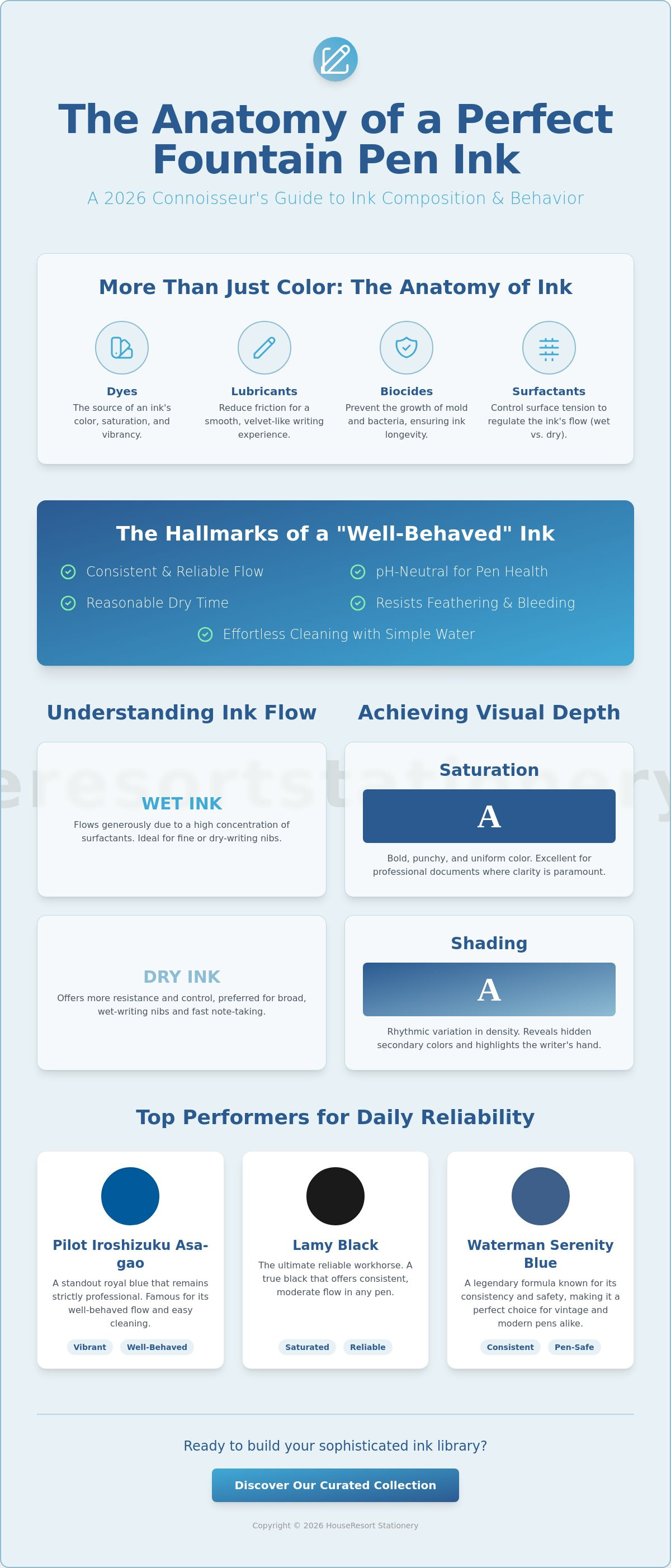
Selecting the right fluid for a high-end pen is an exercise in chemistry as much as aesthetics. Fountain pen ink is a precise chemical solution. It's far more than just pigment in water. A standard Fountain pen ink composition involves a delicate balance of dyes, lubricants, biocides, and surfactants. These components work together to ensure the fluid moves from the reservoir to the nib tip without interruption. When we discuss the best fountain pen inks, we're really talking about "well-behaved" formulas. A well-behaved ink balances consistent flow, reasonable dry times, and effortless cleaning. It doesn't feather on mid-grade paper or leave permanent residues in your favorite converter.
Long-term pen health depends heavily on pH-neutrality. While some vintage-style inks are slightly acidic or alkaline, modern connoisseurs prioritize neutral formulations. This prevents the gradual corrosion of internal metal components and protects delicate rubber seals. Choosing the right ink is a commitment to the longevity of your writing tools. A truly curated collection avoids "cloggers" and focuses on formulas that rinse clean with simple water, ensuring your pens remain in peak condition for decades.
The Mechanics of Flow and Lubrication
Surfactants are the chemical agents that regulate an ink's surface tension. They control the speed of delivery to the nib. If an ink feels "wet," it likely has a high concentration of surfactants, allowing it to flow generously even through a fine nib. Conversely, "dry" inks offer more resistance and are often preferred for pens with very wide feeds. Heritage brands often focus on high lubrication. This reduces friction between the gold nib and the paper, providing a plush, velvet-like writing experience that protects the tipping material over thousands of pages. This technical precision ensures that the best fountain pen inks feel consistent whether you're using an extra-fine Japanese nib or a broad European stub.
Saturation, Shading, and Visual Depth
Modern ink formulations often force a choice between saturation and shading. High-saturation inks provide bold, punchy colors that pop off the page. These are excellent for professional documents where clarity is paramount. However, the current 2026 trend favors chromatography-rich inks. These sophisticated formulas reveal hidden secondary colors as the dyes separate during the drying process. Shading is the natural variation of ink density on the page. It creates a rhythmic visual depth, where the start and end of a stroke appear darker than the middle. This characteristic remains one of the most sought-after traits for those building a curated ink library, as it highlights the unique personality of the writer's hand.
The Essential Daily Drivers: Best Inks for Professional and Personal Use
The foundation of any serious collection rests on its "workhorse" inks. These are the fluids you reach for when the paper quality is unknown or the document is critical. The resurgence in popularity of fountain pens in professional settings has cemented the blue-black category as the ultimate versatile choice. It offers the formality of black with the character of blue. Brands like Waterman and Lamy have maintained legendary status for their consistency. They provide a predictable flow that works in almost any pen without the risk of staining or clogging.
For many, Pilot Iroshizuku bottled ink remains the gold standard for daily reliability. Its sophisticated formulation ensures that even the most saturated colors behave perfectly on the page. As an authorized retailer of fine fountain pens and curated stationery, we often recommend starting with these established manufacturers to build a dependable baseline for your writing experience. These are the best fountain pen inks for those who need their tools to work every time, regardless of the environment.
Best Blue and Black Inks for the Office
Pilot Iroshizuku Asa-gao is a standout for those who want a vibrant royal blue that remains strictly professional. It's bright enough to be distinct but deep enough for legal signatures. For a pure black, Lamy Black is a reliable choice. It offers a consistent flow in both modern steel nibs and sensitive vintage gold nibs. If you need permanence, Sailor Sei-boku is a pigment-based blue-black. It's waterproof and archival, making it ideal for permanent records while maintaining a beautiful, multi-tonal appearance.
Reliable Inks for Students and High-Volume Writers
High-volume writing requires an ink with an excellent value-to-performance ratio. Waterman Serenity Blue is often the first choice here. It's affordable, safe for all pens, and rinses out with ease. TWSBI bottled inks are also favored for their generous 70ml capacity and specialized bottles designed for mess-free filling. Many writers still prefer "washable" blues for daily journaling. These inks are forgiving on low-quality paper and easy to clean from clothes or desk surfaces, ensuring the writing process remains an enjoyable escape.
Exploring the Spectrum: Best Inks for Shading, Sheen, and Shimmer
Moving beyond the utility of daily drivers allows a collector to experience the true artistry of fluid dynamics. Two of the most celebrated properties in this category are sheen and shimmer. Sheen is a metallic-looking surface crystallization of highly saturated dyes. It appears as a secondary color that sits on top of the primary ink once it dries. Shimmer, however, relies on the addition of fine particulate matter, often mica, to provide a literal sparkle to the writing. The best fountain pen inks for creative expression often combine these traits to create a multi-dimensional effect on the page. This pursuit of visual complexity is a hallmark of the modern fountain pen community, where enthusiasts hunt for the perfect balance of color and light.
Shading is perhaps the most sophisticated property. It allows for natural variation in ink density, where a single stroke might transition from a pale lavender to a deep violet. Many 2026 formulations focus on chromatographic shading, where the dyes actually separate into different colors as they interact with the paper fibers. While these boutique inks are visually stunning, they require a more mindful approach to pen care. High-saturation formulas can be more prone to drying in the nib, making regular maintenance a necessity for any connoisseur.
The Magic of Sheen and Shimmer
Pilot Iroshizuku Yama-budo remains an industry benchmark for its iconic gold sheen on a rich purple base. In the current market, we're seeing a rise in complex shading inks that reveal three or four distinct tones in a single word. To fully realize these properties, your choice of nib is critical. We recommend using Medium, Broad, or Stub nibs. Finer nibs often don't lay down enough ink to allow the sheen to crystallize or the shimmer particles to distribute evenly. This tactile synergy between the pen and the fluid is what makes the best fountain pen inks so rewarding to use.
Maintenance for Specialty Inks
Specialty inks demand a more rigorous cleaning schedule. Particulates from shimmer inks can settle in the fine channels of a pen's feed over time. We suggest a thorough fountain pen cleaning every two weeks if you're using high-saturation or shimmer products. When storing your pens, keep them horizontal to prevent particles from pooling in the nib or the back of the converter. Using demonstrator pens, which feature transparent bodies, is a practical way to monitor ink levels and ensure shimmer particles are properly suspended before you begin writing.
The Technical Side of Fluidity: Ink and Paper Synergy
Even the best fountain pen inks can fail if the paper choice is poor. The relationship between fluid and fiber is a technical synergy that determines the final look of your writing. Inks with high surfactant levels, designed for a "wet" feel, will often feather on standard office paper as the liquid follows the path of least resistance through loosely packed fibers. This results in fuzzy lines and distracting bleed-through, where the ink saturates the sheet entirely. To avoid this, connoisseurs turn to Japanese stationery. These papers are the global benchmark for ink testing because they feature specific surface sizing. This coating regulates how quickly the paper absorbs the dye, allowing colors to remain crisp and vibrant on the surface.
Pairing Ink with Midori MD and Traveler’s Notebooks
The Midori MD notebook journal is a favorite for its ability to handle heavy ink loads without compromising the reverse side of the page. Unlike the glass-smooth finish of some coated papers, Midori MD offers a slight "toothy" texture. This provides tactile feedback to the writer, making it an excellent match for inks with high lubrication. Traveler’s Notebook refills use a similar high-quality stock, making them ideal for testing new ink swatches while traveling. The paper's resistance to bleed-through ensures that even the most saturated boutique inks maintain sharp edges and vibrant colors.
Managing Dry Times and Smudging
Surface sizing has one drawback: longer dry times. High-sheen inks stay "wet" on the surface for several minutes on coated paper, which can lead to smudging. If you're a left-handed writer or taking fast-paced notes, you should prioritize "dry" inks that set quickly. For those using high-performance 2026 inks that remain tacky, blotting paper is an essential tool. It absorbs excess fluid without stripping away the sheen or shading you've worked to achieve. Choosing the best fountain pen inks for your lifestyle means considering how much time you can give the page to dry before closing your journal. We recommend experimenting with different nib and paper combinations to find the specific drying rhythm that suits your personal writing speed.
Ready to see your ink collection perform at its peak? Browse our curated selection of journals and notebooks to find the ideal match for your favorite pens.
Curating Your 2026 Ink Library: Heritage Brands and Modern Classics
A sophisticated ink library requires a foundation built on engineering rigor and historical prestige. While boutique labels offer experimental colors, heritage manufacturers like Pilot, Sailor, and Lamy provide the mechanical reliability essential for high-value pens. These makers invest decades into refining their formulas, ensuring that the best fountain pen inks do more than just look beautiful. They protect your nibs. Sailor’s "Manyo" and "Shikiori" lines have redefined modern aesthetics by introducing complex, multi-tonal hues that mimic the subtle shifts of the natural world. These collections have moved the industry away from flat, one-dimensional colors toward a more expressive, painterly approach to writing.
Choosing bottled ink is also a statement of sustainability. In the 2026 market, the shift away from single-use plastic cartridges toward glass bottling is a priority for the eco-conscious writer. Glass is infinitely recyclable and preserves the chemical integrity of the fluid better than plastic. Beyond the environmental benefits, ink remains one of the most accessible ways to indulge in craftsmanship. It's an affordable luxury. A single bottle can last for years, transforming every grocery list or journal entry into a deliberate act of creation.
The Prestige of Pilot Iroshizuku and Sailor
Pilot Iroshizuku remains a benchmark for its nature-themed palette. Each shade, from the deep teal of Ku-jaku to the vibrant sunset of Yu-yake, is inspired by the Japanese landscape. This thematic consistency creates a sense of place and season in your writing. Sailor inks are equally prized for their chemical consistency. Their specific formulations are famously safe for vintage pens, providing a smooth flow that won't degrade older sac-based filling systems. For those beginning their journey, we suggest a "starter trio" of heritage essentials:
- Pilot Iroshizuku Kon-peki: A vibrant, reliable cerulean blue that behaves perfectly on most papers.
- Sailor Manyo Haha: A legendary dual-shading ink that reveals hints of blue and purple.
- Lamy Obsidian: A deep, lubricated black with subtle green undertones for professional use.
Building a Sustainable Analog Practice
To reduce stationery waste, we encourage the use of converters and piston-filling systems. These tools allow you to draw directly from the bottle, eliminating the need for disposable cartridges. When stored in cool, dark environments, a bottle of high-quality ink can remain stable for a decade or more. This longevity makes it a sustainable investment for your personal archive. We invite you to Explore our curated collection of fine fountain pen inks and find the next classic for your collection. Building a library of the best fountain pen inks is a journey of discovery that rewards you with every stroke of the pen.
Elevate Your Writing with a Curated Palette
You've explored the technical mechanics of fluid flow, the visual magic of sheen, and the vital importance of paper synergy. Building a collection is about more than just color. It's about finding the specific tools that respect your pens and inspire your hand. Whether you're selecting a reliable daily blue-black or a dual-shading boutique ink, the right choice transforms every page into a deliberate work of art. Understanding how surfactants interact with the fibers of your journal ensures that your writing remains crisp and your pens stay healthy for decades.
Finding the best fountain pen inks for your specific style requires a trusted partner with deep industry knowledge. As an authorized retailer for Pilot, Sailor, and Lamy, we offer the expert-tested pairings and premium Japanese paper needed to bring your writing to life. We've done the hard work of filtering the market to present only the most reliable and vibrant options. Explore Curated Heritage Inks at HouseResort Stationery to discover your next favorite bottle today. We're here to help you curate a library that reflects your passion for quality materials and timeless craftsmanship. Your next great letter is just one fill away.
Frequently Asked Questions
What is the best fountain pen ink for beginners?
Pilot Iroshizuku and Lamy are the premier choices for those starting their analog journey. These heritage formulas are exceptionally well-behaved and safe for every pen type. They rinse clean with simple water and perform consistently on various paper qualities. Starting with a reliable workhorse helps you understand how a quality fluid should behave before you move on to more temperamental specialty boutique options.
Can I use calligraphy ink in my fountain pen?
You should never use calligraphy or India ink in a fountain pen. These fluids contain binders like shellac or gum arabic that will permanently clog the fine channels of a fountain pen's feed. Calligraphy inks are designed strictly for dip pens. Always ensure your bottle is explicitly labeled as fountain pen ink to protect your fine writing instruments from irreversible internal damage.
How long does fountain pen ink last in a bottle?
A bottle of ink can last for several decades if you store it in a cool, dark environment away from direct sunlight. UV rays can degrade the dyes and cause colors to shift or fade over time. Always keep the cap tightly sealed to prevent evaporation. If you notice any strange odors or sediment that doesn't dissolve when shaken, it's best to discard the bottle to avoid contaminating your pens.
What is the difference between dye-based and pigment-based ink?
Dye-based inks use fully dissolved colorants that are easy to clean and offer a wide range of shading. Pigment-based inks contain tiny solid particles that sit on the surface of the paper, providing permanent and waterproof results. While pigment inks are excellent for archival work, they require more frequent cleaning to prevent those particles from settling and obstructing the pen's flow. Finding the best fountain pen inks for your needs often depends on this balance between convenience and permanence.
Why is my fountain pen ink feathering on the paper?
Feathering occurs when the paper fibers are too absorbent, causing the fluid to spread out in a spiderweb pattern. This is a common issue with standard office paper or porous recycled stocks. To achieve the sharpest lines with the best fountain pen inks, you should switch to specialized Japanese stationery. These papers feature surface sizing that prevents the fluid from soaking in too quickly, preserving the crispness of your strokes.
Is Pilot Iroshizuku ink waterproof?
Most Pilot Iroshizuku colors are not waterproof. They are dye-based inks designed for vibrant color depth and easy cleaning rather than permanent archival use. While some darker shades like Take-sumi might leave a legible mark if they get wet, they will still smudge significantly. If you require true waterproof performance for legal signatures or watercolor sketching, you should look for dedicated pigment or iron-gall formulas.
How often should I clean my pen when using sheening inks?
You should clean your pen every one to two weeks when using high-sheen or highly saturated inks. These formulas have a higher dye concentration, which can lead to faster evaporation and nib buildup if the pen sits unused. A quick flush with room-temperature water is usually sufficient to maintain performance. Regular maintenance ensures that your curated collection continues to flow smoothly without drying out in the feed.
Can I mix different brands of fountain pen ink?
Mixing different brands is generally discouraged because varying chemical compositions can react poorly. Combining inks with significantly different pH levels can result in a precipitate or sludge that will clog your pen's internal components. If you want to experiment with custom colors, it's safest to mix inks from the same brand and product line. Always perform your mix in a separate vial and let it sit for 24 hours to check for any adverse reactions.