
The Best Journals for Fountain Pen Ink: A Connoisseur’s Guide for 2026
A fountain pen is only half of the writing equation; the other half is the paper that either elevates your ink or destroys it. You've likely felt the frustration of watching a vibrant, shimmering ink feather into a fuzzy mess or bleed through to the back of the page. It's disappointing when a premium ink looks flat and dull on standard paper instead of showing the complex sheen you expected. Finding the best journals for fountain pen ink is a technical necessity for any serious collector who values crisp lines and deep color saturation.
This guide promises to help you discover the perfect paper to showcase your ink’s sheen, shimmer, and shading with a curated selection of premium journals. We'll look at the 2026 offerings from heritage manufacturers like Tomoe River and Rhodia to see how they handle high-flow nibs and specialty inks. You'll learn which surfaces prevent ghosting and which specific coatings provide the best feedback for your writing style. We've filtered the market to present only the most reliable, high-quality options for your collection, ensuring your analog tools perform exactly as intended.
Key Takeaways
- Master the technical trifecta of paper performance by identifying how surface sizing and fiber density prevent feathering, bleed-through, and ghosting.
- Identify the best journals for fountain pen ink from our 2026 curated selection, featuring updated heritage favorites like Tomoe River Sanzen and Midori MD.
- Unlock the full aesthetic potential of your ink collection by selecting hard-sized papers that emphasize high sheen and visible shading.
- Move beyond GSM as a quality metric to prioritize paper coating and texture for a writing experience tailored to your specific nib size.
- Learn to curate a complete analog workspace by pairing premium journals with the essential accessories that define the fountain pen lifestyle.
What Makes a Journal Truly Fountain Pen Friendly?
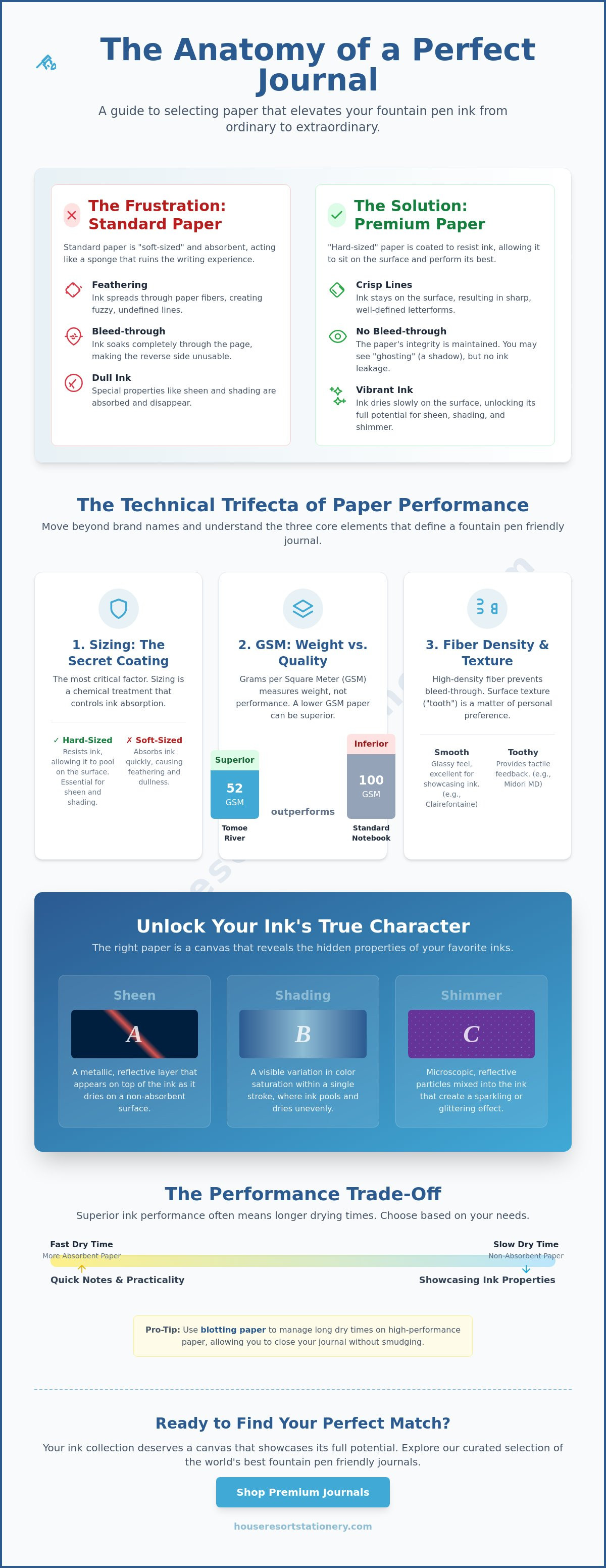
Paper is more than a passive surface. It's a technical component that dictates whether your ink pools into a vibrant masterpiece or dissolves into a blurry mess. When you search for the best journals for fountain pen ink, you're essentially looking for a specific chemical relationship between the paper fibers and the liquid. Standard 80gsm copy paper usually fails this test because it's "soft-sized." The fibers are loose and thirsty; they act like a sponge that pulls ink deep into the page, destroying the sharp edges of your letters.
The secret to high-performance stationery lies in "sizing." This is a coating applied during the manufacturing process to control the paper's absorbency. Hard-sized papers, common in premium journals, allow the ink to sit on top of the fibers rather than soaking in immediately. This surface-level pooling is exactly what creates the visual depth enthusiasts crave. Without proper sizing, even the most expensive ink will look flat and uninspired.
The Enemy of Fine Writing: Feathering and Bleed-through
The most common frustration for writers is feathering. This occurs through capillary action, where the paper fibers "suck" the ink away from the nib in uneven directions. This results in fuzzy, spider-web lines. Understanding what makes a surface fountain pen friendly involves recognizing the difference between ghosting and bleed-through. Ghosting, or "show-through," is simply the shadow of your writing visible on the reverse side. It's common in thin, high-quality papers like Tomoe River. Bleed-through is a failure of the paper where ink actually penetrates to the other side. Don't be fooled by weight alone. A thick, high-GSM paper can still feather if it lacks the correct coating, while a thin, well-sized sheet can handle the wettest nibs with ease.
Dry Time vs. Ink Performance
Superior ink performance often requires a trade-off in dry time. Non-absorbent papers, such as those from Clairefontaine, keep the ink on the surface longer. This allows the dyes and pigments to dry slowly, which is the only way to achieve high sheen and complex shading. If the paper absorbs the ink too quickly, these properties never have a chance to develop. To manage this, many collectors integrate the use of blotting paper into their routine. It's a simple tool that allows you to close your journal quickly without smudging your work. Your writing speed and nib wetness should dictate your choice; a fast-drying paper is practical for quick notes, but a slow-drying surface is mandatory for showcasing the true character of your ink.
The Science of Paper: GSM, Coating, and Fiber
Many enthusiasts mistakenly equate GSM with quality. Grams per Square Meter (GSM) measures weight, but in the world of the best journals for fountain pen ink, weight is a secondary metric. For example, the legendary Tomoe River paper is a mere 52gsm, yet it consistently outperforms 100gsm "premium" notebooks that lack proper treatment. High-density fiber compaction and specialized chemical treatments are what truly define a high-performance sheet. You don't need a thick, heavy page to prevent bleed-through; you need a page with superior structural integrity—a standard also prioritized by commercial experts like Linemark for professional-grade printing.
Sizing is the chemical secret behind this performance. "Hard-sized" paper uses additives like starch or alkyl ketene dimer (AKD) to resist liquid penetration. "Soft-sized" paper, such as standard bond or newsprint, is designed to absorb ink quickly. This is the exact opposite of what a fountain pen needs. If you want to see the true depth of your ink, you need a surface that resists the liquid just enough to let it pool. This pooling is what allows the complex dyes to settle and reveal their character. You can explore our curated selection of heritage notebooks to find the perfect surface for your favorite nib.
The color of your canvas also plays a vital role in your final results. Bright white paper offers the highest color accuracy, allowing vibrant purples and cerulean blues to pop exactly as the manufacturer intended. Cream or ivory paper provides a warmer, more vintage aesthetic, but it can shift the perceived hue of your ink. A classic blue-black ink may appear slightly greener on cream paper. Regardless of your color preference, always ensure your journal is acid-free. Archival standards are vital if you want your entries to remain legible and the paper to stay supple decades from now.
Surface Texture: Tooth vs. Smoothness
Texture is a matter of personal preference and nib choice. Toothy paper, like the iconic Midori MD, offers a tactile, pencil-like feedback that many writers find grounding. It's ideal for larger nibs, such as Medium or Broad, where you want more control over the stroke. Conversely, the glass-like smoothness of Rhodia allows the nib to glide effortlessly across the page. This is often preferred by those using Extra Fine or Fine nibs to prevent the delicate tip from catching on loose fibers.
The Manufacturing Secret: Sizing and Coatings
Sizing happens in two distinct stages: internal and external. Internal sizing is mixed directly into the paper pulp to stabilize the fibers, while external sizing is applied to the finished surface. This creates a microscopic barrier that prevents the ink from "creeping" into the page. Some manufacturers use extreme fiber compaction rather than heavy coatings. This prevents the "repelling" effect where ink beads up or skips on the surface. Finding this balance ensures a frictionless writing session without sacrificing the visual brilliance of your ink.
The Best Journals for Fountain Pens in 2026: Our Curated Top Picks
Selecting a journal is a deeply personal act of curation. While the market is flooded with mass-produced options, the best journals for fountain pen ink are those that respect the heritage of the craft. For 2026, the landscape has shifted toward refined paper formulations that balance classic performance with modern production standards. We've filtered the market to present five essential options that cater to different writing styles and ink types.
- Tomoe River Sanzen (52gsm): The successor to the legendary original, this paper remains the gold standard for showcasing sheen and shimmer. It's exceptionally thin yet remarkably resistant to bleed-through.
- Midori MD: A minimalist masterpiece. This journal is for those who prefer a "toothy" feel and a cream-colored canvas that makes every word feel significant.
- Traveler’s Notebook: The definitive modular system. Its versatility allows you to swap inserts based on your current project or ink preference.
- Clairefontaine Triomphe: Known for its ultra-smooth, 90gsm bright white surface. It's the professional choice for correspondence where color accuracy is paramount.
- Leuchtturm1917 (120g Edition): A substantial upgrade from the classic 80g version. This heavier paper is specifically engineered to handle wet fountain pen nibs without the ghosting typical of thinner sheets.
Japanese Heritage: Midori and Tomoe River
Japanese manufacturers continue to lead the industry because they treat paper as a technical instrument. This dedication to quality is why Japanese stationery dominates the collections of serious enthusiasts. The Midori MD is a standout for its unique texture; it provides a slight resistance that helps stabilize your hand during long writing sessions. Meanwhile, the 2026 Sanzen Tomoe River iteration has been refined to offer slightly faster dry times while maintaining the incredible ink-pooling properties that make complex colors look three-dimensional. It handles high-sheen inks with a clarity that few Western papers can replicate.
Modular Versatility: The Traveler’s Notebook
Modularity is the ultimate luxury for the explorer. By using various Traveler’s Notebook refills, you can test different paper types within a single leather cover. The #013 Lightweight Paper refill is particularly notable for high-volume writers. It uses a thin, Tomoe-style paper that allows for a high page count without adding bulk to your kit. This system allows you to customize your setup, perhaps dedicating one insert to daily planning and another to creative ink swatching. It's a frictionless way to carry multiple paper environments in one compact, durable package.
Matching Your Paper to Your Ink: Sheen, Shading, and Shimmer
A common misconception in the community is that "fountain pen friendly" is a simple binary choice. In reality, the best journals for fountain pen ink act as specialized filters that either amplify or suppress specific ink characteristics. You might own a bottle of ink that looks like a standard blue on office paper but transforms into a vibrant, metallic masterpiece on the right surface. Selecting the best journals for fountain pen ink requires an understanding of the synergy between your ink's chemical composition and your paper's coating.
- Sheen: A metallic luster that appears on the edges of letters when ink dries on the surface rather than soaking in.
- Shading: A gradient effect where the color varies from light to dark within a single stroke, usually caused by ink pooling at the end of a letter.
- Shimmer: Tiny suspended particles, often mica, that add a glittery effect to the writing.
Matching these properties requires a technical eye. If you're using a high-sheen ink, a highly absorbent paper will "kill" the effect by pulling the dyes into the fibers before they can crystallize. To truly appreciate the hidden potential of your collection, you should shop our curated journals and pair them intentionally with your ink's unique traits. Each paper type we select is chosen for its ability to interact with these specific fluid properties.
Showcasing Sheen and Shimmer
Sheen is a surface phenomenon. It requires the ink to pool and dry slowly on top of the paper's sizing. This is why non-absorbent surfaces are mandatory. Many Pilot Iroshizuku inks, known for their sophisticated hues, reveal hidden depths when paired with papers like Tomoe River or Cosmo Air Light. Shimmering inks present a different challenge. While they also benefit from non-absorbent surfaces, very textured or "toothy" papers can sometimes catch the glitter particles unevenly. A smooth, hard-sized surface ensures the shimmer is distributed consistently across your script without clogging the paper's texture or losing the glitter in the fiber grain.
The Art of Shading
Shading is often considered the most elegant ink property. It creates a three-dimensional quality in your writing that digital text can't replicate. Midori MD is the premier choice for shading enthusiasts because its surface allows for a controlled pooling of ink. When the nib lifts at the end of a stroke, a small "bead" of ink remains. On Midori's unique surface, this bead dries into a darker concentration of color. This interaction depends heavily on nib wetness. A dry-writing pen might not provide enough ink for the effect to manifest; conversely, an overly wet nib might flood the page and obscure the gradient. Balancing these variables is what separates a casual writer from a true connoisseur.
Curating Your Perfect Writing Desk with HouseResort Stationery
The philosophy at HouseResort is centered on the tactile joy of analog tools. We view your writing desk as a sanctuary; it's a place where the digital world recedes and craftsmanship takes center stage. Choosing the best journals for fountain pen ink isn't just about technical specs. It's about the emotional connection to your tools. We prioritize heritage manufacturers because their history is written in the quality of their fibers. Our curation process is meticulous, ensuring that every item we offer contributes to a refined and efficient writing experience.
Building a collection requires a technical eye and a passion for material. We've done the hard work of filtering the market to present only the best options. This allows you to focus on the act of creation rather than worrying about paper failure. Whether you're a long-time collector or a newcomer to the hobby, your choice of paper defines the limits of your ink's performance. Our goal is to provide the canvas that allows your pens to reach their full potential.
The Boutique Experience
We're an authorized retailer for the world's most respected stationery brands. This ensures that every notebook in our catalog is authentic and performs to the highest standards. We shop by creator and material, recognizing that a connoisseur's loyalty often lies with the legacy of the maker. This manufacturer-first approach simplifies your search for the best journals for fountain pen ink, allowing you to jump directly to the brands you trust. We're committed to the modern connoisseur, providing curated recommendations that move beyond simple transactions to a shared passion for quality.
Our community-oriented approach means we don't just sell products; we offer expertise. With the fountain pen market projected to grow at a CAGR of 4.581% through 2033, the sheer volume of new products can be overwhelming. We act as your trusted filter, testing the 2026 iterations of heritage papers to ensure they meet our rigorous standards for sheen, shading, and bleed resistance. You're not just buying a notebook; you're joining a community that values the enduring nature of the written word.
Essential Companions
A perfect desk requires more than just a journal. You might pair your writing with sketching or marginalia using the Blackwing 602 pencils, known for their iconic firm graphite and historical prestige. Protective covers are also vital for keeping your premium journals safe for a lifetime. These accessories complement your primary tools, creating a cohesive and functional environment that feels as high-quality as your pen. We invite you to explore our curated collection of journals and notebooks today to begin building your 2026 analog sanctuary.
Your Analog Legacy Begins with the Right Paper
Mastering the technical relationship between your nib and the page is what transforms a simple note into a work of art. You've seen how specific sizing and fiber density dictate the vibrancy of your ink's sheen and the depth of its shading. Finding the best journals for fountain pen ink is a journey that rewards the meticulous collector with a frictionless, bleed-free writing experience. By understanding the science of coatings and texture, you ensure that every drop of premium ink performs exactly as the maker intended.
At HouseResort, we act as your boutique curator, offering expert-tested paper that's been vetted by stationery enthusiasts for enthusiasts. We're an authorized retailer for heritage brands like Midori and Traveler’s Company, ensuring you receive authentic products that respect the craft. It's time to elevate your desk with materials that match the quality of your finest pens. Shop our curated collection of fountain pen friendly journals today and rediscover the tactile joy of a perfectly placed stroke. Your next entry deserves a canvas that lasts a lifetime.
Frequently Asked Questions
Is higher GSM paper always better for fountain pens?
No, higher GSM is not a guarantee of fountain pen compatibility. Grams per Square Meter (GSM) only measures the weight and thickness of the sheet; it doesn't account for surface treatment. A 52gsm Tomoe River sheet often outperforms 100gsm standard paper because its fibers are more densely compacted and treated with sizing to prevent ink penetration.
What is the best journal for someone who hates ink ghosting?
The Leuchtturm1917 120g Edition is the premier choice for minimizing ghosting. While thinner heritage papers are legendary for ink performance, they're prone to "show-through" due to their low opacity. The increased density of the 120g Leuchtturm sheet provides a clean, opaque canvas that keeps your previous entries invisible on the reverse side.
Can I use a fountain pen in a standard Moleskine notebook?
Standard Moleskine notebooks are generally not recommended for fountain pen use. The paper is typically too porous; it leads to significant feathering and bleed-through with most liquid inks. For a similar aesthetic with vastly superior performance, collectors often switch to a Rhodia Webnotebook or a Midori MD journal.
Why does my fountain pen ink look different on different papers?
Paper absorbency dictates how ink dyes settle on the page. On the best journals for fountain pen ink, the liquid pools on the surface to reveal complex sheen and shading properties. On cheaper, absorbent paper, the ink is sucked into the fibers immediately, which mutes the color and prevents these professional characteristics from developing.
What is the difference between original Tomoe River and Sanzen Tomoe River?
Sanzen Tomoe River is the 2026 production standard following the decommissioning of the original machinery. While it retains the iconic 52gsm weight, Sanzen has a slightly different tactile feedback and dry time. It remains a top-tier choice for sheen, though some connoisseurs notice a subtle shift in the surface texture and how it handles wet nibs.
Do I need special paper for shimmer or glitter inks?
Shimmer inks require smooth, hard-sized paper to perform correctly. If the paper is too textured or absorbent, the glitter particles can get trapped in the fibers or clump unevenly. A smooth surface like Clairefontaine Triomphe ensures the shimmer particles are distributed consistently across your writing, allowing the metallic effect to remain visible.
How do I prevent my fountain pen ink from smearing in my journal?
Integrating blotting paper into your routine is the most effective way to prevent smearing. Premium papers take longer to dry because the ink sits on the surface to maximize color depth. Placing a specialized blotting sheet between the pages allows you to close your journal immediately while protecting your work from accidental smudges.
Which journal is best for a "wet" writing fountain pen?
Clairefontaine 90gsm paper is ideal for wet-writing pens with broad or stub nibs. Its exceptionally smooth, hard-sized surface provides a robust barrier against ink penetration. This prevents the "bleeding" effect that often occurs when a high-flow nib meets a less substantial paper type, ensuring your lines remain crisp and defined.