
The Connoisseur’s Guide to Blotting Paper Sheets for Fine Writing and Preservation
You finish a deliberate, ink-heavy entry in your favorite notebook, only to realize that closing the cover will result in a disastrous mirror-image smudge. It's the primary frustration for anyone using high-sheen inks on premium, non-absorbent paper. High-absorbency blotting paper sheets provide the essential bridge between a wet fountain pen line and a pristine, finished page. You shouldn't have to choose between the aesthetic of a rich ink flow and the long-term integrity of your journal entries.
We understand that your writing process is an intentional, tactile experience. This guide will help you eliminate ink transfers and protect your most cherished records by exploring the specialized world of professional-grade stationery tools. You'll gain a technical understanding of archival standards, such as ISO 11108:2025, and learn how to distinguish these materials from common skincare alternatives. We will break down the specifications of heritage makers like J. Herbin and Esterbrook to help you find the reliable, high-performance tools your collection deserves.
Key Takeaways
- Understand how high-cellulose, unsized paper uses capillary action to lift excess ink. It's the most effective way to protect your handwriting from smudges.
- Identify the specific weights and formats of blotting paper sheets that suit your setup. Options range from portable journal interleaving to heavy-duty rocker refills.
- Avoid common mistakes like using lint-heavy paper towels or ineffective copy paper. These materials can damage delicate fountain pen nibs and cause feathering.
- Master the "Press and Lift" technique to prevent lateral smearing. This ensures a clean finish every time you close your notebook or planner.
- Learn to source heritage-quality materials that meet modern archival standards. These tools ensure the long-term preservation of your most important records and journal entries.
What are Blotting Paper Sheets in the Context of Fine Writing?
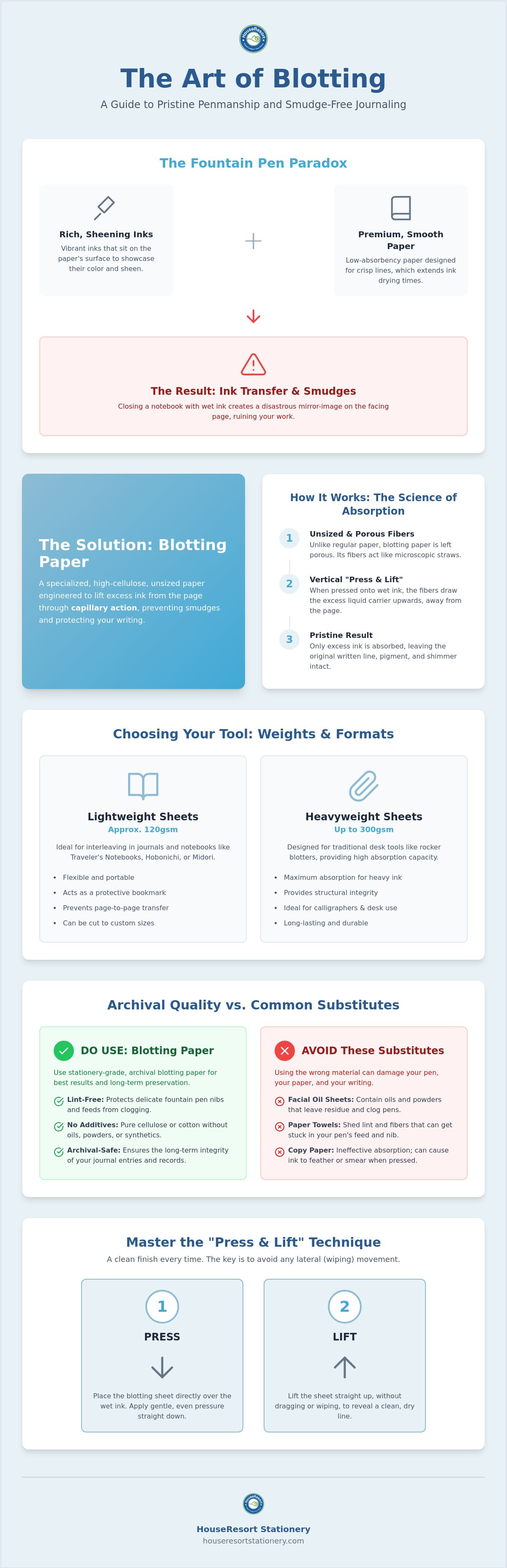
Stationery enthusiasts often view the ritual of writing as a deliberate act. To ensure this act remains pristine, one must understand the role of specialized tools. Technically, Blotting paper is a high-cellulose, unsized material engineered to pull excess moisture away from a surface through capillary action. Unlike standard writing paper, which includes chemical sizing to control ink absorption, these sheets are left porous. This allows the fibers to act as a series of microscopic straws that drink up surplus ink without disturbing the written line.
Historically, the blotter was an inseparable companion to the desk-bound fountain pen. Before the advent of quick-drying ballpoint inks, a rocker blotter or a loose sheet was essential for any professional or personal correspondence. Today, this tradition continues among collectors who appreciate the tactile nature of analog tools. It feels like a quiet nod to a time when quality was measured by the care taken in every stroke of the nib.
It's a common paradox that premium papers, such as Midori MD, actually require blotting paper sheets more than their cheaper counterparts. High-quality stationery is often designed with a smooth, low-absorbency surface to prevent feathering or bleeding. While this creates beautiful, crisp lines and showcases the sheen of inks like Pilot Iroshizuku, it also extends dry times significantly. Without a blotter, closing your journal becomes a gamble with your hard work. The ink sits on the surface, waiting to transfer to the opposite page.
Understanding the difference between blotting and wiping is vital for preservation. Wiping involves lateral movement, which drags wet ink across the page and creates a smear. Blotting relies on vertical pressure to lift only the excess liquid that hasn't yet bonded with the paper. This technique preserves the integrity of your handwriting while drastically reducing the risk of transfer.
The Science of Capillary Action
The secret lies in the absence of sizing agents. Most paper is treated to resist liquid, but blotting sheets use pure wood pulp or cotton linters to maximize surface area. This is critical for high-sheen and shimmer inks, which sit on top of the paper rather than soaking in. By pressing a sheet down, you allow the fibers to absorb the liquid carrier while leaving the pigment and shimmer particles undisturbed on the page.
Blotting Paper vs. Facial Oil Sheets
You might be tempted to reach for skincare blotting paper sheets in a pinch, but this is a mistake that can ruin a fine writing instrument. Facial sheets are frequently treated with synthetic coatings, mineral oils, or powders designed to interact with skin, not ink. These additives can clog a fountain pen nib or leave a greasy residue on your archival paper. Stationery blotting paper is a lint-free, archival tool for ink management. It offers the rigidity needed for a clean press and lift motion without shedding fibers into your pen’s feed.
Essential Weights and Formats: Choosing the Right Sheets
Selecting the correct blotting paper sheets depends entirely on your specific writing environment. A calligrapher at a dedicated desk requires different physical specifications than a traveler documenting their journey in a crowded cafe. The weight and format of the paper dictate its total absorption capacity and its overall portability. Most stationery enthusiasts categorize these tools by their density, measured in grams per square meter (gsm).
Standard weights for fine writing range from approximately 120gsm for thin interleaving sheets to 300gsm for heavy-duty rocker refills. While a lighter sheet is flexible enough to tuck into a notebook, a heavier sheet provides the structural integrity needed for traditional desk tools. Choosing the wrong weight can lead to a cluttered journal or an ineffective blotter that fails to drink up heavy ink pools.
Interleaving Sheets for Journals
Interleaving is the essential secret to keeping a Traveler's Notebook free from ink transfer. Because premium Japanese paper is often engineered for smoothness, ink dry times are longer. Keeping a slim sheet of blotting paper between your pages acts as both a protective shield and a functional bookmark. For enthusiasts who frequent our Japanese stationery online store for favorites like Hobonichi or Midori, custom sizing is often necessary. You can easily cut standard A5 sheets to fit B6 or Slim formats. This simple step prevents the frustrating "mirror-image" ink transfer that occurs when closing a wet journal.
Rocker Blotter Refills
Traditional desk accessories utilize a much heavier grade of blotting paper. These refills are designed to be wrapped around a wooden or brass rocker blotter, providing a cushioned surface for ink absorption. Installing a new sheet usually involves loosening a top handle to release the tension plates. Once the paper is secured, the rocking motion allows you to dry entire paragraphs in seconds. You can determine if a sheet is saturated by observing how quickly the ink disappears into the fibers. When the surface remains wet for more than a few seconds, it's time to rotate or replace the refill. We recommend exploring our curated collection of heritage-quality refills to find the perfect match for your specific desk hardware.
Longevity is a hallmark of quality blotting paper sheets. A single sheet isn't a one-use item. Depending on the wetness of your fountain pen and the saturation of your ink, one sheet can often last for several months of daily journaling. It's an efficient, low-waste tool that respects the archival nature of your work.
Blotting Paper vs. Scrap Paper: Why Quality Matters
Reaching for a piece of scrap paper or a household paper towel is a common reflex when ink stays wet too long. It's also a mistake that can compromise both your writing instrument and your journal’s longevity. Professional blotting paper sheets are specifically engineered for the chemistry of fountain pen ink. They differ fundamentally from the wood-pulp products found in a kitchen or a printer tray.
Standard 80gsm copy paper is heavily "sized" with chemicals to prevent ink from soaking in. This sizing makes ink sit on the surface of a printer page; using it to blot just smears the wet ink across your entry. Conversely, paper towels are too absorbent in the wrong way. They lack the structural density required for a clean lift. This leads to feathering, where the ink follows the loose fibers of the towel, turning a crisp letter into a fuzzy, illegible mark. The visual difference is stark. A blotted entry remains sharp and professional, while a "wiped" or poorly blotted entry looks like a smeared afterthought.
Preservation is another critical factor. Most scrap paper isn't acid-free. Over decades, the acids in cheap paper will migrate to your journal pages, causing yellowing and brittleness. Genuine blotting sheets are pH-neutral and archival-safe. This ensures your records remain pristine for the next generation.
The Risk of Lint and Fiber Clogging
Cheap, fibrous papers pose a direct threat to your fountain pen. Loose lint can easily become lodged between the delicate tines of a gold or steel nib. This disrupts the ink flow and requires a deep cleaning to resolve. Professional-grade sheets utilize short-fiber cellulose. This material is designed to stay intact even when saturated. Heritage brands like J. Herbin and G. Lalo have become the industry standard because their sheets are lint-free. They offer a smooth, rigid surface that manages ink without shedding debris into your pen's feed.
Ink Preservation and Sheen
Blotting is an art of balance. When using a premium ink like Pilot Iroshizuku bottled ink, you want to preserve its unique character. These inks are famous for their "sheen," a metallic-like shimmer that appears as the ink dries. If you blot too aggressively, you might strip away the heavy pigment that creates this effect, leaving a matte finish. Connoisseurs use blotting paper sheets to lift only the excess liquid carrier. This allows the sheen to set properly while ensuring the page is dry enough to close. It's the difference between removing the ink and managing its drying process.
Professional Techniques for Using Blotting Paper Sheets
Mastering the application of your tools is just as vital as selecting the right materials. Even the finest blotting paper sheets can fail if used with poor technique. The primary goal is to manage moisture without disturbing the crispness of your handwriting. This requires a shift from the scrubbing motions used with household cleaning to the precise, vertical movements of a curator.
The "Press and Lift" method is the gold standard for ink management. To execute this, place your sheet directly over the wet text and apply firm, even pressure with your palm or fingertips. Avoid any lateral movement. Dragging the paper across the page, even slightly, will drag the wet ink with it and create a permanent smear. By lifting the sheet straight up, you utilize the paper’s vertical fibers to drink up the excess liquid while leaving the bonded ink undisturbed.
Beyond drying ink, these sheets serve as a protective barrier against skin oils. Many writers find that placing a sheet under their hand while writing prevents oils from transferring to the paper surface. This is a critical step for long-form journaling. Skin oils can create "dead spots" on premium paper where the fountain pen ink will skip or fail to adhere. Using your blotter as a hand-rest ensures the page remains receptive to every stroke of the nib. You can also use a spare corner to catch "burps" or drips that occasionally occur when re-capping a pen or finishing a fresh fill.
The Interleaving Method for Planners
For those who write on the move, interleaving is a non-negotiable habit. The process is simple. First, finish your journal entry. Second, place the blotting sheet directly over the fresh text. Third, close the journal immediately. This technique is especially helpful for fountain pen doodle journaling for beginners, where heavy ink layering and artistic flourishes often lead to high saturation. In a high-volume notebook, you can manage multiple sheets to act as both dryers and bookmarks for different sections.
The Desk Rocker Technique
The desk rocker offers a more traditional, rhythmic approach to drying. By wrapping a heavy-weight sheet around a curved wooden or brass blotter, you can dry signatures or short notes with a single motion. Use a steady hand to roll the rocker across the page, applying enough pressure to make contact without crushing the delicate paper fibers. A single, swift rock is more effective than repeated dabbing. This method provides a clean, uniform finish that is impossible to achieve with loose paper alone. To ensure your desk setup is fully equipped, browse our collection of heritage-grade stationery tools for your next session.
Curating Your Desk: Where to Find Premium Blotter Sheets
HouseResort Stationery prioritizes heritage manufacturers because their legacy represents a commitment to archival standards. Our collection is built for those who value the tactile nature of analog tools; we believe that every instrument on your desk should serve a purpose. In 2026, the stationery aesthetic is defined by functional beauty and clean, minimalist lines. High-absorbency blotting paper sheets fit perfectly into this world. They offer a quiet, professional solution to the common problem of ink transfer while adding a layer of historical charm to your workspace.
A well-organized desk is more than a visual preference. It's an investment in your creative focus. From brass pencil cases that patina over time to archival blotters that protect your journals, these tools create a dedicated space for thought. Pairing your sheets with the right inks and notebooks ensures a frictionless experience. If you use a Midori MD notebook with high-sheen inks, the blotter's the missing piece that prevents your hard work from smudging. It's the bridge between a wet nib and a finished record.
Choosing Sheets for Your Specific Setup
Your choice of material should reflect your lifestyle. Traveler's Notebook users often prefer slim, pre-cut blotting paper sheets that fit seamlessly inside their modular covers. Desk-bound writers, however, might opt for larger A5 or B6 formats that provide more surface area for heavy correspondence. You can identify high-quality sheets by their soft, felt-like touch and significant opacity. These physical traits indicate a high concentration of cotton or alpha-cellulose fibers, which are essential for maximum absorption. Our commitment to authentic, high-end stationery products means we only curate materials that respect the chemistry of your fountain pens.
Final Thoughts on the Analog Escape
The tactile nature of blotting paper enhances the ritual of writing. It turns a simple task into a sophisticated experience. Building a comprehensive kit that includes Blackwing 602 pencils and premium bottled inks allows you to fully engage with your thoughts. Writing is a slow art; it deserves tools that match its pace. We invite you to Explore our curated selection of fine writing accessories and discover the heritage-quality tools that will protect your legacy for years to come.
Elevate Your Writing Ritual
Integrating professional tools into your analog practice transforms the way you interact with your thoughts. By selecting the correct weight and format for your specific setup, you ensure every entry remains a crisp record of your intent. High-performance blotting paper sheets prevent the common frustrations of ink transfer and feathering, allowing you to close your journal with complete confidence. This simple addition protects the archival integrity of your work while honoring the tactile beauty of heritage-quality materials.
HouseResort Stationery serves as a dedicated curator for the fountain pen community. We provide a direct link to the world's most respected makers. As an authorized retailer of heritage brands, we offer a selection specifically curated for enthusiasts and collectors. With national shipping across the United States, we make it easy to refine your desk setup with tools that last. Shop Premium Blotting Paper and Stationery Accessories to discover the perfect companion for your favorite inks. Your next great entry deserves a pristine finish that stands the test of time.
Frequently Asked Questions
Can I reuse blotting paper sheets multiple times?
You can reuse blotting paper sheets multiple times until the cellulose fibers become saturated with dried ink. Most writers find that a single sheet lasts for several months of daily journaling before it loses its efficiency. You'll notice the paper's performance decline once the surface appears heavily mottled with dark, dried pigment, signaling it's time for a fresh replacement.
Will blotting paper remove the sheen from my fountain pen ink?
Blotting can reduce the final sheen of fountain pen ink if the process is handled too aggressively. To preserve the ink's character, use a very light "press and lift" motion to remove only the excess liquid carrier. This allows the concentrated pigments and shimmer particles to remain on the page surface, ensuring the unique properties of high-sheen inks are maintained while drying.
Is there a difference between blotting paper and watercolor paper?
The primary difference lies in the chemical sizing. Watercolor paper is treated with sizing agents to control how liquid moves across the surface. Stationery blotting paper sheets are intentionally unsized and porous. This lack of treatment allows for immediate capillary action, pulling ink deep into the fibers rather than letting it sit on top of the page.
How do I cut blotting paper to fit my Traveler's Notebook?
You can cut standard A5 sheets to fit a Traveler's Notebook using a sharp craft knife and a metal ruler. For a Standard size insert, trim your sheet to approximately 210mm by 110mm. This ensures the blotter sits flush within the notebook, providing edge-to-edge protection against ink transfer when you close the modular cover on a fresh, wet entry.
Can I use blotting paper to clean my fountain pen nib?
You should not use blotting paper to clean a fountain pen nib. While the paper is excellent for managing ink on a page, its dry, porous texture can be abrasive to delicate gold or steel tines. Small fibers may also become trapped in the nib's slit, disrupting ink flow. Use a dedicated lint-free microfiber cloth or specialized nib wipes for pen maintenance instead.
What happens if I use skincare blotting sheets on my paper?
Using skincare blotting sheets on your stationery will likely leave a residue that damages both the paper and your pen. These sheets often contain mineral oils, fragrances, or powders designed for cosmetic use. These additives can clog a fountain pen feed or create greasy "dead spots" on your journal pages where ink will skip or fail to adhere properly.
Does blotting paper expire or lose its absorbency over time?
Blotting paper doesn't expire, though its performance can be affected by environmental factors like high humidity or dust. If the sheets are stored in a damp area, the fibers may absorb atmospheric moisture, reducing their capacity to drink up wet ink. Keep your collection in a cool, dry place within a protective folder to maintain its maximum archival absorbency.
Is blotting paper necessary for ballpoint or gel pens?
Blotting paper is generally unnecessary for ballpoint or gel pens. These instruments utilize quick-drying, oil-based or high-viscosity inks that bond with the paper surface almost instantly. The specialized capillary action of blotting paper sheets is designed for the high-volume, water-based ink flow characteristic of fountain pens and traditional dip pens, where dry times are significantly longer.