
The Definitive Guide to Traveler's Notebook Refills: Curating Your Modular System for 2026
Your notebook isn't just a collection of paper; it's a modular operating system for your thoughts. Selecting the right traveler's notebook refills is a strategic act of curation that separates a simple diary from a high-performance analog tool. You've likely faced the analysis paralysis that comes with too many choices, or the frustration of seeing a premium fountain pen ink ghost through thin pages. It's difficult to maintain focus when your setup feels unnecessarily bulky or disorganized.
We believe the tactile quality of your tools should match the importance of your work. In this guide, you'll discover how to layer specific inserts to create a perfectly balanced system that handles your favorite inks with precision. We'll examine the 128-page lightweight options for high-volume writing, the 36-page Short Trip refills for focused projects, and the essential 2026 diary series. By the end, you'll have a clear roadmap to build an organized daily workflow that feels both professional and personal.
Key Takeaways
- Identify the ideal foundation by comparing the Regular and Passport architectures to match your specific narrative volume.
- Navigate the specialized numbering system to select traveler's notebook refills that prioritize ink performance and tactile feedback.
- Align your functional flow with specific ruling styles, choosing between structured lined pages and the precision of grid layouts.
- Apply the "Rule of Three" stacking technique to maintain an ergonomic profile while maximizing your notebook's modular utility.
- Explore curated refill bundles tailored for professional and creative workflows to simplify your 2026 organizational strategy.
The Architecture of a Modular System: Regular vs. Passport Sizes
The Traveler’s Company ecosystem operates on a modular philosophy. It treats the leather cover as a permanent chassis while the traveler's notebook refills act as the functional software. This design allows you to pivot between a business planner, a creative sketchbook, or a travel journal without changing your primary tool. By 2026, the global community has leaned heavily into this "one cover, many lives" approach. Unlike a standard bound notebook, this system evolves with your needs. Choosing between the two primary sizes is the first strategic decision in your analog journey.
Regular Size: The Canvas for Deep Reflection
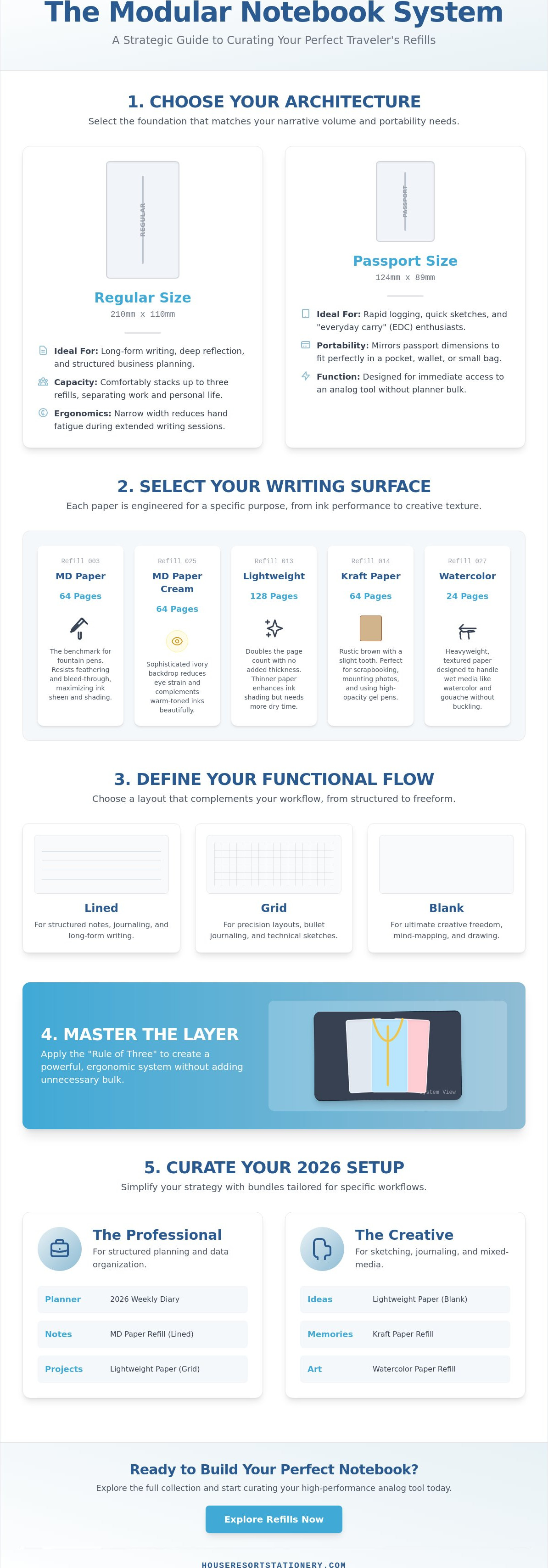
The Regular size measures 210mm by 110mm. This height is similar to an A5 page, but the narrow width is intentional. It creates a slim footprint that fits comfortably in one hand. The reduced width also prevents the hand fatigue often associated with wider journals, as your writing hand maintains a more consistent position across the narrow line. It’s the superior choice for long-form travelogues and structured business planning. You can easily stack up to three traveler's notebook refills to separate your professional life from personal reflections while maintaining a professional profile.
Passport Size: Portability Without Compromise
The Passport size measures 124mm by 89mm. It serves the minimalist who values rapid logging and portability. It mirrors the dimensions of a standard passport, making it an ideal companion for a wallet-style setup. These refills are perfect for grocery lists, quick sketches, or daily affirmations. Because it’s lightweight, it disappears into a jacket pocket or a small bag. It favors the "everyday carry" enthusiast who needs an analog tool available at a second's notice without the bulk of a full-sized planner.
Sticking to one size ecosystem for your 2026 setup ensures that your archived refills remain organized. The official binders are size-specific. If you mix formats, your storage system becomes fragmented. Consistency allows you to swap specialty inserts, like the 2026 weekly diaries, into your existing leather cover without friction. This modularity ensures your system remains high-performance and clutter-free as your collection of completed inserts grows over time.
The Alchemist’s Choice: Comparing MD Paper, Lightweight, and Kraft Inserts
The numbering system for traveler's notebook refills is more than just a cataloging tool; it represents a meticulous study of paper chemistry. Every number from 001 to 026 serves a specific functional role. This system allows you to build a custom analog hard drive tailored to your specific writing instruments. Understanding these technical designations is essential for anyone looking to optimize their daily carry for 2026. It turns a simple leather binder into a precision instrument.
Midori MD Paper remains the benchmark for the collection. This proprietary material is engineered specifically for an effortless writing experience. According to the official TRAVELER'S COMPANY history, the brand's commitment to craftsmanship stems from a deep appreciation for how ink interacts with paper fibers. MD Paper, found in standard traveler's notebook refills like the 001 or 003, is celebrated for its ability to resist feathering and bleed-through. It balances ink absorption with surface smoothness. This allows for high levels of shading and sheen that standard papers simply cannot replicate.
Fountain Pen Performance: MD vs. Lightweight
MD Paper offers the classic 64-page experience with a sturdy, reliable feel. However, high-volume writers often gravitate toward the 128-page Lightweight refill (013). This insert uses a thinner, more translucent paper that doubles the page count without increasing the physical thickness of your leather cover. While it performs admirably with most fountain pens, it does change the ink's behavior. Inks sit on the surface longer. This can enhance the vibrant shading of boutique inks but requires a bit more patience during the drying process. If you prefer a softer aesthetic, the MD Paper Cream (025) provides a sophisticated, ivory backdrop that reduces eye strain and complements warm ink tones better than stark white options.
Specialty Textures: Kraft and Watercolor
Specialized creative work demands varied paper tooth. Kraft paper (Refill 014) provides a distinct, slightly rough texture and a rustic brown aesthetic. It's the ideal choice for scrapbooking, mounting vintage ephemera, or using high-opacity white gel pens that pop against the dark background. For those who enjoy wet media, the Watercolor Paper (Refill 012 or 027) features thick, water-resistant pages designed to handle heavy washes without warping or pilling. The tactile feedback of Midori's heritage paper creates a grounding, sensory experience that digital screens can't mimic. It turns a fleeting note into a permanent artifact.
If you're ready to experiment with these specialized textures, you can explore our curated selection of journals and refills to find your perfect match.
Ruling Styles and Layouts: Finding Your Functional Flow
The choice of ruling style in your traveler's notebook refills isn't just about aesthetics; it's about defining the spatial boundaries of your thoughts. While the paper quality handles the ink, the ruling directs the pen. Choosing the right layout is essential to unlocking the clinical benefits of journaling, which include improved mental clarity and stress reduction. Whether you're a linear writer or a visual thinker, the ruling dictates the rhythm of your analog experience.
The Lined refill (001) remains the standard for structured, long-form narrative. Its 6.5mm spacing provides a comfortable guide for those who treat their notebook as a chronological record. For users who prioritize technical precision, the Grid refill (002) is the preferred choice. The 5mm squares facilitate effortless table creation and technical sketching. If you prefer total freedom, the Blank refill (003) offers an unrestricted canvas for mind mapping and spontaneous illustrations. Finally, the Dot Grid (026) serves as the modern bridge, offering subtle guidance that disappears once the page is filled with ink.
Grid vs. Dot Grid: Which is Better for 2026?
The 5mm grid is superior for bullet journaling and habit tracking because it provides a rigid framework for vertical and horizontal alignment. It's particularly helpful if your handwriting is small and precise. However, the dot grid's primary advantage is its visual invisibility. The dots act as a guide during the writing process but don't interfere with the final aesthetic of the page. When selecting between these traveler's notebook refills, consider how much structural "noise" you want on your paper. If your work involves a mix of text and diagrams, the dot grid offers the most versatile balance.
Dated vs. Undated Planners
Choosing between dated and undated refills depends on your level of temporal detail. Undated refills offer the flexibility needed for seasonal project management or intermittent journaling. You don't feel the pressure of "wasted" pages if you skip a week. Conversely, dated weekly or monthly layouts provide a rigorous structure for those integrating a Traveler's Notebook into an existing digital calendar. This hybrid approach allows you to handle high-level scheduling on your phone while using the notebook for deep daily planning and reflection. Most users find that a monthly undated refill paired with a structured weekly insert creates the most efficient analog workflow for the modern year.
Mastering the Layer: How to Connect and Stack Refills
Modularity is the core strength of this analog system. It allows you to pivot between functions without changing your primary leather chassis. However, the physical assembly of multiple traveler's notebook refills requires a specific technique to maintain the notebook's ergonomic profile. Without proper layering, the cover can become over-stuffed, leading to "overhang" where the paper edges extend beyond the leather protection. Mastering the connection bands is the first step toward a high-performance setup.
The "Rule of Three" is a widely accepted standard among enthusiasts. While the official binders can store up to five inserts, carrying more than three inside the leather cover often compromises the slim, portable nature of the system. Stacking three refills provides a balanced weight and allows the leather to wrap securely around the contents. You can choose between sequential layering, where inserts sit side-by-side, or nested layering. Sequential layering is generally preferred for 2026 setups because it distributes the bulk evenly across the spine, preventing the "v-shape" that can strain the elastic cord.
How to Use Connecting Bands Correctly
Connecting bands are the specialized silicone loops that link your inserts together. To connect two refills, open both to their center pages and place them back-to-back. Loop the connecting band around both bundles so they are joined at the spine. You then slide this pair behind the main elastic cord of the leather cover. For a three-refill system, the third insert simply slides through the main elastic cord between the first two. This configuration ensures that all traveler's notebook refills stay centered and secure during daily use. If the notebook feels too chunky or difficult to close, it's a clear signal to remove a refill or swap a standard insert for a 128-page lightweight version.
Functional Accessory Inserts
Beyond paper, functional accessories expand the utility of your system. The Zipper Case (Refill 008) is a favorite for those who want to eliminate a separate wallet. It provides a secure pocket for coins, keys, and travel documents. Card Files (Refill 007) offer twelve pockets to manage business cards, credit cards, or collected ephemera like stamps and tickets. These non-paper elements should be placed as the outermost layer to protect your writing surfaces from indentations. For more on keeping your system in peak condition, explore our Travelers Journal guide for expert maintenance tips.
Ready to build your bespoke setup? Shop our full collection of authorized traveler's refills and accessories to customize your 2026 system.
Curating Your 2026 Setup: Recommended Refill Bundles
Building a high-performance analog system requires more than just picking paper at random. It involves a thoughtful selection of traveler's notebook refills that align with your specific daily demands. At HouseResort Stationery, we curate combinations based on a manufacturer-first philosophy. We prioritize the technical synergy between heritage paper and premium writing instruments. Whether you're managing a global project or documenting a personal journey, your setup should feel like a cohesive extension of your workflow. We've done the filtering to ensure these bundles provide maximum utility without unnecessary bulk.
The Professional bundle balances structure with organizational utility. It pairs the Lined refill (001) for meeting notes with a Monthly Planner for high-level deadlines. Integrating a Zipper Case (008) allows you to secure receipts and business cards, effectively turning your journal into a professional command center. The Creative setup, conversely, prioritizes texture and visual freedom. It combines the Dot Grid (026) for layout design with Sketch Paper (012) and a Kraft Folder (014) to house loose inspirations. For those who value a slim profile, The Minimalist relies on a single 128-page Lightweight refill (013) paired with a heavy-duty Brass Clip to keep the pages flat during intense writing sessions. This single-insert approach is perfect for those who want the lightest possible everyday carry.
The Fountain Pen Enthusiast's Trio
For the connoisseur, the interaction between ink and fiber is the primary concern. We recommend combining MD Paper refills with specialty Pilot Iroshizuku bottled ink. This combination highlights the ink's natural shading and sheen without the risk of feathering. To maintain a pristine record, use blotting paper inserts to prevent ink transfer between pages during rapid note-taking. For marginalia and preliminary sketches, the iconic Blackwing 602 pencils provide a smooth, graphite contrast that complements the ivory tones of the MD paper perfectly. These tools are selected because they respect the heritage of the analog experience while meeting modern performance standards.
Final Selection Tips for 2026
Audit your usage every quarter to ensure your system remains efficient. If a specific insert remains unused, swap it for a different ruling style that better suits your evolving needs. When you finish a refill, archiving becomes essential. Use the official storage binders, which are designed to hold up to five completed traveler's notebook refills, to categorize your work by year or project. This practice transforms your daily notes into a permanent library of your personal and professional growth. It ensures that your analog history is as organized as your future plans. By treating your notebook as a living archive, you create a valuable resource that lasts well beyond the current year.
We invite you to step inside our digital boutique and explore our curated selection of fine journals and accessories. Discover the perfect components for your 2026 modular system today.
Master Your Analog Narrative for 2026
The transition from a basic notebook to a high-performance modular system is a deliberate act of curation. You've now explored the critical differences between the Regular and Passport architectures and discovered how specialized paper chemistry influences your ink's performance. By applying the Rule of Three and utilizing proper connecting techniques, you ensure your setup remains both functional and ergonomic throughout the year. Every choice you make with your traveler's notebook refills brings you closer to an analog tool that's perfectly synchronized with your professional and creative demands.
HouseResort Stationery stands as a trusted boutique for the discerning collector. As an authorized retailer of Traveler's Company, we specialize in fountain-pen-friendly paper and tools curated by fellow analog enthusiasts. Our mission is to filter the market so you only interact with the highest quality materials available. We invite you to Explore our curated selection of Traveler's Notebook Refills and find the specific inserts that will define your 2026 workflow. Your system is a living archive of your thoughts. We're here to help you build it with precision and care.
Frequently Asked Questions
What is the best Traveler's Notebook refill for fountain pens?
Midori MD Paper is the premier choice for fountain pen enthusiasts. Available in lined, grid, or blank formats, this paper is engineered to handle wet inks without feathering or significant bleed-through. It allows for beautiful shading and sheen while providing a smooth, consistent writing surface. It's the gold standard for anyone who values the interaction between a nib and a premium surface.
How many refills can I fit in a Regular size Traveler's Notebook?
Most users find that one to three traveler's notebook refills provide the best balance between utility and comfort. While the leather cover can technically hold more with extra connecting bands, three inserts are considered the ergonomic sweet spot. This prevents the notebook from becoming too bulky to carry comfortably or difficult to close. Official binders can store up to five completed inserts for archiving.
What is the difference between Refill 001 and Refill 013?
Refill 001 is the standard lined insert featuring 64 pages of premium MD Paper. Refill 013 is the Lightweight Paper option, which provides 128 pages by using a thinner, more translucent material. While 001 is better for structured narrative and daily journaling, 013 is ideal for high-volume writers who want more space without adding physical thickness to their leather cover.
Can I use other brands of inserts in my Traveler's Notebook cover?
You can use third-party inserts as long as the dimensions match the 210mm by 110mm Regular size or the 124mm by 89mm Passport size. However, official traveler's notebook refills are specifically designed to fit the spine depth and elastic tension of the leather covers. This ensures a secure fit and protects the longevity of your system. Sticking to official refills also ensures consistency in your archived library.
How do I use the connecting bands to add more inserts?
Connecting bands allow you to link two inserts by opening them to their center pages and looping the silicone band around both spines. Once joined, you slide the pair behind the main elastic cord of your leather cover. This method keeps multiple refills centered and organized. It's a simple, effective way to expand your system without straining the notebook's primary closure or damaging the paper.
What should I do with my Traveler's Notebook refills once they are full?
Once your inserts are full, you should move them to official storage binders for long-term reference. Each binder is designed to hold up to five completed refills securely. This archiving process keeps your primary leather cover light for daily use. It also creates a permanent, organized library of your personal history and professional projects that's easy to browse later.
Is the lightweight paper refill prone to ink bleed-through?
The lightweight paper is surprisingly resistant to bleed-through, though its thinness results in more visual ghosting from the other side of the page. It's designed to handle most fountain pen inks well. However, extremely wet nibs or heavy ink applications might require a bit more drying time. It remains a favorite for high-volume writers who prioritize page count over total opacity.
Which refill is best for watercolor painting on the go?
Refill 012 (Sketch Paper) or Refill 027 (Watercolor Paper) are the best options for wet media. These inserts feature thicker, textured paper designed to handle water washes without pilling or warping. They provide the necessary tooth for pigments to adhere properly. This makes them essential for artists documenting their journeys in the field who need a reliable, portable canvas for their work.