
The Engine of the Pen: Understanding Fountain Pen Feed and Housing
The most exquisite gold nib is merely a silent ornament without the precision-engineered engine hidden beneath its surface. Developing a thorough understanding fountain pen feed and housing is the difference between a pen that skips and one that sings. It's a common frustration for even the most seasoned collectors. You invest in a heritage piece only to face inconsistent ink flow or the dreaded railroading during a flourish. Perhaps you've even hesitated to deep-clean a favorite tool because the internal complexity of the nib unit feels intimidating.
You can master the technical heart of your writing instrument to ensure perfect ink flow and effortless maintenance. This guide provides the clarity you need to troubleshoot flow issues with confidence and appreciate the meticulous craftsmanship of high-end components. We'll examine the delicate fluid dynamics of modern feeds, the standardized convenience of modular units from makers like JoWo and Bock, and how specialized materials like ebonite provide the rich, consistent flow required for modern flex writing. It's time to move beyond the surface and master the mechanics of your daily carry.
Key Takeaways
- Define the critical roles of the feed and housing in balancing fluid dynamics for a skip-free writing experience.
- Evaluate the performance differences between modern plastic and heritage ebonite feeds to select the right material for your specific flow needs.
- Navigate the complexities of modular nib units by understanding fountain pen feed and housing compatibility across major manufacturers like JoWo and Bock.
- Master essential maintenance workflows, including bulb syringe flushing and ultrasonic cleaning, to protect your pen's delicate internal components.
- Identify the root causes of common flow issues by learning how capillary action and air exchange work together to power your nib.
The Anatomy of Performance: Defining Feed and Housing
To the casual observer, the nib is the star of the show. However, the true performance of a writing instrument depends on the silent coordination of internal components. Gaining a deeper understanding fountain pen feed and housing is essential for any collector who values a consistent, reliable line. These parts act as the pen's respiratory and circulatory systems, managing the delicate balance between liquid ink and atmospheric pressure. Without this precision-engineered "engine," a pen is merely a vessel for ink that won't flow.
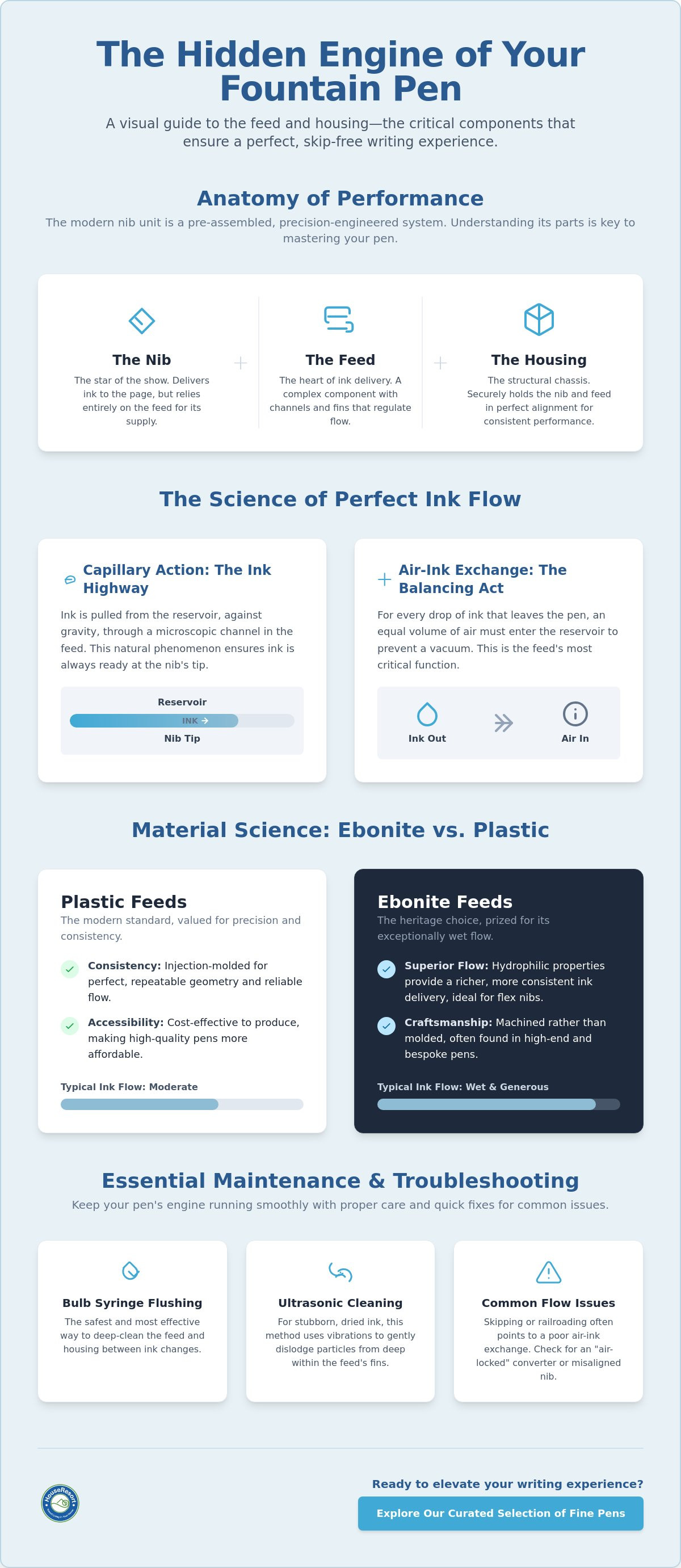
The feed is a precision-carved component, usually manufactured from injection-molded plastic or ebonite. It serves a dual purpose: delivering ink to the nib and allowing air to enter the reservoir. Surrounding the feed is the housing. Think of it as the structural "chassis" of the assembly. It is a sleeve, often threaded, that secures the nib and feed together before they are inserted into the pen's section. When these two parts work in tandem, they create a controlled environment that prevents messy leaks and frustrating dry-outs.
The rise of the "nib unit" concept has fundamentally changed modern fountain pen collecting. In the past, nibs and feeds were often friction-fit directly into the pen body, making repairs a delicate task for experts. Today, many heritage manufacturers utilize standardized units where the nib, feed, and housing are one pre-assembled piece. This modularity allows enthusiasts to swap writing styles in seconds while ensuring the internal geometry remains factory-perfect. Reviewing the Anatomy of a Fountain Pen shows that this evolution has made high-end writing tools more accessible and easier to maintain than ever before.
The Feed: The Heart of Ink Delivery
The ink channel is the highway from the reservoir to the paper. It's a microscopic groove that guides the ink through the length of the feed. Along the sides, you'll find fins. These act as buffer zones, holding excess ink that might otherwise drip due to temperature changes or physical movement. The feed functions as the primary regulator of capillary action, ensuring ink moves from the reservoir to the paper with calculated resistance.
The Housing: The Structural Foundation
Housings generally come in two varieties: threaded and friction-fit. Threaded housings are the gold standard for modularity, as they screw directly into the section for a secure, vacuum-tight seal. This component is vital because it protects the delicate fins of the feed from being crushed during assembly. A high-quality housing ensures that the nib and feed stay perfectly aligned, maintaining the precise contact necessary for a skip-free writing experience.
Capillary Action and Airflow: The Science of the Feed
Mastering the mechanics of your writing instruments requires a deep understanding fountain pen feed and housing beyond their physical appearance. While gravity plays a minor role, the primary driver of ink delivery is capillary action. This phenomenon allows ink to travel through microscopic channels, even against the pull of gravity, to reach the nib's tip. It's a delicate dance of fluid dynamics that ensures your pen is ready to write the moment it touches paper. Every drop matters. Every channel must be clear.
The true genius of the science of the feed lies in the air-ink exchange. For every microliter of ink that deposits onto the page, a corresponding volume of air must enter the reservoir. Without this exchange, a vacuum forms inside the pen, eventually halting the flow entirely. This is why a well-designed feed is just as concerned with managing air as it is with managing ink. Surface tension also dictates performance. Different inks have varying levels of surfactants. These chemicals affect how ink clings to the feed's channels. A "dry" ink might struggle to bridge the gap between the feed and the nib, while a "wet" ink might flow too freely. If you are looking to upgrade your writing experience, you can explore our curated selection of fine fountain pens that feature these precision-engineered components.
The Secret of the Breather Hole
Air enters the feed through a dedicated channel to maintain internal pressure. On many pens, this exchange is visible through the breather hole on the nib. Internal air exchange channels are often hidden within the feed's geometry. If your pen stops writing despite being full, it may be "air-locked." This occurs when a bubble of air gets trapped in a converter or cartridge. A quick prime of the converter usually solves the issue by forcing ink back into the feed channels.
Managing Ink Burps and Blobs
Heat from your hand is a powerful force. As you hold the pen, the air inside the barrel warms and expands. This increased pressure can push ink out of the reservoir faster than intended. The collector fins are designed to "catch" this expanding ink before it reaches the nib. High-capacity pens, such as eyedropper-filled models, require more robust feeds with deeper fins. These components provide a larger buffer zone to prevent the dreaded "burping" of ink onto your journals. Precision matters in every fin's depth.
Material Science: Ebonite vs. Plastic Feeds
The choice of material for your pen's internal components isn't merely a matter of cost; it's a decision that dictates the very soul of the writing experience. A deep understanding fountain pen feed and housing requires looking past the surface to the chemical interaction between ink and material. Most pens you'll encounter use injection-molded plastic. It's reliable, consistent, and perfectly suited for modern production. However, for the connoisseur, ebonite remains the gold standard. This hard rubber material, often associated with heritage craftsmanship, offers a functional superiority that plastics often struggle to replicate.
The primary scientific advantage of ebonite is its hydrophilicity. Unlike many plastics, which are naturally hydrophobic and cause water-based inks to bead up, ebonite attracts ink. This ensures that the ink channel remains primed and ready, even during long writing sessions. This comparison of Ebonite vs. Plastic Feeds highlights how these material differences impact daily performance. Beyond chemistry, ebonite offers a level of customization plastic cannot match. Because it's a thermoplastic, it can be "heat set." By carefully applying heat, a nibmeister can mold the feed to the exact curvature of the nib, eliminating microscopic gaps that cause skipping or hard starts.
The Pros and Cons of Plastic
Plastic feeds are the undisputed champions of durability. They're immune to the corrosive effects of some modern, high-maintenance inks and won't degrade over decades of use. Precision manufacturing ensures that every unit is identical, which means you'll rarely find alignment issues in a factory-fresh assembly. Manufacturers like TWSBI have turned this functional component into a design feature. Their transparent feeds allow you to see the ink as it travels toward the nib, turning the internal mechanics into a visual celebration of color. It's a modern approach that prioritizes both aesthetics and functional consistency.
The Allure of the Ebonite Feed
Ebonite is the material of choice for those who demand a "wet" writing experience. It's particularly vital for broad, flexible, or music nibs that require a high volume of ink to keep up with wide strokes. The process of creating an ebonite feed is often artisanal. Channels are hand-cut or machined with meticulous care rather than simply being pressed into a mold. This is why heritage brands and specialized nib units continue to favor ebonite despite its higher production cost. It represents a commitment to the analog tradition where performance isn't just about output, but about the quality of the flow.
Modular Systems: Navigating Nib Units and Compatibility
The transition from fixed internal components to modular assemblies has revolutionized the hobby. For the modern enthusiast, understanding fountain pen feed and housing compatibility is the key to unlocking a versatile collection. A modular nib unit combines the nib, feed, and housing into a single, threaded component. This design allows you to change the character of your pen in seconds without the risk of misaligning delicate parts. While this modularity offers freedom, it also requires a nuanced knowledge of which systems play well together.
Two German manufacturers, JoWo and Bock, dominate the landscape of high-quality modular units. Most independent and boutique pen makers rely on these standardized systems to ensure reliability. However, proprietary systems remain a significant part of the market. You can't simply install a Pilot nib unit into a Lamy section, as these heritage brands utilize unique internal geometries and threading patterns. Identifying your pen's housing size is equally critical. Most modern pens use a #5 or #6 size, while oversized luxury models often feature a #8. These numbers aren't arbitrary; they correlate directly to the physical scale of the writing end.
JoWo and Bock: The Industry Standards
While they may look similar at a glance, JoWo and Bock units aren't interchangeable. They utilize different threading pitches and feed designs that are specific to their respective housings. JoWo feeds tend to have a flatter profile, whereas Bock feeds often feature a more rounded architecture. It's essential to remember that housing size refers to the diameter of the feed in millimeters. A #6 housing, for instance, accommodates a 6mm feed. This standardization allows collectors to swap nibs across various brands, provided they share the same manufacturer's housing system.
Swapping Units Safely
The most common method for changing a modular system is the "unscrew and replace" technique. This is significantly safer than friction-fit removal, which requires pulling the nib and feed directly out of the section. When installing a new unit, always check for perfect alignment. Ensure the nib is centered on the feed to maintain optimal capillary flow. If you're interested in exploring how various heritage brands manage these systems, our Japanese Stationery Online Store Guide provides an excellent starting point for your research. Once you feel confident in your technical knowledge, browse our curated collection of authorized fountain pens to find your next precision instrument.
Maintenance and Troubleshooting for the Feed and Housing
Precision is paramount. Cleanliness is non-negotiable. While the previous sections explored anatomy and material science, the longevity of your collection depends on a technical understanding fountain pen feed and housing maintenance. Regular care prevents the gradual buildup of dried ink and paper fibers that eventually choke capillary flow. Developing a disciplined cleaning routine ensures that even your most delicate heritage instruments remain ready for the page. It's the difference between a tool that lasts a lifetime and one that requires constant repair.
The bulb syringe is the most valuable tool in your maintenance kit. It allows you to flush water through the feed channels at a higher pressure than a standard converter, effectively clearing out stubborn residues. For deep-seated clogs, an ultrasonic cleaner can be a powerful ally. These devices use high-frequency sound waves to agitate the water, reaching into the microscopic grooves of the collector fins. However, use this method sparingly for housings. Never use ultrasonic cleaning for vintage celluloid or pens with delicate plated finishes. If a feed remains clogged after these steps, particularly after using shimmer or pigment inks, it may indicate that particles are trapped deep within the fins. When simple cleaning fails to restore flow, recognize your limits. A professional nibmeister possesses the specialized tools to deepen channels or reset the heat-set of an ebonite feed without causing structural damage.
Deep Cleaning the Housing
Unscrew the nib unit to begin a thorough soak. This allows you to inspect the housing threads for any dried ink that could cause cross-threading or compromise the vacuum-tight seal. Stubborn residues from saturated fluids require more than just water. For those who frequently use vibrant Pilot Iroshizuku bottled ink, a dedicated pen flush is often necessary to remove every trace of pigment from the internal assembly. Ensure the unit is completely dry before reassembly to prevent ink dilution.
Identifying Feed Misalignment
Use a 10x loupe to inspect the alignment of the nib on the feed. A "rotated" nib, where the slit is not perfectly centered over the ink channel, is a frequent cause of skipping. You should also check for any visible gap between the underside of the nib and the feed surface. This contact is essential for maintaining capillary action. You can often resolve minor flow issues by gently pressing the nib and feed together, but avoid applying excessive force that could snap the delicate plastic fins. Precision adjustments here will song-proof your writing experience.
Elevating Your Writing Experience Through Technical Mastery
Mastering the internal mechanics of your pen transforms a simple writing task into a deliberate act of craftsmanship. By gaining a deeper understanding fountain pen feed and housing, you've moved beyond surface aesthetics to appreciate the complex fluid dynamics that power every stroke. You now know how capillary action balances air and ink, why heritage materials like ebonite remain a favorite for rich flow, and how to maintain these components to ensure they last for generations. This technical clarity allows you to troubleshoot issues with confidence rather than hesitation.
Your writing instruments deserve a curated environment that respects their quality. As an authorized retailer of heritage brands, we invite you to Explore our curated collection of fine fountain pens and accessories. Our expert-vetted stationery selection includes precision instruments and premium journals and planners designed to provide the perfect writing experience. Every item in our boutique is chosen for its ability to sing on the page. We look forward to helping you find the next masterpiece for your collection. Write with confidence and enjoy the effortless flow of a perfectly tuned pen.
Frequently Asked Questions
What is the difference between a fountain pen feed and a housing?
The feed is the component that regulates ink flow, while the housing is the outer sleeve that holds the nib and feed together. The feed manages the air-ink exchange through delicate capillary channels. The housing provides the structural interface that threads or friction-fits into the pen's section. Both parts must be perfectly aligned to ensure a skip-free writing experience.
Can I swap feeds between different brands of fountain pens?
In most cases, you cannot swap feeds between different brands because internal geometries and diameters are proprietary. While modular units from makers like JoWo or Bock are standardized for many boutique manufacturers, heritage brands like Pilot or Lamy use unique designs. Always verify the housing size and manufacturer before attempting a swap to avoid damaging the delicate fins.
Why is my fountain pen feed not drawing ink?
A pen that won't draw ink is often suffering from an air-lock or dried residue within the feed channels. If air cannot enter the reservoir to replace the ink, the flow will stop entirely. This is why understanding fountain pen feed and housing mechanics is vital; a simple flush with a bulb syringe often clears the obstruction and restores the necessary vacuum for capillary action.
Is an ebonite feed better than a plastic one?
Ebonite is generally superior for high-flow needs like flex or broad nibs due to its natural hydrophilicity. Plastic feeds are more common because they are durable and consistently manufactured through precision injection molding. Ebonite attracts ink better, ensuring a wetter and more consistent line, whereas plastic is more resistant to the chemical properties of certain modern inks.
How do I know if my fountain pen has a JoWo or Bock nib unit?
You can identify these units by examining the branding on the nib or the specific threading on the housing. JoWo units typically have a flatter feed profile, while Bock feeds are often more rounded. Many boutique manufacturers specify the unit type in their product descriptions to help collectors manage compatibility. If you're unsure, a loupe can help you see the manufacturer's hallmark.
How often should I deep clean my fountain pen feed?
Deep clean your feed every four to six weeks or whenever you change ink colors. Regular flushing prevents the buildup of pigments and paper fibers that can choke the ink channel. If you use shimmer or high-saturation inks, you should clean the assembly more frequently to prevent particles from settling in the collector fins. A clean feed is the secret to a reliable pen.
What happens if the fins on my feed are broken?
Broken fins can lead to ink burping and inconsistent flow because the feed loses its ability to buffer pressure changes. While a single broken fin might not render the pen useless, multiple damaged fins compromise the air-ink exchange. If the damage is significant, the entire feed or nib unit should be replaced to protect your journals from unexpected blobs of ink.
Can a clogged feed be fixed at home?
Most clogged feeds can be successfully cleared at home using a bulb syringe or a specialized pen flush. These tools provide the necessary pressure to dislodge dried ink from the narrow channels. For understanding fountain pen feed and housing care, remember that stubborn clogs might require a safe soak in room-temperature water. If these methods fail, a professional nibmeister can provide a more intensive cleaning.