
The Ultimate Pilot Pens Buying Guide: Finding Your Perfect Writing Instrument in 2026
A single writing instrument can define your entire creative workflow, yet finding that perfect match often feels like a search for a needle in a haystack. You aren't alone if you feel overwhelmed by the hundreds of pilot pens currently on the market, or if you've ever worried about a premium nib skipping during a critical note-taking session. It is easy to get lost in technical specs, especially with the 2026 market shifts affecting everything from the iconic Custom 823 to the sustainable FriXion Ball+ which now uses over 82% recycled plastic.
We believe every writer deserves a tool that feels like a natural extension of their hand. This guide provides a clear path through Pilot’s extensive catalog, helping you choose between gel, rollerball, and fountain pens with total confidence. You'll learn to distinguish between Japanese and Western nib sizes while discovering which models offer the best performance for your specific style. We will preview the top performing models for 2026, including the latest special editions and the specific models to secure before certain classic gold-trimmed designs are discontinued for good.
Key Takeaways
- Identify the engineering philosophy that makes Japanese stationery a global standard for precision writing and consistent ink performance.
- Compare the tactile benefits of gel and rollerball systems to determine which ink delivery method best suits your specific paper and writing speed.
- Navigate the transition from approachable entry-level models to professional-grade gold nib options within the extensive range of pilot pens.
- Decode the "Japanese Nib Difference" to ensure the line width you expect matches the technical specifications of your next instrument.
- Discover curated recommendations tailored to specific environments, from high-volume note-taking to executive-level correspondence.
The Heritage of Pilot Pens: Why Precision Matters in 2026
Pilot began its journey in 1918 with a vision to create writing instruments that could withstand the rigors of daily use while maintaining an elegant aesthetic. When you explore the Pilot Pen Corporation history, you see a trajectory defined by a relentless pursuit of "precision writing." This isn't just a marketing slogan; it's a manufacturing mandate that started with the original Namiki pens. In 2026, this commitment is more relevant than ever. As digital tools dominate, the tactile reliability of pilot pens provides a necessary anchor for the modern professional. Whether it's a disposable gel pen or a high-end fountain pen, the DNA of Japanese engineering remains consistent across every tier of the catalog.
The Innovation of Pilot Ink Technology
The success of the brand rests largely on its proprietary ink formulas. The G2 gel ink remains a global favorite because it balances viscosity with a fast-drying nature. It doesn't skip, even during rapid note-taking, thanks to the precision-engineered tungsten carbide ball. For those who require flexibility, the FriXion line uses thermo-sensitive ink that disappears with friction-generated heat. In 2025, Pilot advanced this technology with the FriXion Ball+, incorporating over 82% recycled materials into the body to meet modern sustainability needs. For the collector, the Iroshizuku bottled ink series draws inspiration from Japanese nature. These inks are prized for their shading and flow, making them the premier choice for enthusiasts who view writing as a ritual. The bottles themselves are hand-blown, reflecting the brand's dedication to aesthetic beauty alongside functional excellence.
Japanese Craftsmanship vs. Mass Production
Consistency is the true mark of quality. While many manufacturers struggle with nib variations, Pilot maintains rigorous standards in its Japanese facilities. Every steel and gold nib undergoes meticulous inspection before leaving the factory. This ensures that a "Fine" nib purchased today writes exactly like one bought years ago. At HouseResort Stationery, we act as a boutique curator, selecting only the models that reflect this heritage of excellence. We don't just sell pens; we provide access to tools that have been refined over a century. Our 2026 collection features authorized selections ranging from the playful Kakuno to the professional Vanishing Point. Choosing pilot pens means investing in a legacy of reliability that stands out in a world of disposable goods. Each piece in our inventory is chosen to ensure your writing experience is effortless and deeply satisfying.
Decoding the Pilot Catalog: Gel, Rollerball, and Fountain Pens
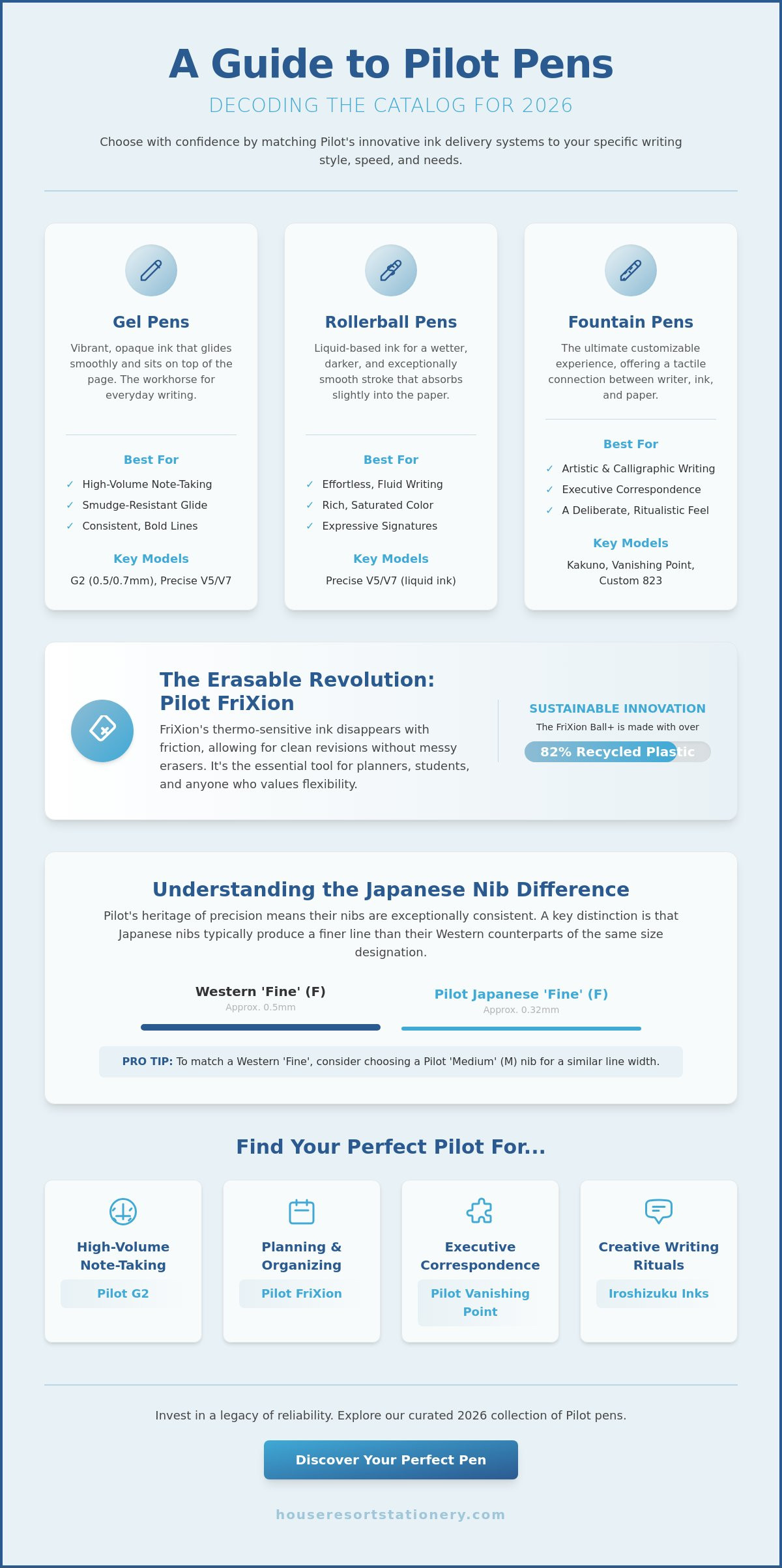
Selecting the right tool from the catalog of pilot pens involves matching the ink delivery system to your specific paper and writing speed. While we previously explored the innovation behind these formulas, the practical application varies significantly between categories. Gel pens offer a vibrant, opaque line that sits on the page surface. Rollerballs use liquid ink for a wetter, darker stroke. Fountain pens provide a customizable experience that bridges the gap between utility and art. Each category serves a distinct purpose in a professional or creative arsenal, whether you prioritize speed, permanence, or the tactile ritual of analog writing.
The Gel Pen Standard: Pilot G2 and Beyond
The Pilot G2 has earned its reputation as a daily workhorse. It's the standard for high-volume note-taking because the gel formula resists smudging while providing a smooth glide. Choosing a tip size is the most critical decision here. The 0.5mm Extra Fine tip is ideal for those with small handwriting or anyone filling out dense planner grids. Conversely, the 0.7mm Fine tip offers a bolder, more expressive line better suited for signatures and general correspondence. For technical drawing or architectural work, the Precise V5 and V7 series utilize a unique liquid ink feeder system. This ensures a consistent line width until the very last drop of ink is consumed.
The Erasable Revolution: Pilot FriXion
The FriXion series has fundamentally changed how we manage schedules. By utilizing thermo-sensitive ink, these pens allow for total revision without the mess of traditional erasers. This makes them essential tools for anyone using a Japanese stationery online store to curate their 2026 organizational system. Users should be aware that the ink becomes invisible when exposed to temperatures reaching 60 degrees Celsius. If notes disappear in a hot car, placing the paper in a freezer can often recover the writing. This flexibility is perfect for planners, though archival documents still require the permanence of a standard gel or ballpoint.
While gel and erasable options dominate mass-market utility, Pilot’s collector-grade fountain pens showcase the brand's ability to blend heritage with luxury. These instruments offer superior ink capacity and archival longevity when paired with pigment-based inks. Whether you prefer the convenience of a disposable or the permanence of a gold nib, Pilot’s engineering ensures every category meets a high standard of durability. You can view our curated selection of these professional instruments at HouseResort Stationery to find your next daily companion.
From Beginner to Collector: Navigating Pilot’s Fountain Pen Range
Moving beyond the utility of gel and rollerball models leads to the specialized world of fountain pens. This category represents the peak of Pilot’s engineering, where the focus shifts from mass-market convenience to a personalized writing ritual. For many enthusiasts, pilot pens serve as the gateway into a lifelong passion for analog tools. The brand offers a logical progression for users to grow their collection, starting with approachable steel nibs and moving toward the sophisticated flexibility of 14k and 18k gold. Each step in this journey introduces new tactile sensations, from the weight of the barrel to the specific feedback of the nib on paper.
The Pilot Kakuno: The Best Starter Fountain Pen
The Kakuno is designed with a specific philosophy: to make fountain pens accessible and joyful. Its most famous feature is the etched "smiley face" on the nib, which serves as a visual guide to ensure the pen is held at the correct angle. The hexagonal barrel prevents the pen from rolling off desks and provides a natural grip for long writing sessions. It is fully compatible with Pilot’s proprietary cartridges or the CON-40 converter, allowing you to explore the vast range of Iroshizuku inks mentioned earlier. Many users find the Kakuno an ideal companion for fountain pen doodle journaling, as its reliable flow supports both structured text and creative sketching.
The next logical step for the developing collector is the Pilot Prera. While it shares the same high-quality steel nib as the Kakuno, the Prera offers a more professional aesthetic and a shorter, pocket-friendly length. Its standout feature is the vacuum-sealed cap. The "click" when closing the pen is remarkably satisfying and ensures the nib remains moist even during periods of inactivity. For those ready to enter the world of gold nibs, the Pilot Custom 74 serves as the gold standard. Its 14k gold nib provides a cushioned, slightly springy feel that steel simply cannot replicate, making it a favorite for executive signatures and daily journaling alike.
Retractable Luxury: The Vanishing Point Series
The Vanishing Point, also known as the Capless in Japan, remains one of the most innovative designs in stationery history. It eliminates the need for a traditional cap through a sophisticated internal trapdoor mechanism. A simple one-handed click deploys the 18k gold nib, offering the convenience of a ballpoint with the prestige of a luxury fountain pen. This series is frequently cited among Pilot's popular and eco-friendly pens due to its refillable nature and durable metal construction. For writers with smaller hands or those who prefer a lighter instrument, the Decimo model offers the same retractable technology in a slimmer, more agile profile. These pilot pens represent a perfect fusion of modern mechanical brilliance and traditional writing quality.
Key Features to Evaluate: Nib Sizes, Ink Flow, and Ergonomics
Technical mastery requires more than just choosing a reputable brand; it involves understanding how the instrument interacts with your specific writing surface. The most significant factor when evaluating pilot pens is the "Japanese Nib Difference." Because Japanese characters require high levels of detail, Pilot grinds its nibs to be approximately one size finer than their European counterparts. A Pilot "Medium" will typically produce a line width similar to a Western "Fine." This precision allows for incredibly clear script, even in cramped margins or dense planners. If you prefer a bold, juicy line, you should consider stepping up to a Broad or exploring specialized nib shapes.
Material choice also dictates the tactile feedback of the pen. Steel nibs, found on models like the Kakuno and Metropolitan, offer a rigid and reliable experience. They are excellent for those who apply more pressure while writing. In contrast, 14k and 18k gold nibs provide a "cushioned" feel. This elasticity, often called "spring," absorbs the vibration of the paper and reduces hand fatigue during long sessions. Ergonomics and weight balance are equally vital. A heavy metal barrel might feel premium for short signatures, but a lightweight resin body is often superior for hours of journaling. Finding a pen that aligns with your hand size and grip style ensures that the tool remains a pleasure to use rather than a chore.
Understanding Pilot Nib Sizing
The 2026 collection offers a spectrum from EF (Extra Fine) to B (Broad). For those seeking artistic expression, Pilot’s "Soft" nibs (marked SF or SM) provide subtle line variation based on your writing pressure. These specialized nibs are particularly effective when used on the high-quality paper found in a traveler’s notebook. The thinner Japanese EF and F nibs prevent ink from feathering or bleeding through modular inserts, making them the preferred choice for mobile enthusiasts who value crisp, legible notes.
Refilling and Maintenance
Pilot utilizes a proprietary cartridge and converter system. It's important to remember that standard international cartridges will not fit these pens. For maximum ink capacity, the CON-70 button-filler converter is the gold standard, though it is only compatible with larger models like the Custom 74. The CON-40 is a versatile alternative for slimmer pens. To ensure your pilot pens last a lifetime, we recommend a simple flush with room-temperature water every four to six weeks. This prevents ink particles from clogging the feed and maintains the consistent flow Pilot is known for. You can browse our full range of converters and maintenance accessories to keep your collection in peak condition.
Curated Recommendations: Finding Your Perfect Pilot at HouseResort
Selecting the ideal writing instrument is a personal endeavor that balances technical requirements with aesthetic preference. After exploring the engineering heritage and the specific mechanics of nib sizing, you are now equipped to select a tool that matches your lifestyle. At HouseResort, we have filtered the vast market to present a selection of pilot pens that represent the pinnacle of Japanese craftsmanship. These recommendations are designed to serve as cornerstones for your collection, whether you are signing contracts or sketching in the margins of a journal.
- Best for Daily Note-Taking: The Pilot G2 Premium Gel remains the top choice for high-volume tasks. Its archival-quality gel formula provides a vibrant line that resists skipping, making it indispensable for students and busy professionals who need reliability without maintenance.
- Best for the Modern Professional: The Pilot Vanishing Point offers the perfect solution for the executive on the move. The 18k gold nib provides a soft, luxurious feel, while the retractable mechanism allows for quick, one-handed operation during meetings.
- Best for Creative Journaling: Creative expression requires a pen that encourages experimentation. The Pilot Kakuno, especially when paired with our range of Iroshizuku bottled inks, allows for expressive shading and a playful writing experience that feels approachable yet sophisticated.
- Best for Detailed Planning: Detailed scheduling demands needle-point precision. The Pilot Precise V5 Extra Fine excels in tight spaces, ensuring your notes remain legible even in the smallest planner grids.
Shopping the 2026 Pilot Collection
Our boutique currently features 16 curated models from the 2026 collection, each selected for its unique contribution to the writing experience. As an authorized retailer, we provide the peace of mind that every instrument is genuine and meets Pilot's strict manufacturing standards. This is particularly important in 2026, as the brand has implemented significant price increases on many core lines, including a 15% rise across most products on January 1st. We focus on Japanese engineering because it offers a level of consistency and tactile feedback that mass-produced alternatives cannot match. Every pen in our inventory is a testament to a century of refinement.
Next Steps for Your Stationery Journey
A pen is only as effective as the surface it touches. To maximize the performance of your new instrument, we recommend pairing it with high-quality journals or fountain-pen-friendly notebooks that resist feathering. Building a versatile "pen wardrobe" allows you to switch tools based on the specific task at hand. You might find yourself using a G2 for quick grocery lists while reserving a Custom 74 for reflective evening writing. This modular approach ensures you always have the right tool for the moment. You can browse the full Pilot Pens collection at HouseResort Stationery to find the next addition to your daily carry.
Begin Your Next Chapter with Pilot Precision
Finding the right instrument is about more than just ink on paper; it's about the connection between your thoughts and the page. We've explored the century-long heritage of Japanese engineering and decoded the technical nuances of nib sizing. You now understand why a Pilot "Fine" offers a different experience than its Western counterparts and how to choose between the daily utility of a G2 and the retractable luxury of a Vanishing Point. With the 2026 price adjustments and the shift toward sustainable models like the FriXion Ball+, staying informed ensures you make a lasting investment in your creative toolkit.
As an authorized retailer with specialized knowledge in Japanese stationery, HouseResort Stationery provides an expertly curated 2026 collection tailored for the modern connoisseur. We've done the hard work of filtering the market so you can focus on the tactile joy of writing. It's time to elevate your analog ritual with pilot pens that reflect your personal style. Your perfect writing partner is waiting to be discovered.
Explore the Curated Pilot Pens Collection
Frequently Asked Questions
Are Pilot fountain pen nibs different from European brands like Lamy?
Pilot nibs are ground significantly finer than those of European manufacturers. A Pilot Fine nib generally produces a line width comparable to a Lamy Extra Fine. This difference exists because Japanese characters require high precision in small spaces. If you are accustomed to Western sizing, we suggest selecting one size larger when purchasing a Pilot instrument to achieve the line thickness you typically expect.
Which Pilot pen is best for left-handed writers to avoid smudging?
The Pilot G2 with a 0.5mm tip or the Precise V5 are excellent for left-handed writers because their ink formulas dry rapidly. Fast-drying ink prevents the smear often caused by the hand trailing over fresh script. Alternatively, the FriXion series offers a unique solution; any accidental smudges can be instantly corrected using the built-in friction eraser, making it a favorite for left-handed journaling.
How long does a Pilot G2 ink refill typically last?
A standard Pilot G2 0.7mm refill is engineered to write for approximately 1,000 meters. The 0.5mm Extra Fine version typically offers a longer lifespan because it deposits less ink per stroke. Your specific results will depend on the paper's tooth and your writing speed. We suggest keeping a spare refill in your stationery kit to ensure your pilot pens remain functional during long projects.
Can I use non-Pilot ink in my Pilot fountain pen?
You can use any high-quality bottled fountain pen ink in your Pilot pen provided you use a converter like the CON-40 or CON-70. Pilot’s cartridges are proprietary and cannot be swapped with standard international brands. For the best performance and to prevent clogging, we recommend using reputable brands like Iroshizuku, which are specifically formulated to flow perfectly through Pilot’s precision-engineered feeds.
Is the Pilot Vanishing Point fountain pen leak-proof for travel?
The Pilot Vanishing Point is highly reliable for daily carry, though no fountain pen is 100% leak-proof during air travel. Its internal trapdoor mechanism creates a functional seal that keeps the nib moist and prevents minor leaks. When flying, we recommend either keeping the pen completely full or entirely empty to minimize air expansion, which is the primary cause of ink leakage in pressurized cabins.
What is the difference between the Pilot Precise V5 and V7?
The primary difference between the Precise V5 and V7 is the tip diameter. The V5 features a 0.5mm Extra Fine point for technical work and small script. The V7 uses a 0.7mm Fine point for a bolder, more fluid line. Both models utilize the same liquid ink system and iconic needle-point tip, ensuring a consistent flow that remains smooth until the reservoir is completely empty.
Does Pilot offer eco-friendly or refillable pen options?
Pilot prioritizes sustainability through its B2P line and the 2025 FriXion Ball+ release, which consists of over 82% recycled plastic. Most pilot pens are designed for longevity through refillable systems. Choosing to replace an ink cartridge rather than the entire pen body significantly reduces environmental impact. This focus on refillability makes Pilot an excellent choice for the eco-conscious writer who values both performance and planetary health.
Why is my Pilot fountain pen skipping, and how can I fix it?
Skipping is usually caused by dried ink residue or paper fibers trapped in the nib. You can typically fix this by flushing the pen with room-temperature water. If the skipping persists, ensure you aren't using heavy pressure, as Pilot nibs are designed to write under their own weight. Regular maintenance every few weeks ensures the ink channel remains clear and the flow remains perfectly consistent.