
What Is a Fude Nib Used For? The Connoisseur’s Guide to Bent Nibs
At first glance, you might think your new fountain pen arrived damaged, but that upturned tip is actually a precision-engineered masterpiece. Many collectors feel a brief moment of panic when they see the dramatic upward bend of a fude nib for the first time. It's natural to wonder what is a fude nib used for if it doesn't look like a standard writing tool. Controlling the generous ink flow and managing varying line widths can feel like a daunting challenge, especially when you're worried about smudging your finest stationery.
We understand that mastering this specialized tool requires a shift in perspective. This guide will show you how the fude nib acts as an analog brush, allowing you to achieve stunning line variation simply by changing your writing angle. We'll explore the specific mechanics of these bent tips, provide techniques for both English script and expressive sketching, and recommend the ideal paper pairings to handle the performance of heritage manufacturers like Sailor. By the end, you'll see why the fude nib is a favorite for those who value tactile craftsmanship and artistic versatility.
Key Takeaways
- Master the precise relationship between pen angle and stroke width to unlock expressive, brush-like textures in your daily writing.
- Discover what is a fude nib used for in the world of urban sketching, where its versatility captures both fine detail and broad architectural forms.
- Understand the critical synergy between high-flow bent nibs and specialized paper to ensure a clean, smudge-free experience.
- Identify industry benchmarks from heritage manufacturers like Sailor to begin your collection with a focus on quality and craft.
- Learn to utilize the broad surface of the nib for ink-washing effects that mimic professional painting techniques without extra tools.
Defining the Fude Nib: Why This "Bent" Pen Is a Creative Essential
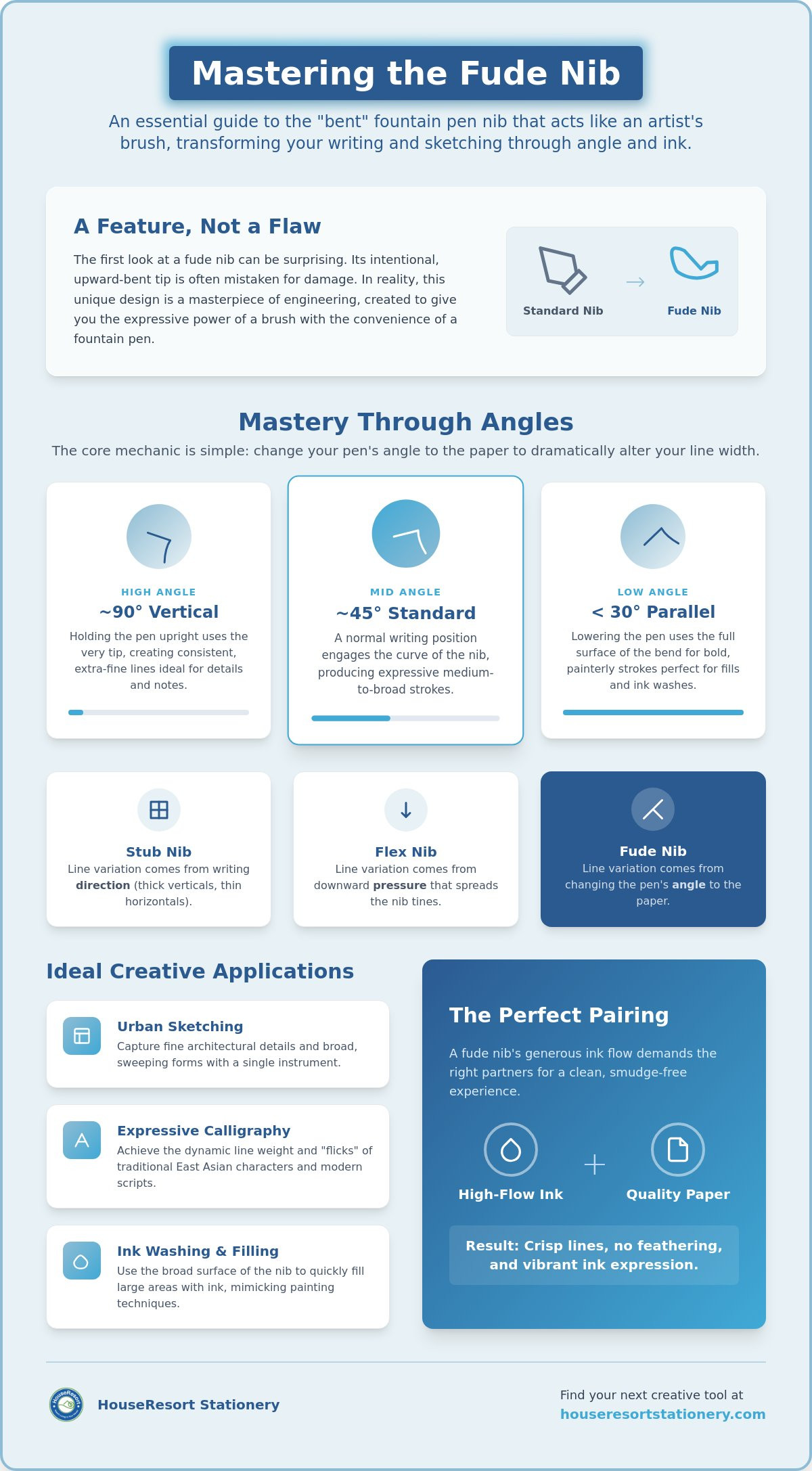
A fude nib, pronounced foo-deh, is a specialized fountain pen nib that features an intentional upward bend at the tip. This unique geometry often triggers a "broken nib" fear for first-time buyers. It is a common misconception; the silhouette looks like the result of a tragic drop or a manufacturing defect. In reality, this bend is a masterpiece of Japanese engineering designed to provide a specific tactile experience. The fude nib serves as a sophisticated hybrid tool, offering the expressive variation of a traditional brush with the portable convenience of a fountain pen. When newcomers ask what is a fude nib used for, the answer lies in its ability to transform a single pen into a multi-tonal instrument for both writing and art.
The Anatomy of the Bend
The defining characteristic of this tool is the precision of its upward curve. Most heritage manufacturers produce these tips at angles between 40 and 55 degrees. A steeper 55-degree bend provides a larger surface area for broad strokes, while a 40-degree angle offers a slightly more controlled experience for those transitioning from standard nibs. Unlike a traditional point that contacts the paper at a single tip, the fude nib utilizes the entire flat side of the bend. This larger contact area requires a high-performance feed system. The feed must maintain a heavy, consistent ink flow to prevent the nib from running dry during wide sweeps. It is a delicate balance of physics and material science that ensures the ink keeps pace with the artist's hand.
A Brief History of Japanese Nib Craft
This design originated in Japan during the cultural transition from traditional brushes to modern, portable writing instruments. Heritage manufacturers like Sailor led the way in perfecting this specific geometry. They recognized that the cultural significance of Kanji characters, which rely on varying line weights and specific "flicks," could not be fully captured by rigid Western nib styles. By bending the metal, they replicated the dynamics of a calligraphy brush without the need for a separate inkwell. Today, this craftsmanship serves a global community of enthusiasts. While it was born for East Asian characters, it has become a creative essential for Western calligraphers and urban sketchers. Understanding what is a fude nib used for today means appreciating this blend of old-world aesthetic and modern utility. It allows the user to control the weight of every stroke through simple wrist adjustments, making it a favorite for those who value the tactile nature of analog tools.
The Mechanics of Line Variation: Mastery Through Angles
Mastering a fude nib requires a departure from standard writing habits. With a traditional nib, you typically search for a static "sweet spot" and maintain a consistent angle to ensure smooth ink flow. The fude nib demands the opposite. It is a tool of constant motion. The fundamental rule of this geometry is simple: the steeper the pen angle, the thinner the line. By rotating your wrist to change the pitch of the pen, you control exactly how much of the nib's metal touches the paper. This allows for dynamic writing and sketching without the need for a flexible nib that might feel unstable or unpredictable under pressure.
When comparing this to other specialized tips, the difference becomes clear. A stub nib provides a fixed ratio of thick vertical strokes and thin horizontal ones. A flex nib requires downward force to spread the tines. In contrast, the fude nib relies on horizontal surface area rather than vertical pressure. This makes it an excellent choice for those who find flex nibs difficult to control or prone to "railroading." Understanding what is a fude nib used for in a professional context often comes down to this specific mechanical advantage. You gain total control over line character through posture alone, preserving the life of the nib while achieving dramatic results.
Step-by-Step: Controlling Your Line Width
To achieve consistent results, you must develop a feel for three primary positions. Holding the pen at a vertical 90-degree angle utilizes only the very tip of the bend. This produces an extra-fine line perfect for intricate detailing or small margin notes. At a standard 45-degree angle, you engage the middle of the curve, resulting in medium to broad strokes suitable for daily headers. For maximum impact, lowering the pen until it is almost parallel to the paper utilizes the full flat surface of the nib. This creates a bold, "painterly" coverage that can fill large areas with ink quickly. If you are looking to experiment with these techniques, exploring our collection of fine fountain pens is a great way to find a balanced instrument that feels comfortable at every angle.
The "Reverse Writing" Technique
The versatility of this tool extends to the back of the nib. By flipping the pen over and writing with the "top" of the bend, you can produce consistent, ultra-fine lines that are even thinner than the 90-degree vertical position. This technique is particularly valuable for architectural sketching or fine-line hatching where precision is paramount. While experimenting with different sides of the nib, always maintain a light touch. This ensures the health of the feed and prevents unnecessary wear on the tipping material. This dual-sided functionality is a primary reason what is a fude nib used for remains a top question for artists who need a single tool that can handle both broad washes and needle-point precision.
Practical Applications: From Calligraphy to Urban Sketching
The fude nib is a shapeshifter. While its origins are rooted in traditional Asian scripts, its modern utility spans across diverse creative disciplines. It replaces the need for carrying multiple pens with different tip sizes. Artists and writers alike find that the bent tip offers a level of spontaneity that standard nibs simply cannot match. What is a fude nib used for in the toolkit of a contemporary enthusiast? It serves as a bridge between precise technical drawing and expressive, painterly gestures.
Beyond traditional art, these pens excel at practical daily tasks. You can use the broad flat of the nib as a refillable highlighter for your planner or textbooks. This is particularly useful for those who prefer using a single ink color across their entire organizational system. The generous ink flow also makes it ideal for adding flair to envelopes and wedding invitations. It creates a bold, professional look that stands out in a mailbox, making your correspondence feel curated and intentional.
The Artist’s Choice for Architectural Drawing
Urban sketchers prioritize efficiency and weight. Carrying a single fude pen allows you to capture an entire cityscape without switching tools. By rotating the pen, you can lay down a thin line for a window frame and then immediately sweep a broad shadow across a building facade. This speed of execution is vital when working on location where light changes quickly. The varying line weights naturally suggest depth and perspective, giving your sketches a professional, multi-dimensional quality. This technique integrates perfectly with fountain pen doodle journaling, where the goal is to mix quick illustrations with daily reflections. You can even use the nib for "ink-washing" effects by laying down a thick line and then pulling the pigment across the paper with a water brush.
Modern Calligraphy for Non-Japanese Scripts
You don't need to be a master of Kanji to appreciate the fude's potential. Modern calligraphers use these pens to create "faux-calligraphy" styles with ease. By mimicking the downstrokes of a pointed pen, you can achieve a classic look with the reliability of a fountain pen feed. It's an excellent way to emphasize specific words in a journal or create dramatic headers. Many collectors use this variation to organize their thoughts within modular systems like the Traveler’s Notebook. A bold fude header provides a visual anchor for a page of smaller, fine-point notes. Understanding what is a fude nib used for beyond its original intent allows you to maximize your stationery collection, turning a specialized tool into a daily workhorse.
Ink and Paper Synergy: Optimizing Your Fude Experience
A fude nib is a thirsty tool. Because the bent tip contacts the paper with such a broad surface area, it deposits significantly more ink than a standard fine or medium point. This high flow is exactly what is a fude nib used for by enthusiasts who want to showcase the complex properties of their ink collection. However, this volume of liquid creates a specific challenge for your stationery. If you use standard, absorbent office paper, you'll immediately encounter feathering and bleed-through. Paper choice is non-negotiable for a successful experience.
To achieve the best results, you must prioritize Japanese stationery designed specifically for fountain pen use. These papers feature a surface sizing that allows the ink to sit on top of the fibers rather than soaking in instantly. This delay in absorption is what permits the ink to "pool" and dry with distinct visual characteristics. Hard-sized papers like Midori MD and Tomoe River are the industry benchmarks for handling high ink saturation without warping or ghosting.
The Best Inks for Fude Nibs
The relationship between the nib and the ink is one of pure synergy. For the most consistent flow, Pilot Iroshizuku bottled ink remains the gold standard. Its lubricated formula ensures that even during fast, broad sweeps, the feed never struggles to keep up. This nib style is also the perfect canvas for shading inks. Because the line width varies so dramatically, you'll see beautiful color transitions from light to dark within a single character. While "sheening" inks also perform exceptionally well on the broad surface, we recommend avoiding high-maintenance shimmer inks. The microscopic particles in shimmering formulas can easily clog a feed that is already working under high demand.
Selecting the Right Paper Surface
Creating a perfect "tactile" writing experience requires testing your nib-ink-paper trinity. A smooth, coated surface will offer a glass-like glide, while a paper with slight "tooth" like Midori MD provides more feedback and control. The goal is to find a surface that allows the ink to showcase its full range without compromising the structural integrity of the page. When you understand what is a fude nib used for in the context of artistic expression, you realize that the paper is just as much a tool as the pen itself. Discover our curated selection of fine fountain pens and journals to begin your own experimentation with high-flow writing.
Choosing Your First Fude Fountain Pen: A Curator’s Guide
Selecting your first bent nib requires a balance between curiosity and quality. For many enthusiasts, the entry point into this niche is driven by a desire to experiment with line weight without a significant initial investment. Budget-friendly options from manufacturers like Jinhao and Duke offer a reliable way to discover what is a fude nib used for in your own creative practice. These steel-nib pens provide a firm, consistent experience that helps you build the muscle memory needed for angle control. While they lack the refined "spring" of luxury gold nibs, they are excellent workhorses for urban sketching and daily journaling where a rugged tool is preferred.
When you are ready to move beyond the basics, the Sailor "Fude de Mannen" series stands as the undisputed industry benchmark. Sailor has perfected the geometry of the bent tip, offering a level of tactile feedback that budget alternatives rarely match. Investing in a pen from an authorized retailer ensures that the delicate feed system and nib alignment have met rigorous quality standards. This authenticity is vital for high-flow tools where a minor manufacturing flaw can lead to frustrating leaks or inconsistent ink delivery. A well-crafted fude pen should feel like a natural extension of your hand, responding to every subtle shift in your wrist's posture.
Sailor’s Specialty Nibs
Sailor offers two primary configurations: the 40-degree and the 55-degree bend. For beginners, the 55-degree nib is often more intuitive. The steeper angle allows you to hold the pen in a more natural, upright position while still achieving significant line variation. The 40-degree version requires a lower writing angle, which can be rewarding for experienced calligraphers but may feel awkward for those used to standard ballpoints or fountain pens. For the true connoisseur, the Naginata Fude and other custom-ground gold nibs represent the pinnacle of Japanese craft. These luxury options provide a softer feel and a more nuanced ink flow, turning every stroke into a deliberate act of expression.
Maintenance and Longevity
Maintaining a high-flow instrument requires a proactive cleaning schedule. Because these pens deposit a large volume of ink, they are more susceptible to "crusting" if left unused for several weeks. We recommend a thorough flush with room-temperature water every time you change ink colors. When it comes to storage, a horizontal position is generally best. This keeps the feed saturated and ready for immediate use. If you notice the pen becoming "burpy" or leaking, try storing it nib-up for a few hours to allow the air pressure to equalize. Starting your journey with a curated selection from HouseResort Stationery ensures you have the right tools and knowledge to master this unique tool. Use this final checklist to prepare:
- Choose a 55-degree nib if you prefer an upright writing posture.
- Select a shading ink to maximize the visual impact of the broad strokes.
- Ensure you have fountain pen friendly paper to handle the high ink volume.
- Commit to a bi-weekly cleaning routine to keep the feed clear.
Master the Art of the Bent Nib
The fude nib represents a unique intersection of tradition and modern utility. By adjusting your writing angle, you unlock a range of line widths that standard nibs simply cannot replicate. You now recognize that success requires the right pairing of lubricated inks and fountain pen friendly paper to manage the generous flow. This tool isn't just for specialized calligraphy; it's a versatile companion for everything from bold headers in your planner to intricate architectural sketches.
Now that you understand what is a fude nib used for, you can confidently choose an instrument that matches your style. As an authorized retailer for heritage brands, HouseResort Stationery offers an expert-curated selection for enthusiasts. We provide national shipping on premium journals and pens, ensuring your tools arrive ready for your next project. Our boutique approach means every item in our catalog is chosen for its craftsmanship and tactile value.
Explore our curated collection of fine fountain pens and Japanese stationery and begin your journey into the world of expressive writing. We can't wait to see the beautiful strokes you create.
Frequently Asked Questions
Is a fude nib only for Japanese or Chinese calligraphy?
No, the fude nib is a versatile tool for various creative pursuits beyond its calligraphic roots. While it was designed for East Asian characters, understanding what is a fude nib used for in a modern context includes urban sketching, architectural drawing, and creative headers in journals. Its ability to mimic brush strokes makes it ideal for any task requiring dramatic line variation in a single stroke.
How do I know if my fude nib is 40 degrees or 55 degrees?
Most heritage manufacturers like Sailor mark the angle on the nib or the pen body. Visually, a 55-degree nib has a more dramatic, upright bend compared to the shallower 40-degree version. If you are unsure, test the writing angle; a 55-degree nib is more intuitive for those who hold their pens vertically, while the 40-degree requires a lower, more horizontal posture.
Can I use a fude nib for everyday note-taking?
You can use a fude nib for notes, but it requires a very high, vertical writing angle to produce a consistent fine line. For long-form writing, a standard nib is often more comfortable for the hand. However, many collectors enjoy using the fude for short, expressive headers or emphasizing key points in their notebooks. It turns simple lists into visually striking records.
Do fude nibs use more ink than regular fountain pens?
Yes, fude nibs consume significantly more ink than standard points. When you utilize the broad surface of the bend, the feed must work at full capacity to keep the paper saturated. This high flow is a primary reason why what is a fude nib used for often involves showcasing shading or sheening inks that require high volume to reveal their unique properties.
What is the best ink for a fude nib to prevent smudging?
The best ink for a fude nib is one with a balanced drying time and excellent flow, such as Pilot Iroshizuku. To prevent smudging, the ink must be paired with high-quality Japanese stationery that manages the high flow without pooling excessively. Using a blotting sheet can also help manage the increased ink volume during fast sketching or writing sessions.
Is a fude nib harder to use than a flex nib?
It is generally considered easier to master than a flex nib because it relies on angle rather than pressure. Flex nibs require precise downward force to spread tines, which can be difficult to control and can lead to railroading. A fude nib allows you to achieve line variation simply by shifting your wrist, providing a more stable and predictable experience for beginners.
Why does my fude nib feel scratchy when I write at a high angle?
Writing at a 90-degree angle uses only the very tip of the bend, which has a much smaller contact area. If it feels scratchy, you might be catching the edge of the bend or the nib tines could be slightly misaligned. Ensuring the pen is held perfectly vertical and using a very light touch will usually smooth out the experience on high-quality paper.
Can I bend my own nib to make it a fude nib?
We don't recommend bending your own nibs. Factory-made fude nibs are precision-engineered to ensure the feed can maintain ink flow to the specific angle of the bend. Attempting to bend a standard nib often results in a starved feed or a permanently damaged instrument that lacks the smooth writing surface found on heritage tools. It's best to purchase a dedicated bent nib.